
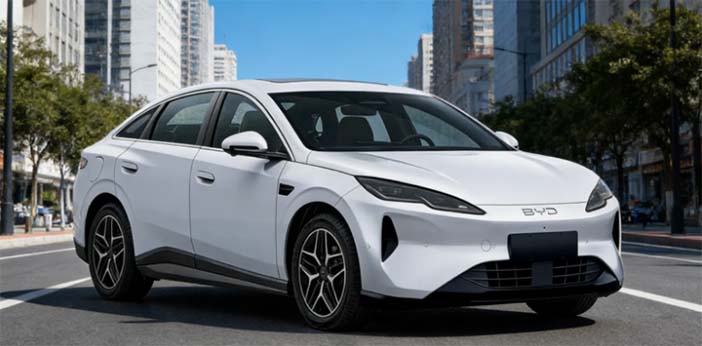
+++ The BYD SEAL 06 series has received significant updates across its EV, DM‑i hybrid and GT hatchback models. The line-up now includes 2 EV range variants with extended driving distances, updated DM‑i hybrids with improved efficiency and refreshed GT performance models. The long-range 630 km variant will feature a 240 kW peak-power motor and achieve 11.4 kWh/100 km energy consumption. The mid-range 530 km variant uses a 120 kW motor and reports a 10.7 kWh/100 km consumption rate. Both benefit from improved battery and motor efficiency compared with earlier Seal 06 EV models. These changes are enabled by next-generation blade battery technology, high-efficiency motors, and integrated smart electric control systems. The Seal 06 EV 630 km will carry a 64.3 kWh battery weighing 444 kg, with a curb weight of 1.795 kg. The Seal 06 EV 530 km has a 52.9 kWh battery weighing 384 kg, with a curb weight of 1.670 kg. The traction battery energy density is 144 Wh/kg, with estimated cell-level energy density exceeding 200 Wh/kg, consistent with advanced blade battery cells. The Seal 06 DM‑i hybrid variants will both use 175 kW motors. One variant offers a 150 km pure-electric range with 15.2 kWh/100 km consumption, while the other delivers 155 km with 14.7 kWh/100 km consumption. These values represent incremental gains compared with earlier DM‑i Seal 06 hybrid models. The Seal 06 GT hatchback models will also be updated. The long-range GT EV features a 200 kW motor and a 57.6 kWh battery with 12.3 kWh/100 km consumption. The performance GT EV variant uses a 240 kW motor, a 69.1 kWh battery, and 12.5 kWh/100 km consumption, with a range of 490 km. The Seal 06 series updates show that BYD has boosted range and motor output while reducing or maintaining energy consumption. The high energy density of the updated blade battery packs, together with high-efficiency motors and integrated smart electric controls, underpin these gains. BYD has not announced official pricing. However, it is expected that the range increases will come with minimal or no price premium to sustain market competitiveness. Analysts anticipate that BYD may pursue a “more range without higher price” approach, keeping incremental pricing within a modest range relative to earlier versions. +++
+++ CHINA ’s Ministry of Industry and Information Technology has outlined plans to accelerate breakthroughs in solid‑state batteries and high‑level autonomous driving technologies while further expanding automotive consumption this year. The announcement followed an inter‑ministerial work meeting in Beijing focused on energy conservation and the development of the new energy vehicle (NEV) industry, with MIIT Party Secretary and Minister Li Lecheng presiding. The meeting framed 2026 as the opening year of the country’s “15th Five‑Year Plan” and said China’s intelligent and connected NEV sector is entering a significant opportunity period. Officials emphasized the need for problem‑orientation, system thinking and bottom‑line awareness while intensifying inter‑agency coordination to improve work measures and support high‑quality industry development. A major priority is coordinating industrial planning with related sectors such as energy and infrastructure, and setting clearer development goals and task assignments to guide innovation. To strengthen domestic supply chains and autonomy, MIIT outlined a new round of high‑quality industry-chain development actions, prioritizing breakthroughs in strategic products, foundational materials, and key software and tools, explicitly naming all‑solid‑state batteries and high‑level autonomous-driving technologies. China’s domestic automakers and suppliers are actively developing all‑solid‑state battery technology to meet the MIIT’s 2026 priorities. Companies such as Dongfeng, Chery and SAIC are moving from laboratory research to prototype deployment and scaled production, with energy densities ranging from 350 - 600 Wh/kg and projected ranges of 1.000–1.300 km. Pilot production lines, strategic partnerships for cathode and electrolyte materials, and GWh‑scale manufacturing plans demonstrate the industry’s push to commercialize next‑generation batteries that deliver higher energy density, longer lifespan, and alignment with national supply chain self‑reliance goals. Chinese automakers are also advancing high‑level autonomous driving in line with government policy. BYD, Xpeng, Li Auto, Changan Deepal and Arcfox have obtained L3 test permits and are conducting pilot operations on designated roads, gathering real‑world data to refine vehicle AI, sensor integration and cloud connectivity. MIIT has granted market access for the first batch of L3 vehicles, enabling controlled deployment of conditionally autonomous passenger cars. These developments position 2026 as a key year for L3 commercialisation in China, illustrating significant progress toward the government’s smart mobility and intelligent vehicle objectives. On the demand side, the Ministry reiterated plans to further expand vehicle consumption. Measures include promoting vehicle trade‑in programs, scaling up the adoption of new-energy heavy trucks, deepening reforms in NEV insurance, and unlocking diversified consumer demand. These policies are designed to streamline replacement cycles and encourage broader adoption of electrified and smart vehicles. Officials also underscored the need to maintain a fair, competitive environment, strengthen cost investigations and price monitoring, and enhance product conformity and quality inspections. The role of standards in driving industry upgrades and guiding corporate self‑discipline was emphasized. International engagement was another pillar of the government’s strategy. The Ministry said it will support trade, investment, and technology cooperation while advancing integration of domestic and foreign trade and investment. It noted enhanced focus on managing technology and investment risks and guiding enterprises toward reasonable, orderly, and secure global expansion to foster new patterns of international industrial cooperation. +++
+++ DACIA will go new model crazy in 2026 with a new hybrid, a new EV and a big estate car to complement the Bigster. And that’s off the back of a near-record year for Renault’s affordable car division, with 2025 total sales up 3 percent to around the 700.000 mark. The new EV is due by the end of the year. “We have a mission to make BEVs affordable”, Dacia sales boss Frank Marotte told during a meeting at the Brussels motorshow. ““And we have an opportunity [with]limited capital investment to bring something more valuable to our customers, which will help sustain our used values”. Critically it will also assist Dacia in meeting its emissions obligations and avoiding fines, given it will take a while to crank up production of the new EV. Dacia’s next-generation affordable EV will be priced under €18,000, product chief Patrice Lévy-Bencheton told in Brussels. “It’s under 4.2-metres long and will be produced in Europe in the same plant as the Renault Twingo”. That means it will qualify for the new M1E affordable EV class that the European Commission will introduce: Dacia will earn ‘super-credits’ towards those all-important emissions targets for every sale, and the car’s European industrialisation will also help profitability. The new model will swerve tariffs on Chinese-built EVs. The new car shares components with the new Renault Twingo, hence its jokey ‘Springo’ nickname within Renault Group. But it could be due a name change: it would be mighty confusing to offer 2 different cars with the same Spring badge concurrently. Marotte confirmed the ‘Springo’ would be wider than the outgoing car, which will boost interior space and stability, thanks to a broader track. “The new model will be much improved in drivability”, he said. It will have a range in excess of 200 km: expect more than 240 km if it shares the Twingo’s 27.5 kWh battery. Dacia’s Sandero was Europe’s best-selling car to retail customers again in 2025. And it will become the final Dacia to be electrified. “We’re going to introduce hybrid on Sandero”, confirmed sales chief Marotte. Expect it to get the same Hybrid 155 system, with 155 hp and electric driving at least 60 percent of the time in urban areas. But why has it been delayed on Dacia’s best-selling model? “It was a strategic decision, because basically electrification was more quickly adopted in the upper segments. We’ve been waiting for hybrid demand to be there and the moment is now”. The proportion of Dacia hybrid sales doubled in 2025 to about 25 percent of volume, with Jogger, Bigster and Duster leading the charge. Dacia has pushed into the midsize ‘C-segment’ with the Jogger and Bigster. The firm is delighted with the latter’s introduction, having delivered 57.000 units from April to November 2025. Marotte reckons that could grow to 85.000 this year, its first full year. But Dacia won’t stop its upmarket push there; in fact, the Bigster’s launch has only given the brand confidence. “After the Bigster, we will deliver a second car in the C-segment. This will be announced later this year, quite late”, confirmed product boss Lévy-Bencheton. “Of course, it’s not a second SUV, we’re trying to maximise our coverage with a very complimentary offer targeting a different customer pool”. The new model will be a practical and spacious estate, referred to internally as C-Neo. It’ll share its platform and engines with the Bigster. +++
+++ HYUNDAI and its sister Kia posted a record combined market share in the United States in 2025, buoyed by expanded local production and strong hybrid vehicle sales, despite Washington’s aggressive tariff measures, officials said Sunday. The 2 South Korean automakers sold a combined 1.84 million vehicles in the US last year, accounting for a record market share of 11.3 percent, according to data from market watcher Wards Intelligence and industry sources. Hyundai accounted for 6.1 percent of the U.S. market with sales of 984.017 units, while Kia held a 5.2 percent share with 852.155 vehicles sold. The motor group ranked fourth in the US market last year, trailing General Motors at 17.5 percent, Toyota at 15.5 percent and Ford at 13.1 percent. The market share growth was attributable to its marked sales expansion. Total US auto sales rose 2.4 percent to 16.23 million vehicles in 2025, while Hyundai and Kia sales climbed 7.5 percent. Analysts also pointed out that the group benefited from a flexible production strategy and a decision to absorb tariff-related costs, rather than passing them on to consumers. Last year, Hyundai completed its third US plant in Georgia, strengthening its ability to respond to local demand and offset tariff pressures. Vehicle shipments from South Korea to the US fell 4.2 percent on-year in 2025. Strong sales of hybrid vehicles also boosted the market share, with the automakers’ US hybrid sales surging 48.8 percent to 331,023 units last year, the data showed. The group has said it plans to expand US production capacity to more than 1.2 million vehicles, up from about 700,000 as of 2024. +++
++ JAGUAR wants to step out of BMW’s shadow and chase Bentley by moving upmarket through a bold rebranding. It’s waving goodbye to combustion engines once and for all, putting all of its eggs in the EV basket. We were supposed to see the first production model of this new era before the end of 2025, but its reveal has been pushed back to later this year. Before Jaguar reinvents itself as a super-luxury brand, some dealers are predictably concerned about how the new direction will unfold. German business newspaper Automobilwoche cites a sales representative who spoke under the protection of anonymity about the uncertainty surrounding Jag’s future: “If we are honest, there is currently no business case for the brand. We have signed that we want to continue with Jaguar in the future. However, whether we will fulfill this declaration of intent will only become clear once we know Jaguar’s future strategy. Then we can decide whether it suits us or not”. But it’s not all doom and gloom. Andreas Everschneider, CEO of the Association of German Jaguar and Land Rover Dealers, is far more optimistic, yet remains cautious: “The new start is an opportunity. But we don’t know what to expect, how big the market is, or which customers will buy the vehicle”. Similarly, Salvatore Colangelo, managing director of Glinicke British Cars, hypes the forthcoming products but is uncertain about the target market: “Brand, design, and technology: the new Jaguar models are something special. This is a new path. The question remains: Who are our future Jaguar customers?” Everschneider told Automobilwoche that Jaguar won’t sell the new electric grand tourer, but rather lease it. The decision to embrace a lease-only strategy reportedly stems from the company’s desire to control the used car market. Should too many vehicles change hands, it would lower residual values and hurt Jaguar’s aspirations to become a true Bentley competitor. Everschneider also pointed out that Jaguar must not fall into Mercedes’ trap of making too many cars. The German luxury brand has been criticized for pumping out volume-oriented products like the A-Class, which have hampered its premium positioning. Then again, all rivals have been doing the same, including BMW with the 1 Series. Audi has even gone a step lower by tackling the subcompact segment with the A1 and Q2. Dealers cited by Automobilwoche claim the new strategy at Jaguar calls for annual production of only 10.000 units. It’s a far cry from 2018, when the Tata Motors-owned company peaked at 181.500 sales. By comparison, BMW sold 2.169.761 cars last year, when Mercedes moved 1.800.800 vehicles and Audi delivered 1.6 million units. Since Jaguar is now chasing Bentley, it makes more sense to look at Crewe’s sales figures. Last year’s numbers aren’t out yet, but it’s worth reminding you that the British automaker delivered 10,643 cars in 2024 and 13.560 in 2023. Its best year ever was 2022, when it sold 15.174 cars. Jaguar dealers have yet to receive the necessary training to lure in customers, but the process is starting this month. Order books are reportedly opening in either March or April for those willing to pay at least 130.000 euro. Jaguar has made it clear that the production-ready Type 00 will be available strictly as an EV. The old Jaguar ways didn’t work, so it was time for a change. Whether such a drastic shift to low-volume, high-margin models will pay off remains to be seen. Going all in on EVs will certainly limit its appeal, since wealthy buyers still want combustion engines. Case in point, Mercedes is committing to Maybach’s V12 and BMW continues to back the 12-cylinder powerhouse found in Rolls-Royce models. Jaguar knows it’ll lose most of its clientele, acknowledging that 85 percent of current buyers won’t return. However, it believes dramatic styling and a bespoke EV platform can convince deep-pocketed customers to take the plunge. To increase its chances of carving out a niche, an SUV will follow the long-hood GT. EVs are notorious for their slim profit margins, if any, so it’ll be interesting to see whether Jaguar can generate sufficient returns while pursuing such a drastically lower annual sales target. +++
+++ A more affordable, more softly styled version of the MG 4 family hatchback will go on sale in February. The maker hinted at the car’s introduction last month when the new model was tested by Euro NCAP, but this is the first time the car has been confirmed for sale. Prices should start from less than 30.000 euro. MG said the new car, called 4 Urban, will act as “a new B-segment MG hatchback designed specifically as an electric vehicle for towns and cities. Built on a new platform to enhance efficiency and range, it expands the successful line-up and offers even more choice”. MG’s head of product and planning, David Allison, last year said: “One of the benefits of the Chinese MG 4 platform being front-wheel drive is that it’s a little bit cheaper. Competition is becoming more intense, more aggressive. Trying to find a way of keeping a competitive-priced product is more and more challenging as the EV targets ramp up”. The MG4 Urban is a totally different car to the MG4 currently sold here. The new front-wheel drive model (the existing car is rear-wheel drive) is already available in China, where it comes in 4 variants with up to 400 km of range. It’s not yet clear how many versions will be offered here, or how they’ll compare to the existing MG4, which itself will be updated next month. That’s right, this totally new MG 4 Urban will be sold alongside (or rather, underneath) the standard 4, offering a more affordable take on the family electric-car formula. The new car won’t be MG’s entry-level EV, however. That’ll be the upcoming MG2. The Urban looks quite different. It gets less aggressive styling, particularly at the front where there’s a softer, more rounded nose, less pronounced air intakes and a much smaller, body-coloured splitter on the bumper. The headlights are smaller too, but the traditional, chrome MG octagon badge remains. The Urban model is 108 mm longer than the current MG 4, and its wheelbase, height and width are also slightly larger. However, what’s particularly groundbreaking about this newer model is its compatibility with semi-solid-state batteries. These packs have the potential to be smaller, lighter, more energy-dense and even less volatile than the ‘liquid’ batteries we see in most current EVs. This has huge implications for MG’s future electric cars because with solid-state batteries they should be better packaged, weigh less, charge more quickly and offer even greater range. While the MG4 tested by Euro NCAP used the regular LFP (Lithium Iron Phosphate) battery already on sale in China, MG’s parent company SAIC says the new semi-solid-state battery has passed “3-direction penetration tests” and “demonstrates improved performance in low-temperature conditions”, which I presume is in comparison with the existing MG4’s battery performance. The new MG 4 also features ‘battery to body’ integration to improve not only rigidity, but also the battery’s crash protection. We’re yet to find out the capacity of the semi-solid-state battery and what range and charging figures the new technology will provide. But thanks to patent filings, we know the Chinese MG 4 has front-wheel drive and is lighter than the car currently sold here, at 1.485 kg compared with 1.635 kg. As with the existing MG 4 which is already sold here, the 4 Urban received a 5-star crash-test rating from Euro NCAP, which MG will be relieved to hear following the recent abysmal showing of the MG 3 during testing. As mentioned, the Urban model will line-up alongside a facelifted MG 4. While little is known about that car yet, in order to stay competitive we expect it to gain influence from the newer MG S5 EV, including things like its 12.8-inch central touchscreen. The MG S5 EV also has a set of physical knobs and buttons for easier adjustment of controls such as the volume and climate settings, which we can expect to cross over into the MG 4. +++
+++ TESLA has slashed the price of its mass-market Model 3 in South Korea, intensifying pricing pressure across an electric vehicle market already grappling with weakening demand. Tesla Korea recently announced that the price of the Model 3 Standard RWD has been cut to 41.99 million won ($28,500) from 59.9 million won, while the newly introduced Premium Long Range RWD is priced at 52.99 million won. With governmental EV subsidies of 1.68 million won and 4.2 million won, respectively, as well as factoring in local incentives, the effective price of the Standard RWD could drop to the 30 million-won range. Tesla’s aggressive pricing push reflects its bid to expand its footprint in the Korean EV market, which has long been dominated by Hyundai Motor Group and German luxury automakers. Last year, Tesla’s passenger car registrations in Korea more than doubled to 59.916 units, lifting its market share to 19.5 percent and placing it third among imported brands, behind BMW and Mercedes-Benz. Building on that momentum, Tesla Korea on December 31 intensified its pricing strategy, cutting prices on key models (including the Model 3 Performance) by as much as 9.4 million won. Given that EV prices in Korea typically centered in the 40 million to 50 million won range, industry watchers say Tesla’s latest cuts could signal spillover from 2025’s China-style “EV chicken game” into the domestic market. In China, Tesla repeatedly reduced prices to defend volume and market share, challenging homegrown rivals such as BYD. In September last year, Tesla China lowered the price of the Model 3 Long-Range RWD by about 10,000 yuan ($1,430) less than a month after its launch (roughly a 3.7 percent cut from its original price of 269,500 yuan), underscoring how quickly the company adjusts pricing in response to market conditions. Hyundai Motor and Kia’s entry-level EV models in the 40 million-won segment are expected to face the most immediate impact. While Hyundai’s Ioniq 5 and Ioniq 6 and Kia’s EV6 have become mainstays of the domestic market, a widening price gap with the Model 3 could make defending market share increasingly difficult. According to the Korea Automobile & Mobility Association and the Korea Automobile Importers & Distributors Association, Tesla sold 55.594 vehicles in Korea from January to November 2025, edging out Kia’s 55.037 units and Hyundai’s 42.789, marking a rare case of an imported brand topping domestic automakers in sales. Imported EV brands are also under pressure. Entry-level models such as the BMW iX1, Mercedes-Benz EQA and Polestar 2 (typically positioned in the 40 million to 50 million won range) may struggle to sustain current pricing. Kim Pil-su, an automotive engineering professor at Daelim University, said, “Tesla’s emphasis on volume over short-term profitability is closely tied to its highly scale-dependent manufacturing structure; the higher the volume, the lower the per-unit manufacturing costs. The move could force competitors to follow suit, triggering a prolonged price war and putting sustained pressure on profitability across the industry”. Meanwhile, the Model 3 Standard RWD (priced in the 30 million-won range after subsidies) comes with trade-offs. It omits several features favored by Korean consumers, including ventilated front seats, heated rear seats, ambient lighting, a rear-seat display and an upgraded audio system. The sound system is also reduced down from 13 to seven speakers and the radio function has been removed. +++