
+++ For many Dutch people, FORD doesn’t feel like a particularly American brand. In the Low Lands, the Blue Oval is associated not with big pick-ups or muscle cars but, depending on your vintage, Taunuses, Escorts, Fiestas and Focuses. Distinctly European-flavoured cars (and Transit vans) that were designed, engineered and often built here. But as Ford has ditched conventional hatchbacks and saloons in recent years in favour of SUVs and crossovers, it has started to lean into its American roots as a point of differentiation from European rivals. It isn’t quite offering cars with a Stars and Stripes vinyl wrap and ADAS functions that chant ‘U-S-A’ instead of beeping, but it is embracing its US-born heritage. That doesn’t mean Ford is preparing to import its US line-up to Europe (aside from the Mustang) which is perhaps good news given the chaos that would probably ensue from a bevy of F-150s invading the Cotswolds. Instead, Ford is sprinkling the names and DNA of some of those models on its European range. The Explorer badge is already here (albeit on an electric SUV riding on a Volkswagen Group platform), and there are plans for more valuable Ford IP to follow. Nothing is official yet but, the firm is working on a new European-focused combustion-engined SUV that will be built in Spain alongside the Kuga and most likely be called Bronco. That name may not have much resonance here in the Netherlands but, having been revived in 2021 after a 25-year absence, the Jeep Wrangler rival has rapidly become one of Ford’s most important models. The Bronco sits on a body-on-frame platform (shared with the Ranger pick-up), and close to 150.000 of them were sold last year. It is a core part of Ford’s pitch to become, as CEO Jim Farley puts it, “the Porsche of off-road”. And the Bronco is no longer just a single model. In the US there’s the Bronco Sport, which retains all-wheel drive and some off-road ability but uses a road-focused architecture (Ford’s C2 platform, on which the Kuga is based), while in China there’s an unrelated Bronco New Energy, offered as an EV and a range-extender. As Farley noted recently: “The Bronco line-up is filling out globally”. He added that the firm has “great plans” for the range. So what is the ethos behind the Bronco? To find out, you need to visit the home of the Bronco. Except, well, there are two. One of them is in Johnson Valley, California a vast, 96.000-acre desert crossed by numerous rocky off-road trails, where the Bronco’s development team travels regularly to test new versions of the machine to its limits. The Bronco’s other home is stamped on the plate bolted to the transmission tunnel of every car: ‘Designed and engineered in Dearborn, Michigan’. Given that my first action on clambering into the Bronco I’ve secured is to crank up the heating and turn on the seat warmers, you can probably surmise that I’m not in California. But while the crowded highways of suburban Detroit aren’t the best canvas on which to sample the Bronco’s abilities, the weather is doing its best: it’s bitterly cold and there is heavy snow falling. At this stage I’m quite glad that, while it is clearly utilitarian with lots of physical switches and hard-wearing floor mats, the Bronco is still well-appointed and very comfortable inside. Plus, the Bronco’s four-wheel drive system and low-ratio gearbox might come in useful after all. Besides, being in wintry Dearborn gives me a chance to meet the people who have led the off-roader’s revival. They include Ed Krenz, the Bronco’s chief engineer and a man who, if he weren’t making Broncos, you sense would probably own one anyway. First, let’s go back. You may have been wondering why, if the Bronco is such a cultural phenomenon and key part of Ford’s line-up, did it disappear for 25 years? “When it went out of production in 1996 it had, in my opinion, lost its way a bit”, says Krenz. “It migrated into a really big vehicle, because customers were looking for a 4-door. It really lost its connection with its roots as an off-road vehicle”. However, like the Land Rover Defender, the Volkswagen bus and the Renault 5, the core concept of the Bronco never really went away, and the desire for a truly capable off-roader remained alive within the firm. Krenz says there was “a solid decade of a group of people within Ford continuing to make proposals and studio renderings” for a Bronco revival. The biggest obstacle? “There was always that hurdle of Jeep”, says Krenz. “The Wrangler was just so dominant in that market. If you’re going to go into a relatively limited market that is dominated by another model, you have to have a plan to succeed”. When the Bronco’s revival was finally approved, Ford’s engineers embraced the challenge of taking on the ubiquitous Wrangler. Krenz says: “The secret sauce was that our engineers became part of the Jeep community”. That said, he insists: “We don’t consider Jeep owners a separate community: it’s an off-road community. We’re all into this off-road thing: it’s a culture that exists beyond a brand”. The aim was to really understand both the Jeep’s appeal and if Ford could do it better, says Krenz: Jeep owners don’t complain about their cars, because they have a high tolerance for what their product is. But we kept asking: ‘How do we objectively do everything better?” 2 examples that Krenz gives are the handling “which is why we don’t use a solid front axle” and the removable doors. “When Jeep owners take the doors off, they can’t store them in the vehicle, so they end up chaining them to a cactus or something”, says Krenz. “And because the mirrors are on the doors, when they take them off they don’t have mirrors”. As a result, the Bronco’s doors are designed to fit in the boot, while the mirrors are mounted on the front wings, so they stay in place when the doors come off. “It was never going to be good enough to show up with a replica and convince the market to buy something other than the Jeep they loved”, says Krenz. From behind the wheel, a Bronco offers an undeniably similar experience to that of a Wrangler, especially in my car’s Badlands spec, with more ground clearance, upgraded HOSS suspension, Bilstein dampers and 33in off-road tyres. As an aside, most Bronco variants are named after US national parks and other wild locations, so Badlands sits above Big Bend and Outer Banks. You can add a Sasquatch package with extra off-road bits to any of those or, for the most hardcore variant, opt for Raptor spec. It’s all very rugged and outdoorsy. As with a Wrangler, there’s a fair degree of wobble due to the ladder-on-frame chassis and off-road tyres. Isolation and road noise are both compromised, too, and the steering lacks a bit of feel. My Bronco is powered by a 2.7-litre twin-turbo V6 with 316 hp and 550 Nm (there’s also a 2.3-litre inline-4 and a 3.0 V6). Driven via a 10-speed auto, it’s a bit gruff and takes a while to get up to speed, but it cruises happily once there. Still, it’s eminently likeable and those on-road compromises are a price many are happy to pay for the immense off-road capability, which I don’t really get to sample touring Dearborn. Still, the Bronco offers ‘Goat” drive modes (a reference to the original 1960s development goal for a vehicle that ‘goes over all terrain’), and the Slippery setting comes in helpful powering through heavy snow. It locks in four-wheel drive, offering enough traction to not just eliminate any sliding but even leave me slightly worried I’m going to rip chunks out of the road. Krenz doesn’t seem to mind me pointing out the Bronco’s compromises on the road. In fact, he describes the Bronco as “unapologetically” compromised. He says: “It knows what it’s designed to do, and it does that well. But in order to do some things great, there are other things it needs to do less great”. The need to do some great things, he notes, applies to every machine that carries the Bronco name. “We’ve written down exactly what the Bronco must do, and we replicate it on Bronco Sport or with New Energy Bronco: it’s a Bronco”, he says. “If the Bronco portfolio grows, we know what the recipe is and the product has to be right. Otherwise, it can’t be a Bronco. Within the segment it’s in, it has to meet and exceed the off-road expectations for a product in that class. If it’s a unibody front-drive architecture like Bronco Sport, it’s not going to do everything a Bronco can do, but it needs to do more than everything else in that segment”. Krenz won’t be drawn on the prospect of a European Bronco, but speaking more broadly he notes that “we’re actively trying to protect the brand”. He adds: “It’s easy to monetise this and just put a Bronco badge on something. Maybe some of our competitors have used their brand liberally, and maybe with some regret”. Given some of the disquiet when Ford used the Capri name on an electric SUV, that passion is refreshing. And since the Wrangler has a small but loyal following in Europe, it’s a shame the full Bronco is only available over here through specialist importers (you can probably thank the vagaries of emissions regulations for that). But, as with the Wrangler, the Bronco’s appeal is tied up in the sense of American adventure it conveys, that urge to take off the doors and drive into the wilderness. Then I remember how cold it is in Michigan and decide just to keep touring the sights in comfort. Still, a less hardcore but still off-road-capable machine tuned for Europe could carry the Bronco name and find some success here. It would be a very different sort of Ford from those many Brits grew up with, but it could be a welcome taste of off-road Americana. +++
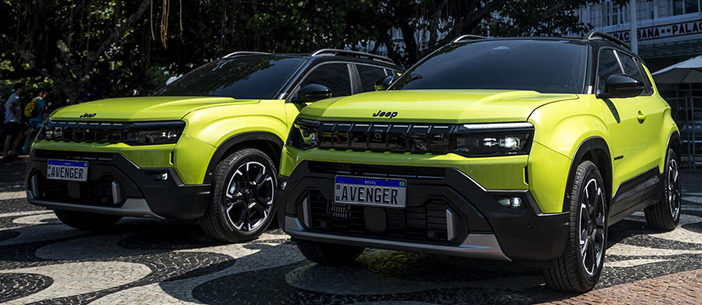
+++ The new-look JEEP AVENGER has quietly made its first public appearance in Brazil, ahead of a European debut in the coming months. Hitting the streets of Rio as part of a local festival, the American brand’s smallest SUV has been lightly restyled after 2 full years on sale, with the main change being a new front end that brings it into line with the newer Compass crossover. The headline change is the introduction of a new version of the trademark 7-slot Jeep grille, which now lights up so it’s easier to pick out at night and has a chunkier, more rugged look, with the chrome surrounds of each slot removed. The reworked grille sits above a new lower valance and bumper, which have been made to look more muscular, with a touch of off-road flavour, while subtly reshaped wings and wheel designs round off the makeover. There’s no word yet on any changes under the skin, and we haven’t seen inside the cabin yet, but Jeep is expected to give a better look at a dedicated European launch in the coming months. The Avenger is currently offered with a wide range of powertrains: there’s a 100 hp petrol with a 6-speed manual gearbox; a 110 hp front-wheel-drive or 145 hp four-wheel-drive hybrid; and a 156 hp front-driven EV with a range of 400 km. The new look marks the first major update since the Avenger was launched in 2023. The Polish-made crossover won the European Car of the Year Award in 2023 and has since proven a success for Jeep, playing a key role in its return to growth in Europe. +++
+++ Could we be heading into an era of much LESS INTRUSIVE SAFETY SYSTEMS ? Are we finally waving goodbye to the infuriating experience of feeling like a car’s lane-keep assist, driver-attention or hazard-warning systems are fighting against you, rather than poised to save your skin if you need them? Not before time, car makers are starting to get smarter, spurred on by new, more stringent Euro NCAP tests that kick in this summer and will make more of how well the technology works, rather than simply whether it’s fitted. So if the car can tell you’re looking forward, alert and paying attention, it can delay any intervention. But if it senses the driver is distracted or tired, then it’ll jump in earlier. Euro NCAP calls it the ‘Driver State Link’, ensuring driver and tech work together, rather than at odds with each other, which is regularly the case at the moment. When driver-assistance systems first started to be developed, car manufacturers tended to take the cheapest and easiest way to appease Euro NCAP, rather than the much trickier direction of developing robust tech that works for the driver and doesn’t just score cheap points. I’ve driven 2 cars recently that feel like a big step in the right direction. The systems in both BMW’s new iX3 and the Polestar 3 are much less intrusive, to the point where for the first time in many years, I didn’t turn off the lane-keep assist, which used to be part of my ‘pre-flight’ ritual in every car I drove. While shortcut buttons and increasingly easy ways to deactivate the assistance systems are progress, it would be much more helpful if many drivers didn’t feel the need to disengage them completely, because you never know when you might actually need them to step in for real. So clever and less intrusive ADAS is great, but it’s only a start. I’ve also driven several, mainly Chinese, cars recently (the worst of which was the BYD Seal 6) where the level of invasive interaction led me to cover (and even consider ripping out!) the driver-monitoring camera just to stop its persistent nagging. We know how quickly the Chinese respond to constructive criticism, so I imagine it won’t be long before we see progress, and new cars cease to be incredibly annoying to drive. +++
+++ For nearly a decade, we’ve been told that bespoke platforms for BEVs bring undeniable advantages in the quest to make them more efficient and better to drive. However, MERCEDES has turned this notion upside down, because it’s now confirmed that in the future, its equivalent BEV and ICE models will be based on one platform, even after it’s already spent the money developing bespoke options. I spoke with Mathias Geisen, Member of the Board of Management of Mercedes-Benz Group, at the Beijing Auto Show, and he confirmed to me that the new plan is for the company to offer a ‘true Mercedes’ experience in each car regardless of the powertrain. He said, “We overestimated the speed with which customers would be willing to switch over to electric mobility. It’s pretty clear that customers want to have the choice and we can’t predict in a reasonable way how quickly that will happen. So we have changed our strategy, so that we are fully flexible in offering products according to the customer’s request. But point two. Years ago, we were under the assumption that customers would appreciate a strong differentiation between the design of a combustion vehicle and the design of an electric vehicle”, he continued. “That has turned out not to be the case today. They tell us ‘We want the same iconic Mercedes design’, so we close the zip on that. However, while this confirmed that the car’s designs would converge, we wanted to clarify whether the platforms would also be combined into one, to which Geisen answered: “Step-by-step, they will come together”. This means that future models with different powertrains will return to a single platform, a policy that Mercedes has already set in motion. The German company’s MMA platform, which underpins the new CLA and its other entry-level models, is flexible enough to accommodate both full electric and hybrid powertrains, and the full electric model is one of the most efficient cars on sale. We already have a good idea what the first of these new converged models will become, because prototypes of the next E-Class electric appear to have identical styling and proportions to the petrol models. The same will also be true of the S-Class, and we expect the next-gen GLE and GLS to do just the same. In the latter half of this decade, it means we’ll see a switch between the 2 big German premium brands. As Mercedes closes the door on development of its pure-BEV platform for its mainstream models, BMW is only just now revealing its bespoke BEV platform to be used by the new iX3 and i3. +++
+++ MINI remains “emotionally attached” to its Oxford factory, according to new boss Jean-Philippe Parain, but plans to start building electric cars there remain in limbo and could rest on the outcomes of trade negotiations between the United Kingdom and the European Union. The historic plant is currently used to produce the petrol-powered Cooper hatchback. In recent years it was upgraded so that the electric version could be built there, but plans to start building electric Coopers in the United Kingdom were postponed indefinitely due to the slowing growth of electric car sales. The electric Cooper is currently built in China, where the EV-only Aceman crossover is also produced. Meanwhile, the petrol and electric Countryman variants are built alongside the closely related BMW X2 in Leipzig, Germany… +++
+++ OMODA will launch a new Jeep Avenger-sized SUV in 2027. The new Omoda 2 will likely start around €23.000, according to the brand’s CEO, hitting the big-selling B-segment with hybrid powertrains and stylish looks. The Chinese company has already been a success in the Netherlands, selling significant numbers of its Omoda 5 and the closely related Jaecoo 7, which are members of the wider Chery family. Specific details on the new model are limited so far, but we know that it’ll sit at around 4.2 meter long, putting it at the larger end of the B-segment SUV class. This will see it rival the top-selling Peugeot 2008, Volkswagen T-Cross and Toyota Yaris Cross, but it could do this with an ace up its sleeve. Launching with a range of hybrid models first, the Omoda 2 is also ripe for an all-electric variant. This is because the newcomer will share its platform with a fresh Jaecoo 1 and Lepas L2, the latter of which will also be available in BEV form. It’s unlikely that a car of this size will be available with a plug-in hybrid powertrain, however, so expect the use of Chery’s Super Hybrid system. I don’t know yet what the Omoda 2 will look like yet either, because the model will be brand new and specific to Europe. This is unlike many of the Chery brand’s future model launches, which are already on sale in its home Chinese market. Inside, expect a similar layout to the newer models in Omoda’s line-up. This will include a large and responsive touchscreen and room for some physical controls. These are considered crucial to models that need to have European appeal, according to Omoda’s bosses, and should mean that with every new model, its cars will be more and more suited to European tastes. The expansion is part of a massive push into global markets for Chery, which is aiming for 10 million sales worldwide by 2030. This is an ambitious target, and expansion into Europe with models specifically tailored to the continent’s drivers, such as the Omoda 2, is all part of the plan. Another new car that we’ll see is a more rugged and more expensive all-wheel drive crossover, which should arrive later in 2027. +++
+++ RENAULT ’s first phase of its self-proclaimed ‘Renaulution’ appears to be complete, thanks to rapid-fire launches over the past few years, but now it’s time for the French brand to refresh its older models. Spy photographers have just caught the updated Renault Megane E-Tech testing and now it’s the turn of the Renault Scenic. With all-electric power, the current fifth-generation Scenic was unveiled in 2023. Since then, Renault has broadened its electric line-up with the Renault 5, the Renault 4 and the recently launched Renault Twingo. The trio of newcomers has stirred up plenty of headlines, thanks in part to their eye-catching retro-futuristic designs, while the Scenic went for a more contemporary look very much based on the MPV bodystyle its nameplate has always been associated with. While the camouflaged test car doesn’t give too much away, we suspect new bumpers will appear front and rear to give Renault’s largest pure-electric model a fresh look. We might also see some tweaks to the headlights and rear lamps, although the visual changes seem pretty mild overall. But the Scenic’s technical make-up is likely to undergo a far more drastic change to keep it competitive until the next-generation Scenic comes along in 2028 with an all-new platform and class-leading EV tech. Underpinning the Scenic E-Tech is Renault’s AmpR Medium platform and right now there’s one battery option: an 87kWh unit with Nickel Manganese Cobalt (NMC) chemistry. That latter part is significant because Renault has been working on cheaper-to-produce lithium iron phosphate (LFP) cells in Europe for the Twingo and we already know the upcoming revised Megane will use this technology, albeit in a larger battery pack than the tiny 27.5kWh unit in the Twingo. We’ll have to wait and see if a new battery chemistry will be able to provide a longer range for the Scenic than the current 605 km maximum. Given the expected cheaper production costs, the new model may have a lower price tag than the current car’s €39.690 entry point. I don’t expect the drivetrain layout to change, with power still being sent to the front wheels, but we’ll wait and see if there’s an alternative to the existing 218 hp electric motor to match the new battery. Given this is our first sighting of the updated Scenic and Renault’s efforts currently being put into the launch of the all-new Twingo and refreshed Megane (the Megane is due in late 2026), I don’t expect to see the facelifted Scenic hit Dutch roads until 2027. The Scenic’s update will be one of 36 worldwide product launches across cars and vans between now and 2030. +++
+++ VOLKSWAGEN could build and sell some of its advanced new China-only models, such as the sleek new ID.Unyx 09 , in Europe as part of efforts to accelerate its transformation plan and boost its competitiveness. Speaking after the release of the Volkswagen Group’s first-quarter financial results, in which the firm’s operating profit fell by 14% to €2.5 billion, CEO Oliver Blume said the firm had made “tangible progress” in its transformation plan despite numerous global headwinds, but added that “we need to step up our goals”. To achieve that, Blume outlined a series of measures including “significantly cutting the number of models from about 150 currently and reducing the number of variants”. He didn’t go into specifics over which models might be cut, but the reduction is expected to hit “double-digit” percentages. He added: “We will focus on these projects that make a tangible difference for our customers”. Other measures detailed as part of the transformation plan including a more focused approach to technology, reducing governance complexity at group level, increasing efficiencies and “right-sizing” production capacity to around 9 million cars per year. Adapting the group’s production strategy is considered vital to allowing it to compete against Chinese rivals operating highly streamlined production networks, especially as those firms start to build European factories. Blume described closing plants as “the worst, most costly” option and said the Volkswagen Group was looking at how to utilise capacity on other projects. The initial focus is on taking on work from the defence industry, but Blume said he was open to the company building Chinese models, whether Volkswagen-derived ones or those from joint-venture partners, in its European plants. The firm has just introduced a new China-only Compact Main Platform (CMP) that has been co-developed with Chinese firm Xpeng, which features an advanced electrical architecture and is designed to underpin a range of EVs developed specifically for China and built locally.
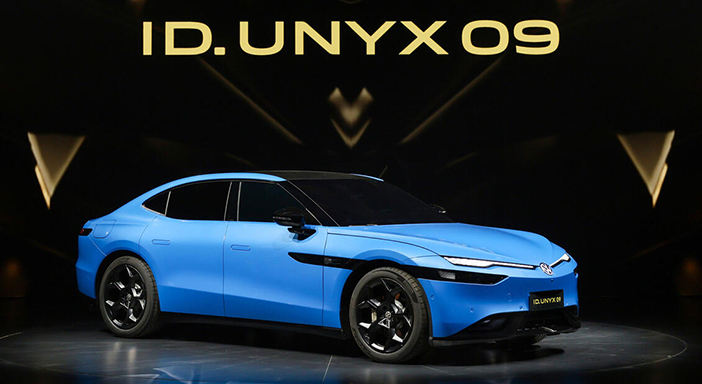
The first models using that platform were launched at the Beijing motor show recently, including the Volkswagen ID.Aura T6 (a SUV) and the striking ID.Unyx 09 (a saloon). Blume hinted that those models could eventually be exported to markets such as South America, Asia, the Middle East and India. He added: “It’s too early to decide if we want to localise a Chinese platform in Germany, but if we would do it, our priority would be to take one of our own platforms first. This year we are ramping up the CMP platform, which is planned for 2027 in China. This work has to be done first, and then we could think about options in Europe and check which products could be the right ones. We are getting right now the feedback and response from the market for our first new product in China. Then we will decide, depending on the success we have in China, which models would fit in Europe, especially in segments where we are not present with our current portfolio in Europe”. Blume said a “second step” could be to offer European production capacity for some of its Chinese joint-venture partners, which include MG owner SAIC and FAW, calling it a potential “clever solution to reduce spare capacities”. The Volkswagen Group’s push to introduce China-only platforms is part of a major push to regain standing in the region. Once the dominant player in the market, it has faced a stiff challenge from Chinese brands lately, with its sales in the country in the opening quarter of 2026 falling 20% year on year. Blume said that “having a strong footprint” in China meant the Volkswagen Group’s Western operations could benefit from “innovation, speed and practices”. He called the Chinese ecosystem “a blueprint in terms of architecture, including for our Rivian software joint venture in the Western world”. Overall, deliveries in the first quarter of 2026 were down 4.0% year on year to 2.0 million vehicles, mostly due to declining sales in the US and China. The group sold 200,000 electric cars, down 7.7% year on year. +++