
+++ The Fiat Grande Panda will spawn a hot ABARTH spin-off and it could see the performance brand return to combustion power. The Italian firm has only 2 models in its European line-up: high-performance versions of the 500 city car and the larger 600 crossover, both exclusively electric. However, both have struggled to find sales success. Fiat has also faced faltering demand for its EVs and reacted accordingly by reverse-engineering the platform of the new 500, originally designed as an electric architecture, to accept a hybrid powertrain. Meanwhile, the Grande Panda that arrived last year, using parent firm Stellantis’s cost-conscious Smart Car architecture, is offered with petrol, electric and hybrid powertrains, depending on the intended market. Fiat is aiming to expand its line-up of Panda-derived models as part of plans to grow the brand, and that could present an opportunity for Abarth to break into a new market. In the meantime, sources understand that the company is already working on a hot version of the Grande Panda, although it has yet to be fully signed off for production. Asked about the prospect of a hot Grande Panda, Abarth and Fiat Europe boss Gaetano Thorel told: “Certainly we will leverage the Abarth legacy on something else. That’s all we can say right now”. While it is understood that a design concept for the model has been developed, there are no firm details on what powertrain it would use. No model on the Smart Car platform, including the Opel Frontera and Citroën C3, has been offered with a performance variant. However, the architecture’s similarity to the STLA Small platform used for the likes of the next-generation Peugeot 208, which itself will spawn a GTi model later this year, suggests that it could accept beefier powertrains. Fiat has previously shown a concept for a Grande Panda 4×4, and although no details of that car’s powertrain have been given, Abarth bosses have suggested it features an “electrified innovative rear axle”. That could allow for a combustion engine driving the front wheels, with a small electric motor adding extra power when required, and it hints at the flexibility that could be employed to give an Abarth model suitable performance. Both Thorel and Fiat and Abarth CEO Olivier François were open about Abarth considering a return to offering combustion-powered versions due to the continued demand for such models from buyers. “When it comes to offering high performance, electric cars are the best you can offer”, François told. “But we are very aware that Abarth customers also want the sound and the raw driving experience, so we are looking at ways to satisfy those customers”. Thorel added: “When you talk to the Abarth enthusiast, it’s more than a performance brand: it has always been a tune-up brand. People who bought Abarths in the past love to put their hands on the engine to improve it, and with electric cars you cannot do that. “The electric Abarths are super performance cars, but an Abarthista cannot touch them, cannot put their hands on them. So we are studying the possibility to make an Abarth again with a thermic engine, but only if we are able to give it the right DNA. If it’s technically possible and we are able, we will do it”. +++
+++ The first models launched by ALPINA under BMW ownership will be based on the X7 and 7-series, and the brand is considering both ICE and EV variants. The Munich manufacturer officially took control of the 60-year-old BMW tuning firm on 1 January after acquiring it from its founders, the Bovensiepen family, in 2022. The first models to wear the new BMW Alpina badge will start “from the top of the BMW brand, with 7-series and the X7”, BMW Group R&D boss Joachim Post confirmed on the side lines of the new i3 unveiling. In its previous iteration as an independent brand, Alpina’s line-up was capped by versions of the 7-series and X7. Both models will be heavily overhauled later this year, in line with BMW’s strategy of rolling out its Neue Klasse design and technology elements to all model lines, and the first new-era Alpina models will follow. Asked if this meant Alpina would also offer EV variants, with the 7 Series currently offered with either ICE or electric power, Post said “we are technology-open”. Further details of the cars (and the brand strategy in general) remain under wraps, but Post said they will be designed and configured with the same philosophy in mind as before. “Alpina will talk not about sport but speed, comfort and luxury”, he said. Despite now being in-house, Alpina will not overlap with the M division but rather operate as “an exclusive standalone brand” with its own distinct attributes. Post said: “Alpina is completely different from a level which other people like from M, which is the performance. That fits very well in the BMW brand. You have the very sporty side of M (born on the race track, made for the road) and the other, which is speed, luxury, comfort on the way and also individualisation”. This is also the case with design, M design boss Oliver Heilmer told: “We wondered in the beginning if there is anything that might overlap”, he explained. “We were looking into the energy based on the past and then looking into the M projects and what they’re standing for, and they are so different in their work. Alpina, as you know it now, is more like having something mature, whereas M is always purpose-driven in terms of the best performance”. BMW previously said that Alpina would offer a “remarkable portfolio” of bespoke options, with a focus on high-quality materials and craftsmanship. It added that would make each Alpina car “an exclusive object for connoisseurs in pursuit of the extraordinary, without compromises on performance, comfort and individuality”. +++
+++ The new Q9 will serve as an indirect successor to the A8 as AUDI ’s luxury flagship when it arrives later this year. The new model, already spied testing but officially announced during Audi’s media conference, will be the German firm’s largest and most luxurious model to date. Sitting above the Q7 in Audi’s SUV line-up, it will be offered as a 7-seater or with a 6-seat layout featuring luxurious separate rear seats. The Q9’s focus on rear passenger comfort is intended to help it take on the role of the A8, which has just gone out of production, as an upmarket executive car. It’s primarily focused on the American, Chinese and Middle Eastern markets but will be offered in Europe too. “The Q9 will be the new flagship of the Audi portfolio”, said CEO Gernot Döllner. “This is a particularly important model for the US”. Audi has given few technical details of the Q9 yet, but spy shots show that it will have a large bonnet and a big new version of Audi’s ‘single-frame’ grille. It’s believed to be based on an extended version of the Volkswagen Group’s Premium Platform Combustion (PPC) platform and will offer a range of powertrains, likely including a twin-turbo 4.0-litre petrol V8 in the flagship SQ9. The Q9 will also form the basis of sibling brand Porsche’s flagship SUV, codenamed K1. That car, tentatively scheduled for a launch in 2028, is expected to be built on the same line at the Volkswagen Group’s factory in Bratislava, Slovakia. +++
+++ BENTLEY won’t retrofit its incoming debut electric car with a combustion engine like rival Lotus has done in response to a lack of buyer interest in the luxury EV segment. Crewe’s first electric model, dubbed ‘Luxury Urban EV by Bentley’, will be revealed in the second half of this year. It was previously slated to arrive in 2025. CEO Frank-Steffen Walliser said the car would be positioned solely as an EV and so re-engineering the platform to accommodate combustion power in the form of a range-extender powertrain (mirroring what Lotus has done with the Eletre X) was not being considered. This was despite the drop in buyer interest for premium EVs, which was what prompted Lotus’s decision. Walliser said that “one of the tricky tasks that we are heading for” is determining “who is really interested and how big is the market” for premium EVs. Regardless, he said Bentley has “no intention to put an ICE engine in or to put a plug-in hybrid drivetrain in” and also admitted that it was also “technically not feasible” to do so with the car’s PPE platform, but did not explain further. Walliser added that it was also “not part of our strategy” as he sees the plug-in hybrid Bentayga as the combustion alternative to the incoming EV. “Part of the Bentley strategy is not to replace a car”, he said. “So the Bentayga will continue, so we don’t have to, let me call it, force people to change from a combustion engine or plug-in hybrid car to an electric car. So we are targeting and looking for new customers with the EV”. Little has been revealed about the EV to date, but Walliser described it as “a different proposition” to what “other competitors are doing”, adding: “I strongly believe we have a very interesting offer”. Ahead of its arrival, its capabilities can be gauged by looking at the incoming Porsche Cayenne Electric with which it will share much technically. That SUV is offered exclusively with dual-motor, four-wheel-drive powertrains putting out as much as 1.160 hp. A 113 kWh battery helps achieve a range of up to 640 km. Bentley R&D boss Matthias Rabe previously said that the EV, whose official name has yet to be announced, was “very comfortable like a Flying Spur and agile like a Continental GT” while also possessing “very fast” 0-100 kph times. He added that it will be “the best Bentley on the road”. +++
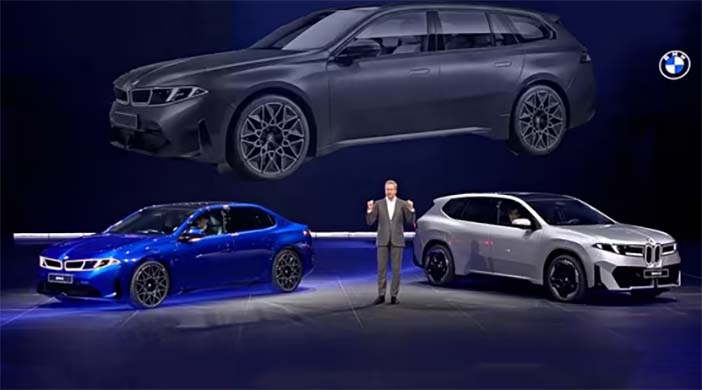
+++ BMW has confirmed the i3, its new electric 3 Series with a range of 900 km, will be offered in Touring form. A silhouette of the new model was briefly shown during the unveiling for the i3, showcasing its different roofline and hatchback boot. “Business customers and families will be particularly delighted: the Touring has always been a favourite with them”, said BMW Group chief Oliver Zipse. For reference, the current petrol 3 Series has 480 litres of boot space as a saloon and 500 litres as a Touring. BMW has yet to publish a capacity for the new i3, however. Zipse said that the i3 “marks a new beginning” for BMW. The i3 and related iX3 are the first models of BMW’s Neue Klasse era; a complete rethink of how it designs and engineers cars for the electric age, inspired by the original Neue Klasse cars that brought the brand into the mainstream 60 years ago. To that end, the i3 is one of the longest-range EVs available in the Netherlands, using a 108 kWh nickel-manganese-cobalt battery and new-generation electric motors on its front and rear axles. The current petrol 3 Series will be heavily updated to bring it into line with the new EV, so it “is basically a new car”, engineers told. +++
+++ DS will shift its focus to smaller, cheaper models following the launch of the new No8 and No7, and will soon give a “concrete” look at its plans for a successor to the DS 3 supermini, inspired by the 2010 original. The French brand is in the midst of a rapid-fire renewal of its line-up, having not launched any new models for 4 years prior to the No8 late last year, and with that rakish crossover flagship now in dealerships, along with the refreshed No4 hatchback and, soon, the mid-sized No7 SUV, CEO Xavier Peugeot has strongly hinted the next priority is launching a premium city car to rival the Renault 5 and Mini Cooper. Asked about a timeframe for the next-generation DS 3 (the current car having been on sale for 7 years), Peugeot suggested an unveiling could come within the coming months. “Having launched the No8, then the No4 and now the No7, we’ve launched quite big-sized cars, so you understand where our thoughts are going to continue this development, and we will be able to show you some concrete elements in quite a near future”, he said. He said DS plans to “shake” the small car market with a model that gives “a good balance between being iconic and in line with our roots”, and rational commercial appeal, in keeping with the brand’s ambitious growth plans. The Paris motor show in October is a likely venue for a new DS to make its debut, possibly in concept form, but Peugeot would only say that was a “very clever” suggestion when asked for confirmation. As previously reported by Autointernationaal.nl, the next DS 3 is tipped to take heavy design influence from the first-gen car, which was launched in 2010 as the first model from Citroën’s new DS sub-brand, before it was hived off as a marque in its own right in 2015. Citing the strong commercial success of the Mk1, which rode lower and was more overtly ‘sporting’ in its positioning than today’s SUV-shaped Mk2, DS designer Thierry Metroz recently said: “We want to take inspiration from the Gen1, but in a very futuristic way. And what I don’t want to do is retro design, but we’d like to keep some design elements which are very strong from the Gen1”. Peugeot doubled down on this rhetoric, explaining that there’s more flexibility to draw inspiration from the past on smaller cars than larger ones. Notably, DS’s sibling brand Peugeot is employing a similar tactic for its own next-gen supermini, the 208 (which will be closely related to the DS 3 underneath) by channelling the spirit of the 1980s 205. “If you look at this kind of ‘retro’, this capacity to start from an iconic product such as the Mini or the Renault 5, we see that the biggest successes when car makers try to regenerate these iconic products were based on small cars rather than large ones, so that’s something we’ve been working on”, said Peugeot. He went so far as to suggest that, in this context, the Mk1 DS 3 is as influential as the classic saloons that defined the brand’s early years: “If we look at our portfolio, the DS from 1955 was iconic, the SM was iconic and the more recent DS 3 was also iconic – these kinds of thoughts are in our mind”. The brand’s intention to tap into its heritage more overtly with future products will not, however, extend to a production version of 2024’s striking SM Tribute concept, which reimagined the eponymous V6-engined sports saloon for the electric era, because the role of flagship has been filled. “The initial SM was to me an iconic product, but you understand that it is a big car (highly iconic, no doubt) but I joined this brand just 1 year ago and I was quickly connected to the launch of another big car, the No 8”, said Peugeot. “And we’ve got No 7, so it’s quite complicated to give priority to another big car in all the work we’ve been doing, but I agree that when we’ve got such strong roots, such a strong DNA, we should ensure that we can extract the key elements and put them into all of the product launches”. He did not write off the prospect of one day reviving the SM in some form, but said it was “not a top priority” for the brand. Peugeot also confirmed that the No8 will be the largest and most expensive model DS launches: “We must play our premium cards (so there is always a pricing impact) but we also need to do volumes, so we should get the balance right, and the priority is not to put in the range a car which is larger than the No8”. He also said there is “no need to go as low” as a notional No1 or No2, so the No3 will be the smallest DS model. There will not be a No5, either, as French fashion house Chanel has the rights to that name for its iconic perfume range, leaving just ‘No6’ as the final potential gap in the DS line-up, one that could possibly be filled by a model that’s positioned between the No4 hatch and No7 crossover. +++
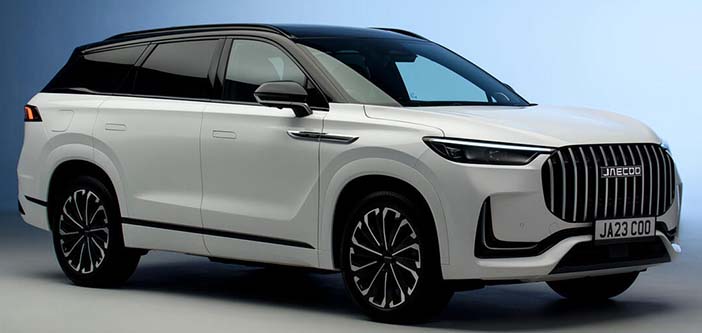
+++ JAECOO has confirmed its flagship 8 will arrive here in May, marking its expansion into more premium territory following the success of the smaller 5 and 7. Featuring curvier, sleeker styling compared to the Chinese brand’s existing models, the plug-in hybrid 8 will arrive in the Netherlands with 2 trim levels: Luxury and Executive. Both are equipped with the Super Hybrid System (SHS) that’s also used by other Chery group models, such as the Omoda 9. The powertrain consists of a 1.5-litre turbocharged petrol engine and a 3-speed automatic gearbox, sending 430 hp and 600 Nm of torque through both axles. This gives the Jaecoo 8 a 0-100 kph time of 5.8 seconds; very nearly as quick as the Volkswagen Golf GTI. It has a combined range of more than 1.100 km and an electric-only range of 140 km, while DC fast-charging capability of up to 40 kW allows for a 30-80% charge in around 20 minutes. Some other Chery group SUVs are offered with electric power, but an EV variant of the 8 isn’t currently planned. The Luxury model features 7 seats, making the 8 the first Jaecoo model offered in the Netherlands to feature a 3-row layout. Meanwhile, the Executive maintains a third row of seating but with a 6-seat layout made up of four extendable ‘captain’s chairs’ upholstered in Nappa leather. Dual 12.3in displays, a Sony 14-speaker sound system, wireless Apple CarPlay and Android Auto and heated, ventilated and massaging front seats are all standard. The 8 isn’t an attempt to distance Jaecoo away from the value segment but rather a further addition to the range in response to market and customer feedback. +++
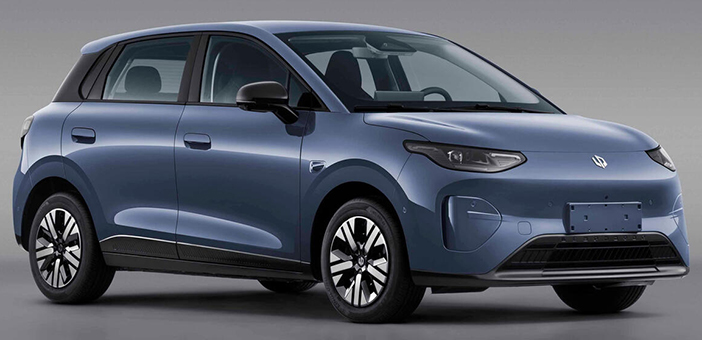
+++ LEAPMOTOR ’s rival for the Volkswagen ID.3 has surfaced ahead of its official unveiling later this year. Named the A05, the electric hatchback will form a key part in the Chinese brand’s ambitious plans to cement itself as a mainstream player in Europe. It measures 4.2 meter long, 1.8 meter wide and 1.6 meter tall, thrusting it into competition with cars such as the Cupra Born, Renault Megane and MG 4. Images published by China’s Ministry of Industry and Information Technology (MIIT) show it bears a strong resemblance to the B03X that Leapmotor revealed last year, with squinting headlights up front and a blocky rear end. The MIIT filing also reveals the A05 will be powered by a single front-mounted motor with either 95hp or 122 hp. There will be a choice of 2 lithium-iron-phosphate batteries, although their capacities have yet to be disclosed. Pricing for the A05 is expected to start below €25.000 when it arrives in the Netherlands later this year. The rapid expansion of the brand’s line-up will be key in securing its position against long-established rivals: “Versus 2025, we will go from about a third of the market covered to almost 90% of the market covered”, he said, although he admitted that “when you get bigger, life gets more complicated”. Dally said that maintaining Leapmotor’s approach of offering one trim level for each of its cars would be “key” in helping customers to understand its range and offering “no compromise” in kit. “We’re positioning Leapmotor as the ultimate non-materialistic brand”, he explained. “I’m saying to you ‘spend less on your car, spend more on life, spend more time with your family’. We give a product that is specified to the nines at a great price. There’s no compromise. The only compromise is you’re gonna have to get your head around a new badge on the front, which is backed by Stellantis, the world’s 4th-largest vehicle maker”. +++
+++ MERCEDES-BENZ will unveil 40 new or facelifted models this year, but arguably the most important is the C-Class EQ. Having until now concentrated its electric efforts in luxury segments with the EQE and EQS, this is the first time the brand is targeting the area dominated by the Tesla Model 3, and it’s doing so with an EV version of its best-selling model. It arrives at a time when its key rivals are doing the same: the BMW i3 has just been revealed and Audi is planning to launch an electric A4 e-Tron later in the decade. Before the new C-Class EQ is unveiled next month, press members have been given a ride in a development prototype at Mercedes’ Immendingen proving ground in southern Germany. The pre-production prototype is heavily disguised, but the differences to the ICE C-Class are clear: the front end is more upright, it sits lower and the rear window is set at a much steeper angle (likely for aerodynamic purposes). Inside it is bigger, too, thanks to its longer wheelbase and wider tracks. The EV is the second Mercedes to use the company’s 800V MB.EA architecture. Several battery sizes are planned, ranging from 64 kWh to 94 kWh. Range will be “beyond 700 km”. During my first laps, it quickly becomes clear how agile the new car is. There is impressive resistance to body roll and particularly strong front-end grip. The effect of the optional rear-wheel steering becomes evident through tighter bends. We then move to a public road to expose weaknesses in suspension tuning. Yet the cabin remains strikingly calm. Road noise is subdued. “We wanted a car that feels light on its feet but still delivers the customary comfort of the current C-Class”, explained engineer Ewald Dirks. “The goal was that the driver should not really sense the added weight brought by the switch to electric power. Compared with the ICE C-Class, it is another level. There is also a much broader spread between the sportiest and most comfortable settings”. The road deteriorates further. Small, sharp bumps ripple through the surface. But the prototype absorbs the impacts with impressive composure and control. Throughout my time as a passenger, one characteristic stands out above all: refinement. Mercedes appears to have replicated the dynamic qualities that have long defined the C-Class. We await our time behind the wheel in the coming months. +++