
+++ The next-generation ALFA ROMEO GIULIA will arrive in 2028, alongside a new Stelvio, and the wild, range-topping Quadrifoglio super saloon is set to return to rival the BMW M3 with a choice of electric and petrol power. The new Giulia and Stelvio were originally due to be launched last year exclusively as EVs, but the Italian brand has revamped its plans as part of a wider rollback by parent firm Stellantis, prompted by the uneven uptake of electric cars. The current models will remain on sale until next year. The 2 new Alfas will still switch to an advanced new platform that will allow for massively upgraded electric technology, including ultra-fast charging, but the architecture has now been reworked so that the brand can continue to offer plug-in hybrid powertrains. Alfa Romeo boss Santo Ficili told that “we need to consider the entire world because the brand is global”, adding that “the world is not ready everywhere” for EVs. He declared that the firm would continue to offer combustion cars for as long as there is demand, saying: “We need to find a way to satisfy the needs of our customers. What does this mean? It means BEV and it means all the other kinds of endothermic powertrains, so ICE, PHEV, BEV. So that’s the direction”. The existing Giulia and Stelvio first went on sale in 2015 and 2016 respectively and use the ageing Giorgio platform, which was developed by FCA before the company became part of the Stellantis empire. The next-generation models will move onto Stellantis’s new STLA Large platform, which was developed as an electric-biased multi-powertrain architecture. The long delay to the model launch is so that the cars can be adapted to fit plug-in hybrid powertrains. While the platform can accept PHEV technology, Autointernationaal.nl understands the issue for Alfa concerned re-engineering the body itself to allow more cooling for combustion powertrains. As such, design revisions such as new front fascias to open up the grilles and allow more airflow were required. Both the Giulia and Stelvio will grow in size as a result of switching platforms, and they will also feature more aerodynamic designs in an effort to reduce drag and maximise range for the electric versions. Furthermore, they will adopt the new Alfa design language introduced by the Junior. Both models will feature split headlights and daytime-running lights up front, a set of arrow-shaped lights at the rear and a ducktail-style lip spoiler. Alfa’s trademark grille will also be revamped, in part because, due to European Union rules, manufacturers are no longer allowed to fit numberplates offset on the wings of a car. Instead, the numberplates of the Giulia and Stelvio will be located under the grille. Inside, screen use will largely be kept to a single central display with Alfa’s signature ‘cannocchiale’ (telescope) instrument binnacle retained, albeit most likely digitised. The next-generation Giulia and Stelvio will be available with the largest choice of powertrains yet offered by an Alfa Romeo. The line-ups are expected to open with turbocharged 4-cylinder petrol engines, but these will gain mild-hybrid technology in order to keep emissions down. What will power the plug-in hybrid versions of the Giulia and Stelvio is still up for debate, but they could adopt an uprated version of the 245 hp powertrain used by other STLA-based PHEVS, such as the Peugeot 408 Plug-in Hybrid. That combines a 1.6-litre 4-cylinder turbo petrol engine with a rear electric motor and a 21 kWh battery to offer an electric range of 80 km. the STLA Large platform can accommodate battery packs with a capacity ranging from 85 kWh to 118 kWh. This should result in a range of more than 650 km for the most efficient electric Giulia and Stelvio-key to keeping them competitive against technically advanced rivals, especially the new BMW i3 saloon, which has a headline range of 900 km. The good news for performance enthusiasts is that the Giulia and Stelvio will continue to be crowned by hot Quadrifoglio (QV) versions, and they will be equipped with both electric and combustion powertrains. The quickest electric cars on the STLA Large platform can crack the 0-100 kph sprint in around 2.0 seconds, claims Stellantis; almost twice as quick as the 3.8 and 3.9 seconds times quoted for the current V6 petrol-engined Giulia QV and Stelvio QV. The US-market Dodge Charger Daytona EV, the first performance car to use the platform-makes up to 670 hp with a dual-motor set-up. With that power, the electric QVs would match the Hyundai Ioniq 6 N and most potent Porsche Macan. There have previously been suggestions that the Giulia QV could deliver as much as 1.000 hp from a tri-motor system, which would make it a close rival to the Porsche Taycan Turbo GT and upcoming BMW M3. However, no model in the Stellantis stable currently produces that much power. The combustion-engined QV models are expected to continue with the same 520 hp 2.9-litre V6 as fitted to today’s versions. Notably, that powertrain has recently been made compliant with incoming Euro 7 emissions standards. However, some sources suggest Alfa is looking at other options, including the 560 hp twin-turbo 3.0-litre straight-6 used by the combustion variant of the Charger Daytona. Due to emissions rules, it’s possible that such a version could be offered only in certain markets, such as the US. The Giulia and Stelvio will be first to use Stellantis’s new STLA Brain software architecture, which Alfa said would enable a more flexible dynamic character -particularly for the performance versions. This advanced, centralised on-board computing system will use artificial intelligence to actively manage the car’s chassis dynamics, torque vectoring and active suspension damping in real time. This, claims Alfa, will allow the electric versions to match the dynamic capabilities of lighter ICE siblings while mitigating against the added weight brought by an electric powertrain. The cars will also be updated over the air throughout their lifetimes for further refinement. The STLA Brain is also expected to power a next-generation augmented reality head-up display. Notably for track-day enthusiasts, this system could potentially project a ‘ghost car’ onto the Tarmac ahead, showing drivers the optimal braking points and racing lines on a circuit. The STLA Large platform uses an 800 Volt electrical architecture; a first for Stellantis. The smaller STLA Medium, which underpins cars ranging from the Peugeot e-3008/5008 to the DS N°8, has a 400 Volt system. Primarily, the 800 Volt wiring will mean a substantially faster maximum charging rate, potentially beyond the 270 kW of today’s fastest-charging Stellantis EVs. However, it’s also important for the range-topping QV pair, as the higher voltage allows for thinner wiring and therefore a significant reduction to each car’s weight. Both the Stelvio and Giulia will be built at the Cassino plant in italy alongside one or more Maserati models, also based on the STLA Large platform. +++
+++ FERRARI has turned up the heat on the Purosangue with the addition of a new Handling Speciale pack. The new option brings a revised calibration for the SUV’s adaptive suspension that is said to make it notably tauter, reducing body roll by 10%. It also adjusts the mapping of the automatic gearbox to exaggerate shifts, with greater emphasis in the Race and ESC-Off modes. When changing gears manually, shifts are exaggerated from 5.500 rpm onwards. Additionally, more V12 engine sound is pumped through to the cabin on start-up and while accelerating compared with standard. A Purosangue with the Handling Speciale pack is marked out by new diamond-cut wheels, carbonfibre side skirts and a black prancing horse badge on its rear end. Inside, ‘Handling Speciale’ plaques are mounted behind the rear seats and a matching graphic can be found along the doorsills.
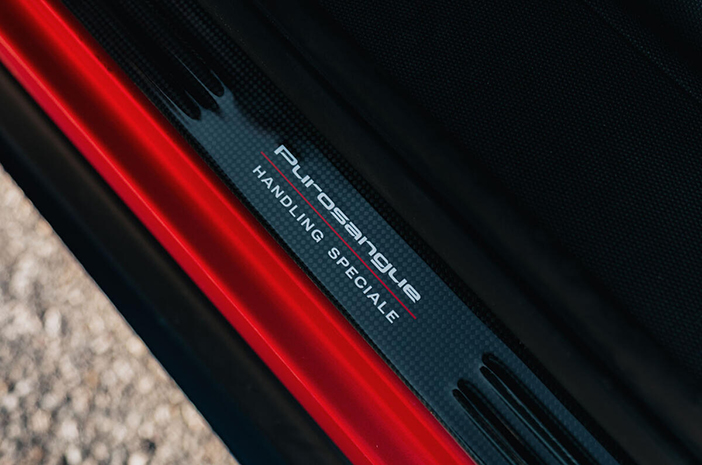
A Purosangue in Handling Speciale specification costs €650.000 in the Netherlands. The Purosangue has been regarded as the best driver’s SUV when it arrived in 2023, beating the Aston Martin DBX 707 in a shootout on its merit as a driver’s car. But several sporting rivals have since arrived, including a new DBX S (which outpunches the Purosangue by 2 hp, at 717 hp), the Range Rover Sport SV and the Bentley Bentayga Speed. In further stiffening the Purosangue, it appears that Ferrari is hoping to defend its position as the class leader. +++
+++ The JEEP AVENGER is set to gain an updated look when it’s refreshed later this year. A newly released teaser image show that Jeep’s small electric SUV will get an illuminated grille, while ongoing rumours also point towards the Avenger receiving more exterior changes, big tech upgrades and perhaps an updated powertrain.
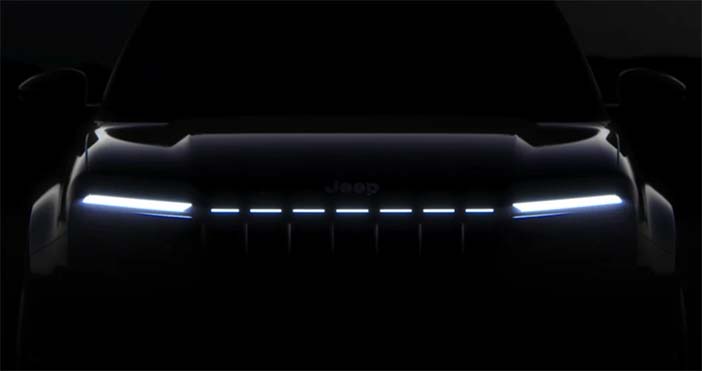
Minimal, if any, changes are set to be made to the Avenger’s led headlights, which feature a horizontal daytime running light at the top. After the updates, however, they will flank an illuminated version of Jeep’s trademark seven-slatted grille. The implementation will be much the same as on the larger Jeep Compass in the sense that each segment will receive its own line, effectively joining the headlights in one segmented light bar. What you can’t see from Jeep’s teaser picture, though, is that the facelifted Avenger will also feature updated front and rear bumper designs. Buyers can also expect updated alloy wheel designs, as well as potentially new colour options. The greatest visual changes are expected to occur on the inside, because those same pictures of a pre-production version of the Avenger facelift also seem to confirm the arrival of a new, larger touchscreen. Current versions of the smallest Jeep feature a 10.25-inch display, although the software is in dire need of an update when you consider the slicker set-ups of rivals. As before, I also expect front- and all-wheel-drive mild-hybrid petrol powertrains to be offered alongside the electric model. Both currently employ a 1.2-litre 3-cylinder engine, with the latter getting an additional electric motor on the rear axle to provide it with all-wheel drive. I believe the new Jeep Avenger will be unveiled in the next couple of months. +++
+++ LEAPMOTOR has revealed a new warmed-up Ultra version of its B05 hatchback at the Beijing motor show, previewing a potential new line of range-topping models featuring extra power and other performance upgrades. Known in China as the Lafa 5, the standard version of the Volkswagen ID.3 Neo rival will arrive in Europe showrooms in the coming months, although it isn’t yet known if the new Ultra variant will eventually follow.
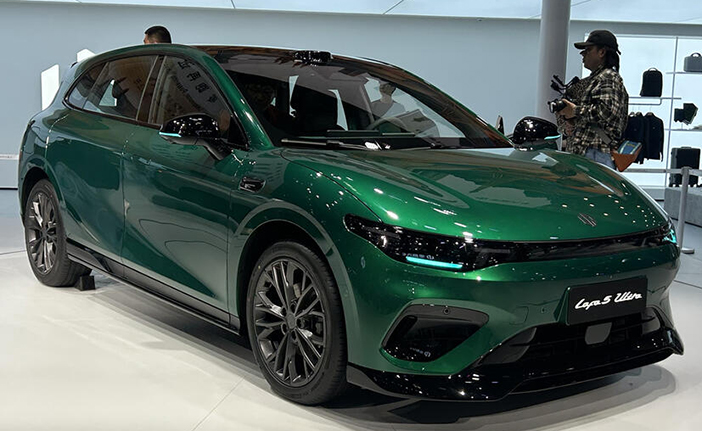
In China, the Lafa 5 Ultra features a notable boost in power to 245 hp, up from 218 hp in the standard model, which is sent to the rear wheels through a single motor on the back axle. Leapmotor has also increased the responsiveness of the motor to enhance the driving experience, and the Ultra can achieve 0-100 lph in 5.9 seconds. It will be offered with either a 56.2 kWh lithium-iron-phosphate battery giving a range of 440 km or a 67.1 kWh version that can run for 600 km. The ride height has been lowered to 1.510 mm, while weight has been reduced to 1.665 kg, with Leapmotor claiming a 50:50 distribution front to rear. There are a series of exterior styling tweaks, including a front splitter, sculpted bodywork elements, a rear wing that’s claimed to improve aerodynamics and 19in wheels clothed in Hankook performance tyres. The interior has also been given a makeover with a focus on adding extra refinement, with new ‘suede-inspired’ sport seats. The Ultra will be priced in China from around €36.000, compared with a starting price of €25.995 for the regular Lafa 5. The Ultra name could be used for warmed-up versions of other models in the Leapmotor range where there’s likely to be demand. The B05 will be joined later this year by the Ford Puma-rivalling B03X crossover. +++
+++ MERCEDES-AMG will soften the SL and reposition it as a traditional open-top grand tourer in a move to more clearly distinguish the car from its hard-top GT sibling. The changes will arrive as part of a facelift for the 7th-generation car next year and work is already well advanced, a source has told. The SL and GT share a platform, chassis, drivetrains, electrical architecture and other key components. Mercedes-AMG’s decision to put more clear air between the 2 models comes after what one high-ranking insider described as an “overwhelmingly positive reaction to the comfort-focused Maybach SL, which was launched last year. The mid-life revisions to the SL go beyond chassis tuning and pure dynamic differences, though. They also encompass a new range of engines, driven in large part by the upcoming Euro 7 emissions regulations. The most significant change is the discontinuation of the existing SL 43. Its 381 hp 2.0-litre turbocharged 4-cylinder engine is set to be dropped. In its place, Mercedes-AMG will introduce a revised version of its 3.0-litre inline turbocharged 6-cylinder engine recently launched in the GLC 53. It is planned to power a new SL 53 model, producing around 450 hp. Further revisions are in store for V8-powered models. Both the SL 55 and SL 63 will switch from cross-plane crankshafts to a flat-plane design, as is used by the updated S-Class in its range-topping S580 guise. The change is driven by emissions and allows Mercedes to meet Euro 7 limits without a drastic cut in power output. The SL 55 is expected to deliver around 545 hp, while the SL 63 will climb to nearly 660 hp-up from the 577 hp of the existing model. Topping the range will be the SL 680 Maybach, which is set to adopt the 63’s V8 in a milder state of tune, at around 612 hp. All models will be mild hybrids, with a starter-generator mounted ahead of Mercedes’ 9-speed automatic gearbox. It remains to be seen whether AMG will continue with the SL 63 SE Performance and its petrol-electric plug-in hybrid system. Insiders have suggested it could axed. As part of the facelift, the SL will receive an exterior makeover. Revisions include new-look front and rear lights with the star-shaped graphics of other recent Mercedes models, among other more subtle tweaks. Inside, the SL will adopt Mercedes’ latest MB.OS operating system, a new display and a different steering wheel. +++
+++ It’s not had quite the same success in Europe as sister brand Jaecoo, but OMODA is looking to build its profile here with the all-new Omoda 4. The small SUV is set to be the entry-level model in the Omoda range, below the Omoda 5, Omoda 7 and Omoda 9. And the model was on display this week at the Beijing Auto Show, where Omoda disclosed some new information about its Nissan Juke rival, including what lies beneath the bonnet.
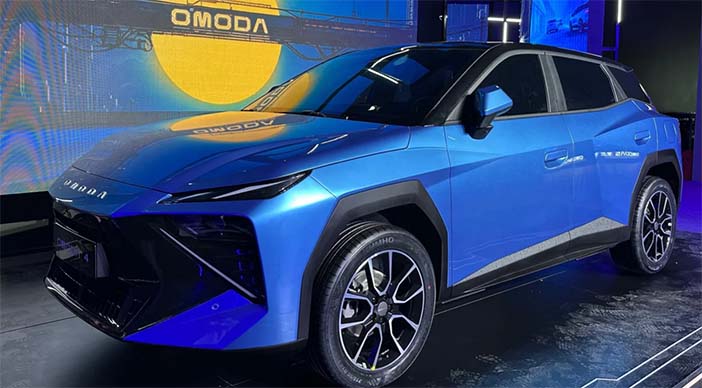
Powering the Omoda 4 when it arrives in Europe later this year will be the “full hybrid SHS-H” powertrain, which I’ve already tried in the Omoda 5 and has since been shared with the Jaecoo 7. The set-up uses a 1.5-litre turbocharged 4-cylinder engine paired with a small electric motor and 1.83 kWh battery pack. Power in the Omoda goes to the front wheels via a dedicated hybrid transmission called (DHT); something we’ve seen in a few plug-in hybrid cars from the Chery group already. The system works in a similar way to Toyota’s hybrid tech, with the petrol engine recharging that small battery. The SHS-H isn’t designed for a large amount of electric-only driving (and Omoda hasn’t provided a range estimate anyway), although in the Omoda 5 claims far superior efficiency. Although the first Omoda 4 will be a full hybrid, a pure-electric alternative has been confirmed too, which I suspect will be called Omoda E4 to sit under the Omoda E5. The tie-in with the Omoda 5 shouldn’t come as much of a surprise, because the new B-segment SUV shares its T1X platform. There’s no confirmation of Dutch pricing, but the Omoda 4 will have a lower starting price than the Omoda 5, which kicks off at €29.990. Compared with its more premium sister brand Jaecoo, Omoda focuses on value with its philosophy of “affordable premium”. And with the Omoda 4, it appears this will be done with some eye-catching design. As well as a very angular and aggressive exterior design that looks to take inspiration from cars such as the Lamborghini Urus, the company also revealed its ‘Starship Cockpit’, featuring a large central touchscreen and a flip-up, fighter jet-style start button. I’ve even seen a docking station for a Nintendo Switch on the centre console. +++
+++ New spy pictures and associated patent images of the upcoming electric ROLLS-ROYCE SUV have landed in our inbox, revealing an interesting party trick that harks back to the brand’s pre-war era. It appears the as-yet-unnamed EV will get a centre-hinged bonnet, probably opening to reveal a small storage spot for charging cables or a bespoke luggage set. The new model, likely to cost from around €400.000, will sit alongside the petrol-powered Rolls-Royce Cullinan but be pitched as a more urban-focused vehicle. It’ll be revealed in full in 2027 as the brand’s second full-production EV, following on from the Rolls-Royce Spectre 2-door coupe. Earlier this year, spy shots from BMW’s winter testing program revealed a prototype that was both very large and quite different to the more upright Cullinan. This new model is lower and sleeker, with an almost wagon-like silhouette and shallower windows. Yet while it looks lower, it’s almost certainly longer, possibly stretching to more than 5.3 metres. There’s no mistaking this car’s core Rolls-Royce design cues, dominated by that long bonnet, upright nose, and short front and long rear overhangs. Peer under the camouflage and you’ll also see the same rear-opening ‘coach’ doors, and a set of small Spectre-inspired rear lights. But up front there’s something more innovative going on. Central to the front-end design will sit a typical Pantheon grille, but look closely and you’ll notice a shut-line running down the centre of the bonnet.
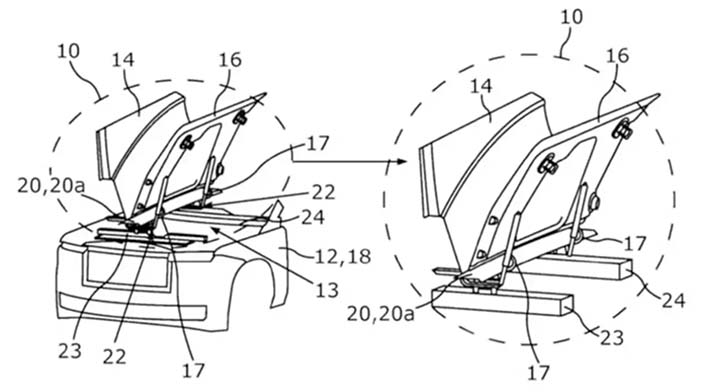
New patent images show a hinged arrangement that will allow the bonnet to open like those on the firm’s iconic pre-war cars, lifting to reveal not a powerful V12, but a spot for a five-figure luxury luggage set. Elsewhere, I expect a new lighting signature, including a set of LED lighting strakes at the intersection of the bonnet and front bumper which taper from angled to vertical as they get closer to the centre of the car. Underneath these are vertically-arranged headlights, and while they aren’t the production units, their basic layout and placement will transfer to the future road car. Given this model’s placement in the Rolls-Royce range as one of its more progressive model types (after all, this isn’t a V12-powered saloon) I expect the interior to be more digitised than ever before in one of the brand’s creations. Expect larger screens and more digital customisation alongside Rolls-Royce’s famous leather, wood and metal craftsmanship. Under the skin, this model will improve its electric driving range as its battery technology should be based on the Neue Klasse architecture from its parent company BMW. But the sheer size and weight of the new SUV will probably see the maximum distance on a charge remain somewhere in the 500 to 650 km ballpark. Expect a twin-motor layout with upwards of 500 hp; a 600 hp-plus Black Badge is also highly likely. However, as with the Spectre, this won’t be about outright speed, rather a feeling of effortless power. The electric SUV won’t be a replacement for the existing Cullinan, as the petrol-powered SUV still does big sales in petrol-hungry markets like the USA and the Middle East. While Rolls-Royce hasn’t rowed back on its EV plans, it has extended the life of its illustrious V12. It’s not yet clear whether the Cullinan will be replaced, but it’s unlikely Rolls-Royce will deem it appropriate to extend production of the now 8-year-old SUV beyond the turn of the decade, at least not without significant updates. Of course, this big new Rolls-Royce won’t be the only ultra-luxury British electric SUV coming out next year, as Bentley’s ‘Urban SUV’ is also on the way. Due to be quite a lot smaller and more agile than the Rolls, given its shared underpinnings with the new Porsche Cayenne Electric, the Bentley won’t directly compete for the same customers. Instead, it’s probably Jaguar, with its SUV follow-up to the forthcoming GT that could be the Bentley’s more pointed competitor. +++
+++ Leapmotor and STELLANTIS , whose brands include Citroën, Fiat, Peugeot and Opel, will look to further “leverage the synergies” of their partnership, which could include the development of new shared vehicle platforms. Stellantis holds a stake of around 20% in the Chinese firm, along with a 51% stake in Leapmotor International, which distributes its models in global markets. While that means Leapmotor cars could be sold in Europe through Stellantis’s dealer network, those are technically unrelated to cars from their sibling brands. There is already technical cooperation between the firms, as European engineers help Leapmotor with the development of models for international markets. And that cooperation could increase in the future, according to Leapmotor International boss Tianshu Xin. Speaking at the Beijing motor show, he said: “One of the beauties of this partnership is really to leverage the best of both sides. So Leapmotor is providing a very innovative product at a completive cost while Stellantis is providing global infrastructure with the dealer network, IT systems, parts distribution and more. Leapmotor and Stellantis are 2 independent OEMs and have their own platforms. But one of the strategic rationale of this partnership is to generate synergies, potentially including the platform operation and components. Around 65% of Leapmotor’s components are produced in-house, and there are synergies for Stellantis to use Leapmotor parts in future Stellantis platforms”. Asked if that could extend to the development of a platform that could underpin both Leapmotor and Stellantis models, potentially allowing for Stellantis models to be produced at lower cost in Leapmotor plants, Xin said: “I will not rule it out completely at this moment, and this great idea is certainly under exploration”. +++