
+++ DACIA is priming a sub-€18.000 city car as 1 of 4 new EVs it will launch between now and 2030. The new model is twinned with the Renault Twingo and the close ties between the 2 models will be evident. Like its retro sibling, the Dacia has a raked C-pillar, curved roofline and rounded rear windows, plus similar surfacing around its wheel arches. Yet significant differences are also evident: it loses the Twingo’s signature rounded front light design for a thin gloss-black panel, like that on the Spring. At the rear, it does not have the Twingo’s lozenge-style window shroud, and the brake lights are also notably higher-set than on the Twingo. The new Dacia city car will be revealed later this year, ahead of a public debut at the Paris motor show in October. It has been developed in just 16 months. Although it is positioned similarly to the Spring, it will not immediately replace that model. Dacia product boss Patrice Lévy-Bencheton told that “they are still quite different”: it will be slightly larger and wider, and its design takes greater influence from Dacia’s SUVs. While Dacia has yet to give firm technical details of the car, it is likely to closely match the Twingo, with a 27.5 kWh battery giving a range of 260 km. Notably, Dacia has confirmed the model will be priced from less than €18.000, undercutting the €20.995 Twingo and making it one of the cheapest EVs on sale. +++
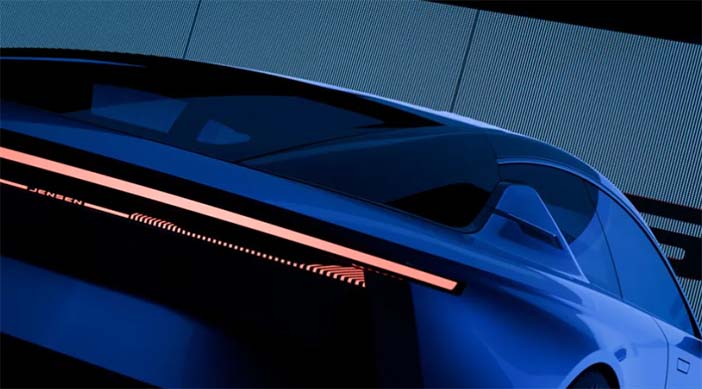
+++ The JENSEN INTERCEPTOR is to be reborn as a new British-built, V8-powered GT, 50 years after production of the iconic original ended. Banbury-based Jensen International Automotive (JIA) has confirmed its new model, due to be revealed in the coming months, will be called the Interceptor GTX. It will be JIA’s first clean-sheet design, the firm having previously specialised in restoring and modernising Interceptors, creating restomods such as the Interceptor R. It will be hand-built in “ultra-low” numbers and therefore probably command a very high price. It is claimed to be an “ultra-high-performance”, luxury proposition that will offer a fully analogue driving experience. This suggests that it will use a manual gearbox and the cabin will be flooded with physical controls and switches, similar to the original 1960s Interceptor. While further details have yet to be revealed, Autointernationaal.nl understands the new car will be powered by the engine from the latest Chevrolet Corvette. The Corvette’s 6.2-litre V8 puts out 507 hp and 600 Nm of torque as standard, but JIA said its new car’s powertrain will be “bespoke”. The original Interceptor used a 6.3-litre big-block Chrysler V8, giving it more than 250 hp and a top speed of nearly 225 kph. The as-yet-unnamed JIA GT will sit on a lightweight aluminium chassis, likely as part of an effort to give it the highest power-to-weight ratio possible. While its design has yet to be revealed, the first official picture confirms that it will follow a similar philosophy to the original, with a long bonnet, raked roofline and a low-slung stance. Managing director David Dürden said JIA is “taking the theme of the luxury British GT to fresh, thoroughly modern heights” with a car that “will stand proudly as a completely all-new car in its own right”. A release date has yet to be confirmed but, given that JIA is keen to highlight the car’s British roots, a debut at the Goodwood Festival of Speed in July seems plausible. +++
+++ The new open-top LAMBORGHINI TEMERARIO SPYDER has been spotted testing on the road and on-track ahead of the drop-top speed machine’s world debut later this year. As with Lamborghini’s previous entry-level supercars, the Gallardo and Huracan, the convertible version of the Temerario is arriving about 2 years after the original hard-top version was released. However, unlike its predecessors, it appears that Lamborghini has given the Temerario Spyder a metal folding roof, not a traditional fabric one, that as we can see preserves the look of the coupe, just like its key rivals: the Ferrari 296 GTB and McLaren Artura. Obviously, a retractable hard-top like this will be heavier than a fabric roof, so Lamborghini’s engineers may need to strengthen the chassis further to minimise any loss in rigidity. Although perhaps not too much, as the Temerario’s aluminium spaceframe underpinnings are already over 20 percent stiffer than the Huracan’s. Sadly, I didn’t get to see the Temerario Spyder with its roof down, but when it is, the driver and their lucky passenger will be able to fully enjoy the twin-turbo 4.0-litre V8 that can rev to a superbike-like 10.000 rpm. The engine is assisted by 3 electric motors, which work together to send 920 hp and 730 Nm of torque to all 4 wheels. The Temerario Spyder is one of a few new models Lamborghini is expected to launch before the end of the year. The brand is keeping details of exactly what it’s up to and when we’ll see these cars close to its chest, but has said it’s got plans for the 2026 Goodwood Festival of Speed in July and the Monterey Car Week in August. We suspect another of these mysterious new models will be the Lamborghini Urus Performante, which we also spotted testing recently. +++
+++ NISSAN is gearing up for a comeback. We were on hand earlier this week as the company unveiled the new Rogue E-Power Hybrid at its headquarters in Yokohama, Japan, while also teasing the return of the Xterra nameplate. But it’s not stopping there. In a conversation with Richard Candler, Nissan’s global head of product strategy, he said that the brand is serious about bringing sporty cars back into the line-up. And not just the GT-R and Z, potentially other enthusiast-favorite nameplates as well. He notes: ‘We are really deeply looking at a sports lineup again. We want to do some cool cars. The first car I ever bought was a Silvia, so I’d love to bring back that nameplate. I do think it’s really valuable. I think there’s still space for Silvia, and we need to find the right solution for it’. This isn’t the first time Nissan has hinted at reviving the Silvia. CEO Ivan Espinosa previously suggested that more sports cars could be in development alongside the upcoming R36 GT-R. While he stopped short of confirming the Silvia nameplate specifically, he did say that we will see “more sports cars coming into the portfolio”. What a new Silvia might look like is still unclear, but it would likely target rivals like the Mazda MX-5 and Toyota GR 86 / Subaru BRZ. As Candler puts it, “price access and accessibility are important for that product”. +++
+++ People are spoiled for choice when shopping for a new car. Gasoline, diesel, mild hybrid, full hybrid, plug-in hybrid, battery EVs, and even fuel-cell hydrogen vehicles all make up today’s vastly diverse automotive universe. However, one automaker has put all its eggs in the electric basket and no longer considers plug-in hybrids a good choice. POLESTAR Australia’s managing director candidly shared his take on PHEVs in an interview with local media. The executive from a company controlled by automotive giant Geely isn’t a fan of cars that combine a combustion engine with an electric motor. Scott Maynard delivered his blunt assessment: ‘I think plug-in hybrid vehicles are the worst of both worlds. So, you’ve got all the complexity of an electric drivetrain, coupled with all of the weight and complexity of a petrol drivetrain. You don’t have zero emission, you have an increase in maintenance requirements, because you’ve got all of those varying systems that need to be maintained independently’. Maynard’s criticism goes beyond the complications stemming from the extra hardware. The Polestar official argues that many PHEV owners rarely charge their cars, failing to maximize the benefits of carrying a battery pack. An irrefutable point I’d add is that a plug-in hybrid running exclusively on its combustion engine will be less efficient than an equivalent ICE-only vehicle due to the added weight of the battery. Packaging constraints are also unavoidable. We can all agree that Polestar’s Australian boss raises several valid concerns about the downsides of PHEVs. He believes they’re “fast becoming irrelevant” as advances in EV technology steadily ease range anxiety. However, there’s an element of irony in that stance. The company’s first production model after becoming a standalone brand was the Polestar 1, a plug-in hybrid. Production of the China-built PHEV ended in 2021, after which Polestar effectively transitioned into an EV-only automaker. Additionally, Polestar is part of the Geely Group alongside Volvo and Lotus, both of which continue to sell PHEVs. The lesser-known Lynk & Co brand also offers plug-in hybrids, while the Chinese auto giant has EVs with range-extender combustion engines. +++
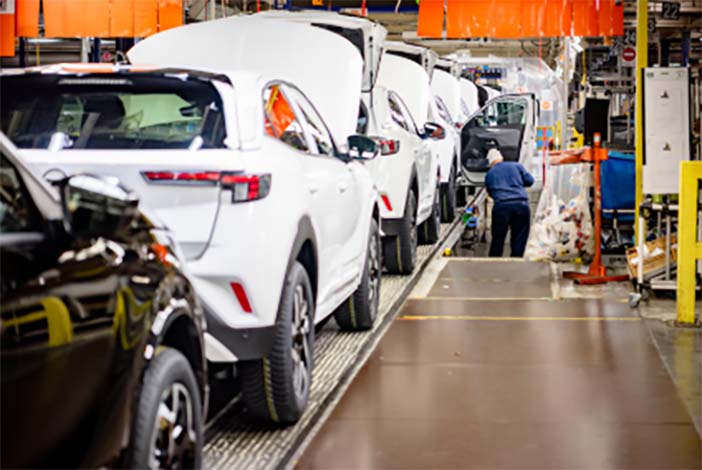
+++ To address overcapacity, STELLANTIS plans to phase out vehicle production at its Poissy plant in France within the next 3 to 4 years, while continuing component manufacturing. The site currently builds the DS 3 and Opel Mokka, including their electric variants. Production of both models will continue until at least 2028, a Stellantis spokesperson confirmed. Once production of the DS 3 and Opel Mokka ends, vehicle manufacturing at the Poissy plant near Paris will cease, while the site itself will remain in operation. Stellantis has committed to investing €100 million in transforming the facility, according to discussions with trade unions. Poissy already produces automotive components that are subsequently assembled into vehicles at other Stellantis plants. The components business will continue and even expand: the announced investment is expected to enable new activities, such as 3D printing of parts and the refurbishment and recycling of used vehicles, according to Reuters. However, details regarding the future number of employees in the components sector and the fate of the existing vehicle production workforce remain unclear. As early as autumn 2024, it was announced that Stellantis plans to relocate production of the next-generation DS 3 E-Tense, due in 2027, from the Poissy plant in France to the former Opel facility in Zaragoza, Spain. Additionally, a future Opel electric SUV featuring Leapmotor technology could reportedly be manufactured at the Stellantis plant in Zaragoza. Stellantis has long faced overcapacity following the merger of PSA and Fiat Chrysler. The group streamlined its production logic to create synergies between platforms and closely related models. While this has improved efficiency, it has also left several plants underutilised, largely because overall capacity in Europe remains too high. The downturn in demand during the Covid-19 pandemic further exacerbated the issue. The figures illustrate the trend: the Poissy plant is expected to produce around 68.000 vehicles this year, falling to roughly 65.000 units by 2027. By comparison, output exceeded 145.000 cars in 2023, while at its peak in 1976, the site built around 500.000 vehicles. Employment has also declined significantly, from 27.000 staff in 1976 to around 1.600 today. To better utilise or monetise its existing but underused capacities, Stellantis is reportedly in talks with its Chinese joint venture partner Dongfeng. The discussions are said to focus on how Dongfeng could gain access to Stellantis’s unused production capacities in Europe, while also exploring the possibility of manufacturing certain Stellantis models at Dongfeng’s facilities in China. Dongfeng could accelerate its European market entry and circumvent EU tariffs by producing at Stellantis plants or even acquiring an entire facility. Rumours of similar discussions between Stellantis and Xiaomi or Xpeng first emerged in March. With the announced phase-out of vehicle production in Poissy over the coming years, the French plant could theoretically be well-suited for such a deal, though this has not yet been confirmed. In addition to Poissy, Stellantis operates four other vehicle production plants in France. +++
+++ Global car demand has proven uneven this year, with regional pressures shaping very different outcomes for major automakers. Like many other car manufacturers, the VOLKSWAGEN GROUP has had a difficult start to 2026. Company sales slipped 4 percent in the first quarter, and EVs fell even further, despite a generally positive outlook across Europe. The world’s second-largest automaker ended the first quarter having sold 2.048.900 vehicles, down 4 percent from the 2.133.600 it sold in the same 3 months of 2025. This drop was largely due to a 14.8 percent collapse in China, from 644.100 units to 548.700. Similarly, sales were down 13.3 percent in North America from 237.200 units to 205.500. The drop was led by the United States, where sales fell 20.5 percent, blamed on the current tariff situation, “as well as changes in regulations”. Sales were also down 8 percent in Asia-Pacific to 70.200 and declined 5.3 percent in the Middle East and Africa to 92.800. Bucking the trend was a 4.2 percent increase in sales in Western Europe, rising from 814.000 to 848.500. Sales in Central and Eastern Europe also climbed 7.6 percent to 135.300, while sales in South America increased 7 percent to 147.900. “The first quarter of 2026 was once again characterized by very challenging economic and geopolitical conditions. The worldwide automotive market declined overall through the end of March”, VW’s Marco Schubert said of the results. Just 3 brands from the VW Group reported sales rises in the first quarter. The first was Skoda, whose sales rose 14 percent to 271.900; up from 238.600 in the first quarter of 2025. Additionally, Volkswagen Commercial Vehicles sales rose 10.1 percent to 88.900, while MAN truck sales climbed 14.5 percent to 23.600. +++