
+++ BYD the world’s largest electric vehicle maker, unveiled a series of technology advances, including what it calls China’s first automotive-grade 4-nanometer chip for self-driving cars. The semiconductor breakthrough approaches the lead of Chinese tech giant Huawei Technologies, which currently makes chips with a geometry of 7 nm but has pledged to debut 1.4 nm chips by 2031. It’s designed to allow BYD’s computer-assisted driving to stand out from a crowded Chinese EV market that includes rivals such as Xpeng and Xiaomi. Facing 8 months in a row of falling sales and intense competition for more advanced charging and intelligent driving technologies, BYD is looking to spark more demand for its vehicles. CEO Wang Chuanfu announced the Xuanji A3 chip at an event Thursday at its Shenzhen headquarters, saying it has the best energy efficiency in the industry and uses 20% less power than similar semiconductors. The most advanced chip globally is the 2 nm N2 node made by Taiwan Semiconductor Manufacturing. The nanometer measure is used to indicate the size of transistors on a chip. The smaller a transistor becomes, the more can be fitted on a chip, which in turn will become more powerful. The Xuanji A3 is the centerpiece of BYD’s new laptop-size central computing platform. The company said the unified software suite speeds up 3 previously separate domains within an EV: its smart cockpit of dashboard controls, an advanced driver-assistance feature and the core electric propulsion. BYD is waiting for China to formalize legislation allowing more consumer-facing deployment of self-driving vehicles, which the company expects to happen as soon as 2027. The carmaker is prepared to roll out products at that level of autonomy when the time comes, according to Yang Dongsheng, a senior vice president. While it doesn’t offer that fully driverless technology yet, BYD plans to expand its partially automated driver-assist system across all models in China. It will deploy that feature with laser-mapping sensors known as LiDAR to mass-market EVs such as its compact hatchback Seagull, which starts at 69.800 yuan (€14.000 in Dutch pricing). The technology, which automakers usually reserve for premium vehicles, will be available at a standard price of 12.000 yuan. Offering the upgraded driver assistance as a paid-for add-on gives the company a new revenue stream amid a fierce price war in China that has crunched earnings. “Even the affordable Seagull or Dolphin models can be equipped with the smart driving experience that usually goes with luxury cars”, Wang said. “Our add-on package is the most sincere in the industry, priced only at cost”. Wang said his company is providing one year of insurance that fully covers any damages that might result from accidents when a BYD car has engaged the latest version of its assisted-driving technology, which it markets under the name God’s Eye. BYD made God’s Eye a standard feature last year on most of its vehicles. However, that initial phase relied on a tiered structure with more affordable models receiving only basic highway cruise control, while advanced urban navigation was limited to more pricey vehicles. The system has also attracted a litany of complaints that it doesn’t work as promised. To accelerate software development, BYD is capitalizing on its massive market share to build a real-world data collection loop. The company says it has more than 3.15 million vehicles equipped with advanced driver-assistance hardware on the roads, generating roughly 200 million kilometers of driving data every day. Some industry analysts caution that deployment scale does not automatically equate to system maturity, noting that BYD’s automation performance has historically trailed pioneers like Tesla. However, the Chinese automaker expressed confidence in the software’s trajectory. Tesla is pursuing a competing technological path, relying on a vision-only approach that uses standard cameras and neural networks instead of radar or LiDAR. The U.S. carmaker is currently working to clear regulatory hurdles to launch its so-called advanced Full Self-Driving system in China, which still requires active human intervention and will be marketed under a different name due to tight scrutiny by Chinese transportation authorities. +++
+++ Major Chinese electric vehicle makers, including BYD, Chery and Geely, are scaling back their expansion into CANADA ; a strategic entry point to North America beyond the US market, where intensifying anti-China trade policies have effectively shut out Chinese EVs. Experts indicate the shift could help car brands from other countries to defend their ground in the profitable market, where demand for high-margin SUVs and eco-friendly vehicles remains strong. According to a recent report by Automotive News Canada, BYD, Chery and Geely are revisiting their plans to enter the Canadian market, with launch timelines potentially being pushed back from this year to 2027. One of the key challenges is the Canadian government’s new quota system for China-made EV imports, which replaced the previous 100 percent tariff earlier this year. The system limits vehicle imports to 49.000 units in 2026, with the quota set to increase by 6.5 percent annually. The new policy, on the surface, had appeared more lenient than hefty tariffs. However, the limited import quota creates new uncertainties for Chinese brands, as they must compete for a share of that quota not only among themselves but also against Tesla, a major player in Canada’s EV market. Tesla imports entry-level models such as the Model 3 sedan from its Shanghai factory, with reports indicating that the company is expected to secure 24.500 vehicles or half of the total quota allocation. Lee Ho-geun, an automotive engineering professor at Daeduk University, noted that the quota system creates greater hurdles for Chinese EV makers than a 100 percent tariff. “Earlier this year, I visited China to study automotive production costs, and the findings suggested that some vehicles were being sold at roughly half the estimated production cost for non-Chinese companies, meaning that Chinese companies significantly benefit from government subsidies”, he said. Lee explained that such support could enable Chinese companies to remain profitable even under steep tariffs by relying on high-volume sales. But once imports are restricted under a quota cap, the economic incentive for Chinese brands to aggressively expand into the Canadian market becomes much weaker. While its Chinese competitors scramble to recalibrate their strategies, car brands from other countries may gain more room to expand its presence in Canada, North America’s second-largest car market. Unlike the volatile US tariff landscape or the lower-margin Mexican market centered on gas-powered, compact vehicles, Canada offers a relatively stable, FTA-protected market where high-priced SUVs and ecofriendly models can drive more profitable growth. Canada could emerge as a strategic market, offering stronger profitability potential than many emerging markets such as Southeast Asia, India and Latin America, where sales are largely concentrated in lower-margin vehicles. While the group’s diversification into those regions helped boost overall sales volumes last year, it also weighed on operating profit. Lee echoed the view and said, “Like the US, Canada has relatively high income levels, reaching the average vehicle transaction price at around $50.000. This could create favourable conditions for expanding sales of SUVs, eco-friendly vehicles and premium models strengthening both revenue and profitability. Canada is not engaging in the direct geopolitical rivalry with China as the US, but it is in a unique position to impose tougher measures, as it is primarily an auto consumption market rather than a major vehicle-exporting nation. +++
+++ HONDA has launched its new “Super-One,” a compact electric vehicle (EV). The model is based on the “N-One e:,” a compact EV model launched last year, but has an increased overall width. It features a “boost mode” function, which increases motor output, and has a driving range of 274 kilometers on a full charge. The car costs ¥3,390,200, including tax. However, with government subsidies, the price falls to the ¥2.09 million range, making it roughly the same price as other kei EVs.
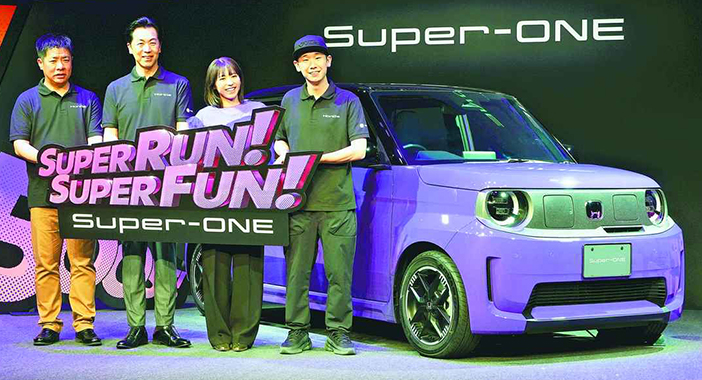
Although the company had only just revised its strategy for promoting EVs overseas in response to declining demand in the North American market, it still plans to expand its line-up in Japan, citing strong demand from customers who use them in their everyday lives. In March, Honda announced that it had canceled development of three EV models scheduled for the U.S. market and said it intended to focus on hybrid vehicles. Meanwhile, in Japan, the company anticipates growing demand for small EVs, including kei cars, to be used for grocery shopping and other everyday tasks. In 2028, Honda plans to launch an EV version of its popular “N-Box” kei car. Preorders for the Super-One have already reached about 7.000 units. In fiscal 2025, Honda sold about 11.100 EVs in Japan. A Honda official in charge of Japan regional operations speaking at a launch event on Thursday, said, “We will make the Japanese EV market and our customers’ daily lives exciting and fun”. +++
+++ Facing intensifying price competition from Chinese automakers in Europe, KIA is betting that a broader electric vehicle lineup and tighter EU rules on Chinese battery supply chains will help narrow the price gap with rivals and lift market share. Kia recently outlined the strategy to investors during non-deal roadshows in Singapore and Hong Kong led by CEO Song Ho-sung. Chinese automakers have accelerated their push into Europe (the world’s second-largest EV market) after effectively being shut out of the US by Washington’s decoupling measures against China. Kia, however, has struggled to strengthen its EV presence in the region. The automaker said its European sales declined for 2 straight years after it phased out the gasoline-powered Ceed hatchback, once a key volume model, to expand EV production. But weaker-than-expected EV demand weighed on the transition. Kia now sees 2026 as a turning point after completing a broader EV line-up, spanning compact to large SUVs, including the EV2, EV4, EV5, EV6 and EV9. Its sales in Western Europe rose 3.2 percent in the January-April period, supported by recovering EV demand and a stronger portfolio of lower-priced electric models. Kia also expects Europe’s tightening industrial policies to weaken Chinese competitors’ cost advantage.“If Europe limits subsidies to EVs equipped with locally produced batteries, Chinese automakers may no longer fully benefit from China’s low-cost manufacturing base and government-backed subsidies”, said Korea Investment & Securities analyst Kim Chang-ho, who joined the roadshows. “That could narrow the price gap between Kia and Chinese EV makers”. The EU is moving to reduce dependence on China-dominated battery supply chains. Under the bloc’s Industrial Accelerator Act, EVs sold in Europe will qualify for incentives from 2027 only if they use locally produced batteries. Kia said a core strategy is achieving price parity between EVs and internal combustion engine vehicles to accelerate mass-market adoption. In Germany’s C-segment SUV market, gasoline vehicles currently sell for around 35.000 euros, while Kia’s EV6 initially sold for 55.000 to 60.000 euros because of low production volumes and high early-stage costs. Kia expects the gap to narrow significantly by 2030, with both gasoline and EV models in the segment projected to converge at around 40.000 euros. The company expects battery costs to fall roughly 30 percent by 2030, from around $130 per kilowatt-hour to below $100, helped by lower raw material prices and internal cost-cutting efforts, including improvements in electric power systems. Kia also said it plans to work strategically with battery suppliers, including LG Energy Solution, Samsung SDI, SK On and CATL, selecting batteries based on vehicle positioning and pricing strategy. +++
+++ MITSUBISHI will launch a new version of its Pajero by the end of this fiscal year, the company said on Friday. The Pajero was once the company’s flagship product, but production for the domestic market ended in 2019. Due to popular demand from long-time fans, the model will be revived for the first time in 7 years. In addition to the standard Pajero, the company also announced plans to add 2 smaller models bearing the Pajero name, creating a series of models. Details regarding the release date and prices will be announced at a later date. +++
+++ NISSAN is considering downsizing its Yokohama Plant. If carried out, it would be the company’s first restructuring of one of its domestic parts plants. Nissan is undergoing a business restructuring, and it has decided to end vehicle production at 7 plants worldwide. The company is aiming to improve its business performance by increasing capacity utilization in line with the restructuring. The Yokohama Plant is the site of the company’s founding. It is a key facility with an annual production capacity of 400.000 to 500.000 units, primarily manufacturing power trains including engines for the Note and the X-Trail. The plant spans 3 districts across Kanagawa Ward and Tsurumi Ward in Yokohama, and the firm is considering downsizing on a district-by-district basis. The downsizing is expected to begin in 2028 or later. The facility will not be closed since Nissan is also proceeding with prototyping all-solid-state batteries for next-generation electric vehicles at the Yokohama Plant. Power trains are also manufactured domestically at the Iwaki Plant in Fukushima Prefecture and at plants operated by subsidiaries. The Yokohama Plant became a candidate for restructuring due to its low operating rate and aging infrastructure, according to sources. The Yokohama Plant began operations in 1935. It covers an area of approximately 540.000 square meters and employed about 3.000 people as of September 2025. Against the backdrop of a global sales slump, Nissan has posted net losses exceeding ¥500 billion for 2 consecutive fiscal years. The company plans to cease production at the Oppama Plant in Yokosuka, Kanagawa Prefecture, and the Shonan Plant (which belongs to Nissan’s subsidiary Nissan Shatai), located in Hiratsuka, Kanagawa Prefecture, by the end of the 2027 fiscal year. As a result, domestic vehicle production capacity is expected to decrease by approximately 400.000 units per year. As part of the restructuring plan, the company will also improve capacity utilization and reduce production costs by downsizing its parts plants. +++
+++ TOYOTA said Thursday its exports from Japan to the Middle East plunged 91.7 percent in April from a year earlier to 2.418 units amid the conflict in the region. Toyota’s global sales fell 3.1 percent to 849.306 vehicles, marking the third consecutive month of decline, while global output rose 2.0 percent to 831.971 units, a record high for the month. Its overall exports from Japan sank 7.0 percent to 166.972 vehicles, marking the second straight month of decline. Overseas sales by the world’s largest automaker by volume dropped 7.5 percent to 699.382 units, with sales in the United States declining 4.6 percent to 222.378 vehicles despite continued solid demand for hybrid vehicles in North America. Sales in the Middle East dipped 33.7 percent to 31.360 vehicles, while those in China saw a 25.4 percent drop to 106.479 cars amid intensifying competition. However, sales in Japan jumped 24.2 percent to 149.924 units, helped by demand from consumers who had held off purchases ahead of the abolition of the environmental performance tax at the end of March. Toyota’s overseas production climbed 3.8 percent to 567.578 cars, also hitting a record high for the month, with output in India surging 38.5 percent to 33.770 units, reflecting increased operating days. Output in North America fell 3.3 percent to 198.098 vehicles, while domestic production edged down 1.7 percent to 264.393 units. Due to prolonged logistical disruptions amid the Middle East crisis, Toyota plans to cut overseas production mainly destined for the region and Asian markets by 83.000 vehicles by around November, according to sources close to the matter. The automaker also slashed production in Japan for exports to the Middle East by around 40.000 units in total in March and April from its earlier plans. Meanwhile, global sales by Japan’s 8 major carmakers, including Toyota, in April fell 1.3 percent from the previous year to 1.94 million vehicles. Sales by struggling Nissan dropped 7.6 percent to 208.663 cars, while those by Honda declined 7.9 percent to 265.215 vehicles. However, Suzuki saw a 20.9 percent rise to 309.237 vehicles, supported by strong sales in India. Global output by the 8 automakers totaled 2.00 million vehicles, up 3.2 percent, while domestic production rose 2.4 percent to 651.159 vehicles. +++