
+++ Picture this: you drop serious cash on a luxury SUV, expecting years of smooth, worry-free driving, only to discover your prized ride is quietly rusting away underneath. That’s the claim of some AUDI (S)Q5 owners and now they’re dragging Audi into court to answer for it. A fresh class-action lawsuit says that Audi Q5 and SQ5 models that were built from 2009 to 2017 have a big problem with their rear subframes; the part that keeps the suspension, drivetrain, and wheels in check. But this isn’t your run-of-the-mill surface rust. Owners claim the corrosion is sneaky, hiding out of sight until it’s already done some serious damage. The whole thing kicked off when a Maryland owner of a Q5 built in 2025 found a nasty surprise during a regular check-up: once the mechanic peeled back the plastic covers on the subframe, there was rust everywhere. The heart of the lawsuit is Audi’s plastic protective covers on the rear subframe, which, according to owners, are doing the exact opposite of protecting anything. Instead of keeping the elements out, these covers apparently trap water, salt and road grime right up against the steel, giving rust a perfect hiding spot and making it nearly impossible for owners or mechanics to spot the problem until it’s too late. The lawsuit says this hidden rust can eat right through the subframe, leaving holes and weakening the structure. Since the subframe is what keeps your suspension and drivetrain together, owners argue that letting the rust go unchecked could turn into a real safety hazard. Plenty of owners have already sounded the alarm, filing complaints with the NHTSA and swapping horror stories on forums. The repair bills aren’t pretty: some owners are staring down costs ranging from a few grand to $10.000, depending on how bad the rust has gotten. To make matters worse, owners say Audi often refused to cover these repairs under warranty, leaving them to foot the bill themselves. What Happens Next? Right now, these are just allegations. Audi still gets its day in court to argue its side. The plaintiffs want this to become a class action, so other Q5 and SQ5 owners can jump in. They say Audi should have known about the rust problem from all the warranty claims, dealer reports and customer complaints piling up. Whether the court buys it is anyone’s guess. These cases can drag on for years and the ending could be anything from a quick dismissal to a big settlement or a drawn-out court battle. In the meantime, expect plenty of Q5 and SQ5 owners (especially in salty, snowy states) to start peeking under their SUVs. If you own one, it might be time for a closer inspection. +++
+++ A successor to the Alpina B5 has arrived in the form of the BOVENSIEPEN 05 GT: – an adapted version of the BMW M5 Touring from the family who founded Alpina but recently sold the naming rights to BMW. The 05 GT comes hot on the heels of the Bovensiepen Zagato, though it is pitched at a less elevated price than the carbon-bodied coupé and demonstrates an easily repeatable format for the brand as it forges a new path. Unlike the limited-edition, M4-based Zagato, the 05 GT involves no fundamental rethinking of the donor car, either in stylistic or mechanical terms. Nonetheless, there are myriad changes that explain the circa €50.000 cost of the conversion, which takes place on site in Buchloe, Germany. Foremost among them is an exterior styling package from the studio of Frank Stephenson, known for his work on the Ferrari F430, the first BMW Mini and McLaren’s P1. The aim has been to tone down the bravura of the regular M5 Touring while reducing the visual heft of the flanks. New bumpers front and rear, as well as fairly involved treatment of the skirts and a trailing rear spoiler, are the notable elements, replete with ‘Bovensiepen’ script at the front. Seen in the metal at a small launch event in Austria, the 05 GT is considerably more subtle than the G90-generation M5 and the only real hints of its hammer-like performance are the quartet of tips for the titanium exhaust from Akrapovic, which saves 8 kg over the standard stainless steel piping. Changes to the driveline are limited to a retune of the 4.4-litre S68 twin-turbo V8, which, along with an optimised air intake and the free-flowing exhaust, raises total output from to 800 hp and 1.100 Nm. The electrical portion of the driveline remains untouched and still provides up to 200 hp and 55 km or so of real-world electric range. Bovensiepen quotes a top speed of more than 305 kph and a 0-100 kph time of “less than” 3.6 seconds. A 2.555 kg kerb weight makes it 5 kg heavier than the regular M5 Touring.
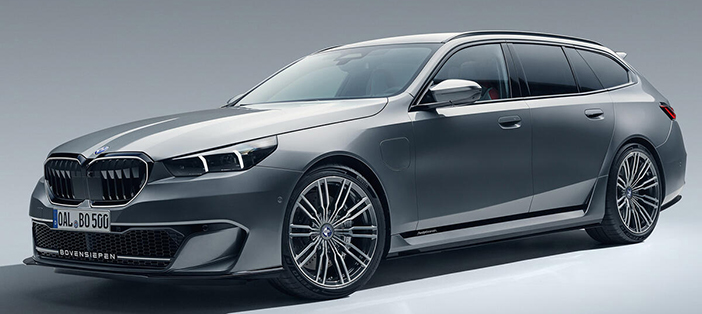
Of more interest to the traditional Alpina buyer (still the kind of customer Bovensiepen is targeting here, with the 05 GT’s blend of monumental speed and supposedly M5-beating comfort) are the suspension modifications. The M5’s M Adaptive dampers have undergone a retune and the 05 GT is also fitted with its own unique Eibach springs, as well as new strut-tower braces. The staggered wheel set-up of the regular M5 is also dispensed with and the Bovensiepen is fitted with 21 inch alloys (with milled spokes) all round. ‘BOV’-marked tyres, bespoke from Pirelli, complete the package. Inside, the 05 GT is as per the M5, albeit with almost limitless customisation potential in terms of leather and stitching colours, the use of Alcantara and even custom embossing of the headrests. It is the labour-intensive nature of this work that will limit production at the historical Buchloe factory to no more than 100 units annually, all of them Tourings for the time being. First deliveries are scheduled for the end of the year, with prices starting at €198.900 in Germany before options such as Lavalina leather. The car seen here is optioned to around €215.000. +++
+++ Parent company Stellantis intends to maintain distance between its dedicated passenger cars and light commercial vehicles (LCVs). The future CITROEN BERLINGO , therefore, will sit on a different platform, and pave the way for a whole family of small to mid-size vans for Citroen, Peugeot, Fiat and more. “Berlingo and ELO – I think these are 2 different kinds of vehicle”, Citroen CEO Xavier Chardon told me. “In the past we had the Berlingo on one side, but we also had the Picasso family on the other. The Berlingo is even more down to earth in terms of simplicity, and you need to have a much, much bigger boot. So we believe there is space for 2 different kinds of vehicle in our future line-up, especially as one is also derived from a van that we actually need in our line-up”, he said. Separately, Andrew Cowell, Stellantis LCV head of design, told me: “The Berlingo is becoming much more of an international product and that’s where we have to evolve. The recipe is there; in the future it will become much more relevant; people will start to turn back to what the old Berlingo was all about; I think we’ll go back to those ideas”. Asked why Citroen thinks there’s room for a range of conventional practical boxy, Van-derived MPVs when the entire market seems to be moving to SUVs, Cowell said: “The SUV is becoming difficult as a product in certain marketplaces; laws and regulations will push us in different directions. I think most people think they know what they want to do: as soon as they have kids, they switch. They become their parents. When you get to a certain age, you start to appreciate that cycle”. Design-wise, I expect the next Berlingo’s shape and overall form to stick closely to the existing model’s, with an updated look to bring it in line with Citroen’s SUVs, as well as the production-ready ELO. Some things are non-negotiable. Items like the “front door graphic” have evolved over the various generations, while the “little kick on the D-pillar is always there”, Cowell said, adding: “These are little elements that get carried across that anchor it with the original”. The Van and its passenger variant are very important for the firm: “We have 30 years of success with Berlingo, both on the MPV and LCV side, so we’d be foolish to stop this”, Chardon said. “So we continue; clearly you cannot fool customers that have trusted the model for 30 years, so you need to offer versatility, volume and the roominess. For me, it’s a car that is absolutely embedded in this ‘more for less’ philosophy that we want to expand”. The Berlingo’s ability to transcend time (the first generation was on sale for 12 years, while the second lasted a decade) means the third generation still has time left to run. The successor isn’t expected before 2030. Again, a multi-fuel strategy is key to the car’s success: “There’s still a market for the diesel engine because of the torque; they’re carrying a lot of weight because of the way customers use it”. Cowell told me. “Then, if you want to go in and out of towns, they also require the electric version. So at the moment, with the rules we have, the multi-energy solution is much better”, he added. +++
+++ Specifications for the new DENZA Z have been disclosed in Chinese regulatory filings, revealing the electric supercar will pack a huge 1.600 hp. The 2+2 roadster was previously revealed at the Beijing motor show as the BYD-owned luxury brand’s new flagship. Denza has said it will be capable of sprinting from 0-100 kph in less than 2.0 seconds (as fast as the Rimac Nevera) and its top speed has now been revealed as 350 kph. The Z weighs 2.650 kg in soft-top form or 2.580 kg with a metal roof.
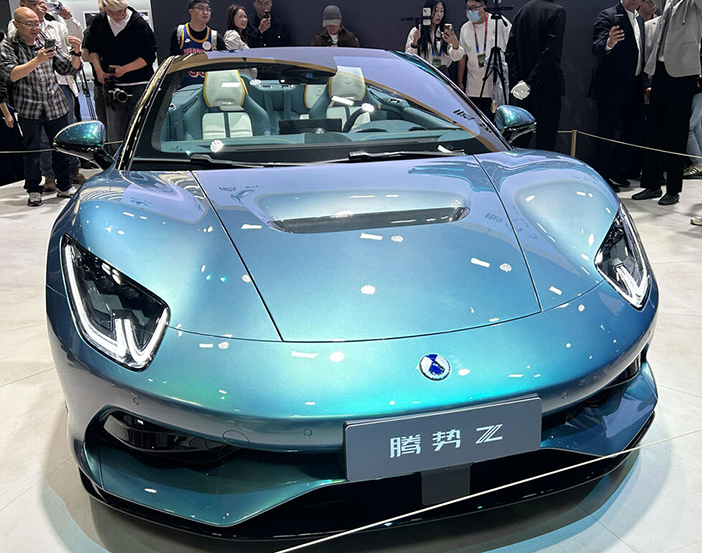
It will also be offered with a sporting package that adds a large rear spoiler and boosts the top speed from the standard 300 kph to its full potential. Shaped by BYD’s chief designer Wolfgang Egger (whose previous works include the Alfa Romeo 8C Competizione), the Z remains true to the concept car that was shown in last year with smooth surfacing and a cab-forward silhouette. Inside the show car’s brightly decorated cabin, with turquoise and yellow upholstery, it departs from BYD convention in gaining a smattering of physical controls on the dash and squared-off steering wheel, including what look to be drive mode and suspension adjustment functions. Exposed carbonfibre in the centre console and in the backs of the bucket seats further nod to the Z’s sporting remit.
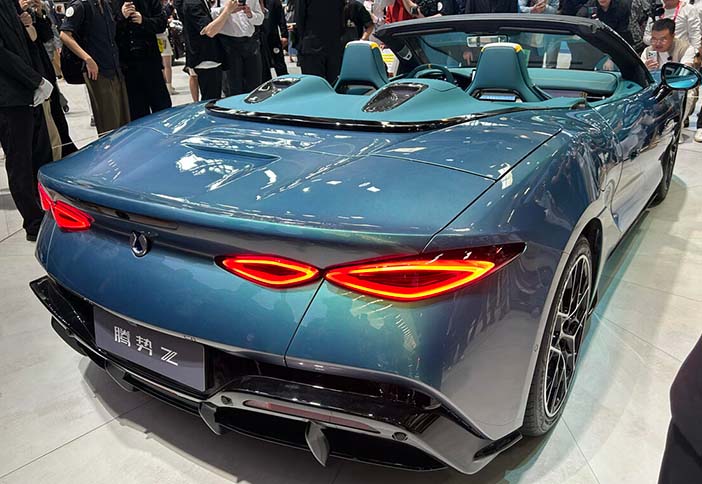
Unusually, Denza will launch the Z first in Europe, as it aims to establish a foothold for its fledgling premium brand in a market historically dominated by the British and German stalwarts, before starting sales in its home market. The Z is powered by 3 electric motors (2 on the rear axle, 1 up front). It is also equipped with a steer-by-wire system and the same ‘DiSus-M’ magnetorheological suspension as the wild Yangwang U9 hypercar. This will give the 4-seater the same predictive damping technology that primes the chassis for upcoming changes in the road surface, but it’s unconfirmed whether it will be able to jump into the air on command, like the U9. Denza has yet to give a steer on pricing, but the Z’s closest rival on paper would be the Maserati Granturismo Folgore, which starts at around €199.300 in The Netherlands. The brand could look to undercut the established competition with its new super-GT, but it will naturally cost significantly more than the new Denza Z9 GT, which is tipped to start at around €110.000 when it lands in the next few months. +++
++ A couple of weeks ago, a senior FORD executive hinted at the possibility of a Mustang sedan and now I’m going to explain why I think it must be electric to succeed. The executive in question was Andrew Frick, president of Ford Blue and Model e, and his comments included noting that sedans still have appeal to some buyers. But he also said that for the Blue Oval to do a sedan, it would “have to make sense within our portfolio”. He added that any expansion of the family has to be “very cost-effective”. While the prospect of a rear-drive four-door with a V8 is certainly enticing, such a thing would be expensive and have narrower appeal than an EV, and Ford has been hinting at an electric sedan for some time now. The signs that Ford will launch an electric sedan are numerous, including hints from CEO Jim Farley. When announcing five new vehicles under $40,000, Ford said that the platform beneath these new products, the Universal EV Platform, would underpin “cars, trucks, SUVs, Vans and multi-energy powertrains”. That means that whatever sedan Ford is planning is unlikely to share architecture with the S650 Mustang coupe. It also implies that the new Ford sedan will be built around diverse powertrain options shared with numerous other models in the portfolio. This makes a V8 less likely, especially if pricing is to be attractive, though not impossible. Ford needs a Mustang sedan to be “very cost-effective” and while there are no doubt parts of the S650 that could be applied to a sedan, a lot of reengineering would surely be required to make that work; engineering that is unlikely to be applied to anything else in the portfolio. With a new platform and the use of electric power, Ford could apply learnings from the Mach-E in a vastly more efficient manner. Also, Ford’s application to trademark the name ‘Mach 4’ could be construed as a hint that the Mustang sedan would be part of the same family as the Mach-E. Granted, the Universal EV Platform’s ability to accommodate “multi-energy” means that a combustion-only or hybrid powertrain is possible, but a V8? That sounds highly challenging for under $40k when a Coyote engine alone retails for 5 figures. On the other hand, an all-new platform can unlock cost efficiencies that are not possible when repurposing existing architecture. The biggest clues that a Mustang sedan would have electric power have been from CEO Jim Farley, who has repeatedly noted how “the sedan silhouette turns out to be very clean aerodynamically”; a boon for range-chasing EVs. In a video shot during Monterey Car Week last August, Farley asked, “Should Ford do a rear-wheel-drive, high-performance, affordable sedan, with a really cool closure system in the back so you can carry a lot of stuff, as an all-electric vehicle with incredible performance?” He added that this description is how he thinks about a new Ford sedan. High-performance? Rear-drive? That sure sounds like a Mustang. A cool closure system in the back? That sounds like a liftback, similar to the Audi A5, and it again calls to mind the practical nature of the Mustang Mach-E. To recap, Ford wants to offer sedans at an attractive price point. It wants them to be efficient and practical. It wants them to be built on a new platform. And it wants them to be profitable, unlike the Fusion, which was a European Mondeo that had to be updated to American standards, causing Ford to lose money. Conversely, an electric Mustang sedan could also be sold in Europe, where stricter emissions controls make a V8 difficult. All of these factors mean that a V8 Mustang sedan is not only improbable but arguably financially irresponsible, especially compared with an electrified vehicle that can share multiple components with other models. Time will tell, but I’m calling it now: the Mustang sedan will not have a V8. Not for less than $40k. +++
+++ A fresh MERCEDES-AMG GLE 63 S has been revealed, the first of a new generation of models that feature a brand-new high-performance V8 engine. Joining the recently updated Mercedes GLE range, it’ll be available in this SUV bodystyle and a sleeker Coupé variant. Much of the GLE 63’s styling and tech upgrades have been brought over from the wider range, but the big news is the V8 engine. Even with a need to pass tough new Euro 7 emissions regulations, power and torque is on-par with the previous generation, producing 612 hp and 850 Nm of torque. To do this, the AMG’s V8 has undergone some pretty major technical changes, not least a controversial switch to a flat-plane crankshaft design. Despite the appreciative gains in efficiency and smoothness, though, these crankshafts often remove some of the character that’s fundamental to any AMG V-engined model, as was found with the first AMG with such a motor, the more experimental AMG GT Black Series. However, the brand is confident that it has developed new technology for the engine and its subsidiary parts to ensure that the burbly V8 exhaust noise has been retained. At 4.0 litres, its capacity is the same as before, but as well as the new crank, and a fresh firing order to go with it, the entire injection, intake and exhaust systems have been redesigned. There’s also a new camshaft on the intake side, a new compressor and housing for the turbos, plus a redesigned exhaust system that now features an exhaust-particulate filter on all markets, not just those in Europe. Like before, the engine is connected to a 48V mild-hybrid system, which incorporates an integrated starter-generator that produces a further 23 hp and 205 Nm of torque. As well as extending the start-stop functionality, this set-up is also able to torque-fill the lower end of the rev-range to improve initial throttle response. Power is then sent to all four wheels through AMG’s 9-speed automatic transmission. To keep everything in check, AMG has beefed up the drivetrain with new driveshafts and bigger brakes all round. All GLE 63 S models feature air-suspension, with further support coming from an active anti-roll system. Models in most markets will be available with 21 and 22-inch wheel options.
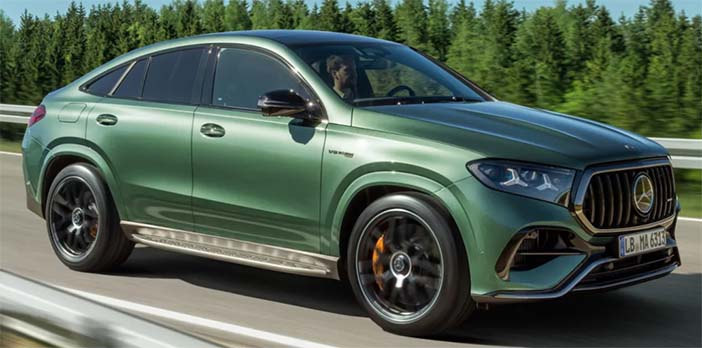
The newcomer’s other updates carry across from the revised GLE range. The more assertive nose features an even bigger grille, only now it has to compete for attention with the new headlights that integrate two star graphics inside them. The back includes the same black rear bar that now connects the lights, and the AMG’s typical oblong exhaust pipes and rear spoiler remain, too. Inside, the remodelled dashboard and fresh user interface have been given the AMG treatment, with more figure-hugging seats and a new steering wheel. It might look similar to the previous car, but the 2 satellite controls that control the car’s dynamic functions have fresh displays and look sharper and are of a higher quality. There’s also the introduction of scroll wheels on the steering wheel’s upper spokes, much to the delight of existing Mercedes customers. As before, the GLE 63 S will be available in an SUV or Coupé body style, the latter having a more dynamic silhouette … and compromised rear headroom to go with it. A 7-seater GLS 63 will also be launched as well. +++
+++ If you seek to identify the companies that are rising, falling, diversifying, redeeming themselves or in danger of disappearing, you’re currently spoilt for choice. On 1 June, MG announced its return to Europe as a manufacturer. Disappointingly, it’s opting for Spain, not Britain, where it has all but died as a producer. But since MG’s adoption by an Asian parent company (SAIC) resulted in the brand being put through a highly successful rebirth, rehabilitation and redemption process, it’s been left in rude health. Can the same be said of former big sister Jaguar, which, while also under Asian parentage (Tata), has been more in regret, retreat and official “reimagine” mode in recent years? I’m only asking. Although MG couldn’t be tempted to go back to its production roots in the UK and many fans of British cars worry that Jag showrooms have remained scarily empty and hauntingly echoey for too long, as they await the arrival of the €135.000 Type 01, other people will be ecstatically happy about some other aspects of UK automotive life. None more than Nissan finally has confirmed on 3 June what Autointernationaal.nl has, via this Newsflash, been hinting at for months: the Japanese firm is in deep, highly positive discussions with Chery in the hope and expectation that the Chinese company will soon see its own vehicles rolling off 1 of the 2 lines at Nissan’s Sunderland factory. Currently, this plant is massively underutilised. So upping productivity levels is a must, not least to safeguard the jobs of existing workers, in addition to creating fresh employment opportunities for others in and around the region. What we have here is a great, almost genius coming together of Japan and China on British soil, thereby creating one of the most unlikely but diverse vehicle-making facilities in Europe. Who’d have thought it? The very real prospect of Nissan’s plant being used to build Cherys in a Britain where consumers are already buying just-arrived Chery vehicles from overseas in surprisingly large numbers. The company has only been selling its models here for a few months. But industry figures published on 4 June revealed that the brand outsold Citroen, Dacia, Fiat, Jeep, Lexus, Fiat, Honda, Mazda, Polestar, Seat, Suzuki, Tesla and several other British and foreign marques in May. All this before Chery production begins here, probably within months, not years. +++
+++ PEUGEOT is plotting a new range of Le Mans edition cars with sportier design and performance, as it goes all in on excitement at the 2026 Le Mans 24 Hours race. First the lion brand unveiled the new e-208 GTi with 281 hp, then it announced its intention to return next year with Le Mans editions of for four big-sellers in its portfolio. “We plan to launch a limited edition Peugeot 24 Hours of Le Mans”, said head of product Agnes Tesson Faget. “These cars will come with a specific design, which will elevate their French charisma and make it possible for our customers to experience the Le Mans spirit with Peugeot”. Faget confirmed that the 308, the 408 and the 3008 / 5008 SUVs would all get the Le Mans treatment Marketing chief Phil York was asked about the Le Mans recipe. “When we launched GTI, we said we wouldn’t do it unless it really delivered on that GTi promise.
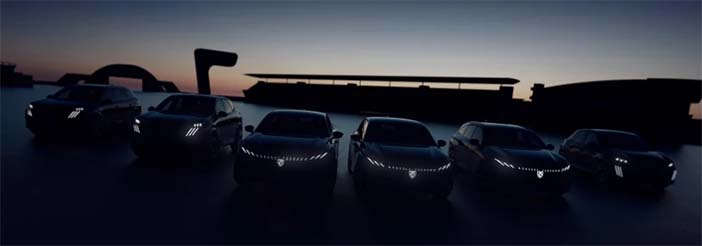
Now we’re defining what the Le Mans promise is. It’s a different package for sure, but it’s an opportunity to make sure that we bring some real value to the customer”. The Le Mans editions are shaping up to be luxurious, highly specced cars with Le Mans branding, sportier touches inside and out, ideally unique colours and higher-performance powertrains. “We won’t make it design only, it has to be the full package”, Ms Faget told. “We want technology!” That suggests punchy electric power won’t be excluded from this new generation of Le Mans cars. She elaborated on the product pillars that will underpin the GTi-light models. “Le Mans and Peugeot share the same values: technological innovation, endurance and French prestige”. And there’s a precedent for pumped-up Peugeots inspired by Le Mans: the 306 got the same treatment back in 1993. It was released to celebrate the Peugeot 905 Evo 1B’s victory in the 24 Hours race. It ran the upgraded 2.0-litre 16-valve engine shared with the S16, producing around 160 hp, and the cars got unique paint such as Lucifer Red and upholstery upgrades. Peugeot produced 400 of the special editions, aimed at the European market. Let’s just hope we don’t have to wait for Peugeot to win the 24 Hours to get these specials: the 9X8 hypercar was one of the first cars eliminated in qualifying. +++