
+++ Automakers from CHINA are shaking up the European market, shedding their image as “low-cost fringe players” in the birthplace of automobiles. Armed with advanced features and cost-effectiveness, Chinese brands have surpassed Japanese automakers in sales for the first time in May, overcoming high tariff barriers. As Europe accelerates its shift to eco-friendly vehicles, Chinese automakers are swiftly filling the gap left by Japanese rivals, who lag in electrification. According to the European Automobile Manufacturers’ Association (ACEA), the combined sales of 5 Chinese automakers (SAIC, BYD, Geely Group, Chery Automobile and Li Auto) in 31 major European countries reached 138.410 units in May. This gave Chinese brands a 12.0% market share, surpassing Japanese brands, which sold 134.240 units (11.3%). South Korean brands followed with 80.644 units (7.5%). This marks the first time Chinese automakers have overtaken Japanese rivals to rank below European local brands in monthly sales; a dramatic shift within 3–4 years of their full-scale entry into Europe. The surge in Chinese market share is driven by an increase in the number of Chinese automakers officially recognized by ACEA, which expanded to 5 in April, adding the Geely Group, Chery Automobile and Li Auto to SAIC and BYD. Volvo, previously counted separately, was integrated under Geely Group. Even accounting for this, Chinese brands’ growth remains dominant. In May, Geely Group sold 38.145 units, BYD 32.380, SAIC 30.527, Chery Automobile 27.412 and Li Auto 9.945. BYD and Chery Automobile recorded explosive year-on-year growth of 136.6% and 244.1%, respectively. BYD’s plug-in hybrid (PHEV) midsize SUV (the ‘Seal U DM-i) and Chery’s PHEV Jaecoo 7 (dubbed the “Temu version of a Range Rover in the UK market) have driven this surge. BYD’s sales alone nearly caught up with Hyundai’s 37.062 units. China’s automotive surge stems from high oil prices and shifting European subsidy policies. Sales of pure electric vehicles (EVs) in Europe rose 31.2% to 1.247.545 units, while PHEVs increased 25.0% to 594.439 units. As Germany revived EV subsidies and Italy expanded support amid economic slowdown, Chinese automakers (leaders in electrification) benefited. Despite the EU imposing tariffs of up to 45.3% on Chinese EVs, their cost competitiveness has proven unshakable. For instance, BYD’s small ‘Dolphin Surf Boost’, subject to a 27% tariff, retails for 26.990 euros in Germany but is discounted to 15.940 euros via promotions; less than half the price of the Renault 5 E-Tech (28.000 euros). Chinese automakers also leveraged PHEVs, which face lower tariffs. Chery’s ‘Jaecoo 7 PHEV’ undercuts Kia’s Sportage PHEV by approximately 4.500 euros. +++
+++ GENESIS is open to launching smaller electric cars in the future as it continues to expand its range. For now, its smallest is the 4.5 meter-long GV60 crossover, which leaves plenty of room below it. Genesis has experimented with a smaller model in the past with the Mint concept in 2019. Now it’s investigating future segments that it could enter in order to expand its customer base, said Genesis Europe MD Peter Kronschnabl. When asked specifically whether that means smaller models, particularly at a time when parent brand Hyundai is about to launch a smaller mainstream EV of its own in the Ioniq 3, Kronschnabl said: “We’re evaluating this still but have nothing to confirm. For sure, for a brand that is evolving, we need to look at fast-growing segments where we might need to be present in order to nurture customers”. Any segment that Genesis enters will need to have long-term and sustainable growth potential, though: the brand won’t go chasing short-term opportunities. “There are some niches”, said Kronschnabl. “For instance, there’s not a real premium pick-up truck. But is that a segment you should enter? So there are segments where maybe there is white space but they don’t make sense for us. You need to be very careful when you look into this white space and not just go there because you believe there is a short-term opportunity”. Asked if that means all decisions are taken with a long-term view, Kronschnabl said the Genesis project is “a marathon not a sprint. We have to have the right products in order to continuously grow the brand. Therefore the long term is more important than the medium term”. +++
+++ There’s no getting around the reality that new-car buyers in the United States face. The average price of a new car in America is consistently hovering around $50,000. That’s becoming much, much harder to manage for the average American. That said, there’s still some good news in the latest inventory data. A quarter of most dealer lots feature cars that are $35,000 or less, and a third of the lot is $40,000 or less. According to Cox Automotive’s latest Auto Live Market View report, dealers ended June with 2.82 million new vehicles in stock. Inventory was down 2.4 percent from May but was largely unchanged from a year earlier. The average listing price increased to $49.336, up 1.4 percent from June 2025 and 0.3 percent from the revised-lower May figure. On its face, that’s another reminder of how expensive new vehicles have become.
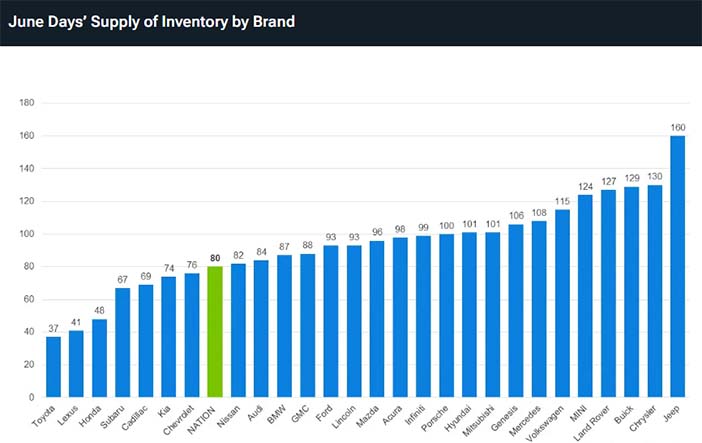
But averages can be deceptive, especially in a market where 6-figure luxury SUVs, heavy-duty pickups and premium EVs can skew the numbers upward. The more telling statistic is where inventory is actually concentrated. Nearly one-quarter of all new vehicles available in June, more than 688.000 units, were priced between $30.000 and $40.000. Within that group, the average listing price was $35,377 and those vehicles carried a 70-day supply, well below the industry average. That bracket also accounted for 28 percent of June sales, meaning it moved at a faster pace than it was stocked. Expand the range slightly, and roughly 34 percent of all new vehicles on dealer lots were priced below $40,000. That suggests the oft-repeated “$50,000 average new car” doesn’t accurately describe what many shoppers will find when they walk onto a dealer lot. Instead, it reflects how the industry’s growing mix of premium pick-up trucks, luxury SUVs and high-end EVs continues to pull the average upward. Inventory also remains highly uneven depending on the badge. Toyota went into July with the tightest supply of any brand at 37 days, with Lexus at 41 and Honda at 48 right behind. Subaru (67) and Cadillac (69) also sat under the 80-day national average, along with Kia at 74 and Chevrolet at 76. Stellantis occupies the other end of the chart, where Jeep, Ram, and Dodge all carry more than twice the industry figure. JEEP is the extreme case at 160 days, the worst on the board. Brands buried that deep usually start writing checks to dig out, but Jeep’s incentives came in at 6.7 percent of the stickerprice in June, under the 7 percent industry average. Essentially, the brand with the most unsold metal in the country is discounting less than rivals with a fraction of the problem. Walk into a Jeep dealership expecting to name your price and you’ll probably leave disappointed. Despite persistent concerns over affordability, inflation and geopolitical uncertainty, the broader new-car market has remained remarkably steady this year. Inventories have stayed balanced, sales continue at a healthy pace, and while the average transaction price may be flirting with $50.000, the data suggests there’s still a real supply of new vehicles available for buyers shopping much closer to the mid-$30,000 range. +++
+++ MARUTI SUZUKI ’s market share has dropped to approximately 39% as Indian buyers increasingly prioritize premium features and SUVs over entry-level hatchbacks. The shift poses a strategic challenge for the automaker, which historically relied on a low-cost, fuel-efficient model to maintain dominance. Investors are now tracking the company’s ability to pivot toward higher-value products to reclaim market share from rivals like Tata Motors and Mahindra. Maruti Suzuki, the long-standing leader of the Indian passenger vehicle segment, is facing a significant change in its market position. Once holding a market share that reached as high as 80% during its peak, the company’s share of new car sales has now moderated to approximately 39%. This evolution reflects a broader transformation in the Indian automotive market, where the consumer preference is moving rapidly away from budget-friendly, small hatchbacks toward more sophisticated SUVs and vehicles equipped with premium technology. For decades, the company’s business model was built on the foundation of high-volume, low-cost vehicles that offered excellent fuel efficiency. However, the rise of a more affluent middle class has altered buying patterns. Competitors such as Tata Motors and Mahindra capitalized on this trend by introducing feature-rich SUVs earlier than Maruti Suzuki. According to recent industry reports, these 2 rivals have seen their combined market influence grow significantly, with each now capturing approx. 14% of the market. This shift has forced a reassessment of product strategy within Maruti Suzuki. Internal discussions have highlighted a transition in decision-making, with the company moving to empower local teams to better align vehicle offerings with Indian customer preferences. This includes a departure from a strictly cost-centric approach that previously limited the inclusion of features like sunroofs, advanced connectivity and large display systems in its mass-market models. Despite the decline in market share, Maruti Suzuki’s financial trajectory has remained robust in absolute terms. Over the past 5 years, the company has seen its revenue double and profits triple, supported by its strong distribution network and high service penetration. However, the company is currently contending with the CEO’s stated objective of maintaining a 50% market share, a target that remains under pressure due to the cooling demand for small, entry-level cars. To address this, Maruti Suzuki has announced a roadmap to introduce 7 new SUV models by 2030. These vehicles are expected to incorporate modern driver-assistance systems and higher-spec interiors to appeal to younger, more affluent buyers. The challenge for the company lies in its product mix; currently, less than 3% of its sales originate from the premium segment priced above $15,500, a stark contrast to the wider industry, where this segment accounts for over 21% of total sales. Moving forward, the primary factor for investors to track is the successful execution of the company’s premium product strategy. While the company is scaling its research and development efforts, the speed of its SUV rollout and its ability to compete against rivals in the feature-heavy segment will be critical. Furthermore, monitoring the profit margin impact of transitioning from a low-cost model to a more technologically complex, higher-value product mix will be essential for assessing long-term financial health. +++
+++ Now that Mercedes-Benz has updated its 3-row GLS SUV, the automaker is ready to reveal the new MAYBACH variant. This GLS 680 will go on sale later this year, featuring a refreshed exterior, a more powerful engine and a revamped cabin. Under the hood is Mercedes’ latest twin-turbocharged 4.0-liter V8, the M1770 Evo, which now produces 612 horsepower and 850 Nm of torque. That’s an increase of 54 hp and 20 Nm over the outgoing model. The V8 is electrified with a second-generation starter generator. Mercedes revised the GLS’s steering system, and the Maybach comes standard with the Airmatic air suspension. Buyers will be able to opt for the automaker’s new E-Active Body Control, which actively controls spring and damper forces to counteract roll, pitch and lift. The 2027 Maybach GLS has an all-new front end that features an illuminated grille surround. It also has an illuminated Maybach grille badge and an illuminated standing Mercedes-Benz Star; both are a first for the automaker. The standard wheels are 22 inches with a 20-hole design. Optional 23-inch forged wheels feature a precision ball-bearing mechanism that keeps the wheel’s star logo vertically aligned.
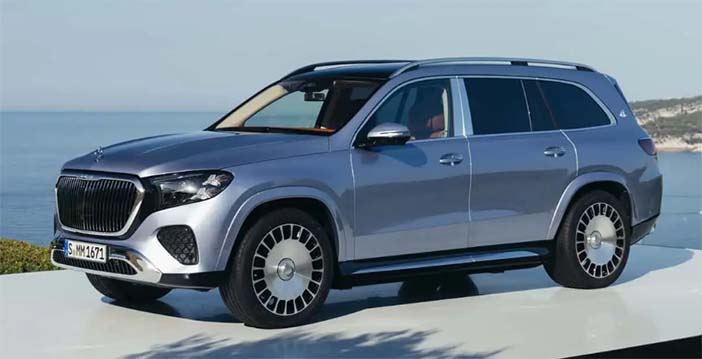
Inside, like the standard GLS, the Maybach features the MBUX Superscreen, the automaker’s triple-display setup, and comes with the automaker’s latest infotainment software. It has Rose Gold dials, illuminated outer climate control air vents, and improved massaging functionality for first- and second-row passengers. The SUV comes standard with an enhanced Burmester 3D Surround System with Dolby Atmos. The audio system now has two additional speakers, for 15 total, and a more powerful 710-watt amplifier. The 2027 Mercedes-Maybach GLS 680 will begin arriving at dealerships later this year. Mercedes did not reveal pricing for the updated Maybach GLS. +++
+++ PEUGEOT will keep the current 208 supermini on sale with petrol power well into the future, with CEO Alain Favey confirming the new electric e-208 will be sold alongside the ICE car rather than as a replacement for it. “We will continue to offer the 208 in its current form to cover the part of the market that will still not be EV and will still require some ICE or hybrid solutions”, he said. “We will have these on the existing 208 as long as there will be demand”. The current 208 is offered with a choice of 2 mildly hybridised petrol engines and the new pure-petrol Turbo 100 1.2-litre triple, which has just been added to the options list. Favey suggested these powertrain options will continue to be offered past 2030 to cater to the remaining portion of supermini buyers not ready to go electric, but he said Peugeot does “not expect this demand to be very strong”. He added: “We believe that BEV demand will grow very, very strongly. We believe there will be continued growth for BEV demand in the coming years, which is definitely where our focus is going to be and that’s why, for us, the launch of the new e-208 is the most important event in the B-segment”. Even if it is fundamentally unchanged underneath, the current 208 is likely to be extensively updated cosmetically inside and out to bring it in line with its new electric sibling and keep it fresh as the model passes its 7th birthday. +++
+++ SMART is putting the finishing touches on the new #2 ahead of its unveiling at October’s Paris motor show. The replacement for Smart’s signature model, the Fortwo, marks the brand’s return to its roots after launching a range of electric crossovers, including the #5, its largest model yet. Due in dealerships next year, it has been designed to offer what Smart calls “uncompromised urban capability”. The 2-seater is based on a bespoke ‘Electric Compact Arcitechture’ developed by Geely. The Chinese company co-owns the Smart brand with its original founder Mercedes-Benz, which took the lead on the #2’s design. Full details remain under wraps until the Paris motor show, but Smart has confirmed the new EV will offer a range of 300 km and be capable of charging its battery from 10-80% in less than 20 minutes. It will also have vehicle-to-load capability, allowing its battery to power external devices. New images of a #2 prototype in tests showcase a strong similarity to the concept car that was shown earlier this year, retaining its “wheels-at-the-corners” stance and ultra-compact footprint. This will give it a turning circle of just 6.95 meter. At just 2.792 mm long, the concept was only around 100 mm longer than the previous Fortwo, so it will reclaim its position as the shortest electric car on sale, undercutting the Fiat 500e by almost a metre. Anything smaller, like the Citroën Ami or Micro Microlino, officially fits into the quadricycle category. Smart said the new #2 will move its entry-level model upmarket while “brilliantly maximising interior space” within its compact dimensions; a product of moving onto a bespoke EV architecture, as the old electric Fortwo was based on an ICE car platform. The Concept #2 “elevates the city car beyond mere utility” according to Smart and while it hasn’t yet revealed the cabin in full, it promises to be much plusher and more luxuriously appointed than the sparsely furnished original.
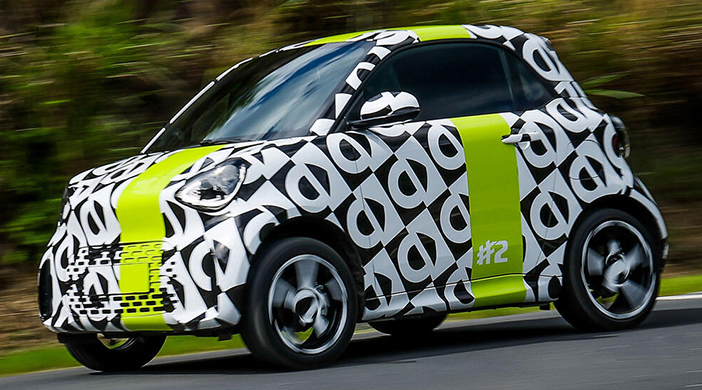
It will still be minimalist, in keeping with an exterior design that’s been “reduced to its essence”, but liberal use of leather, translucent surfacing and two-tone gold paintwork will help to cultivate more of a premium aesthetic. Notably, will it swap traditional front seats for a bench which, Smart claims, frees up additional interior space. Kai Sieber, head of Smart design at Mercedes, said the concept demonstrates the company’s vision that “a city car should do more than solve challenges: it should spark joy”. He continued: “Carrying the heritage of the Fortwo’s iconic design, the Concept #2 translates our bold personality into a new era where function becomes fashion. It is not only about clever practicality but serves as a true extension of personal identity”. Smart has given no indication of pricing ahead of next year’s scheduled launch, but the more luxurious cockpit and vastly superior technical attributes mean the #2 could command a premium over its short-legged predecessor, which cost around €25.000 when it was discontinued in 2024. There’s no word yet on whether Smart plans to stretch the #2 and add a back seat to create a successor to the Forfour, but such a model would give the brand a footprint in the increasingly competitive electric supermini market, where it could take on the likes of the Renault 5, Citroën C3 and next Fiat Pandina. +++