
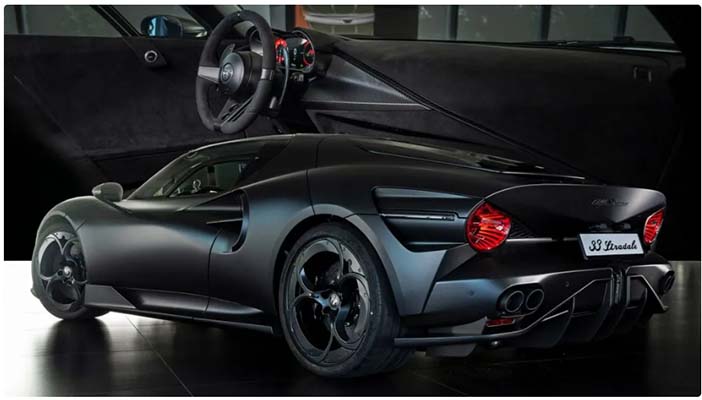
+++ ALFA ROMEO will be launching a new concept car at the Paris Motor Show, but before the big reveal they unleased a special model. The 33 Stradale Perla Nera is a one-off blacked-out spec of the limited production supercar created by the Bottegafuoriserie division. Cristiano Fiorio, General Manager of the Bottegafuoriserie division for Alfa Romeo and Maserati said that “every detail” of the 33 Stradale Perla Nera was “developed together with its owner”. The company didn’t reveal the name of the owner who is described as ”a passionate Alfa Romeo collector and profound connoisseur of the automotive world”.
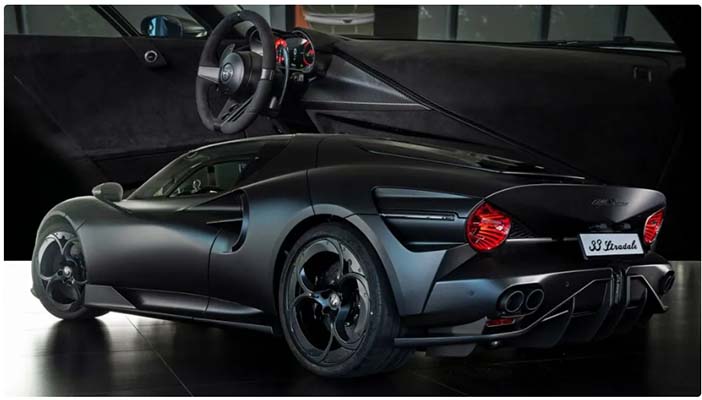
The same individual is the one who chose and registered the Perla Nera moniker. Visually, the highlight is the matte black finish on the exposed carbon fiber bodywork, combined with black three-spoke wheels and matching brake calipers. According to Alfa Romeo, the carbon fiber was laid by hand within the mould, ensuring that its weave follows the contours of the Italian exotic.
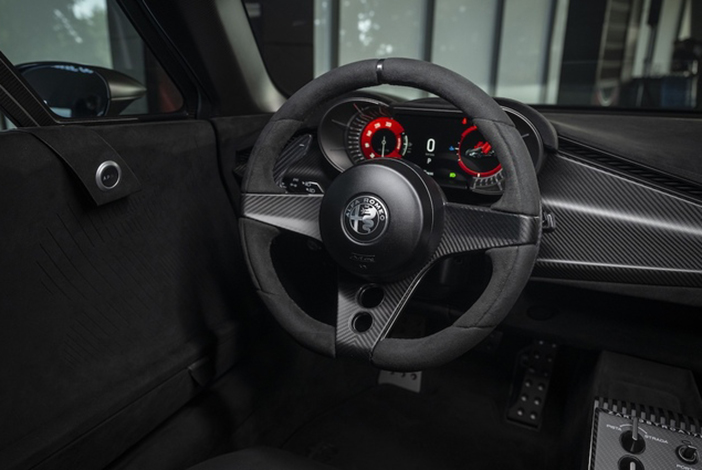
The interior is consistent with the blacked-out theme, combining exposed carbon fiber with full Alcantara upholstery. The cabin features a pair of bespoke sports seats which have been redesigned to meet comfort and performance requirements of the owner’s physique “through dedicated fitting sessions and consultations”. Other custom details include the “cannelloni” pattern on the door cards and door sills, the Quadrifoglio and Autodelta symbols, and the owner’s initials on the Alfa rotary selector. The Perla Nera logo appears on various places around the cabin including the storage compartment mounted on the rear wall which also features the 03/33 numbering. The same number can be found on the custom luggage set which is also wrapped in Alcantara.
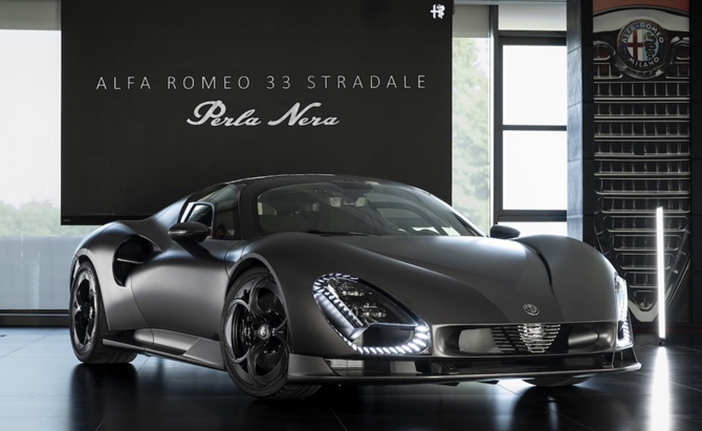
The mid-engined supercar is sharing its carbon fiber monocoque and H-frame aluminium chassis with the Maserati MC20 and the facelifted MCPura. The same applies to the twin-turbo V6 engine which is good for 629 hp, sending power to the rear wheels via an 8-speed dual-clutch gearbox. +++
+++ Is the market’s insatiable appetite for SUVs finally starting to dwindle? CITROEN certainly hopes so, as it prepares a counter-attack in the form of a brand-new successor to the iconic C4 Picasso: a spacious, design-led 35.000 euro MPV based on the ELO concept first shown at the Brussels Motor Show in January this year. Marking the start of a new era of versatile family cars for the brand, the MPV will sit alongside Citroen’s ever-expanding range of Aircross SUVs. Expected to offer a choice of 5- and 7-seat layouts, the future Picasso (or more likely, SpaceTourer) will put practicality first, with a spacious cabin and plenty of clever storage solutions. Citroen’s CEO, Xavier Chardon, told me earlier this year that he and his team are “working on the future of the MPV”, and that the ELO concept is “a good inspiration” for what’s to come. Changes will be necessary to productionise the innovative, future-gazing MPV, including removal of the concept’s quirky interior layout, which featured a McLaren F1-style central driving position, with an offset seat on either side. This will be swapped for a traditional dashboard arrangement. Citroen has been experimenting with colours, materials and textures in its recent models, so expect some bright flashes and innovative design flourishes for the production car. But the ELO’s slim infotainment system that runs the entire width of the cabin (not dissimilar to the BMW iX3’s Panoramic Vision iDrive display) will probably make way for a conventional central screen, possibly with a head-up display to complement the digital instrument cluster. You can almost certainly discount any chance of a supplementary screen folding down from the roof, too. “I don’t believe every customer is looking at more and more technology”, Chardon told me. “That’s why in current and future Citroens you won’t see multiple screens everywhere. This is not our territory”. Behind the ELO’s funky front row was a rear bench seat that folded flat for added versatility. Depending on the car’s length, Citroen could look to add a pair of folding chairs in the boot. As before, the maker may choose to offer differing body lengths, with a longer wheelbase for the 7-seat Grand version. Pierre LeClercq, who has been the head of design at Citroen since 2018, told us previously that “interior design, ergonomics and functionality are so, so important”. He said: “The customer has to be in the centre of all this. If we do a feature that is unusable, let’s not do it. We’re doing what we do really well”. The future Picasso successor will double down on this idea of usefulness, with LeClercq insisting that design flair cannot come at the expense of functionality. “Where do you put your phone? How do you read your information?” he asked. “Whether you’re a tall person or a short person, you have to make sure you use every square centimetre perfectly”. The price point of 35.000 euro would position the future MPV as a more family-focused alternative to the C5 Aircross, possibly handing it the SpaceTourer moniker; ‘Picasso’ was dropped in 2018 at the end of the licensing agreement and presumably deemed too expensive to renew. Given the expansion of the Aircross line-up, if the new MPV is a success, there’s nothing to stop Citroen building a range of SpaceTourer models (both bigger and smaller) that could cover all corners of the market. As mentioned, Citroen will continue to favour a multi-fuel strategy and offer its customers a variety of powertrains. Any future ELO-inspired MPV is therefore likely to be offered with a range of hybrid and electric engine options; expect an evolution of Citroen’s current line-up, plus PHEVs and electric cars with greater zero-emission range and faster charging. Citroen has so far refused to comment on when the reinvented MPV might come to market, but recently announced plans for 3 new models before the end of the decade. We know one of these will be the fruits of the reinvented 2CV E-Car project, due for reveal at the Paris Motor Show in October. The remaining two (both set to be based on Stellantis’s Smart Car platform) could include this mooted C4 SpaceTourer. +++
+++ Black, white and grey are some of the most popular car colours. But in 2027, buyers could finally see a little more variety. Axalta Coating Systems has picked its car colour of the year for 2027, and it’s called Redefined.
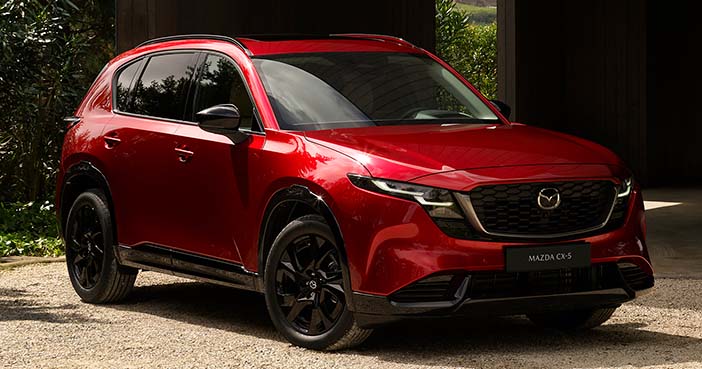
Redefined is a DEEP RUBY RED with a subtle shimmer. Axalta unveiled the colour earlier this month at Automechanika Frankfurt, a major automotive trade show in Germany. The finish uses coating technology designed to mimic the look and depth of a gemstone. Fancy. Red is one of the oldest colours in automotive paint, but Axalta says Redefined puts a modern spin on the familiar shade. The company says the finish has more depth and a reflective quality that sets it apart from traditional ruby-red paints. The shimmer comes from the way light interacts with the different layers of the coating, rather than simply relying on metallic flakes. That gives the paint its jewel-like appearance and allows it to look slightly different as the lighting changes. Matthew Boland, Vice President of Global Refinish Technology at Axalta, described the thinking behind the pick: “Redefined represents where we see automotive colour going, expressive and individual, but still refined and timeless. The deepness of the ruby tone combined with its luminosity and depth creates a colour that comes alive with the vehicle”. Axalta presents the choice as a response to buyers who want a car that looks personal without sacrificing a finished, upscale appearance. Paint choices like this sit alongside other unusual finishes automakers have rolled out recently. Redefined carries a link back to where Axalta’s colour program began. The company launched its Global Automotive Color of the Year series 13 years ago with a shade called Radiant Red, and Redefined returns the list to that same red family for 2027. Axalta says the shift from Radiant Red to Redefined tracks how paint technology has moved forward, with pigments and effect coatings now capable of producing depth that wasn’t achievable when the program started. The company points to this as evidence of how far its coating science has come. The 2027 pick follows a run of very different shades. Axalta named Solar Boost as its color for 2026, Evergreen Sprint for 2025, Starry Night for 2024, Techno Blue for 2023, Royal Magenta for 2022, and Electrolight for 2021. Automakers have adopted distinctive paint programs of their own in recent years, such as BMW’s retro-inspired colours on the M340i. Axalta did not name specific vehicle programs that will carry Redefined. +++
+++ MCLAREN has applied for ‘Remuera’ and ‘Muriwai’, but the company has not linked either word to a specific model, badge, or program. According to McLaren’s September 22 announcement, the new wordmark itself, not these trademarks, is what the company has actually confirmed. It draws directly from the McLaren International logo with speedmark introduced in 1981 and updates that identity rather than replacing it outright. That timing changes expectations. Automakers routinely reserve names years before deciding whether to use them, and McLaren has done this before without every filing turning into a nameplate. Recent reporting on the brand’s next-generation models has not mentioned either word. McLaren’s own statements have focused entirely on the visual identity update. Reading these trademarks as a hint at replacing alphanumeric names like 750S is speculation the company has not confirmed. Remuera is the Auckland suburb where Bruce McLaren grew up, and where his parents, Les and Ruth, ran the family garage. That building’s signage is the direct source of McLaren’s new wordmark, unveiled as part of a broader identity refresh spanning both McLaren Racing and McLaren Automotive. Muriwai carries a different, earlier chapter. At 15, Bruce McLaren made his competitive racing debut at the Muriwai Beach hill climb in 1952, driving an Austin Ulster his family had prepared in that same Remuera garage. He later named his home in England after that beach, a detail that shows how much the place shaped his identity even after he had left New Zealand for European racing. McLaren has kept the Speedmark, the Papaya color, and the Speedy Kiwi emblem intact through the identity update, treating this as a refinement rather than a break from its racing heritage. +++
+++ The all-new, pint-sized SMART #2 is primed and ready for its world debut on 12 October at the 2026 Paris Motor Show, promising to deliver “unmatched urban agility”. After Smart launched three SUVs back-to-back, the long-awaited successor to the innovative ForTwo marks the brand’s return to its roots. And at less than three metres long, the new two-seat runabout will still be about the same size as its famously ultra-compact predecessors. Underneath is a brand-new, purpose-built platform, called the Electric Compact Architecture (ECA), which “demonstrates how intelligent use of space, agility, safety and everyday electric usability can be brought together in a vehicle of this size”, according to the brand. Cramming everything Smart wanted onto an all-electric architecture and within a sub-three-metre-long package apparently posed a tough challenge for the engineers. However, the brand says they’ve managed to deliver generous cabin space, advanced powertrain tech, robust safety structures and agile driving dynamics, all in one super-small vehicle. Smart says the new #2 combines its ultra-compact dimensions with unmatched manoeuvrability and a turning circle of just 6.95 metres is the proof. That’s the same as the last ForTwo’s, far better than the Fiat 500e’s 9.6-metre turning circle, and so tight that you could do a U-turn on London’s narrow streets without touching any kerbs. However, the #2 is not intended to be only a city car. Smart’s goal was to create a “fully capable electric vehicle” that just happens to be incredibly small, suggesting it be able to hold its own on the open road as well. For one thing, it features 5-link independent rear suspension, which is not something I’d expect to see on a city car; it’s supposed to help make the car feel more responsive, stable and agile than we might expect. The #2’s rear tyres are also wider than the fronts, to help make the steering as precise as possible, while enhancing grip and stability at the rear, clearly without compromising agility. Thanks to a 35.7 kWh battery, the Smart #2 will offer more than 300 km of range; far better than the 256 km of the Renault Twingo. The brand says its new car can also be recharged from 10 to 80 percent in just 20 minutes. I don’t know all the performance figures yet, but it’ll supposedly sprint from 0-30mph in less than four seconds. The #2 will be rear-wheel drive and have 82 hp on tap, which doesn’t sound like much, but it will weigh in at a relatively light 1.130 kg. The dedicated architecture has been designed to make the best use of the available interior space, so it incorporates a highly compact 11-in-1 electric drive unit that crams a lot into it to make packaging less complex. The car also has incredibly short overhangs, with all four wheels pushed right out to the edges of the body. Meanwhile, the battery under the floor should result in a slightly higher driving position than in the previous ForTwo, improving visibility as well as the sense of roominess. Elsewhere, Smart has confirmed the new #2 will feature an evolution of the ‘Tridion Cell’ concept from the ForTwo. This was a signature component of the old Smart cars, and acted as a reinforced steel roll cage that encased the passenger compartment. This latest version is made primarily from high-strength steel, can withstand a roof load of more than four tonnes and is part of the reason this little car can complete the famous Moose test at nearly 80 kph. +++
+++ A new TESLA ROADSTER patent describes a two-piece rear wing that shifts between low drag, high downforce, and crash-safety positions. The patent describes a two-piece active rear wing that sits flush with the car when stowed. The patent lists a high-downforce mode producing up to 700 kilos above 160 kph. The wing mechanically retracts on a central or corner impact until its trailing edge lines up with the car’s rear.
Tesla’s next Roadster is due to break cover on October 1, and a freshly published patent gives the clearest look yet at what might be hiding under its bodywork. The filing describes a 2-piece active rear wing built to sit flush with the car when it is not needed. The application, titled “Deployable and Active Rear Wing Assembly with Safety Features”, surfaced through the US Patent and Trademark Office on September 24, 2026. It names David Lemire and James Michael Arthur Crook as inventors. The wing assembly splits into a main element and a smaller leading-edge slat, held apart by 3 to 15 millimeters via a 4-bar linkage, according to the filing. That gap lets air pass between the 2 pieces once deployed, shaping how the wing bites into the airflow. Tesla describes the whole assembly moving from fully stowed to fully deployed in under 3 seconds. Angle changes happen in under a quarter of a second once it is out. Deployment is not left purely to driver choice. The patent describes the system having access to speed, steering angle, braking data, GPS location, and autonomous-driving sensor inputs to decide when the wing should move and how far. It also covers an automatic switch into a track-oriented mode based on location. The document does not confirm the wing will reach production, treating it strictly as a proposed design rather than a locked-in spec for the Roadster. The numbers in the filing vary sharply depending on mode. Tesla’s patent lists a Formula 1 DRS (drag reduction system)-style setting that produces 0 kg of downforce, aimed at cutting drag on straights, sitting opposite a high-downforce mode good for up to 700 kg at speeds above 160 kph. Deploying the wing out of DRS adds 350 drag counts, per the filing. Rotating it back into the low-drag position cuts 250 counts versus the deployed-but-undeployed state. That aerodynamic trade-off is tied to a mechanical failsafe. The patent states the wing “retracts until its trailing edge lines up with the rear of the car on a central or corner impact” using both sensor triggers and physical retraction to pull the structure back into the bodywork during a crash. Tesla filed this application in August 2025, and it appeared in the public database in September 2026. Whether any of it appears on stage in Waco remains unconfirmed until the October reveal event itself. +++
+++ VOLVO wants to go after the Range Rover with a new flagship SUV that would be even bigger than the existing XC90, further increasing the Swedish brand’s desirability and luxury appeal, particularly in America, where bigger is always better. Chief designer Thomas Ingenlath said during the company’s recent product strategy conference, “Volvo clearly is a brand that very naturally would have such an F-segment-sized car in its portfolio. Our brand can very much carry that. So I’m very much looking forward to bringing this to life now”. The XC90 is by no means a small car, stretching nearly 5 metres long, and its electric counterpart, the EX90, is even larger. However, both sit in the ‘E-segment’ of the car market, meaning they’re rivals for the likes of the BMW X5 or Audi Q7. The F-segment is reserved for the biggest vehicles on the road, such as the Range Rover, BMW X7 and Audi Q9. Ingenlath recalled parking a Volvo XC90 next to a Range Rover, to see how these 2 big SUVs compared to one another. “I wanted to enjoy how that car XC90 competes with it, and I have to say, design-wise, I would say it competes with it. But definitely size-wise, I mean, Jesus, it is a different dimension. It’s a different dimension between an F- and an E-segment”. Unsurprisingly, America is going to be the target market for this new and as-yet-unnamed flagship SUV because, as the design boss put it, “In the US, size matters. It’s about the size of a car”. However, he added that it’s not just in the land of super-sizing where there’s demand for a model like this. “Even in Europe”, he said, “you can see how these cars are driven on our much more tiny roads”. Aside from the Range Rover, the Swede’s new flagship will have to compete against the BMW X7 (the next generation of which should be arriving next year) and the Mercedes GLS that was recently refreshed. There’s also the all-new Audi Q9 that’s just launched and this, like the forthcoming flagship Volvo, is its maker’s biggest, most luxurious model, designed primarily to conquer America. In the States specifically, there’s also the Cadillac Escalade and Lincoln Navigator to consider. The desirability of Volvo was something Ingenlath also spoke about during the conference. “Let’s face it, that’s what makes a Louis Vuitton handbag sell for an incredible multiple of its production price. This is why a Rolex Daytona sells for 70.000 Euros, because it’s the desirability of the product, and it is the power of the brand that makes this pricing possible”. Desirability is what the designers bring to the brand, Ingenlath believes, and he would know. This is the man who made Volvo cool and desirable with its last major product overhaul a little over a decade ago, which led to the Swedish outfit becoming a proper premium player. The launch of the second-generation XC90 in 2014 was a particular turning point because it pushed the brand’s quality and pricing levels to new heights. Presumably, this next flagship will see both elevated once again. Volvo CEO Håkan Samuelsson, who previously expressed interest in an even bigger SUV as well, has now set Volvo on a path to try and become “the leading premium car brand” with the promise of 13 brand-new models by 2030. This new flagship F-segment SUV is almost certainly one of them. The company has already announced plans to build a “new, next-generation hybrid model” tailored to the American market in its Ridgeville, South Carolina, factory before 2030. This is the same plant where it’s now producing the best-selling XC60 and, while not confirmed, I suspect this new hybrid is the flagship SUV. It makes sense that Volvo would choose hybrid power for its new luxury leviathan because there’s a slump in demand for high-end EVs at the moment, especially in America. Plus the company has just launched its new ‘long-range plug-in hybrid powertrain’ that delivers enormous EV range figures. The XC90 is now capable of 160 km on battery power alone thanks to this technology. In terms of what the new range-topping will look like, we should get a clearer picture soon, because Ingenlath announced that a concept car being revealed early next year will show the brand’s latest design direction, as well as a commitment to bring back tactile controls. Another thing he is keen to improve is how people recognise Volvo’s cars, hinting that we may see a fresh interpretation of its signature iron mark badge and the grille that frames it. “As a customer, the product that you buy, you want to be identified with the personality and the character of this brand. And in order to do so, you have to actually recognise the brand on the product. And I think one of the major topics for the car industry today is the anonymous look of cars”. Ingenlath used a classic Leica camera as an example of what Volvo is going for. “It’s not just about switching a button. It’s about the sensation and the sensual quality that such an interaction can give in terms of premiumness, the experience, the luxury of high-quality materials, the luxury of this great sound that that button will create. The desire to return to more physical buttons was driven by feedback from customers and media, who haven’t appreciated the reliance on touchscreens in Volvo’s latest models. Volvo is “not going away from touchscreens”, the design boss noted, “it’s just to use the screen for what it’s good at”. Being the biggest Volvo ever will also make the new SUV the brand’s most spacious car ever, and it’s almost certainly going to feature 3 rows of seats. But as we’ve seen with rivals such as the Audi Q9, there’s presumably going to be a version with cushier captain’s chairs to suit the chauffeur market. When it comes to making its new cars feel as premium as possible, Ingenlath and his team may look to the Chinese market because, “In China, there’s an incredible level of expectation when it comes to premiumness and luxury. I enjoy working together with our design team in Shanghai”, he said, “getting as well the demand from our salespeople there and from our Chinese colleagues, who really are pushing us to go beyond what we are used to doing when it comes to luxury, features and comfort in the first and especially the second row”. Ingenlath hinted that these insights will not only aid the 6 upcoming models Volvo is developing exclusively for China. The design chief also aims to integrate these lessons across global line-ups, delivering new standards of “luxury and premiumness,” emphasising that “we definitely have to keep fighting and making that a strong aspect of our brand”. As previously announced, Volvo’s CEO Samuelsson is stepping down soon, with current Skoda CEO Klaus Zellmer set to take the big chair no later than October 31, 2027. It’ll be very interesting to see how much of a priority he makes this new extra-luxurious flagship SUV. +++
+++ VOLVO CARS has imposed a global freeze on hiring for white-collar jobs and is taking a more “restrictive approach” to external spending, according to an internal memo. “To support our affordability ambitions and ensure we use our resources where they create the greatest value, we are introducing new rules around recruitment, contingent workers and bought services”, the memo said. “In practice, this means we are stopping external hiring and taking a more restrictive approach to external spending across the company”. The move comes as the Swedish luxury automaker contends with softening demand in key markets, including China and the United States. Volvo Cars employs about 20.000 white-collar workers globally. “To support our affordability ambitions and ensure we use our resources where they create the greatest value, we are introducing new rules around recruitment, contingent workers and bought services”, the memo noted. “In practice, this means we are stopping external hiring and taking a more restrictive approach to external spending across the company”. Internal recruitment is also being temporarily paused while the company reviews its approach to talent development, career opportunities and job rotation, according to the memo. The measures are intended to “reduce complexity, create stronger regional synergies and ensure resources are focused on the areas that have the greatest impact on our performance and transformation”. The hiring freeze does not affect Volvo Cars’ factories and related operations, such as purchasing and logistics. Volvo’s challenges are especially thorny in the U.S., its second-largest market. The brand’s share of the U.S. luxury market slid to 5.8 percent last year, the lowest since 2019, according to Automotive News Research & Data Center. 2025 sales totalled 121.607, the smallest volume since 2022. Global retail sales fell 7 percent to 710.000 vehicles in 2025. Volvo’s U.S. sales are pressured by higher import tariffs on European-built vehicles, the end of federal EV tax credits last year and weaker consumer appetite for plug-in hybrids and battery-electric models. First-quarter U.S. sales plunged 32 percent from a year earlier, to the lowest level since 2020. It gained momentum in the second quarter but still finished the first half 12 percent below its 2025 pace. Volvo’s inventory sold in an average of 88 days during the first half of 2026; well above the industry average of 63 days and worse than the 81 days it took for the brand in the same period last year. Last year, Volvo announced a $1.8 billion (18 billion Swedish kronor) cost-and-cash action plan that included axing about 3.000 jobs, mostly white-collar, representing roughly 15 percent of its office-based workforce. The reductions were concentrated in Sweden but affected operations worldwide and were largely completed by late 2025. +++