
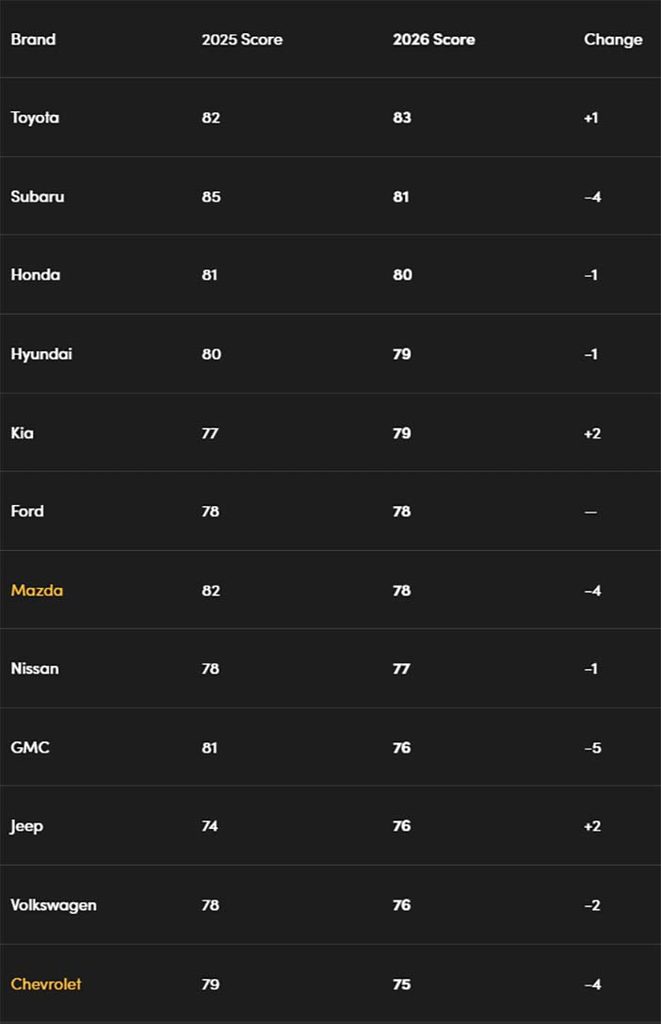
+++ Which brand drive AMERICA’S MOST SATISFIED CAR OWNERS ? Thousands of respondents weighed in on their rides this past year, and (surprise, surprise) a familiar name clawed its way to the top of the heap. Buying a car is just the start of ownership, but post-purchase satisfaction usually determines whether owners stay loyal to a brand. It covers everything that happens after the purchase, from reliability to dealership experience, and whether owners feel they got their money’s worth. That’s what the latest American Customer Satisfaction Index (ACSI) Automobile Study for 2026 tried to measure. This year, satisfaction dipped slightly as buyers wrestled with sticker shock and wallets that just won’t stretch. Still, a few brands made their way to the top of the rankings by offering what matters most to owners after they drive out of the showroom. Toyota took the crown this year, scoring an 83 and edging up a point from last time. That’s enough to knock Subaru off its perch and leave Honda, Hyundai, Kia, Ford, Chevy, Nissan, Volkswagen, Jeep, GMC and the rest of the usual suspects trailing behind. So, what’s Toyota’s secret? According to the study, the Japanese automaker’s hybrid play made a huge impact. It gave buyers the choice of gas, plug-in or full electric and, as it turns out, people like saving fuel without flipping their whole driving routine upside down. Subaru slid down to 81, Honda clocked in at 80 and both Hyundai plus Kia landed at 79, though Kia gets a gold star for one of the year’s biggest jumps. Ford settled at 78, Nissan at 77 and Chevrolet dropped to 75. Ram and Jeep, meanwhile, got solid year-over-year gains. Not everyone had a good year, though. Buick took the biggest tumble, dropping 16 points to 68. GMC and Chevrolet also lost ground, with satisfaction scores heading south compared to last year. This means General Motors has a lot homework to do. And invest in hybrid models. +++
+++ What looks to be the first-ever AUDI RS Q5 eHybrid is on the way, with both Sportback and SUV versions of the anticipated plug-in hybrid bruiser having been spotted in quick succession. Both of these performance mid-size SUVs should arrive as early as next year. The RS Q5 will borrow many technical elements from the new RS5. At its core is a twin-turbocharged 2.9-litre V6 engine that’s paired with an electric motor sandwiched between the engine and an eight-speed automatic transmission, driven from a 25.9 kWh battery pack. Peak power from the RS Q5’s engine and electric motor should match the RS5’s 639 hp, as should its 825 Nm maximum torque. Performance is likely to be marginally down on the lower and likely lighter RS5, taking somewhere in the high 3-second range to hit 100 kph. However, this powertrain doesn’t just unleash incredible performance, but will also offer an impressive electric range of up to 80 km. This will also usefully reduce the car’s fuel consumption, while CO2 should be around the 100g/km mark. Compared to traditional non-hybridised high-performance SUVs, this will cut running costs. Yet the RS Q5’s changes will go deeper than just offering huge performance. Audi hasn’t changed the body-in-white as it does with its RS5, but it has fitted some small arch extensions that make room for wider axles and larger wheels (21 inches). The RS5’s clever rear differential and rear-wheel steering will also help control the weight, which is likely to be around 2.500 kg. The styling is also set to undergo a fundamental overhaul, as this new model will feature the new design language Audi’s Concept C and Nuvolari supercar. This is obvious with the grille, which gets a squarer shape, flanked by 2 tall and narrow outer intakes. This new model hasn’t gone as far as to replace the headlights or bonnet, but it already previews a more restrained aesthetic than we’ve been used to seeing on RS models over the past decade or so. A similarly understated approach is also applied at the rear, where the 2 large oval exhaust pipes now sit in their more traditional positions compared to other new-age RS models. The RS Q5 might well arrive at the perfect time for Audi. Neither BMW or Mercedes-AMG offer direct rivals with this level of performance in the class, with the X3 topping out with the ‘warm’ M50 model and AMG’s new GLC 53 matching that car for power and price. The Alfa Romeo Stelvio Quadrifoglio and Maserati Grecale Trofeo are still available, but both are ageing and don’t offer the versatility of a plug-in hybrid option. Finally, Porsche’s new petrol-powered Macan is being hastily developed, but is still at least 24 months away. It will also share many of the Audi’s components, potentially including the plug-in hybrid powertrain. This all suggests that, for now at least, Audi’s new RS Q5 might be the only choice for anyone after a petrol-powered mid-sized high-performance SUV. However, if you’re willing to go full EV, the Porsche Macan Turbo and forthcoming iX3 M and GLC Electric AMG will be compelling alternatives. +++
+++ As software-defined vehicles become more prevalent, automakers may be under pressure to adapt to avoid falling behind. One of the most recent examples is BMW , which is introducing BMW Maps with Driver Assistance for models equipped with Operating System X. It may be a new rollout, but Tesla has offered similar driving visualizations for years. BMW Maps with Driver Assistance provides a 3D navigation view while displaying information about features like hands-free driving in the same scene. It aims to create a more seamless experience than separate navigation and assistance displays. Tesla offered an early version of driving visualization in October 2015, showing nearby vehicles on the instrument cluster. The EV maker improved its visualizations through the years via over-the-air updates, with today’s FSD display showing a more comprehensive view of navigation and surroundings. Regardless, the winners are the owners who get to use these increasingly advanced interfaces. Developed by BMW using Mapbox’s navigation data and mapping technology, BMW Maps with Driver Assistance displays route guidance, surrounding vehicles, and driver-assistance information on the infotainment screen. It can help drivers interpret complex highways, intersections, and urban traffic more easily. The new feature is especially relevant while using the Bavarian automaker’s Highway Assistant or Highway & City Assistant. Highway Assistant supports automated lane changes that drivers confirm by glancing at the relevant exterior mirror. The rollout will begin in October 2026 in select countries, cities, and on select roads, though the press release didn’t name the first markets. BMW did say that navigation-guided, semi-automated urban driving will begin rolling out to Operating System X-equipped models in 2027, initially in Germany. With this type of advancement, it will be interesting to see where in-vehicle technologies are in the upcoming years. Mercedes-Benz even has a navigation function that overlays augmented-reality arrows onto live camera images, similar to racing video games, to guide drivers. Another area to watch is eyes-off driving, despite BMW dropping its Level 3 system from the 7 Series this year. Automakers like Ford plan to introduce eyes-off driving before the end of this decade. Such systems could be paired with advanced navigation displays to let drivers know about the route and active vehicle functions while the car manages acceleration, braking, and steering under supported conditions. +++
+++ LOTUS has been going through a major transformation, but it hasn’t forgotten what made the brand famous in the first place. The British sports-car specialist is preparing a new mid-engined model that will combine a V6 or V8 with hybrid technology, and it’s targeting more than 1.000 horsepower without letting the car balloon in weight (too much). Known internally as the Type 135, the upcoming sports car is scheduled to debut in 2028. Lotus hasn’t officially said it will be called Esprit, but all signs point to the iconic name returning after a 22-year absence. The last Lotus to combine those ingredients was the original V8 Esprit, which went out of production in 2004. Speaking during a recent earnings call, CEO Qingfeng Feng described the Type 135 as a critical high-performance hybrid product for the company’s next phase. And Lotus isn’t messing around with the numbers. The V8 version will produce more than 1.000 hp, while the entire car is being engineered to weigh around 1.5 tons. That’s a seriously ambitious target considering the hardware involved: an 800-volt electrical architecture, a hybrid system, a V8 engine, and electric motors. Lotus acknowledges that keeping the weight around 1.5 tons will be one of the project’s biggest challenges. But that’s also where the company believes it can set itself apart. Lightweight engineering, aerodynamics and chassis tuning remain central to the Type 135, with Lotus determined to prove that electrification doesn’t automatically have to turn a sports car into a heavyweight. The company has already gone to extreme lengths to save weight. Lotus says it has used Formula 1 technology to reduce the mass of a 150 kW electric motor from the typical 75-95 kg to just 20 kg. It’s also co-developing an 8-speed dual-clutch transmission with Horse, designed to handle high torque while keeping weight to a minimum. Like pretty much every other automaker, Lotus is embracing hybrid power for regulatory reasons. For the Type 135, Lotus says the V6/V8 hybrid approach will help it comply with global emissions regulations while retaining the characteristics traditional sports-car buyers expect. So before you bring out the pitchforks, electrification is a necessary evil, and in 2026, it’s becoming increasingly difficult not to embrace hybrids. The most recent example is Audi’s new plug-in RS5. The company originally committed to becoming fully electric, but it has since acknowledged that the global transition to EVs isn’t happening at the same pace everywhere. Lotus has therefore switched to a multi-powertrain strategy covering combustion engines, hybrids and pure EVs. +++
+++ MCLAREN will begin production of a performance SUV in Great-Britain in the coming years, as the first in a new line-up of models enabled by a landmark £500 million investment that will fund another factory, significantly boost its production volumes and create 4.000 jobs. McLaren merged with EV start-up Forseven in early 2025 and hinted at plans for a significant expansion of its operations and model line-up, but had yet to reveal any firm details about what the future held for the Woking supercar maker. Now, McLaren has confirmed £500 million of investment from the Abu Dhabi government’s L’IMAD investment arm, and has disclosed new details of how the company will be transformed over the coming years, as well as confirming that it will launch a long-mooted SUV model line. That machine could be carbon-tubbed and is likely to spawn other front-engined models in the future. McLaren’s chief operating officer Michael Straughan has given details about what the announcement means for the company and its cars, and emphasised the firmness of the strategy that has been signed off. “There’s a roadmap for about the next 10 years that gives us real confidence. We’ve got a growth plan and a delivery perspective on how we can get to where we want to get to”, he said. “This isn’t empty words: this is a firm plan, and we’ll be held to task against the plan, and rightly so”. L’IMAD is McLaren’s new owner, having recently absorbed CYVN Holdings, which acquired the sports car firm from Bahraini wealth fund Mumtalakat in late 2024 and promptly merged it with another automotive brand in its portfolio, Forseven. L’IMAD’s £500m injection into Woking forms part of a “larger commitment” in McLaren’s future, but it has not hinted at the scope of any future investments. The money will be used to develop future models and expand McLaren’s UK production operations, chiefly with the addition of a second assembly facility to supplement the McLaren Production Centre at Woking, which built around 2.000 cars in 2025. The company has not revealed where this new facility will be, but said it forms part of a plan to “ensure the next generation of McLaren Automotive cars are built in Britain”, including the long-awaited SUV, which is in the advanced stages of planning ahead of a launch before 2030. Straughan explained that the expansion into new car segments makes extra production capacity necessary: “No longer will we be only rear-engined, rear-wheel-drive cars. There’s going to be front-engined, and either four-wheel drive or perhaps rear-wheel drive in the future. It’s very difficult off one assembly line, so we need another assembly line, wherever we decide to put that”. He also said that McLaren would not look to build cars on a line within another manufacturer’s factory in the UK, because “low volume is quite disruptive to an OEM’s larger volumes”, so the new facility will be all-new and bespoke. The main factory in Woking will also be expanded, as will the firm’s carbonfibre facility in Sheffield. Significantly, McLaren will also bring engine development and production in-house for the first time, having previously bought in engines for all of its road cars, primarily from Shoreham-based engineering firm Ricardo, which has powered all core models since McLaren’s relaunch with the 12C in 2011. First among these are a pair of new combustion engines and associated gearboxes. McLaren hasn’t alluded to their technical specifications, but says they will support “the company’s hybrid engine strategy”. Altogether, the new models, production operations and development programmes are estimated to create “at least” 1.000 jobs within and around McLaren, with another 3.000 added across the supply chain as a result. McLaren’s expansion announcement comes just a few days after JLR (the biggest automotive employer of the United Kingdom) announced it would cut 4.000 jobs from its global workforce as part of a radical cost-cutting initiative, and Straughan acknowledged that meant there was “a skilled workforce out there” that could fill some of Woking’s vacancies. However, he also noted that while McLaren “will reach out” to affected JLR employees, “not everybody travels well to Surrey from the Midlands” and the priority for McLaren was to “grow our own” through apprentice, graduate and internships that “turn into full-time jobs”.
+++ NISSAN will bring its popular Kicks crossover to Europe with hybrid power and plans to build it at its Sunderland plant following an investment worth €200 million. The B-segment car was launched in 2016 with a focus on Brazil, and the second-generation model, launched in 2024, is currently manufactured in Brazil, Japan and Mexico. While the Kicks has never previously been offered in Europe, it is sold in most of Nissan’s other global markets. Sunderland currently produces the Qashqai, Juke and Leaf. It will build the electric next-generation Juke, but plans for an electric Qashqai have been scrapped, so the arrival of the Kicks will be a major boost for the plant. The Kicks will sit beneath the Qashqai in Nissan’s line-up of traditional SUVs, and replace the similarly sized ICE-powered Juke, which is now in its 7th year on sale. The international version is 4.365 mm long, making it slightly longer than the Juke, with which it shares the CMF-B platform. However, Nissan has warned that the decision to bring European production of the Kicks to the UK might not happen if the government doesn’t relax its ZEV mandate to a level acceptable to the company in the UK. “A large part of this is subject to the ZEV mandate amendment”, European head Max Messina said after Nissan announced the investment in Sunderland. The announcement that Sunderland will build the Kicks confirms Nissan’s commitment to the plant. However, the SUV is a powered by a hybridised combustion engine rather than electric, which could limit Nissan’s ability to sell it in the United Kingdom past 2030, when 80% of all new car sales must be electric. Messina said Nissan is looking for the government to drop that to 50% or lower as part of a review of the legislation announced in August. “We expect the mandate to be amended to the level that allows us as a UK manufacturer to be competitive”, Messina said. “To us 50% is something that makes sense financially; 40% would be better”. The government has said it aims to ensure the EV sales mix targets “remain pro-business and grounded in the real world”. EV sales have jumped in recent months as more consumers have switched to electric due to rising petrol and diesel prices and the launches of cheaper models. EV market share reached 30% in August after sales jumped 28%. However, car makers have yet to reduce costs on EVs to the point that profit margins are on par with those of ICE models. Messina said he expected car makers to have more visibility of the planned changes by next week,and urged the government to move fast. “Sooner is better, because the sooner we can engage with suppliers to prepare our line in Sunderland to welcome the car”, he said. Nissan, along with other car makers, is locked in an existential battle with Chinese manufacturers, who are attacking the volume segment with better-value models offering more technology. Messina said car makers operating in the UK need help to stay competitive, because “we have some competition which is not necessarily paying the same salaries, it’s not paying the same social charges, not paying the same taxes”. Chinese firms are able to sell higher levels of EVs in the UK than in the EU, because the UK hasn’t applied the same ‘countervailing’ import tariffs on EVs built in China. The UK may need to change its position on that for the EU to agree for its inclusion in the proposed ‘Made in Europe’ regulation changes, which would favour cars built within the bloc. “I assume that to have the UK part of the EU, they cannot have a Trojan horse in the UK”, Messina said. The UK and the Society of Motor Manufacturers and Traders have been reluctant to raise barriers to Chinese car makers, whose overall market share broke 20% in August, helped by strong growth for the Chery group, MG and BYD. Their rise has hurt volume brands like Nissan, which struggle to match the Chinese on costs. Nissan needs for the EU to recognise the UK as European as part of its Industrial Accelerator Act proposal, but Messina fears the tariff discrepancy could be a stumbling. “I would expect that Nissan’s competitiveness in the UK has to be as good as in France”, he said. “If we have a distortion in these 2 markets, clearly it’s going to create issues about where I produce, what I produce and for which market, which is counterintuitive”. Nissan is also in talks with Chery about a deal for the Chinese giant to build cars in Sunderland. This could result in up to 6 models being produced at the facility, which is celebrating its 40th anniversary this year and has produced more than 12 million cars to date. It’s a welcome development after recent news that Sunderland was shutting a production line. In a statement, UK business secretary Jonathan Reynolds said: “The decision to build this new model in Sunderland is a huge vote of confidence in the UK’s manufacturing expertise and automotive future”. +++
+++ PORSCHE just added new options to the Cayenne Electric, including wireless charging. This update applies specifically to the Cayenne Electric range sold in Europe for the MY2027 model year. Paint to Sample now spans 105 colors, up from 13, for €9.500. Wireless charging can now actually be ordered, not just prepared for: the vehicle-side hardware runs about €2.300 on top of a PTS shade, plus a separate €6.400 ground pad delivering up to 11 kW at roughly 90 percent efficiency, with an automatic charging halt if anything wanders onto the pad.
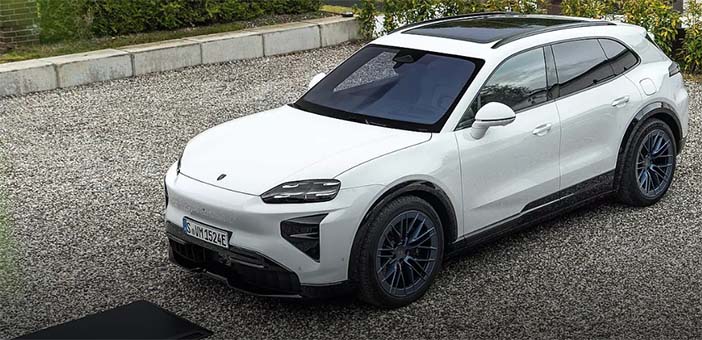
Electric self-closing doors add €1.900, and a new massage seat option (16 air cushions, 6 sound actuators and what Porsche calls a “4-dimensional musical experience”) runs about €3.500. Porsche’s wireless charging system remains the more technically notable story here. Engineering constraints mean it can’t currently fit in the smaller Taycan or Macan Electric, making the Cayenne’s extra size a genuine functional advantage rather than just a styling choice.
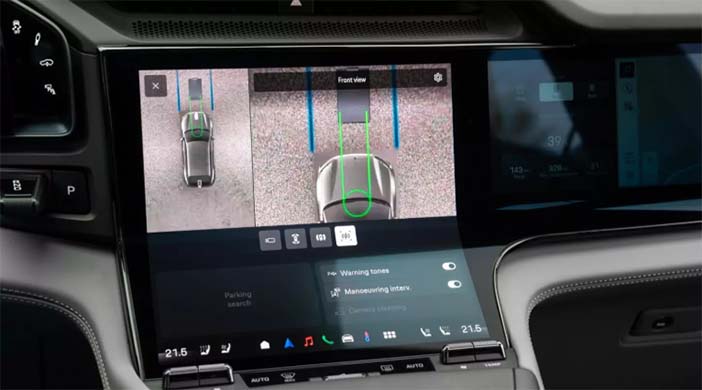
That Europe is now the market where buyers can actually check the box for it, rather than just prepare the hardware for a later install, is arguably more significant than the paint news the original story led with, even if Porsche’s habit of charging steeply for marginal extras is well established. +++