
+++ The ALFA ROMEO CUORE ROSSO CONCEPT showcases an ambition to break from the “war of centimetres” on screens inside new cars, according to its chief designer. The striking fastback was revealed at last week’s Paris motor show and hints at key cues coming in the brand’s next-generation cars, including a simplified interior that minimises digital surfaces. “Let’s get rid of the screens”, Alejandro Mesonero-Romanos told. “We were in search of emptiness. Screens are nice when you’re sitting in the car, but when you’re driving I’m not convinced. We’re in a kind of war of centimetres for the screens, and to me it doesn’t make any sense, because they become huge. They are designing the dashboard for you, basically. I think that in some years’ time, these screens will become obsolete, they will be old, they will start costing money. Whatever you put on a screen, you don’t put somewhere else, and I prefer to put it somewhere else”.
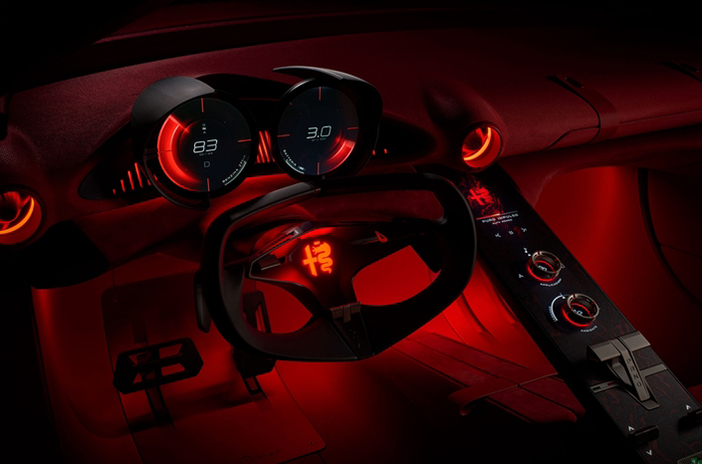
To this end, the Curorerosso previews a new take on Alfa Romeo’s long-running ‘cannocchiale’ instrument binnacle design, in which 2 round screens can merge to form just one, displaying only the most important driving information. Mesonero-Romanos said the split-instrument approach produces additional flexibility, which could mean a conventional central touchscreen becomes redundant. For example, 1 of the 2 roundels can be used to display the sat-nav, the other the instrumentation. “I want to have an infotainment screen but I don’t want to have it on all the time, so I want to hide it”, said Mesonero-Romanos. “I’m aware that a big part of the public wants to have big screens, but then don’t buy an Alfa, buy something else. I’m sure there are a lot of people out there who think like we do. There’s a lot of people that will be happy with this experience”. The other key development inside the Curorerosso is its ‘Magma’ centre console. This retains physical buttons, dials and switches for vital functions such as the fan speed and temperature, but a small projection is positioned at the top of the spine, displaying secondary functions that are selected using the upper dial, such as the current song or the sat-nav. These are then adjusted using haptic touch controls. “The whole thing is a screen, but it’s not a conventional screen”, said Mesonero-Romanos. “It’s a support for the physical commands with one part that’s like a proper screen, like on a telephone. It has a film on top that isn’t intrusive: you see through it and then it’s hidden when you don’t need it. You can switch it off. It’s my dream to drive at night with a single cannocchiale, all lit red, and nothing else”. +++
+++ The forthcoming ALPINE 2+2 electric roadster will sit on the new platform developed for the next-generation A110, but it will have a new look unrelated to that model, according to brand chief Philippe Krief. The next-generation A110 EV will launch next year as the first model on the highly flexible Alpine Performance Platform (APP). But while it will be an entirely new car, its styling it set to remain close to the previous A110, which takes inspiration from the 1960s original. Alpine unveiled an A310 concept car at the Paris motor show, which was inspired by the company’s 1970s coupé. But while the firm had at one stage planned to use that model as the basis for a 4-seater, it will instead inspire a limited-run 2-seater that will sit in Alpine’s special series. Krief said that the design planned for the 2+2 “is not a tribute” to a past Alpine model, or based on the A110. He added: “It’s something outstanding, but not attributed to the A310”. He acknowledged the previous plan for the 2+2 to be based on the A310, but said “this first one was too close” to the original, hinting instead the new model will be “very, very modern”. “If the A110 is recognised worldwide as an absolute timeless beauty, the A310 is loved by French guys and connoisseurs, but the appeal is more niche. That’s why we are going to do the 2+2 with an outstanding but more modern design”. Alpine will launch the A110 next year, but has yet to confirm whether the priority after that will be launching the 2+2 as a series production model, or developing the A310 as a limited-run special edition. Krief suggested the final decision could depend on the “awareness and desirability of the brand” in the coming months and years, “and also globally where we are in terms of network profitability”. Krief wouldn’t give details about production volumes for an A310 special, but said that the A110 Ultime (the first car in Alpine’s special series) pointed to its potential market segment. He added: “The Ultime was something to try. It’s not to make money. You don’t do this kind of car to make money: except Ferrari, nobody is making money. The Ultime was to promote the brand, which was an A110 with infinite possibility of personalisation. With this car we were able to average €300.000, so we found customers. So there’s room there, and the A310 will have the scope to go in that direction in terms of exclusivity, personalisation and exclusivity”. +++
+++ While some special ‘lightweight’ versions of high-performance cars are put on a token diet, the BENTLEY SUPERSPORTS goes further: it’s a whopping 500 kg lighter than the Continental GT it’s based on. Soon, though, you’ll be able to add a load of weight back in, with a Bentley Continental Supersports Convertible spotted undergoing testing around the Nürburgring Nordschleife in Germany. Mind you, it’ll still be significantly lighter than the current Continental GTC. We’re expecting it to follow the same recipe as the coupé, which involves binning the hefty plug-in hybrid system and the all-wheel-drive set-up for the bulk of the savings. To trim the fat further, the roof, front bumper, rear diffuser and boot are all made from carbon fibre, and there’s a full titanium exhaust. On the subject of the bodywork, new spy shots clearly show that the convertible will share the same front bumper with its distinctive splitter and diveplanes, and the sizeable ducktail rear spoiler. The drop-top Supersports looks to be wearing the same 22-inch Manthey forged wheels as the coupé, albeit with a simple monotone finish and no centre caps on this prototype. They’re shod in what look to be Pirelli P Zero PZ5 tyres, with Trofeo RS rubber likely available as a more focused option, if the coupé is anything to go by. Behind the wheels, we can see the enormous 440 mm carbon-silicon carbide brake discs at the front, squeezed by 10-piston calipers. Although the Supersports is the most focused Bentley you can buy, it’s far from the fastest accelerating, owing to its rear-wheel-drive layout. Still, a 0-100 kph time of 3.7 seconds is not to be sniffed at. Expect the cabriolet version to be a tenth or two slower, owing to its inevitable extra bulk. The source of propulsion will remain a 4.0-litre V8, with bigger turbochargers to boost the output to 666 hp and 800 Nm of torque. All 500 units of the coupé are already sold out. +++
+++ CHERY is about to take its assault on the British car market to the next level as the Chinese automotive giant’s chairman, Yin Tongyue, has told that the firm wishes to “become British”; a plan that could possibly involve an even closer relationship with Jaguar Land Rover. “We need to be a British brand”, Yin said in a roundtable interview at the firm’s headquarters in Wuhu, China. “In the future, I really want to have products designed in the United Kingdom (UK), engineered in the UK and produced in the UK, but to sell worldwide”. For a long time, Chery, and in particular its subsidiaries, have been accused of copying British designs, with the top-selling Jaecoo 7 having been described as the ‘Temu Range Rover’. Yet despite Yin admitting that “I really dislike the nickname”, he also conceded that “UK design beats the world”. Such is the case that the chairman says he’s “thinking of moving the Chery Design Center HQ to the UK”, revealing the firm is currently “in talks with British design masters”. But it doesn’t stop there. Chery has already established an engineering centre at UTAC Millbrook in Bedfordshire; an operation that could be expanded if the firm wishes to base itself out of the UK. Earlier this year, Chery also signed a Memorandum of Understanding with Nissan in order to potentially make use of its spare manufacturing capacity in Sunderland. Building cars in the UK might seem counterintuitive given the much higher production costs than China, but it could be a wise move given that the Business Secretary, Jonathan Reynolds, is rumoured to be weighing up implementing tariffs on Chinese-car imports. While Yin said Chery would “adjust the price and margin to suit the competition”, making cars here could help Chery’s profits and keep British jobs alive. All of this is a big undertaking for an automotive firm that only came into being in the late nineties, with Yin at the helm since the very beginning. With this in mind, Chery has hinted it would be keen to build an even closer relationship with Jaguar Land Rover. The 2 titans already partnered to form Chery Jaguar Land Rover in 2012 as a means to build SUVs for the Chinese market. This was followed by the introduction of the Freelander brand earlier this year, which involves Chery licensing JLR’s expertise and intellectual property. “We want to have a discussion: how can we help JLR to resume volume scale as it used to?”, Yin said. “Our collaboration with JLR is deep in many perspectives. I wouldn’t be able to share too much with you because I think if we want to share, we should share together with JLR”. What the deepening of this relationship could involve is another matter; Yin highlighted how Chery wants “to find more UK capability in terms of engineering to handle the dynamics”, but a potential investment (or even buyout) cannot be ruled out. Adding to this idea is the fact that Yin said: “I have a personal, deep emotion with the UK as a country. I kind of want to revitalise a UK brand (for example, could we find a sports car company that we could help?” Jaguar could potentially be a prime target, with the 63-year-old even hinting at his ambition to go motor racing. Whatever happens between JLR and Chery, any investment in the UK motor industry would come as a relief to many; car production fell to a 73-year low in 2025 following the implementation of import tariffs by US president, Donald Trump, as well as the pause in manufacturing caused by the cyber attack on JLR. “If we want to become a great company, it’s more than just market share”, Yin explained. “It’s more like a social responsibility: the value we can provide to the customers, and also contribute to the economy for a country”. +++
++ If you firmly believe there is no replacement for displacement, MERCEDES has good news. It’s finally acknowledging what enthusiasts have said for years: You can’t swap out a big engine for a complex hybrid setup and expect everyone to be happy. The company isn’t abandoning electrification, but its latest comments suggest the V8 is getting another chance to shine and the V12 may have a future beyond its current applications. Speaking at a media roundtable, CEO Ola Källenius admitted in an interview that the company had underestimated the appeal of traditional 8-cylinder engines. Discussing the 4-cylinder plug-in hybrid C63, he said: “What we perhaps underestimated at the time was the good old V8 crowd is a pretty good crowd. So you did not get the whole tribe with you”. That’s about as close as an automaker gets to admitting it misread the room. The outgoing C63 S E Performance combines a turbocharged 2.0-liter 4-cylinder engine with an electric motor to deliver a combined 671 hp. Impressive numbers haven’t stopped enthusiasts from missing the old V8, however, and Mercedes appears to have taken notice. Mercedes isn’t giving up on combustion engines just yet. AMG CEO Stefan Weckbach confirmed that the V8-powered CLE 63 will arrive next year, adding that the company is returning to what its customers want. “We learn from the reaction of our customers”, Weckbach said. “So we go back to what our customers love: the V8 AMGs”. Unfortunately, the V8’s return to AMG doesn’t mean the C63 will get its old-school soundtrack back. Mercedes has confirmed that it has no plans to bring the 8-cylinder engine back to its performance sedan/wagon, despite acknowledging that it underestimated demand for traditional V8 AMGs. Why? Well, money. The company is unlikely to recoup the development costs of a V8-powered C-Class this late in the current model’s life cycle. So, while the V8 will survive in other Mercedes models, C63 fans shouldn’t hold their breath for a reprieve. The bigger surprise concerns the V12. When asked whether Mercedes could do something for customers who still want a 12-cylinder engine, Källenius gave a short but intriguing response: “Watch this space”. It’s hardly confirmation of a new V12-powered model, but it suggests the company hasn’t forgotten its most demanding customers. Mercedes currently offers a twin-turbo 6.0-liter V12 in the Maybach S-Class and the armored S-Class Guard, depending on the market. Mercedes previously confirmed that 12-cylinder engines would remain available in selected regions with more relaxed emissions regulations. That commitment leaves room for the V12 to survive in ultra-luxury vehicles, where exclusivity and smoothness matter more than outright efficiency. Could the V12 find its way into additional models? That’s speculation for now. Källenius didn’t name a vehicle or provide a timeline, so it’s too early to say a new 12-cylinder Mercedes is on the way. Still, his response is encouraging for buyers who aren’t ready to settle for fewer cylinders. Sitting near the top of Mercedes’ model range, the G-Class would make a compelling candidate for a V12 engine. After all, if any SUV deserves 12 cylinders under the hood, it’s the boxy off-roader that has evolved (or is it devolved?) into a status symbol for the wealthy. Mercedes used to offer the AMG G65 with a dozen cylinders, but now only tuners like Brabus cram a V12 under the Geländewagen’s hood. That’s definitive proof the engine fits, so we hope something other than the S-Class will wear the V12 badge again. For now, all we know for sure is that Mercedes is working on a next-generation G-Class, but whether it will get a V12 or stick with the familiar V8 remains anyone’s guess. +++
+++ How do you successfully update a phenomenally successful rebirth of an icon? This is the question that’s bouncing around the walls inside Renault as it ponders how to maintain the momentum generated by the brilliant RENAULT 5 . After reinventing the ‘5’ once, the job of updating it will be carefully articulated. Expect evolution, rather than revolution, as its design language has firmly set a template that works for this specific model, but won’t be expanded to others. Renault does have a secret weapon up its sleeve, though. China speed is something that’s being rapidly rolled out across its development processes in all markets, and the same is true here. Renault Group CEO François Provost, he told: “We are working to nurture our icon. As we can now develop in less than 2 years, you will see some significant changes soon”. This applies to all parts of the car, so while any major hardware changes will take time, Renault’s ability to offer the latest trends and diversify into different trims and specifications could keep the 5 E-tech relevant. There’s little scope to change the general package, however; the Renault 5 will remain a B-segment hatchback. As a result, I don’t expect to see a Mini-style expansion into various models or body styles, leaving those movements to its other retro-inspired models like the Renault 4 and Renault Twingo. Instead, the 5’s changes will hone its existing package into something that keeps up with the capability and technology from rivals. In fact, on paper, many already have it on the back foot. At its launch, the 5 E-Tech’s 400 km-or-so range was best in class and a great improvement on the immediate competition. Yet with the introduction of Volkswagen’s new MEB+ models, such as the Volkswagen ID.Polo and Cupra Raval, as well as new rivals such as the Hyundai Ioniq 3 and Kia EV2, the 5’s range is no longer class-leading. The in-cabin tech is also under pressure from new systems found in both Korean and European rivals. Their screens are bigger, more configurable and easier to operate. However, the long-term reliance on in-fashion models can, and often does, lead to disaster in the long run, and Provost is aware of this. “We cannot only rely on a few icons”. Renault still hasn’t clarified what will happen when the Clio requires an EV powertrain. The need to offer an ICE variant well into the 2030s will keep the 2 superminis independent for the time being. +++
+++ RIVIAN delivered 19.248 vehicles in the US during the third quarter; a figure that put the company in second place among individual EV brands, trailing only Tesla. The result came in a contracting but rebounding market. Overall EV sales are still far below last year but higher than in the spring. Cox Automotive’s separate estimate of 19.239 units lines up almost exactly. Either number is enough to leapfrog Chevrolet, which held that spot a year ago. For shoppers wondering if Rivian can supply a car at scale, this quarter answers that question. A year earlier, Rivian sat in 10th place among EV brands on the American market. Its climb to second came while nearly every other automaker posted lower EV volume for the quarter. Rivian’s deliveries rose 45.7 percent compared with the third quarter of 2025, giving the brand a 7.2 percent slice of the EV market in the US, according to Cox Automotive estimates.

That share is worth separating from General Motors’ own numbers. Chevrolet, Cadillac and GMC still outsell Rivian when GM’s brands are added together. Rivian’s rise reflects a single nameplate passing a single nameplate, not the whole portfolio losing ground. The gain still counts, since GM’s own EV demand has been slipping brand by brand. Toyota, Lexus, Mercedes and Subaru were the other brands that grew EV sales in Q3, each driven by a specific new model. Rivian’s growth carries over into the year-to-date totals too, up 26.8 percent through the first 9 months of 2026 compared with the same stretch last year. Rivian’s third quarter results total down into 4 distinct products. The R1S SUV remains the volume leader at 5.582 units, with the R1T pickup adding 1.732. The R2 contributed 3.456 sales in what Cox Automotive calls its first full quarter on sale, with only the pricier Performance trim available so far.
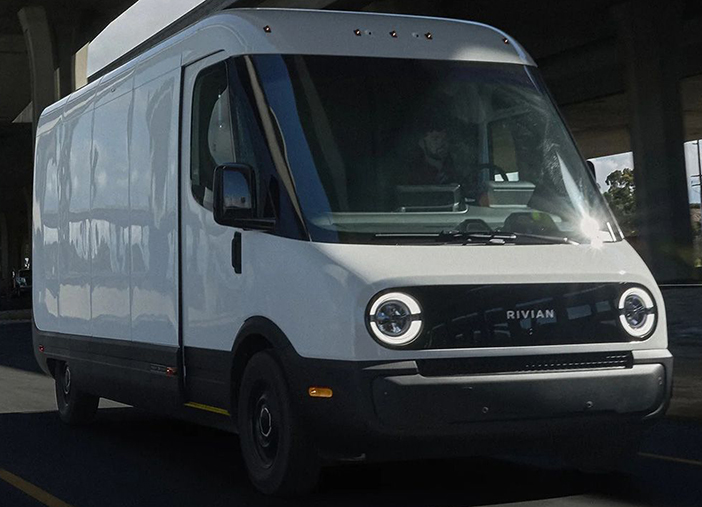
The bigger surprise sits in the delivery van business. Rivian’s EDV 500 and EDV 700 commercial Vans sold 8.469 units in the third quarter; up 220.9 percent year over year. That single product line now outsells either of Rivian’s own passenger vehicles. Year-to-date van sales have already topped 15.000 units. Those Vans support Rivian’s commercial work with Amazon and other logistics and fleet buyers. It’s a sign the company is building revenue outside the retail showroom. Through the first 3 quarters of 2026, the R1S has logged 17.259 units and the Vans 15.685, roughly matching each other for the year. The R2’s real test is still ahead. Rivian has cheaper R2 variants coming, and only the top-dollar version has shipped so far. Once Rivian reaches the cheaper (roughly $50.000) trims, volume could climb well past this quarter’s 3.456 units. +++
+++ VOLVO says production of its new EX60 SUV is “taking longer than planned to ramp up” because of the challenges associated with its radical new technology and construction. The company says it has taken more than 50.000 orders for the electric equivalent to the best-selling XC60, but so far has built just 5.000 units since the model entered production in April, and CEO Håkan Samuelsson has warned that the crucial new model’s “financial contribution will be delayed as we are not ramping up to the plan we had before”. Delays to the EX60’s full-scale launch are particularly poorly timed because Volvo has posted losses of roughly €450 million in a “very disappointing” third quarter of 2026 and announced plans to cut its workforce by 2.500 as part of a drive to rebuild profits. Samuelsson said the EX60 will play a crucial role in Volvo’s turnaround plan, eventually serving as “one of the company’s best profit-contributing models”, but its impact on the bottom line will not be fully realised until output reaches capacity at the Swedish firm’s Torslanda plant near Gothenburg. BMW recently announced that it had taken 100.000 orders for the iX3, a close rival for the EX60, which was launched last October, with its new Hungary factory ramping up more quickly than any BMW plant in history to meet demand. Production of the iX3 was boosted recently with a third shift at the Debrecen facility, which is now running at capacity 24/7. Volvo chief commercial officer Erik Severinson said it has been “difficult to start production as we want” with the EX60, because the new SPA3 platform on which it is based requires significant adaptation to the production process. Volvo has invested around €850 million in its Torslanda facility to build EVs based on the architecture, which introduces a radical new megacasting production method, reducing the number of individual bodywork components, and uses an innovative cell-to-body battery packaging arrangement. Volvo cited the battery packaging as the main reason behind the delay and said the setback is completely unrelated to the software issues that delayed the rollout of the larger EX90 in 2024. Samuelsson said the slow start highlighted the differences between the EX60 and Volvo’s existing EVs and said the firm is steadily accelerating output. “If you want to have class-leading new technology, it means a higher risk to implement than continuing with more conventional technology”, he said. “In this new car, its megacasting has caused us no headaches. It is really the assembly of batteries directly into the underbody of the car, which is a highly automated process”. He said the EX60 battery’s circa 100 cells cannot be inserted manually but rather by an automated process, which makes for “a highly complex mechanical assembly line”. However, he added that he is “quite confident that we will master that. We were maybe too optimistic in the ramp-up, but we are improving”. The EX60 will be joined in autumn next year by a more affordable SPA3-based electric SUV, which is thought to be a successor to the ageing EX40. The new model is one of 13 new cars Volvo will launch by 2030 globally and will be designed and engineered primarily for the European market, in line with the company’s new regionalised product development strategy. Volvo is also working on a new flagship SUV for the US, based on the XC90’s SPA2 platform, and 6 models specifically for China based on modular architecture from parent company Geely. Volvo hasn’t given any firm details of the next SPA3 car, but that early hint at its positioning would suggest a smaller SUV aimed at Europe’s most popular C-segment, where Volvo currently fields the ageing EX40 (recently facelifted after nearly a decade on the market). Also available with petrol power as the XC40, the compact SUV remains Volvo’s second best-selling model line after the XC60, for which the new EX60 serves as an electric equivalent. It’s possible that the new volume-focused model (named EX50?) will replace the EX40, with the petrol-powered XC40 remaining on sale atop the CMA platform. Volvo has previously said that its new European line-up will eventually include “new low- and high-body types”, hinting at a return to the saloon and estate segments from which it has pulled back in recent years, but the second SPA3 car’s volume focus means an SUV is more likely, given the much greater popularity of taller cars in the region. The platform can be used for cars ranging in size from the EX30 (4.2m long) to the EX90 (5.0m) and has been engineered to offer packaging flexibility, meaning the battery cells can be rearranged within the floorpan to accommodate different vehicle shapes. The SPA3 platform introduces a number of significant developments from its SPA2 predecessor, including a new cell-to-body battery design, megacasting production that reduces the number of individual parts and new-generation drivetrain hardware that boosts efficiency and dynamics. Volvo said that introducing a second, higher-volume model atop SPA3 will accelerate its efforts to recoup the substantial development and production costs associated with the new, bespoke platform; especially important as it battles to recover from heavy losses in recent months and make good on its ambition to achieve an 8% profit margin. Investors are loosing their patience however, as Volvo lost 27 percent of it value at the stockmarket. +++