
+++ FIAT CHRYSLER AUTOMOBILES (FCA) is nearing an agreement to plead guilty to criminal conduct to resolve a multiyear emissions fraud probe surrounding Ram pickupSs and Jeep SUV models with diesel engines, people familiar with the matter said. FCA lawyers and U.S. Justice Department officials are brokering a plea deal that could be unveiled in coming weeks and include financial penalties totaling between $250 million and $300 million, the people said. Such a resolution with FCA, which is now part of Stellantis, would come more than 4 years after Volkswagen pleaded guilty to criminal charges to resolve its own diesel-emissions scandal involving nearly 600.000 vehicles.It would also mark the final significant chapter in the government crackdown on automakers’ emissions practices that was precipitated by Volkswagen’s deception, which became known as “Dieselgate”. The FCA investigation focuses on roughly 100.000 diesel-powered vehicles that allegedly evaded emissions requirements. The plea negotiations are fluid and some terms, including the size of any financial penalties, could change as discussions continue, the people said. Justice Department officials are preparing paperwork that will likely be negotiated with FCA to finalize the plea deal, which could result in changes and also present an outside chance for the agreement to fall apart, the people said. A plea agreement would cap a series of investigations dating back to 2015 surrounding diesel-powered vehicles in FCA’s U.S. lineup. The current criminal investigation targets the U.S unit of the Italian-American automaker. The affected vehicles span model years 2014 to 2016. Representatives for FCA parent Stellantis and the Justice Department declined to comment. The scandals over emissions cheating tarnished diesel technology and accelerated the industry’s shift to electric vehicles. The European automakers had promoted “clean diesel” technology as a way to reduce carbon dioxide emissions and ease a transition to an all-electric future. When regulators on both sides of the Atlantic uncovered evidence that diesel vehicles polluted far more in real world driving, the argument for a slower transition to battery electric vehicles was shredded. Now, automakers are accelerating battery electric vehicle development to comply with tougher, post-Dieselgate pollution standards. The FCA discussions are heating up as one of its employees prepares to face trial next year on charges he misled regulators about pollution from the vehicles, and continued the deception even after officials caught Volkswagen cheating on government emissions tests. In April, the Justice Department unveiled charges against 2 additional FCA employees in the alleged emissions fraud. Italian authorities arrested 1 of the 2 additional employees in September. An indictment alleges the employees conspired to install illegal software known as defeat devices in vehicles so they could dupe government emissions tests and then pollute beyond legal limits on roadways. FCA has previously resolved related civil allegations while denying it deliberately attempted to cheat on emissions tests. Other legal troubles have also dogged the automaker. In March, the company pleaded guilty to violating U.S. labor law, admitting it conspired to make illegal payments to union officials. The current plea negotiations in the emissions probe come on the heels of other changes at FCA. The company earlier this year sealed a merger with Peugeot SA to form Stellantis. In September, Stellantis said FCA’s former top boss would depart to become chief executive of AutoNation, the largest U.S. dealership chain. In the emissions probe, the criminal case against FCA is expected to track closely with one against Volkswagen that the Justice Department unveiled in 2017, the people said. Volkswagen admitted to cheating on government emissions tests with diesel-powered vehicles, in the process misleading the U.S. Environmental Protection Agency and customers. The German automaker pleaded guilty to charges including conspiracy to defraud the United States, commit wire fraud and violate the Clean Air Act. Volkswagen agreed to pay $2.8 billion to resolve that criminal case, and billions of dollars more to settle Justice Department civil allegations and lawsuits from vehicle owners and state officials. FCA, meanwhile, spoke with senior Justice Department officials in recent months to push back against a demand that the company plead guilty, the people familiar with the matter said. The automaker instead argued for a so-called deferred prosecution agreement, the people said. In such agreements, a company is criminally charged and agrees to monitoring and other conditions instead of pleading guilty. If the company abides by the agreement, prosecutors later ask a judge to dismiss the charges. Justice Department officials rejected FCA’s request for the more lenient treatment. In talks with U.S. prosecutors, FCA has emphasized the automaker’s January 2019 agreement to pay roughly $800 million to settle civil litigation brought by the Justice Department, state officials and consumers alleging the company’s vehicles evaded emissions requirements, one of the people said. Separately, FCA this year resolved legal claims from customers who opted out of the earlier settlement with consumers, according to court records. +++
+++ Rumors of an electrified powertrain for the next-generation Mustang are swirling yet again after a former FORD engineer reportedly leaked his involvement in hybrid powertrain development for the pony car’s forthcoming redesign, further bolstering expectations for more electrified models. The most recent tip comes from LinkedIn (yet again). Someone spotted an engineer who reportedly listed experience working on 2 separate powertrains marked as hybrids: 1 based on the 2.3-liter turbocharged 4-cylinder found in the base car and EcoBoost high performance models, along with one based on what appears to be a variant of the Coyote V8. Yeah, that’s right. A V8 hybrid. While Ford has not yet paired a V8 with an electric motor in any production offerings, a pony car would certainly be a good fit for such a treatment. And this is not the first time we’ve heard rumors of a hybrid V8 from Ford; in fact, the last time we heard one, all-wheel drive was in the mix too. The key to the whole formula is Ford’s 10-speed automatic transmission. This gearbox was designed from the ground up to allow enough modularity for electrification, and it is utilized in virtually every rear-wheel-drive-based platform Ford offers. It’s the gearbox that puts the F-150 PowerBoost Hybrid’s 430 hp and 650 Nm to the ground, but you’ll also find it in the Bronco, Ranger and Explorer, along with Lincoln’s rear-drive offerings. Not only can Ford hybridize this transmission pretty much across the board, but Autoblog has been told (but is unable to officially confirm) that hybrid powertrains have been prototyped for several of these models. The only thing we don’t know for certain is whether (or when) Ford will green-light those projects. Stay tuned! +++
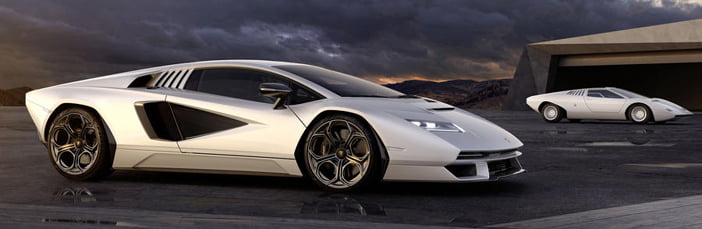
+++ The designer of the groundbreaking LAMBORGHINI Countach, Marcello Gandini, has issued a remarkable statement to the press regarding the recently released Countach LPI 800-4. In it, he repeatedly affirms that he had nothing to do with the revived Countach that Lamborghini revealed at Monterey Car Week on the occasion of the model’s 50th anniversary. Gandini alleges that Lamborghini may have misled the public into thinking he had something to do with the Sián reskin, and he wants to make it clear that he had nothing to do with it. “The external public, seeing and reading what has been communicated by Automobili Lamborghini and consequently by the media during recent weeks, may be led into believing that Marcello Gandini was a part of, or was involved with, or the project may have had his blessing. It is therefore appropriate to clarify the facts and reiterate that he did not participate in, nor was he aware of the project in any way”. Rarely has a designer of Gandini’s stature and repute so publicly refuted a company they’ve worked for. Though Gandini penned cars from the humble Renault 5 to the masterful E12 BMW 5 Series to the incredible Lancia Stratos, it is Lamborghini (where he was responsible for the legendary Miura, Espada, Marzal and Countach, among others) that Gandini is historically most closely associated with. Some of the confusion Gandini references stems from a video published by Lamborghini earlier this year. In it, Gandini talks about his design philosophy (which, ironically, includes breaking new ground with every design) and current Lamborghini head of design Mitja Borkert presents Gandini with a scale model of the then-upcoming Countach LPI 800-4. The latter believes that his presence in the video equates to tacit approval of the new design. “Neither earlier, nor during the interview was it stated that the car was scheduled for limited series production. With the elegance and kindness that have always distinguished Marcello Gandini, when Mitja Borkert presented the scale model during the interview, the former did smile and acknowledge as would be customary to do so”. Gandini believed that the model was the end of it, but after Lamborghini pulled the wraps off of the LPI 800-4, he says he received “countless requests for clarification” from press and colleagues in the auto design field. He decided to issue the statement to make clear he had nothing to do with the remake. Furthermore, he wants the public to know that he’s against the idea altogether. And though he doesn’t criticize the design itself, he skewers the notion of a remake. “Thus, Marcello Gandini would like to reaffirm that he had no role in this operation, and as the author and creator of the original design from 1971, would like to clarify that the makeover does not reflect his spirit and his vision. A spirit of innovation and breaking the mould which is in his opinion totally absent in this new design: ‘I have built my identity as a designer, especially when working on supercars for Lamborghini, on a unique concept: each new model I would work on would be an innovation, a breaker, something completely different from the previous one. Courage, the ability to create a break without sticking to the success of the previous car, the confidence in not wanting to give in to habit were the very essence of my work’, explains Marcello Gandini. ‘It is clear that markets and marketing itself has changed a lot since then, but as far as I am concerned, to repeat a model of the past, represents in my opinion the negation of the founding principles of my DNA’ “. For its part, Lamborghini has issued its own response to Gandini. The company explains that the Countach LPI 800-4 was the work of designers at their Centro Stile and R&D department. “The company has never attributed any role to Marcello Gandini in the realisation of the Countach LPI 800-4. Instead, Automobili Lamborghini have invited Mr Gandini to take part in an interview that took place in June 2021. This was a conversation with the designer and Head of Centro Stile Lamborghini about the comparison between the old model and the new one”. It’s understandable that Gandini wants to protect his legacy and name, but it also seems obvious that Lamborghini never meant to mislead the public about his involvement. However, it must be said that all 112 units have already been sold out, so someone out there does appreciate them. All in all, it’s a regrettable misunderstanding that has marred what should otherwise be a golden anniversary celebration of one of the most famous and beloved cars of all time. Perhaps we should just ignore it and revel in the Countach LP500 concept rebirth instead. +++
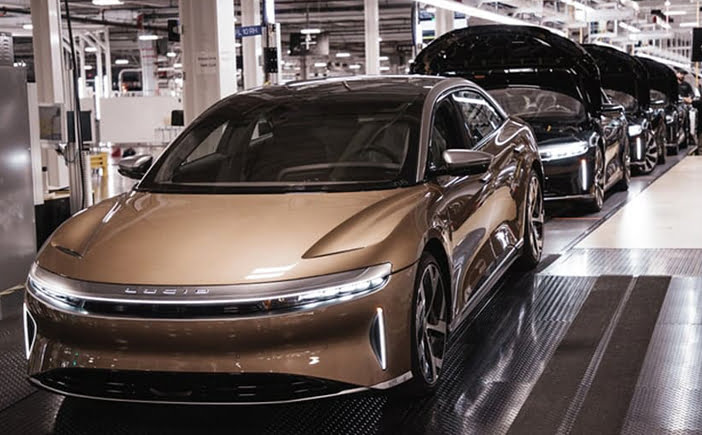
+++ LUCID MOTORS is about to reach a major milestone. Nearly 5 years after it unveiled its first prototype, and a few days after it released a photo of six EVs parked on a car hauler, it announced that it will start delivering the Air to reservation holders on October 30. Built in Arizona, and available with a 830 km driving range, the electric Air was designed largely to lure buyers away from the Tesla fold. This goal partially explains why Lucid won’t launch the sedan by merely trucking it to the folks who paid for it: it will host an event called Dream Delivery that buyers in line to receive the first batch of cars will travel to. Executives and engineers will attend the party to show new owners what their new sedan is capable of in terms of ride, handling and performance. There’s no word on how many cars will be delivered. In September 2021, Lucid revealed it’s sitting on approximately 13.000 reservations. Although that’s a very small number in the grand scheme of things, it’s a good start for a young company that has never made a car and that just fired up a new factory for the first time. Lucid explained that it plans to deliver 520 customer-configured units of the Air Dream Edition before it turns its attention to cheaper and less powerful variants. Dream buyers will have two variants to choose from called Performance and Range, respectively. Each one does exactly what the name suggests: one puts a big focus on performance and the other prioritizes range. Customers waiting for a Grand Touring model will get it after every Dream Edition has been delivered, while Touring and Pure models will be delivered at some point in 2022. Looking ahead, the first Lucid crossover is tentatively scheduled to make its debut in 2023. It will offer about 400 miles of driving range. +++
+++ MERCEDES-BENZ originally planned to sell the EQC om the American market from 2020 onwards. It was delayed last year for obvious reasons. Then, come February of this year, Mercedes-Benz told “Following a comprehensive review of market developments, the EQC will not be offered in the United States for now”. The EQC will eventually be sold in North America, but it won’t be until “around 2025”. As disappointed as Mercedes dealers will be not to get a product they’d really like to offer, the delay makes sense. Mercedes-Benz USA CEO Dimitris Psillakis served up a bowl of truth when he told in May: “When you launch a new brand, you have to have the right products. We cannot come to the market with half-cooked plans”. The EQC could have looked partially uncooked on arrival. It’s based on the regular GLC with an internal combustion engine that’s been on sale for 5 years, currently Mercedes’ bestselling vehicle in the U.S. With the EQS electric sedan and its wow-factor hyperscreen headed to dealerships, the EQC interior might have been perceived as an unacceptably steep comedown even for a vehicle costing $34.000 less than the EQS. It makes more sense for the brand to lead with its best, on top of not wanting to disappoint a bread-and-butter crowd. Furthermore, next year brings another tranche of dedicated electric crossovers that aren’t burdened by platform compromises, meaning the market would be moving further ahead of the late-arriving EQC. In it’s current form, the Mercedes uses an 80 kWh battery rated for 411 km on the European WLTP cycle; a range figure that could put it last in its competitive set of the Audi e-Tron, Jaguar I-Pace and Tesla Model X. Finally, Mercedes would be better helped selling every EQC it can build in Europe, where fleet emissions targets are challenging and penalties for missing targets are punishing. We can expect the second-generation EQC built on Mercedes’ new dedicated Modular Architecture for EVs. The new bones and technology will result in a better interior with more interior room compared to the current EQC, as well as more range and faster charging. Mercedes also told dealers it will bring its battery-electric C-Class sedan, sitting on the same architecture, to the U.S. in the same timeframe as the EQC. +++
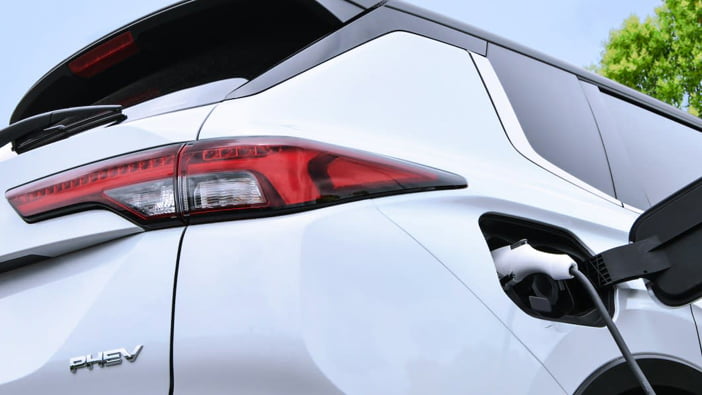
+++ So it turns out we still don’t have full details on the new MITSUBISHI Outlander PHEV. Information will continue to trickle out instead. But at least we have information on one of the SUV’s most critical parts: the battery pack. It has more capacity, and should have more range. The outgoing Outlander PHEV had a 13.8 kWh battery pack good for 30 to 40 km of all-electric range. The new model’s battery expands to 20 kWh. On the WLTP cycle, it’s good for 86 km. But it would still trail the RAV4 Plug-in’s range. Mitsubishi also noted that the gas tank has expanded, too, so the Outlander PHEV’s overall range should increase. Despite all this, the plug-in hybrid also retains a third row of seats, something its predecessor lost. This is due to a revised rear motor that includes the motor controller as part of the unit. The previous model had the controller located in the passenger compartment. Mitsubishi says this freed up interior room for the rear-most seats and also reduced the amount of high-frequency noise in the cabin. As for the powertrain itself, Mitsubishi isn’t sharing output details. All it has said is that the Outlander PHEV still has dual electric motors, plus a gas engine. That engine is a 2.4-liter 4-cylinder similar to the current model. The press release Mitsubishi provided suggests the electric motors are more potent, so we may see more than the 224 combined horsepower of the outgoing model. The Outlander PHEV will go on sale in the United State in the second half of next year, but there are no plans to offer it in Europe. +++
+++ STELLANTIS ‘ 4 new electrified platforms are expected to each underpin the production of 2 million vehicles a year, the automaker’s head for Italy said. Since the creation of the world’s 4th largest carmaker at the beginning of this year through the merger of Fiat Chrysler Automobilbes and Peugeot SA, chief executive Carlos Tavares has pushed for a convergence of the combined group’s 14 brands to achieve a goal of over €5 billion in annual synergies and accelerate its transition to cleaner mobility. Stellantis will invest over €30 billion through 2025 on electrifying its vehicle lineup. As part of this plan, the group has announced it was setting up four new platforms. They are STLA Small, STLA Medium, STLA Large and STLA Frame. By 2024, Stellantis aims for over 800 km of range, 0-100 kph in 2 seconds and charging 320 km of range in 10 minutes. They will underpin vehicles as diverse as small cars for Europe, and a Dodge EV muscle car and Ram electric pickup. “The 4 platforms are designed with a high level of flexibility and parts sharing, to create scale economies”, said Santo Ficili, Stellantis country manager for Italy. “In this way, each platform will be able to support the production of up to 2 million units every year”. Stellantis is targeting for more than 70 % of its sales in Europe to come from low-emission vehicles by 2030, and aims to make the total cost of owning an electric vehicle equal to that of a gasoline-powered model by 2026. Ficili said that while costs to produce electric cars were higher than for traditional combustion engine models, there was more urgent need to focus on giving buyers access to electric cars through better financing and more extensive charging infrastructure. +++
+++ In the UNITED STATES , the global computer chip shortage cut into third-quarter profits at both Ford and crosstown rival General Motors, with both companies having to temporarily close factories, pinching supplies on dealer lots. Ford’s net income of $1.83 billion fell 23 % from a year ago, while GM’s profit dropped 40 % to $2.4 billion. High prices, mainly for the pickups and big SUVs that the automakers sold, eased the sting from lower sales. Ford said it would resume paying a dividend, 10 cents per share, starting in the 4th quarter. It will cost the company about $400 million per quarter. The company said its revenue dropped 5 % from a year ago to $ 35.68 billion. That fell short of Wall Street estimates of $38.2 billion. Excluding one-time items, the Dearborn, Michigan, company made 51 cents per share, beating the 27 cents expected by analysts polled by FactSet. Ford’s sales fell 27 % from July through September in the U.S., its most lucrative market. The company also lost 2.4 percentage points of U.S. market share, largely because like GM, it couldn’t produce enough vehicles to meet demand. But the average Ford new vehicle sold for more than $51,000 during the quarter, up almost 13 % from a year ago. Chief financial officer John Lawler said Ford has the cash and income to invest in electric vehicles and services. He said the company is confident in the trajectory of its business. “That’s providing us the financial flexibility to fully fund our plan and all of our other capital needs”, he said. “We also are focused on total shareholder returns, not only appreciating stock price but also the dividends”. Lawler said there is strong demand for Ford’s products that the company can’t meet because of the chip shortage. Globally, he said he thinks the company could sell 200.000 Mustang Mach-E electric SUVs per year. He said the chip shortage should ease a bit from October through December and sales to dealers should rise 10 % this quarter over the previous one. While supplies will improve, the shortage will continue into next year and possibly into 2023, he said. Ford raised its full-year pretax earnings outlook to between $10.5 billion and $11.5 billion, and said it plans to make capital investments of $40 billion to $45 billion from 2020 to 2025. That includes about $15 billion that will go toward battery-electric vehicles during the period. Lawler cautioned, however, that the company faces higher costs in materials and freight. Commodity costs such as steel are expected to rise $3 billion to $3.5 billion this year, and another $1.5 billion next year, he said. GM’s earnings fell from $4 billion last year as sales slumped and the company lost market share in the U.S., its most profitable country. Revenue for the quarter plunged 25% to $26.78 billion. GM CEO Mary Barra, meanwhile, said on a conference call with analysts that she is “pretty confident” that GM’s San Francisco-based Cruise autonomous vehicle subsidiary would be carrying passengers without human safety drivers sometime next year. To do that, Cruise still needs a final permit from California regulators. Barra also told reporters that the global shortage of semiconductors, plus Covid outbreaks at supplier factories, hit the company during the third quarter. “It still continues to be somewhat volatile”, she said. However, GM is seeing improvement in the current quarter and expects additional supplies in the first 3 months of 2022. GM has said it expects to produce about 200.000 fewer vehicles in the second half of this year compared with the first half, with most of the impact occurring from July through September. Barra said she’s spoken with the CEOs of most major chip makers, and the companies are working on strategies to make sure the shortages don’t happen again. “I think we’ll definitely see changes to ensure we have the right supply”, she said. GM’s profit came even though U.S. third-quarter sales were almost 33 % lower than a year ago. The company lost 3.8 percentage points of U.S. market share. But Barra said she expects GM’s market share to bounce back when factories get back to normal production. “We are selling everything we can. I wish we had more vehicles”, she said. Consumer willingness to pay high prices for scarce new vehicles kept the money flowing for GM. The average sale price paid for a GM vehicle topped $50.000 for the quarter, up more than 16 % from a year ago. Barra said that once supplies grow, she expects the high prices to ease. With the expected improvement in chip supplies, GM increased its full-year net income guidance to a range of $8.1 billion to $9.6 billion. In the second quarter it had forecast $7.7 billion to $9.2 billion for the year. +++