
+++ Water. Giver of life, destroyer of electronics. As cars get more packed with technology, the risk of a liquid disaster increases. Case in point: The BMW X7 is the subject of a class-action lawsuit that alleges a design flaw can cause airbags to malfunction when wet. As it happens, the airbag module in question is located right under the cupholders. Paperwork to kick off the lawsuit was filed last week at a U.S. District Court in Orange County, California. The suit claims that the cupholders found on the X7 are “not properly designed to hold cups filled with liquid”. Apparently, fluids that have escaped their containers can leak through the X7’s cupholders and onto a sensitive SRS (supplemental restraint system, aka airbag) module located beneath them. Users have written about their experiences, which include an SRS warning light illuminated on the dashboard after liquid seeped below the cupholders. To be clear, this user claims that 1-2 oz of liquid seeped out of the bottom of a paper cup, and that it wasn’t a splashing spill situation. While there don’t appear to have been any reports of airbags deploying as a result, the lawsuit alleges that a faulty deployment could occur. Instead, users have reported repair bills for the SRS module that have totaled a couple thousand dollars. Requests to cover the repairs lodged to BMW North America customer service have been rebuffed. Warranty claims have been rejected as well, as BMW considers the liquid “outside interference”. The plaintiffs believe that the cupholder flaw may not be limited to the X7. It’s not clear whether other BMW models have the same problem. +++
+++ The HYUNDAI MOTOR GROUP raised its global electric vehicle (EV) sales target for 2026 to 1.7 million units from 1 million units, its chief executive has said, underscoring the automaker’s push to meet the growing EV demand. Hyundai Motor CEO Chang Jae-hoon made the remark in an interview, saying that the company will double the EV lineup to at least 13 models by 2026. “That’s very ambitious. Next year, we expect to sell about 220.000 EVs around the world for Hyundai and Genesis, which is about a 56 percent increase over what we expect this year”, Chang said. The updated sales target combines the sales from Hyundai, Kia and Genesis, according to Chang. Prior to the revision, Hyundai had set the global EV targets at 560.000 units by 2025 and Kia at 500.000 units by 2026. Chang said that the automaker has been aggressive in its electrification plan toward carbon neutrality, and how to bring the transition faster is one of its goals. “In 2035, there will be 100 percent carbon neutrality in Europe. That will be followed by major markets like the US We’re going to keep this pace around the world”, Chang said. Regarding the US market, Chang explained that Hyundai is shortening the production development schedule to have more EVs by 2025-2026, adding that it needs to procure 50 percent of the total sales from EVs by 2030. “We see a clear signal from the market that demand will be increasing. There is a big momentum in how customers feel about EVs and the Biden administration is also driving more eco-friendly EV policies”, he said. +++
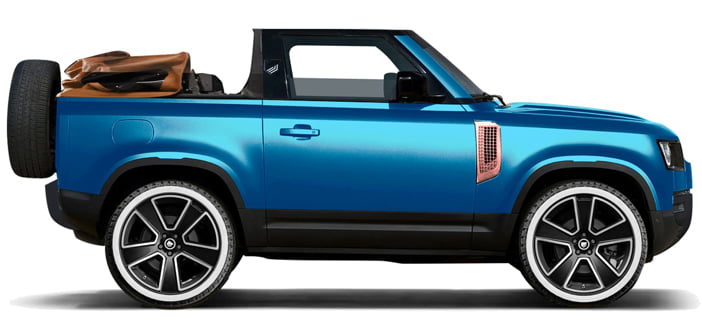
+++ LAND ROVER ’s reinvented Defender has been a success story the world over for the brand. But die-hard fans of the original may think there is still something missing: a convertible version. That’s where Dutch coachbuilder Niels van Roij Design steps in. The company’s Heritage Customs division has announced it will produce a select number of drop-top variants of its Valiance, an upgraded and modified version of the new Defender. Just 5 build slots for the hand-built model will be allocated for 2022, and if official communications are to be believed it looks unlikely that any further examples will be produced. Each will be priced at €138,000 excluding taxes. The Valiance Convertible is based on the short-wheelbase Defender 90, and has only been shown in design renderings and sketches so far. It retains the same proportions, and the lower half of the body is identical to the standard car’s, but what appears to be a part-electric fabric roof has been engineered in to replace the hard top. The company has detailed 3 custom ‘curations’ of the Valiance Convertible to help inspire customers. The first, dubbed the Cote d’Azur, features bespoke blue paint and whitewall tyres, while the Solihull Sand version references the original 1948 model. Finally, the Kokkini Paralia model has dark matt red exterior paint. All feature bespoke detailing, customised interiors and Magic Metal interior and exterior packs. Heritage Customs claims customers can “work closely with their team of specialist designers and craftspeople via the personal commission guide called Architecture”. In this program patrons can create or enhance their own unique Heritage Customs vehicle. +++
+++ LOTUS has ended production for all three of its stalwart models, with the final Elise, Exige and Evora models rolling off the production line ahead of the launch of the new Emira-led era. Combined, Lotus has produced 51.738 units of the 3 models, which amounts to nearly half of the firm’s total production over its 73-year history. The final version of each car to be finished will be kept in Lotus’ heritage collection. The new Emira will go into production in spring 2022. It will be the final pure combustion-engine Lotus, and the first new series production machine since the firm was bought by Geely, and along with the Evija hypercar will mark a new era of future models. Lotus boss Matt Windle paid tribute to the team who have worked on the 3 cars, noting that they would transfer their expertise to producing the Emira and Evija. He added: “I would also like to convey enormous gratitude to all the customers of the Elise, Exige and Evora over the last 26 years for their passion, enthusiasm and support”, said Matt Windle, Lotus managing director. “These customers have given our ‘three Es’ true cult status; usually reserved for long-out-of-production classics. As we say farewell to the last few cars, we look forward to the Emira and Evija in the all-new factories at Hethel and sub-assembly facilities in Norwich, which introduce greater efficiencies and automation, higher quality and flexibility and the hugely exciting next chapter in our Vision80 strategy”. The Elise, first produced in 1996, has gained a Sport 240 Final Edition in yellow which is the final model out of 35.124 cars produced. The last Exige is a Cup 430 Final Edition in heritage racing green and is the 10.497 th example to come out of Hethel. The model launched back in 2000. The 2 models are based on Lotus’ small car platform that was also used to produce the Opel Speedster and the original Tesla Roadster. Around 7.200 Speedsters and 2.515 Roasters were produced alongside the Lotus 340R, Europa, 2-Eleven and 3-Eleven cars for 56.618 cars produced on the platform. The larger Evora first hit roads in 2009. Its final model is painted in dark metallic grey and represents the 6.117th Evora out of the firm’s Norwich factory. “Together with the Lotus design team, I have lived and breathed these cars for over 26 years”, said Russell Carr, Lotus’ design director. “We will miss them, but a bit like Christmas, once it’s over, the excitement for the next one starts to build, and that’s what’s happening now at Lotus with the Evija, Emira and forthcoming Type 132. 2022 is going to be a great year as a new Lotus generation swings into action”, said Carr. +++
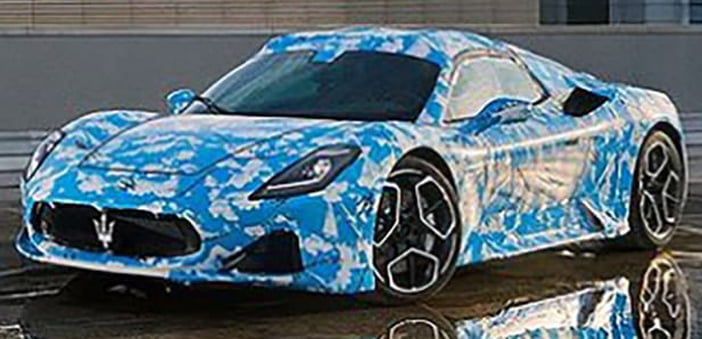
+++ MASERATI is pushing forward with its new model rollout, teasing another model due to arrive in 2022 alongside the Grecale SUV, GranTurismo GT and GranCabrio convertible. The recently launched MC20 supercar is likely to be joined by a convertible version next year, and Maserati has released the first official images of the Lamborghini Huracan EVO Spyder rival. Captioned “An early prototype of the new MC20 convertible has exited the gates of our Modena plant” , the new images show the MC20 in typical prototype camouflage wrapping. We can see that the roof is a hard top, suggesting it’ll have a similar folding metal roof arrangement to cars such as the Ferrari F8 Spider and McLaren 600LT Spider. Elsewhere, there seems to be little visual difference between the already revealed coupe and this drop-top version. It is also unclear if it will simply be dubbed ‘convertible’ or if it will adopt the ‘Spider’ nameplate. Expect to see the price increase somewhat over the €270.000 figure (Dutch pricing) for the MC20 coupe, perhaps nudging the €300.000 mark (which would still undercut the F8 Spider by almost €30.000). Weight will likely increase over the 1.475k g figure quoted for the coupe on account of the complex roof mechanism. I’m expecting to see the MC20 Spider arrive with the same mid-mounted 621 hp ‘Nettuno’ twin-turbo V6 as the coupe, which arrives in the showrooms in the next couple of months. That should make it capable of 0-100 kph in around 3 seconds, although it remains to be seen if the 324 kph top speed of the coupe will be reduced by the folding roof. However, unlike the majority of Maserati’s rivals, the brand also intends to launch a fully electric version of the MC20 in due course. It was also due to launch in 2022, but it’s unclear if this has been pushed back due to the same pandemic and chip shortage-related delays that pushed back the launch of the Grecale. +++
+++ POLESTAR will commence sales in South Korea next January and aims to introduce at least 1 new electric vehicle (EV) model every year through 2026. The Gothenburg, Sweden-based automaker said the Polestar 2, its all-electric hatchback, will be sold in Korea starting January 18. “We plan for the cars to be delivered sometime after mid-March”, said Lee Se-min, head of commercial operations. The Polestar Precept was introduced at Destination Seoul, its first Korean showroom, which opened Tuesday at Hannam-dong, central Seoul. The vehicle is a concept car and will be available in 2024 as Polestar 5. It will be exhibited at the venue for a week. The all-electric Polestar 3 SUV will be sold next year, and the Polestar 4 will be available in 2023. Polestar aims to sell 30.000 cars in South Korea by end of 2026. “With our strong founding parent companies, Volvo Cars and Geely Holding, we have direct access to the expertise and economies of scale needed to deliver quality products, with established processes, support and networks already in place”, said Thomas Ingenlath, CEO of Polestar, via video message at the event. Polestar is a joint venture established in 2017 between Volvo Cars and its Zhejiang, China-based parent company Geely Holding. Polestar Korea was established as a wholly owned subsidiary in March. Customers who buy the Polestar cars will be able to have their vehicles checked and serviced at 31 Volvo service centers across the nation. Polestar said the roll out of Polestar 2 will not be affected by the chip supply shortage. “The chip supply issue that all manufacturers are dealing with was also evident at Polestar in 2020”, said Kim Nam-ho, head of pre-sales. “However, all problems were solved ahead of our Korean sales slated for 2022, and we are certain there will be no chip supply issues for cars sold in Korea”. A spokesperson for the company said it has been planning for sale of Polestar 2 since last year, and was able to source sufficient components. Ahead of sales, the company announced it will spend 50 billion won to open various showrooms and “retail touch points”, places where cars are stocked and people can go for test drives. Its second showroom, Space Gyeonggi, will open Dec. 31 at the Starfield Hanam, a shopping complex in Gyeonggi. Its Space Busan showroom will open at the Centum City mall in Haeundae District, Busan, on January 19 next year. Destination Jeju is expected to open on the island next March. Seven retail touch points will be built in major cities in Korea in 2022. Another 3 will be added by the end of 2024. Polestar’s showrooms don’t sell cars but allow customers to see the vehicles, be briefed about them from “Polestar Specialists” and take test drives. Orders can only be made online, and the company said it partnered with a financial firm, unnamed, to offer safe online payment services. It also has plans to work with local companies in battery and chips in the future. +++
+++ For better or worse, TESLA may have invented a category of cars that slots between new and used. Its online inventory of vehicles lists several 2021 examples of the Model 3 that are equipped with a battery pack built as far back as 2017 and that has degraded accordingly. Buyers can’t order a nearly-new EV with an older battery through the company’s online configurator; instead, they need to browse Tesla’s inventory of new and used cars. Enter a valid zip code, tick the “Model 3” and “new” boxes, and you’ll notice that some of the results come with a warning: “range figures may be up to 12% lower due to battery age”. This only applies to 2021 cars that are labeled as new; click the “used” box and there’s no mention of battery degradation, which certainly doesn’t mean that the battery hasn’t lost part of its capacity. “This vehicle was built with a battery pack manufactured as early as 2017. While this pack was brand new when the vehicle was built, the cells have reduced capacity due to their age and you can expect up to 12 % reduction in range from current production specifications”, the company notes. How a car titled as a 2021 model ended up with a battery pack manufactured in 2017 remains a rather enigmatic point. One explanation is that the new-old Model 3s are labeled as demo vehicles, meaning they were likely used for test drives, and Tesla could have installed older batteries in the cars it sets asides for its stores. These EVs may also be ex-engineering test mules or cars that customers declined. Regardless, it sounds like Tesla is sitting on an inventory of old, unused batteries. Tesla’s disclaimer and its definition of the term “brand new” are murky. What’s made clear is that the pack was “brand new” when the vehicle was built. And yet, it was manufactured “as early as 2017” and it’s installed a car titled as a 2021 model, so one presumably not made in 2017. Should we assume that “built and stored for a couple of years” means “brand new” in Tesla-speak, and not “new-old-stock”? Tesla hasn’t commented on the report. +++