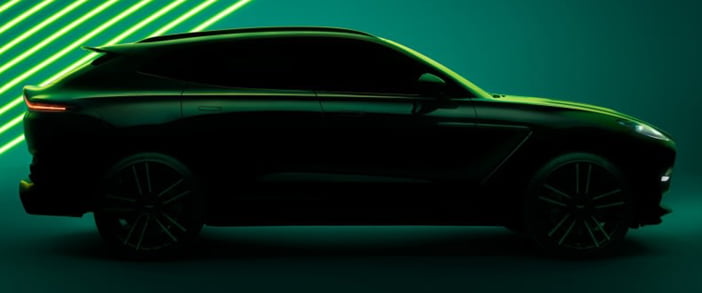
+++ ASTON MARTIN is slowly taking the wraps off of a more powerful evolution of the DBX. Possibly assigned the S suffix, the hot-rodded family-hauler will stand proud as the world’s most powerful luxury SUV when it makes its official debut online on February 1, 2022. The model remains shrouded in darkness, but the latest preview image published by the British firm is a lot more informative than the video it previously released. We can tell several styling cues differentiate the S and the regular DBX, including model-specific wheels and a bigger roof-mounted spoiler. It also looks like the quicker and more powerful variant rides lower, which hints at a series of suspension tweaks. As I’ve previously reported, the DBX S will likely land with a V8 engine rather than with a V12. Specifications haven’t been released yet, but Aston Martin pledged that it designed the model as “the world’s most powerful luxury SUV,” a crown that will require over 670 horsepower to claim. I’m guessing that the 8-cylinder in question will be a version of the Mercedes-AMG sourced 4.0-liter found in the standard DBX, among other Aston Martin models. It will be twin-turbocharged, and it will spin the 4 wheels via an automatic transmission; nothing suggests that the S will be a hardcore, track-ready machine with a 7-speed manual transmission and a gutted interior. More information about the 2023 Aston Martin DBX S (assuming that’s indeed what it’s called) will emerge in the coming days, and its full reveal is scheduled for February 1, 2022. Sales should start shortly after with a base price pegged somewhere north of €300.000 in the Netherlands. +++
+++ South Korea’s LG Energy Solution (LGES) plans to spend $2.1 billion with General Motors to build a U.S. electric vehicle (EV) BATTERY PLANT , parent firm LG Chem said on Tuesday. LGES and GM are expected to fund the project equally via Ultium Cells, their U.S.-based battery joint venture, for what will be their third joint battery plant in the United States, LG Chem’s regulatory filings showed. LGES declined to provide detail on the location or production capacity of the new plant. However, Reuters reported in December that GM had proposed building a $2.5 billion battery plant near Lansing, Michigan, with a third party, likely LGES. LGES commands more than 20 % of the global electric vehicle battery market and supplies Tesla, Volkswagen and Hyundai Motor, among others. It is already building 2 plants with GM in Ohio and Tennessee to manufacture 70 GWh of batteries, which could power about 1 million EVs by 2024. LGES has production sites in the United States, China, South Korea, Poland and Indonesia. Its announcement came ahead of the company’s market debut later this week after launching South Korea’s biggest ever IPO. The IPO attracted $12.8 trillion worth of bids from institutional investors and $96 billion from retail investors. The IPO price values LGES at about 70.2 trillion won ($58.57 billion) and will make it South Korea’s third most-valuable company after Samsung Electronics and SK Hynix. +++
+++ BENTLEY ’s first electric car, to arrive in 2025, will be built at the luxury firm’s Crewe plant in the UK, it confirmed today. The news cements the future of the Bentley factory, which employs 4.000 people, as it commits £2.5 billion to the site and research and development over the next decade with a particular focus on sustainability. While it has long been hoped that Bentley EVs would be built at the plant, CEO Adrian Hallmark told Autocar in 2020 that it must earn the right to do so ahead of its Volkswagen Group peers. That has now happened. He said at the time: “We started building in Crewe in 1936 and we’ve invested hundreds of millions in infrastructure and certification for electrification, so we have the capability to do it. But the important thing to note is that we still have to be competitive, and fight to ensure the maximum possible content for our cars is made in Crewe. We are part of a group so we must prove we are the best option, but from a brand point of view, it is our mission to ensure everything can be built here”. Unpainted bodies of the upcoming EV will, however, be built in the Volkswagen Group plant in Hanover, Germany, before being shipped to Crewe. A sibling EV from Audi (which has led the development of the luxury EV platform) is set to be assembled at the Hannover site. Today’s announcement forms part of Bentley’s Beyond100 strategy, which was launched in 2020 and will see Bentley go exclusively electric and fully carbon neutral by 2030. Alongside the existing site, Bentley will build a new greenfield facility. Not all of the land for the expansion is yet purchased, but any facility will be adjacent to the current buildings rather than at another location in Crewe. The so-called ‘Bentley Dream Factory’, which includes the existing site and the upcoming expansion, is intended to transform Bentley operations “into the future benchmark of luxury car manufacturing with unique customer and employee experiences”, incorporating next-generation digital manufacturing concepts as well as having a low environmental impact. Hallmark said: “Beyond100 is the boldest plan in Bentley’s illustrious history, and in the luxury segment. It’s an ambitious and credible roadmap to carbon neutrality of our total business system, including the shift to 100% battery-electric vehicles in just 8 years. “Our aim is to become the benchmark not just for luxury cars or sustainable credentials but the entire scope of our operations. Securing production of our first BEV in Crewe is a milestone moment for Bentley, and the UK, as we plan for a long-term sustainable future in Crewe”. Bentley’s manufacturing board member Peter Bosch added: “We are already marking the pinnacle in luxury car production and have already transformed our factory to become carbon neutral, with industry-leading environmental credentials. With our new ‘Dream Factory’ concept, we now go to zero also with water, waste and other environmental impacts until 2030. Unique craftsmanship, customer interaction and employee experience will be enhanced by digital tech, higher flexibility and new ways of personalisation. We will develop the best of Crewe into the future benchmark of luxury car manufacturing”. +++
+++ Hyundai and affiliate Kia have climbed one spot to 4th place in the EUROPEAN CAR MARKET to claim it from BMW. The European Automobile Manufacturers’ Association said Tuesday the combined share of Hyundai and Kia in Europe last year was 8.7 percent, a record high. The automakers sold more than 1 million cars together, up more than 21 percent on-year, despite a 1.5-percent contraction in European vehicle sales overall. Among their bestselling models were Hyundai’s Tucson with some 147.000 cars sold and Kia’s Ceed with 135.000 cars. The bestselling eco-friendly model was Kia’s Niro with around 89.000 units. Volkswagen topped the market, followed by Stellantis and Groupe Renault. +++
+++ GENERAL MOTORS announced a $7 billion investment in Michigan manufacturing, much of which is earmarked for EV production. 4 sites are included, but the key elements are a new battery cell plant in Lansing and the conversion of GM’s existing Orion Township facility to expand production of the forthcoming Chevrolet Silverado EV and its GMC Sierra sibling. GM says it is the largest investment announcement in company history and that it will create 4.000 new jobs. It also says 1.000 jobs will be retained. “We are building on the positive consumer response and reservations for our recent EV launches and debuts, including the GMC Hummer EV, Cadillac Lyriq, Chevrolet Equinox EV and Chevrolet Silverado EV”, said GM CEO Mary Barra. GM says the Orion expansion and new battery plant will support an increase in full-size electric truck production capacity to 600.000 units. This is in addition to the Factory Zero facility in Detroit that will also be constructing the electric Silverado and Sierra. The Orion Township factory current builds the Chevrolet Bolt EV and EUV, and will continue to do so during the plant’s conversion. GM did not indicate what will happen with the Bolts once that conversion is complete or whether all will continue to be built at Orion. They do not use the Ultium vehicle architecture. GM will build other EV models at 3 other factories that are under construction or being converted. They are located in Spring Hill, Tennessee, Ingersoll, Ontario, and Ramos Arizpe, Mexico. GM says that it will have the ability to produce 1 million electric vehicles by 2025. The Ultium Cells Lansing facility is a $2.6 billion joint investment by GM and LG Energy Solution. GM says it alone will create 1.700 jobs once fully operational by late 2024. It will join two other GM Ultium Cells battery factories currently under construction in the United States, one in Ohio and the other in Tennessee. Not all of the $7 billion investment will be for EVs. It also announced $510 million of the total will go toward upgrading the Lansing Delta Township Assembly to produce the next-generation Chevrolet Traverse and Buick Enclave. Money will also go to upgrading Lansing Grand River Assembly. That currently builds the Cadillac CT4, Cadillac CT5 and Chevrolet Camaro, but there was no mention of those in GM’s release: just “investment is for plant upgrades”. That’s probably not a good thing for Camaro enthusiasts. +++
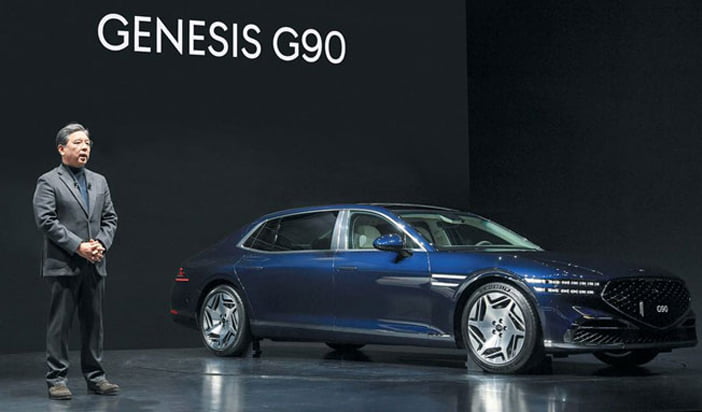
+++ Hyundai’s luxury brand GENESIS released its fully revamped G90 sedan. The sedan will compete with the Mercedes-Benz S Class and BMW 7 Series. Hyundai said, “The G90 is an amalgamation of Genesis’ cutting-edge technologies”. Hyundai CEO Chang Jae-hoon speaks at a press event in Yongin, Gyeonggi Province on Tuesday, ahead of the release of the Genesis G90. The interior was designed for comfort and space, with all seats equipped with massage functions, while 23 Bang & Olufsen speakers deliver surround sound. A parking-assist system using wide-angle-lens cameras enables automated parking. The G90 costs between W89.6 million and W166 million depending on the trim (US$1=W1,186). The carmaker also plans to release it in China, the Middle East and the U.S. +++
+++ HYUNDAI achieved record-high earnings last year with operating profit surging a whopping 179 percent. The stellar performance stemmed from increased sales of SUVs and premium sedans overseas despite a shortage of automotive semiconductors. The carmaker said Tuesday that 2021 sales reached W117.6 trillion, while operating profit totaled W6.68 trillion (US$1=W1,198). Sales edged down the previous year due to the coronavirus pandemic but increased 13.1 percent again in 2021. Last year’s operating profit was the highest in 7 years. Hyundai sold 3.89 million cars around the world last year, and SUVs accounted for 47 percent and the Genesis premium brand for 5 percent. “Rising sales of high value-added automobiles led to more than a W1.8 trillion increase in operating profit”, the company said. Sales increased in all major markets overseas except China, surging 26 percent in Europe to 590.000 cars and 22 percent in North America to 960.000. +++
+++ KIA grabbed the top spot in terms of car sales in the domestic market last year. According to Carisyou, a website that tracks auto sales, Kia sold 469.361 vehicles while Hyundai sold 430.489. Although Hyundai’s figure excludes cars manufactured under its premium brand Genesis, this is the first time Kia has surpassed Hyundai in terms of domestic sales. In the imported car market, Mercedes-Benz sold 76.284 vehicles here and BMW sold 65.682, outselling Korea’s 3 smaller carmakers: Renault Samsung (59.995), Ssangyong (55.697) and GM Korea (52.275). While their assembly lines were idle for a long period amid a global shortage of semiconductor chips in addition to a lack of new models, demand for luxury vehicles soared here. Tesla sold 17.828 vehicles, ranking 4th among imported brands after Audi just 4 years after launching sales in Korea. +++
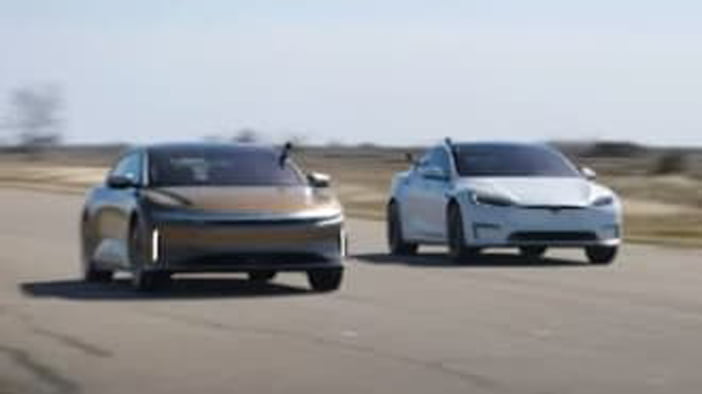
+++ Now that the LUCID AIR is a practical reality, there’s a looming question: how well does it fare in a drag race against the other well-known electric luxury sedan, Tesla’s Model S Plaid? You now have a better idea. DragTimes has shared a long-teased video of a quarter-mile faceoff between the Air and Model S Plaid, and the outcome is at once expected but still full of insights. It won’t shock you to hear the Model S Plaid wins 3 of the 4 runs, including one with a rolling start. It has a shorter claimed 0-to-96 kph time (1.99 seconds versus 2.5) and its lighter curb weight (4.828 pounds versus about 5.200) helps offset the horsepower deficiency. The Tesla didn’t have its drag strip prep mode enabled, either. If you’re fortunate enough to cross-shop these EVs, the Model S is still your pick for raw acceleration. The Lucid Air still holds up well, though, and it even won a race when the Model S Plaid’s launch mode wasn’t engaged. That added power still matters, to put it another way, and this is worth considering if you’re more interested in green light races (where a launch mode likely won’t be an option) than drag strips. Lucid also pointed out that you can precondition the Air for better straight-line performance, and that it’s currently focused more on “luxury and efficiency” than speed. The conditions weren’t ideal between relatively chilly temperatures for the Houston-area strip and strong winds. You’ll likely see faster times elsewhere. Even so, the video is worthwhile as a rare chance to see how different electric car platforms manage in real conditions. It also shows just how far EVs have come: these are figures you’d have previously associated with higher-end supercars, not people carriers. +++
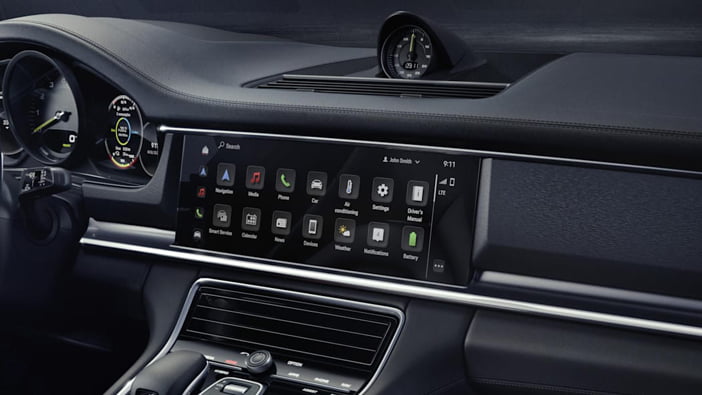
+++ PORSCHE announced its new PCM 6.0 infotainment system last year, but today the company has a few updates to share with us about this software. The most important update arrives for Taycan owners, who will get to experience a revamped charging planner. New in this update, the planner now prioritizes charging stations with a higher energy output. Porsche specifically says it will attempt to bring you to chargers that offer speeds of 150 kW and higher to take advantage of the Taycan’s super-fast charging capability. Additionally, Porsche has factored in the time it takes to start and end the charging process to your arrival time, such that you get a more accurate time predicted by the navigation system. And lastly, a new view mode allows you to zoom in and out in your immediate vicinity to survey charging stations and also determine if they are available for use or already taken. A filter in this mode allows you to sort the charging stations by their charging speed, so you can spot the fast ones, too. Beyond that, there are other updates that are applied to the Taycan, 911, Cayenne and Panamera. The interface itself is getting a heavy dose of color to make the icons easier to differentiate from each other. Plus, Porsche says it’s improved its voice assistant for better performance and greater use across various vehicle functions. The last update is to do with Spotify and its new integration into the infotainment system. You’ll be able to login to your Spotify account on the vehicle itself, which means you can stream directly from the car instead of using your phone via Bluetooth, or Apple CarPlay or Android Auto. Porsche says all of these updates will be fitted to newly-produced models, starting at some point in the next few weeks. It does not, however, provide details on when already-produced cars will be receiving the features. Porsche has said in the past that its PCM 6.0 infotainment will receive over-the-air updates to keep the software current, so it should just be a matter of time before existing cars with PCM 6.0 receive the upgrades. +++