
+++ As demand for lithium has risen sharply, Chinese BATTERY makers have accelerated steps to acquire lithium mining operations at home and abroad. All this is a result of the explosive development of new energy vehicles. Eve Energy, a Chinese lithium battery company, recently announced it has signed a strategic partnership agreement with Sunresin New Materials, a large special resin manufacturer based in Xi’an, Shaanxi province. Sunresin, a high-tech company, has mastered technologies to extract lithium from salt lakes. The partners will work together closely to improve the lithium resource industrial chain, and actively participate in the development and utilization of lithium resources at Jese Tsakha Salt Lake in the Tibet autonomous region. The company has also acquired a 49 percent stake in Qinghai Qaidam Xinghua Lithium Salt, founded in 2016, which is licensed to manufacture and sell lithium salts and boron compounds. The battery maker said the move will help it further focus on the main business of lithium batteries, expand the upstream industrial chain and optimize its industrial deployment. The global lithium market has seen prices moving to new record highs almost daily, boosted by limited supply and significant demand, according to S&P Global Platts, a provider of energy and commodity information. The trend is expected to continue into 2022, as supply tightness persists and demand for electric vehicles continues to grow. Seaborne lithium carbonate prices have surged 413 percent from the start of 2021 to December 14, while lithium hydroxide prices have climbed 254 percent over the same period, it added. These two forms of lithium can be used in electric vehicles and lithiumion batteries. Dong Yang, vice-president of leading automotive think tank China EV 100, said the price spike in the raw material is a result of tight supplies and surging demand for lithium batteries spurred by fast-growing demand for NEVs. Dong added that the soaring price of lithium will become a key factor restricting the development of the NEV industry, and affect the manufacturing and delivery of new NEVs. China has a large supply of lithium, but its deposits mainly exist in salt lakes which require complicated processes to extract, as well as in the Qinghai-Tibet Plateau, which can also complicate extraction due to weather conditions. All these factors can drive up costs. As a result, lithium carbonate and other lithium salts are highly dependent on imports. Most of the world’s high-quality lithium salts are in South America’s Lithium Triangle, which encompasses Argentina, Bolivia and Chile. Chinese lithium companies have beefed up efforts to expand their global footprint in a bid to secure key material supplies and lower the high cost of NEV batteries. Last month, Chinese battery material producer Zhejiang Huayou Cobalt said it will acquire a lithium mining company in Zimbabwe for $422 million. It is the latest acquisition of overseas battery mineral resources by Chinese companies looking to shore up supply to meet demand from the burgeoning electric vehicle sector. Chinese lithium manufacturer Ganfeng Lithium announced in June it planned to pay $130 million for a stake in a spodumene mine project in Mali, Africa. Spodumene is a lithium-rich mineral that can be converted into battery-grade lithium products. The company also bought 8.58 percent of shares in Litio Minera Argentina from Canada’s International Lithium through its wholly owned subsidiary Ganfeng Lithium Netherlands for $13.2 million in October. The company, headquartered in Xinyu, Jiangxi province, covers a wide swath of the lithium battery supply chain, from lithium resource development, refining and processing to battery manufacturing and battery recycling. Data from the China Automotive Battery Innovation Alliance showed that China’s output of storage batteries to power NEVs jumped by 163.4 percent on a yearly basis to reach 219.7 gigawatt-hours in 2021 as the NEV industry continued to boom. The output of lithium iron phosphate batteries reached 125.4 GWh last year, surging by 262.9 percent year-on-year. The country produced 93.9 GWh of ternary lithium batteries during the period, up 93.6 percent year-on-year. This type of battery uses metal oxides of nickel, cobalt and manganese and packs more punch for its weight than other batteries. Cui Dongshu, secretary-general of the China Passenger Car Association, said the accelerated exploitation of lithium resources will gradually expand production and alleviate the lithium resource shortage. Chinese companies, in obtaining permission to develop the resources, will expand production, helping moderate prices and alleviate supply shortages and high prices, experts said. “In 2022, the price of lithium will witness a slight increase, and the price is expected to gradually drop to a reasonable range in 2023”, Cui added. Yang Weibin, an independent power battery industry expert, said the rise in lithium prices will increase the costs of power battery production and will force carmakers to develop new models of vehicles that use less lithium as a raw material. Plug-in hybrids and conventional hybrids will develop rapidly, he added. +++
+++ The competition in CHINA ’s new energy vehicle market is set to intensify because of the soaring price of lithium batteries, global chip shortages and a reduction in government subsidies on the vehicles, industry experts said. They said NEV companies should shift their focus to accelerating technological innovation and enhancing the competitiveness of products while reducing manufacturing costs. In addition, more efforts should be made to speed up the construction of battery charging facilities. Cui Dongshu, secretary-general of the China Passenger Car Association (CPCA), said the country’s NEV market has shown robust growth, and NEV sales are expected to surpass 6 million units in 2022, accounting for about 22 percent of all vehicle sales. A total of 2.99 million new energy passenger cars were sold last year, up 169 percent year-on-year, according to the CPCA. NEVs include electric vehicles, plug-in hybrids and hydrogen fuel-cell energy vehicles. In December alone, retail sales of new energy passenger vehicles stood at 475.000, an increase of 128.8 percent, said the CPCA. Total sales of passenger cars in the country rose 4.4 percent year-on-year to 20.15 million units in 2021. Subsidies for buying NEVs, such as electric cars, were reduced by 30 percent at the beginning of 2022 before being scrapped completely by year’s end, according to a notice issued by the Ministry of Finance and another three government departments. The CPCA said that while the decline of subsidies for NEV purchases may affect consumer sentiment, sales of NEVs are expected to see a limited impact given that a backlog of pre-delivery orders remains. Tesla said on December 31 it would bump up the price of its Model 3 sedan by 10.000 yuan ($1,577) and Model Y by 21.000 yuan. EV startup Xpeng raised the price of its flagship sedan P7 by between 4.300 yuan and 5.900 yuan. Cui said Chinese consumers’ acceptance of NEVs has greatly improved, and price hikes for NEVs are just a short-term trend. As more and more traditional carmakers have jumped on the NEV bandwagon, related technologies continue to improve and the cost of production is predicted to drop accordingly. Carmakers hope to remain competitive, so it is an inevitable trend that the price of NEVs will continue to fall over the longer term as technology advances, Cui said. He estimated that sales of NEVs will witness explosive growth in China (the world’s largest vehicle market) this year. China has ranked first globally in terms of NEV sales for seven consecutive years, according to the Ministry of Industry and Information Technology. However, a serious global shortage of semiconductor chips for automobiles has triggered an imbalance in supply and demand in the domestic market. In addition, Chinese battery suppliers have raised prices, spurred by a continuous price surge in raw materials, such as lithium carbonate, and soaring demand for NEVs. At present, lithium carbonate and other lithium salts are highly dependent on imports. But the world’s major chip enterprises have gradually increased their production and supply of automotive chips, and the supply shortage is expected to ease this year, according to Wang Weiming, an official from the MIIT. Zhang Xiang, a researcher at the Automobile Industry Innovation Research Center, which is part of North China University of Technology in Beijing, said the further reduction of subsidies this year won’t have a big impact on the NEV market. Some policies such as the exemption from sales tax on electric cars will further boost the sector’s development, Zhang said. “The shortage of chips and lithium batteries in the NEV market will exist this year, but the situation is likely to ease in the second half of 2022 given that semiconductor companies and battery makers have scaled up new production capacity,” Zhang said, adding the supply chain pressure won’t restrain consumer demand for NEVs. According to the latest development plan for the NEV industry from 2021 to 2035 approved by the State Council, the country’s Cabinet, vehicles used in public transport will be completely electrified by 2035. Hainan province started building a global NEV experience center on December 29, with a total investment of about $500 million. The first phase of the project is expected to be put into operation in 2023. The center will attract world-renowned NEV companies, as well as automobile service and mobility service enterprises, focusing on boosting the development of the province’s NEV industry. Hainan is the first province in China to announce a ban on the sale of gasoline-fueled automobiles by 2030. In recent years, the provincial authorities have released several policies to encourage the purchase and use of NEVs, while speeding up the construction of NEV charging stations and other infrastructure. NEV companies are betting on brighter market prospects in Hainan. Tesla has built charging facilities covering the whole island of Hainan, while Chinese EV startup Nio has set up three battery swap facilities in Haikou, Qionghai and Danzhou. According to the Hainan branch of the China Southern Power Grid, a total of 337,000 charging piles and 430 public battery swap stations will be built in Hainan by 2025, with the number of NEVs rising to 2 million. +++
+++ Chinese carmaker GREAT WALL MOTORS is expected to start production of vehicles in Brazil in the second half of 2023. The company made the announcement when it took over a Daimler plant in the South American country on Friday. Great Wall Motors will import vehicles into the country before the plant is ready for production, with the first one to hit the market later this year. In 3 years, it will offer 10 models under 4 marques in the country, all of which will be electrified, said the carmaker. The models will have connectivity features and driving-assist functions. Great Wall Motors said it will invest up to 11.5 billion yuan ($1.81 billion) in 10 years in Brazil in terms of digitalization and localization efforts to become a leading carmaker in the country’s new energy vehicle market. It said 60 percent of components for vehicles made in Brazil will be sourced from local suppliers by 2025. In a previous statement, Great Wall Motors said the plant will produce SUVs, pickups and electric vehicles for local customers and those in other South American markets. The carmaker has been exporting vehicles to South America for over a decade, which it said will be an important pillar for its global sales goal of 4 million vehicles by 2025. Great Wall Motors has been stepping up its overseas strategy in recent years. Besides Brazil, it now has car-producing plants in countries including Russia, Thailand and India. The carmaker’s vehicles are now available in over 170 countries and regions. Last year, a record number of 143,000 units were sold in international markets, accounting for over 11 percent of the carmaker’s total sales. +++
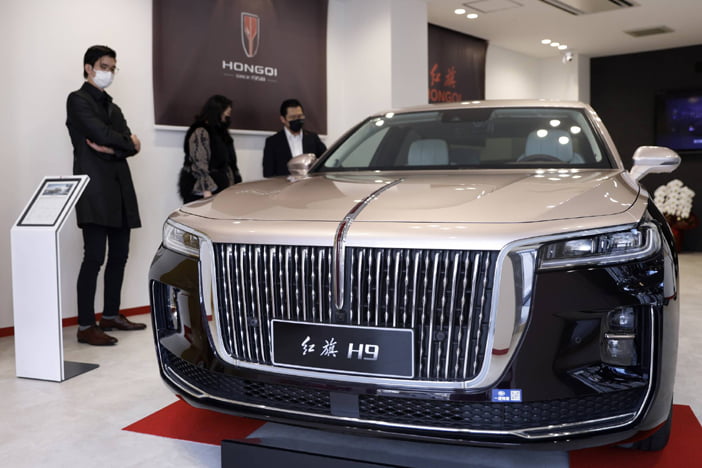
+++ China FAW Group, the carmaker whose luxury HONGQI model was used to transport Community Party Chairman Mao Zedong, is betting on a new audience in Japan, opening its first showroom in the country as it seeks to crack a market that’s fiercely loyal to domestic brands. A Hongqi (which means “red flag”) dealership opened in Osaka last month and 22 vehicles have been sold so far, although they went to Chinese living in Japan, Li Wang, an executive at the dealership, said Friday. FAW’s most popular model, the H9, costs as much as ¥15 million ($130,000). “Hongqi is special, it’s more than just a car” especially for many Chinese people, Li said. Japan has almost 787.000 Chinese residents, making up more than a quarter of all immigrants. Osaka is particularly known for its diverse community. Although Hongqi’s main markets outside of China to date have been the Middle East and Europe, FAW is seeking to target wealthy Chinese in Japan, at least in the first instance. Foreign passenger cars command a tiny 7 % of the market, which is dominated by powerful domestic players like Toyota, Honda and Nissan. The Osaka dealership is currently offering 4 models, including a hybrid. An enhanced lineup this year will include a fully electric SUV and another Hongqi outlet is slated for Tokyo’s high-end Ginza district. The most expensive model, the L5, starts from ¥160 million. One reason there aren’t more Chinese-made cars in Japan: differing safety, emission and noise standards. The United Nations Economic Commission for Europe sets strict regulations for the export of cars into Japan, and unlike European automakers, China isn’t part of that. Chinese car sales in Japan will be “extremely limited”, said Tatsuo Yoshida, an analyst at Bloomberg Intelligence. Toyota’s Lexus and some German brands are far more popular premium choices, he said. Political tensions have also kept a lid on sales but as Japan strives to reach carbon neutrality by 2050, that’s slowly changing. A growing number of Chinese automakers are sending commercial electric delivery vans to Japan to help logistics companies wanting to lower costs. +++
+++ Smart electric vehicle firm JIDU AUTO , a joint venture tech giant Baidu Inc and carmaker Geely Holding Group set up in March, announced it has finished a round of Series A financing, raising nearly $400 million. This round was backed by Baidu and its strategic partner multinational auto manufacturer Geely. With the completion of financing, Jidu is set to continue accelerating progress in R&D and mass production. The brand’s first robocar concept will be unveiled at the Beijing Auto Show in April this year, with a mass-produced model set to be launched in 2023, Baidu said in a statement. In January 2021, Baidu announced plans to enter the automotive industry by launching a smart car company. In March, Jidu was established and received over $300 million in start-up capital. Moving forward, Jidu will expand its R&D team with a focus on talent acquisition, especially in fields including advanced autonomous driving, smart cockpit and smart manufacturing. It will also build up a system to facilitate user growth and market operation. “It has only been 10 months since Jidu started its journey”, said Xia Yiping, CEO of Jidu. With the support of cutting-edge AI technology combined with a high-quality vehicle platform and manufacturing process, Jidu’s automotive robots developed rapidly. When the product is delivered in 2023, it will be a benchmark-level product, Xia said. +++
+++ LAND ROVER is shifting its internal focus from the soon-to-launch, radically reinvented fifth-generation Range Rover to development of the new Range Rover Sport, the current version of which has become one of the company’s best-selling cars. Due to launch around a year after its full-sized sibling, the new Mk3 Range Rover Sport will play a fundamental role in supporting Jaguar Land Rover as the firm embarks on a wide-reaching and rapid-fire electrification programme. Every year for the past 5 years, the current model has outsold the standard Range Rover by more than 40 % and more recently has jostled with the smaller Evoque and Discovery Sport for the position of JLR’s bestselling overall model. The roll-out of Land Rover’s new MLA Flex architecture to its largest models means the Mk3 Range Rover Sport will be a radically different proposition from the outgoing car, which will be 10 years old by the time it is replaced. Claimed to bring 50% more torsional stiffness and to reduce structure-borne noise by 24%, the new shell promises to substantially improve rolling refinement for the Range Rover family. The Sport, in particular, could have an enhanced focus placed on its dynamic credentials as a Porsche Cayenne rival. This is especially notable in light of a powertrain-sharing agreement between JLR and BMW. The tie-up means the most potent Range Rover Sport SVR will swap its supercharged V8 for a BMW-developed, twin-turbocharged 4.4-litre V8, which paves the way for a hefty power increase and (more radically) a highly potent plug-in hybrid drivetrain option. The current Range Rover Sport SVR uses the 575 hp 5.0-litre V8 reserved for models in the company’s Special Vehicles portfolio, currently comprising identically powered versions of the Land Rover Defender, Range Rover, Jaguar F-Pace and Jaguar F-Type. This engine was historically producedby Ford in Bridgend but was taken in-house when that facility closed in 2019. As the implementation of stricter Euro 7 emissions legislation looms, production of this engine will be gradually wound down and JLR’s most potent models will make the switch to BMW power. The 4.4-litre V8, referred to internally as the S63, currently propels BMW’s hottest M cars, with maximum outputs of 635 hp and 750 Nm in the hardcore M5 CS super-saloon. Land Rover will deploy its own version of the engine in its top-rung SUVs, with a bespoke tune and various modifications carried out by its engineers to best suit their characteristics. As featured in the Range Rover, it produces 530 hp for a 0-100 kph time of 4.6 seconds, slightly less power but a comfortable performance improvement over the previous V8 car, and those outputs are expected to be increased for the Sport in line with its more overt driver-focused billing. It is most likely that the new Sport SVR (which will be marked out by an aggressive styling package comprising quad-exit exhausts and a prominent rear spoiler) will be tuned to match the 625 hp of the BMW X6 M Competition. That will bring the 0-100 kph time closer to the 4.0 seconds mark and bump the top speed to around 290 kph. Such a boost would strengthen the hottest Range Rover’s credentials in the fiercely competitive and increasingly important super-SUV segment, which has swelled considerably since the current car’s 2013 introduction. New arrivals include the Aston Martin DBX, Porsche Cayenne Coupé, Lamborghini Urus and Maserati Levante Trofeo. Not only that, but the BMW V8 is said to be 17 % more efficient than the outgoing ‘AJ’ unit. In its lower state of tune, it is officially capable of 265 g/km on the WLTP combined cycle. However, Land Rover will take its push to reduce its impact on the environment further with a more widely electrified Range Rover Sport line-up. The MLA architecture can accommodate a variety of electrified powertrains and the standard Sport will follow the Range Rover in adopting a range of 48 Volt mild-hybrid-equipped straight-6 engines (both petrol and diesel) ranging in output from 250 hp to 400 hp. But more notable will be the introduction of a heavily uprated plug-in hybrid system that pairs a 3.0-litre 6-cylinder petrol engine with a 143 hp electric motor and a 31.8 kWh (usable) battery offering 100 km of EV range. BMW has also recently demonstrated that its V8 can be used as part of a PHEV system, with the new Concept XM adding a high-output electric motor for total outputs of 750 hp and 1.000 Nm, while a 20 kWh battery pack supplies 80 km of EV range. A similar set-up will be deployed inthe upcoming BMW M5 and could feasibly be adapted for use in the Range Rover Sport to create the most powerful Land Rover model yet. Beyond that, the Sport will ultimately be offered with a pure-electric drivetrain in line with Land Rover’s plans to transition away from combustion power. The company has confirmed that all models will be offered with a pure-electric option by the end of the decade, starting with the standard Range Rover in 2024, and it hopes to achieve a 60 % EV sales mix by that point. Ushering in a zero-emission Sport will be vital to achieving that goal, so it will no doubt follow soon after its larger sibling, launching around the middle of the decade. Whether these electric Range Rover models will also use BMW-derived powertrains has yet to be confirmed. JLR’s partnership with the German firm centres on shared development of new EV drive systems, but BMW already offers a variety of rear- and all-wheel-drive electric cars, including the new iX, which is available with three different twin-motor set-ups. The top-rung M60 car’s 621 hp, 1.100 Nm arrangement would endow the Range Rover Sport EV with performance on a par with (if not superior to) the forthcoming V8-powered SVR. +++
+++ LOTUS said it is joining hands with battery producer Britshvolt to develop a battery pack for its forthcoming electric sports cars. The sports car maker, partly owned by Chinese conglomerate Geely, said key focuses of the partnership will be fast-charging, optimizing energy density and weight reduction. Britishvolt is a major British investor in battery cell technologies. The carmaker said the collaboration with Britishvolt is another significant development in its ongoing transformation from a British sports car company to a global and all-electric performance car brand. The deal follows an investment of 100 million pounds by Lotus in its facilities in the UK, which include manufacturing centers for the Evija, a pure electric hypercar, and its last gasoline model, Emira. Evija’s deliveries will start later this year, and all Lotus’ future models will be pure electric, said the carmaker. Matt Windle, managing director of Lotus Cars, said “Last year we committed Lotus to a pure electric future…In the coming months we will be unveiling the Type 132, an all-new and all-electric Lotus SUV and we’ve confirmed three more EVs are on the way”. After its first ever SUV, Lotus will it will launch a four-door coupe in 2023 and another SUV in 2025, which will be followed by an all-new electric sports car in 2026, according to a product plan it released last year. Besides the manufacturing facilities in Britain, Lotus is building a plant in Central China’s Wuhan city, which has a designed production capacity of 150,000 vehicles a year. Lotus said the UK team will be responsible for the development and production of sports cars and the electric hypercar Evija, as well as co-coordinating global sales for the Lotus brand. The China plant, which is expected to start production later this year, will produce a new generation of products which are largely designed for a larger customer group. Globally, Lotus sold 1.710 new cars in 2021, up 24 percent year-on-year. Lotus said it was the carmaker’s best performance in a decade. +++
+++ STELLANTIS , which was formed through the merger of French carmaker PSA and Italian-American conglomerate Fiat Chrysler, is planning to increase its stake in its joint venture with China’s GAC from 50 percent to 75 percent. China has removed the equity cap for international carmakers in joint ventures in the passenger vehicle segment since Jan 1, 2022. The car group announced the plan on Thursday, saying that it will be a key element of Stellantis’ plan to set a new basis for its business in China, the world’s largest vehicle market. “We are now finalizing our plans for China, which we consider as a strategic market in terms of untapped potential”, said Gregoire Olivier, chief operating officer of Stellantis China. Stellantis said details on the plan for the Chinese market will be announced in March when the carmaker release its global strategic plan. The joint venture, GAC-Stellantis, was set up in March 2010, which mainly produces and sells Jeep-branded vehicles in China. Stellantis said GAC Group has agreed to complete the relevant formalities of the deal, which remains subject to the approval of the Chinese government. GAC said in a separate statement that the two has not yet inked the final deal. Jeep-branded vehicles are not selling well in China because of a smaller number of models available and the rising competitive edge of local Chinese brands and other international carmakers. In September, Stellantis announced that it would create a simplified operating organization to develop the Jeep brand in China. Stellantis said it and GAC “will continue collaborating closely with each other to grow the brand’s profitable business in China”. Besides Jeep vehicles, Stellantis is producing Peugeot and Citroen-branded vehicles in China via its joint venture with State-owned carmaker Dongfeng. The joint venture, Dongfeng Peugeot Citroen Automobile, sold over 100,000 vehicles in 2021, more than doubling the sales in 2020. “This business performance made 2021 the turnaround year for DPCA”, said Stellantis. +++
+++ TESLA ’s operating margin hit a record figure of 14.7 percent in the fourth quarter last year, which it said was the highest among volume carmakers across the globe, said the United States electric carmaker on Thursday. In the conventional auto industry, single-digit margins are considered normal, according to industry statistics. In the 4th quarter Tesla generated an operating income of $17.7 billion. “This is demonstrating that EVs can be more profitable than combustion engine vehicles”, said the company in its financial statement. Tesla sold 936.000 vehicles around the world in 2021, up 87 percent year-on-year, with 308,600 units delivered in the fourth quarter. The carmaker produced over 1.22 million vehicles in 2021, and it said one of its priorities this year would be ramping up production further. “We believe competitiveness in the EV market will be determined by the ability to add capacity across the supply chain and ramp production”, it said. “We aim to increase our production as quickly as we can, not only through ramping production at new factories in Austin and Berlin, but also by maximizing output from our established factories in Fremont and Shanghai”, said Tesla. The Berlin plant is in the stage of equipment test and is expected to produce vehicles soon for European markets. The popular Model 3 vehicles sold in Europe are now produced at the Shanghai plant. But Tesla said the Shanghai plant will remain its “main export hub”, a role the facility has played since the second half last year. Last year, the plant produced over 480.000 vehicles and shipped over 160.000 vehicles of them from China into more than 10 countries, the majority of which were Model 3 sedans. The Shanghai plant, which started production in late 2019, is Tesla’s first car manufacturing facility outside the United States and China’s first and only passenger car manufacturing facility wholly owned by an overseas carmaker. +++
+++ TOYOTA plans to rev up global production to a record 11 million vehicles in the next fiscal year beginning in April, up 22 percent from the volume projected earlier for the current fiscal year, sources familiar with the matter said. The production plan compares with 9 million vehicles projected in September for the year through March 2022. But it is unclear whether the automaker can proceed with output as planned, as the projection assumes that a global semiconductor shortage caused amid the coronavirus pandemic will be resolved and the coronavirus pandemic will come under control, the sources said. The world’s No. 1 automaker by volume initially planned to produce about 9.3 million of its Toyota and upscale Lexus brand vehicles for the year through March 2022. But it revised downward its global output projection in September to 9 million vehicles due to a surge in Covid-19 cases in Southeast Asia that led to factory shutdowns. Earlier this month, the carmaker said the global volume will most likely fall behind the 9 million vehicles after cutting its output for February by around 150.000 vehicles because of an ongoing semiconductor shortage. In fiscal 2020, Toyota’s production stood at 8.18 million units. +++