
+++ ASTON MARTIN ’s shares jumped 20% on Friday after the British luxury carmaker announced an capital raising that will see Saudi Arabia’s Public Investment Fund (PIF) become its second-largest shareholder with an almost 17% stake. PIF’s 78 million pound investment, together with a 575 million pound rights issue, will allow the 109-year-old company lower its debt and invest in new models. PIF will own a 16.7% stake in Aston Martin and will be entitled to 2 board seats, behind the 18.3% holding chairman Lawrence Stroll’s Yew Tree will have after the rights issue. The sovereign wealth fund, which owns stakes in electric carmaker Lucid Motors and British supercar group McLaren has been diversifying its oil-rich investment portfolio. For Aston Martin, the preferred ride of fictional secret agent James Bond which has gone bankrupt seven times in its history, the investment means it can secure its long-term future. Its current second-largest shareholder, German carmaker Mercedes-Benz, will own about 9.7% after the capital raising. “In 2020, I inherited a business in deep trouble that needed to be reset”, Stroll told reporters. “Covid-19 lockdowns and the disruption to global supply chains has slowed the company’s recovery”, he added. Half of the new capital will be used to repay debt that stood at 957 million pounds at the end of March. The company also pushed back the date at which it will start producing cash from 2023 to 2024. The carmaker said former owner Italian investment group Investindustrial and China’s Geely had proposed up to 1.3 billion pounds in funds last week, which the board rejected. The pair would have injected 203 million pounds for a stake, making them the largest shareholder. Stroll said the proposal would have been highly dilutive to shareholders and believed it was a takeover offer in disguise. +++
+++ We rarely get to talk about the Z4, mainly due to the reason sales of the soft-top roadster have been poor. Because of dwindling customer demand, BMW hasn’t bothered updating the 2-seater sports car, knowing it wouldn’t be worth the hassle. However, the small rear-wheeldrive machine with an electrically deployable fabric roof will still go through the typical Life Cycle Impulse (LCI). For the first time, my spies have spotted the Z4 LCI out and about. Even though the prototype’s body was fully camouflaged, I’m not expecting any major changes. In fact, the only modification noticeable is at the front where the bumper has been redesigned, but nothing to write home about. BMW left the headlights and taillights exposed since they’ve been borrowed from the current car. It’s unclear whether more evolved test vehicles will have updates to the lighting clusters. Although my spies couldn’t take a peek inside, some of the attached spy shots show the prototype had the Z4’s current dashboard design. In other words, the sporty roadster was still stuck with the old iDrive 7 rather than switching to the new setup with side-by-side screens. Traditionalists will argue that’s all for the better as retaining the current layout means the facelifted Z4 will keep the separate HVAC controls rather than being swallowed by the touchscreen. Why isn’t BMW giving the Z4 its latest iDrive 8? For the same reason why the design tweaks will be kept down to a minimum; the return on investment wouldn’t be enough considering the convertible’s sales are weak. In an attempt to rejuvenate demand, it is believed a manual gearbox will be offered for the 6-cylinder engine (M40i) as opposed to today when only the smaller 4-pot mill comes with a clutch pedal. Such a move would follow Toyota’s decision of introducing a Supra 3.0 with a stick shift. According to people familiar with BMW’s agenda, the Z4 LCI will enter production in November. If that’s true, it means we’re only a few months away from its official premiere. The G29 model as it’s known among enthusiasts will reportedly cease to exist in October 2025 when Magna Steyr will end production at its Graz plant in Austria, with no direct replacement in sight. As a matter of fact, BMW is believed to be slimming down its convertible offerings by merging the 2-door 4 Series and 8 Series 2-door models into a resurrected 6 Series as early as 2026. The oddball 6 GT still offered in some markets could disappear while the 8 Series Gran Coupe is rumoured to survive. +++
+++ CHINA ’s auto sales rose by a lackluster 3.4% over a year earlier in the first half of 2022 as anti-virus controls kept buyers away from dealerships, but demand in the industry’s biggest global market rebounded in June. Sales in January-June rose to 10.4 million, according to the China Association of Automobile Manufacturers. June sales jumped 41.2% over a year earlier to 2.2 million after controls that shut down Shanghai and other industrial centers were eased. Total vehicle sales, including trucks and buses, fell 6.6% over a year earlier in the first half to 12.1 million, CAAM reported. Total sales in June rose 23.8% to 2.5 million. The decline in total sales was less severe than an estimate of a 7.1% contraction released Friday by CAAM based on data from major brands. Growth in June sales was stronger than the earlier 20.9% estimate. China’s auto sales have suffered from consumer jitters over an economic downturn and anti-virus controls imposed starting in late March. Production has been hampered by shortages of processor chips and disruption of global supply chains. The downturn squeezes cash flow for global automakers that are looking to China to drive sales growth and are spending billions of dollars to meet government sales quotas for electric vehicles. Sales of electric and gasoline-electric SUVs and sedans rose 130% over a year ago in June to 596.000, according to CAAM. Sales in the first half of 2020 rose 115% to 2.6 million, accounting for half the global market. +++
+++ CITROEN ’s pure-electric car line-up currently stands at one with the ë-C4 (discounting the van-based ë-Berlingo), but soon broadening the firm’s EV range will be an electric version of the next C3. We expect it to be named ‘ë-C3’, mirroring the format of the ë-C4 nameplate. The third-generation C3 has been with us since 2016 and is based on the old PF1 platform from the now defunct PSA Group. Electrification of the C3’s powertrain hasn’t been possible, but now Citroen is looking to Stellantis for the architecture of the next C3. Citroen is potentially aiming for a 2023 release of the new C3, ahead of the SUV Aircross version. The CMP platform that underpins Stellanis Group cars such as the Opel Corsa and Peugeot 208 will make its way onto the new C3 supermini. This means an all-electric ‘e-C3’ model will be viable, utilising the same tech from the Corsa-e and e-208. The 50 kWh battery-based powertrain from those cars isn’t likely to be changed if it features in the ë-C3, so we can expect 136 hp and a range of around 350 km (Peugeot unlocked an extra 20 km of range in 2022). Arnaud Ribault, Citroen’s European boss, confirmed the use of the CMP platform and explained the decision behind it. “The work we are doing now is to decrease the costs or to be capable of compensating for the increasing cost of raw materials and electrification in all the projects we are developing”. There will be a focus on providing a more budget-friendly alternative to the likes of Opel and the Peugeot with the new ë-C3, so we can expect pricing to undercut the Corsa-e’s €33.999 Dutch starting figure. There will also be a cheaper internal-combustion engined version, making use of the widely used Puretech 1.2-litre 3-cylinder petrol unit we see in other Stellantis Group cars plus the current C3. In terms of design, the new C3 will take inspiration from the recently revised C5 Aircross. At the front, the angular headlight design has been seen on other Citroëns recently, as has the lighting effect on the double-stacked grille. There’s a blacked-out wheel arch, just like the current C3, to give it a chunkier stance, along with Citroen’s ‘Airbumps’ on the side. Stellantis announced its plan earlier this year that it will be going fully electric in Europe by 2026. This means the petrol variants of the new Citroen C3 will have a short lifespan, but the ë-C3 will be able to continue on. +++
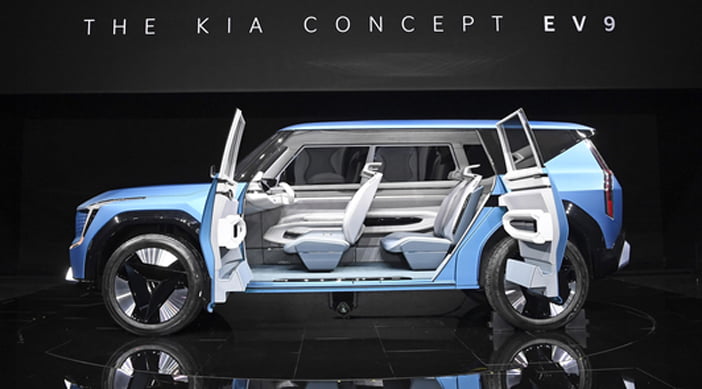
+++ The largest model in KIA ’s car portfolio is about to launch, called the EV9. As you can tell from the ‘EV’ moniker, it’ll sit in the firm’s growing all-electric lineup as a 7-seat, family-friendly SUV. It’s expected the EV9 will hit European markets in 2023. It will carry over plenty of the design details seen on the Concept EV9, unveiled at last year’s LA Motor Show (photo). The overall boxy proportions will remain, more in keeping with the e-Soul’s profile than the EV6’s curvy look. At the front we can expect a rather bluff nose, with vertical headlights just like the concept. Underneath the camouflage there’ll be a blanked-off front grille. A clamshell bonnet also features, which could allow for generous front storage. The set of roof rails could potentially feature the same retractability feature as the concept to improve aerodynamic efficiency. Unlike the Concept EV9, the wing mirrors aren’t digital cameras, but they are quite angular. The rear pillar will be part of the same upswept shoulder line. The Concept EV9’s ‘triangular aero design’ 22 inch wheels will be swapped for a smaller set of rims. The rear overhang will be very short, as is the one at the front, which should aid off-road ability. The extra length of the wheelbase will allow more space for the battery to be incorporated and the positioning of the camouflage suggests a similar rear LED light design to the concept’s will feature on the production car. I’ve not seen inside the EV9 yet, although I expect plenty more inspiration from the concept car. A 27 inch widescreen display would be one of the largest screens fitted to a production car (still smaller than the 31-inch unit in the new BMW 7 Series, however), and it’ll sit high up on the dash. We also expect a fairly minimalist cabin design, with few physical buttons but don’t think the concept’s one-spoke, oval steering wheel will come to market. In the Concept EV9 the cabin can actually change its layout depending on which of its three settings is selected. There’s Active Mode for a traditional driver-focused set-up, while Pause Mode rotates the front and third-row seats around, turning the second row into a table to mimic a “first-class lounge”. Enjoy Mode sees all three rows of seats face the tailgate, which opens to give occupants “the opportunity to connect with the outside environment”. While the EV9 will probably stop short of rotating the seats, we think there’ll be a selection of modes to alter the cabin’s feel. At 4.930 mm long, 2.055 mm wide and 1.790 mm tall, the Concept EV9 is larger than the Sorento, the firm’s range-topping model in Europe and 1 cm shorter than the North American-market Telluride. I don’t expect the EV9 will deviate too much in size from its concept. Unsurprisingly, it will sit above the EV6 in Kia’s electric SUV range, offering 3-row seating to rival the likes of the Mercedes EQB and upcoming Hyundai Ioniq 7. Just like the Ioniq 7 that’s due in 2023, the EV9 will be based on the modular E-GMP platform. This means we could see the EV6’s 77.4 kWh battery being made available for the EV9. The EV6 has a maximum range of 528 km, so expect a bit less in the EV9 due to its extra size and weight if this pack is carried over. Of course, Kia could enlarge the battery for this bigger, heavier and less aerodynamic model, with the larger wheelbase providing scope for this in future as well. Just like the EV6, the EV9 should also offer single and dual-motor options, while its 800 Volt electrical architecture will allow super fast charging speeds of up to 350 kW. The Concept EV9 is a core part of Kia’s plan to become a “Sustainable Mobility Solutions Provider”. It aims to achieve carbon neutrality throughout the firm’s value chain by 2045; through logistics, vehicle production, vehicle use and disposal. +++
+++ We don’t know a lot about the supercar that will eventually replace the LAMBORGHINI Huracan. The automaker’s entry-level coupe debuted in late 2013, so it’s no longer a young gun in the segment. There are rumours that a replacement could arrive in 2024, but nothing is certain. However, Lamborghini has confirmed that the Huracan will get a plug-in hybrid powertrain in the near future. The PHEV powertrain could power the supercar as soon as next year. Lamborghini chief technological officer Rouven Mohr dished some details about the car’s powertrain, revealing that the company would pair an electric motor with an engine with more than six cylinders but less than 12 for the Huracan. Not only that, but this new engine will be bespoke to Lamborghini. However, Mohr said he couldn’t comment on the “final details” about the powertrain. Lamborghini has an aggressive plan to offer each vehicle with a hybrid variant by the end of 2024. The company is investing heavily into its electrification efforts that will eventually spawn the brand’s first electric vehicle in the second half of the decade. The EV will be a 4-seat GT car. The Urus is another Lamborghini getting a hybrid makeover, with the automaker beginning its hybridisation efforts with the Aventador replacement that will arrive in 2023. Spy shots captured the crossover out testing earlier this month, and the SUV could use a Porsche-sourced twin-turbocharged 4.0-litre V8 hybrid powertrain that powers the Panamera Turbo S E-Hybrid. It makes 700 hp in that application, with rumours suggesting it could deliver around 830 hp in the Urus. It’s unclear how bespoke Lamborghini’s new engine will be to the brand. Sources suggest that Lamborghini could design the engine in-house. This powertrain is rumoured to deliver more than 850 hp, which would be a substantial increase compared to the current model. Lamborghini could electrify the car’s current 5.2-litre V10, too. The Huracan’s new hybrid powertrain could arrive as soon as next year, but it’s unclear if it’ll debut in the successor or be found in another iteration of the aging supercar. The last ICE-only Huracan models will debut this year, and we’re uncertain what comes next. We’ll keep an eye out for more information about the model’s future. +++
+++ The manufacturing and electric power industries, mainstays of the Chugoku region that emit large amounts of carbon dioxide, are under pressure to accelerate their decarbonization efforts. But high hurdles stand in their way, with slow progress being seen in the shift toward electric vehicles and use of renewable energy sources. If they fail to respond, the industries that support the regional economy, including their parts suppliers, could fall into decline. On June 2, MAZDA announced its goal of bringing greenhouse gas emissions to net zero at its plants in Japan and overseas by 2035. To ensure widespread adoption of the initiative, the company has held online briefings for the media on 3 occasions, with each session allotting double the time for a question-and-answer part compared with the explanation of its plans. At the briefings, Hiroshi Kinoshita, 42, chief of the corporate strategy office, emphasized the company’s decarbonization efforts. “We will promote the decarbonization of our manufacturing and energy sources and realize a clean ‘making’ process as quickly as possible”, he said. To decarbonize manufacturing processes, Mazda will not only expand the number of electric vehicles and other automobiles with low carbon dioxide emissions but also engage in a wide range of other initiatives. It aims to achieve virtually zero emissions throughout its supply chain by 2050. The focus will be on reducing carbon dioxide emissions at its own plants and offices, which emitted 529.000 tons in the fiscal year beginning April 2020. However, the road ahead is not easy. Mazda’s decarbonization drive will also target the electricity sources for its production lines and machine tools. One option is to increase the ratio of biomass, which is burned along with coal in the plant’s thermal power generation system, a major source of its electricity. Hydrogen and ammonia are also being considered, but Kinoshita said, “The supply network for hydrogen has not been established at all, and it would be difficult to use it in our operations at this point”. Procuring electricity from renewables is another option. Mazda’s Ujina plant in the city of Hiroshima has solar panels, but the amount of power it generates is only 0.2% of the total electricity consumed at its main domestic facilities. Mazda envisions increasing renewable energy generation through initiatives involving local industry, government and academia, and it hopes to conclude long-term purchase contracts. As the core company in the automotive industry in the Chugoku region, Mazda is clearly committed to pushing forward with decarbonization on a regionwide basis. There are challenges here as well, however. Demand for renewable energy beyond the auto industry is growing dramatically, and there is a possibility of a supply crunch in 2030 or later. Kinoshita conceded that the June announcement was also aimed at sending out a strong message to accelerate the supply capacity expansion. In terms of the decarbonization of its products, Mazda’s first mass-produced EV, the MX-30, sold 183 units in Japan last year, falling short of the target of 500 units per year. Because of insufficient EV charging infrastructure in Japan, expansion of EV sales in the domestic market will likely take time. Mazda plans to make all of its new vehicles to use at least some electric power in 2030. While 25% of those will be fully electric vehicles, Mazda will retain engine-powered vehicles as well in consideration of the trends in each market. Masatoshi Nishimoto, 49, manager of research firm S&P Global Mobility, points out that a compromise is necessary as electrification of all parts puts a heavy burden on the firm. In the Chugoku region, Mitsubishi and Nissan have begun mass production of a new electric minivehicle they co-developed at Mitsubishi’s Mizushima plant in Kurashiki, Okayama Prefecture, which may play a key role in spreading EVs in Japan. The car can run up to 180 kilometers on a single charge. It is designed to be used for shopping and other outings in the neighborhood and to be recharged at home. The price, less than ¥2 million if subsidies are applied, is also an advantage. “EVs are no longer a special car; they have become an affordable choice”, Takao Kato, 60, president of Mitsubishi, said at a ceremony in May for the start of mass production. The 2 companies have already received a total of 15.000 orders for their new electric minivehicle. Marujun, an affiliate of Honda, also announced in May its plan to start operation of a new plant in Asakuchi, Okayama Prefecture, in 2024. It will supply Mitsubishi’s Mizushima plant with parts for car body frames and EV batteries. Competition across affiliations and regions is beginning to emerge. Meanwhile, auto parts makers are also diversifying their products with an eye on EVs. At Hiroshima Aluminum Industry’s Honji plant in Kitahiroshima, a few dozen centimeters of aluminum alloy with finely engraved bumps and dips are produced from a die-casting machine for parts that protect suspensions. The company has specialized in engine and transmission parts but is now taking on the challenge of casting suspension parts. If steel parts are made of aluminum, the weight is reduced by about one-quarter. “We are making the parts as thin as 2.5 millimeters to 3 mm to prevent gases from mixing in the casting process”, Michihiro Fujiwara, 42, general manager of the production department, said, adding that the parts are mass produced for Mazda’s new models. Behind the decision to start producing new parts came from a sense of crisis over the wave of electrification of vehicles. Last July, the European Union announced its plan to effectively ban the sale of new gasoline and diesel vehicles, including hybrids, by 2035. Other countries are also tightening regulations. “I don’t think engine cars will disappear anytime soon, but I wonder what will happen in the future”, said Fumiharu Tashima, 73, president of Hiroshima Aluminum. He is bracing for a dramatic reduction in orders for engine parts in the event EVs spread rapidly under the banner of reducing carbon dioxide emissions. The company has taken steps. In 2019, it constructed a new building on the grounds of the Honji plant and installed seven casting machines there to produce aluminum parts that are likely to remain in demand even with EVs. The company has been promoting aluminum parts based on their light weight and has also been producing EV battery cases. While EVs are becoming popular in Europe and China, there are many markets, including Japan, where EVs are not growing as fast. Mazda is also retaining gas-powered vehicles by focusing on improving engine performance to make them more environmentally friendly, leaving little incentive for local parts suppliers to switch fully to EVs. Nevertheless, the Automotive Technology Innovation Center of the Hiroshima Industrial Promotion Organization will this summer invite parts manufacturers to analyze the performance of EVs using actual vehicles. Ten companies have applied to participate in the project, which aims to help them better deal with the electrification of vehicles. One of them is Molten, a manufacturer of plastic parts based in Hiroshima. Although the company has experience in making motor-related parts for Japanese manufacturers, it cannot gain knowledge of EVs just by following the orders from users, a company official said. An official of another participating company said, “We may face our competitors, but we will prioritize research on EVs, which we have few opportunities to learn about”. The possible arrival of the EV era may lead to a realignment of parts manufacturers in the region, says Norifumi Uno, 60, chairman of a cooperative association among 61 local parts suppliers for Mazda. “Mazda will play a coordinating role while member companies strengthen communication with each other and mutually improve their technologies”, he said, adding that they are looking for a new form of cooperation. +++
+++ The MCLAREN F1 is undoubtedly one of the greatest collaborations in the history of the automotive industry. Even today, it is still considered among the best supercars ever made and you can probably understand our excitement when we heard the rumours that the 2 companies are currently discussing a potential new joint project. Nothing is official yet but there’s a new report shining more light on the topic. BMW and McLaren met earlier this year behind closed doors and talked about 2 brand new products that could receive versions wearing the logos of both firms. 1 of these 2 new models is reportedly a halo electric performance car with McLaren expected to be responsible for the carbon fibre chassis and BMW supplying the batteries, electric motors and software. It will be based on a new architecture, something that became known in April this year. If you are wondering why would BMW embark on such a costly experiment, the answer probably has something to do with the fact that Audi and Mercedes-AMG, as well as Porsche, are reportedly all working on electric high-performance models for a launch later this decade. Leaving the competition with no direct rival would surely be a huge marketing hit for the Bavarian brand, which has no answer to the Audi R8 and Mercedes-AMG GT today. “McLaren impressed us by rethinking the way a modern sports car should be engineered and built; their fresh approach to the integration of key components is particularly clever”, a source from Bavaria told. The second rumoured model is a high-performance high-riding electric machine, though the benefits of a potential partnership between BMW and McLaren are less clear regarding this new product. But what is exactly expected from McLaren in this cooperation? And what exactly BMW M cannot engineer by itself? Analysts speculate that the British automaker could help its colleagues from Bavaria when it comes to weight and torsional rigidity. Also, it could add unique selling features not even Ferrari is able to match. +++
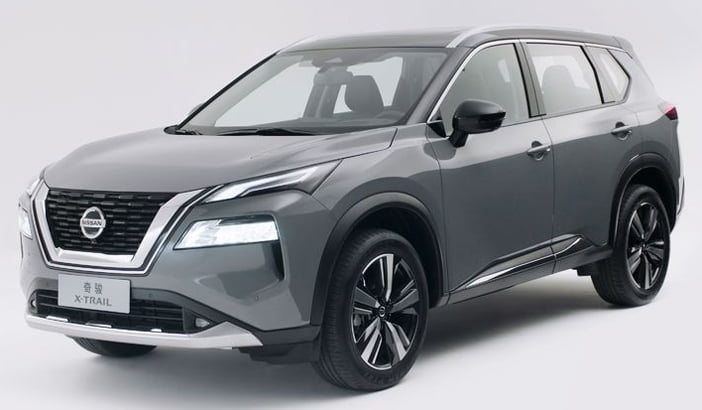
+++ The 4th generation NISSAN X-Trail is being readied for launch later this year. We’ve seen it unveiled overseas and the European market X-Trail will likely look identical to the car that has already broken cover when it goes on sale here in late 2022. Nissan’s rival for the Kia Sorento, Peugeot 5008 and Skoda Kodiaq will move onto the same CMF-C underpinnings as the latest Qashqai, meaning it’ll be available with Nissan’s latest e-Power hybrid powertrain. Unlike the brand’s popular Qashqai however, European buyers will also be offered the new hybrid technology from launch. Nissan’s e-Power hybrid system blends a turbocharged 1.5-litre 4-cylinder petrol engine with a compact battery pack and an electric motor to deliver 190 hp and 330 Nm of torque. It’s a bit more complicated than the systems found in hybrids such as the Toyota Prius, because the petrol engine never drives the wheels directly. Instead, it acts as a generator, constantly topping up the battery pack, which then sends power to the electric motor. The set-up ensures the petrol engine is always running at its optimal efficiency, which helps lower emissions and fuel consumption. Nissan also says the system provides a driving experience similar to that of an electric car, with instant torque from the electric motor. There’ll also be a version of the X-Trail with selectable four-wheeldrive, although European specifications for this powertrain are yet to be confirmed. However, Nissan says that the system will give the X-Trail “rugged versatility”, offering specific drivetrain settings for snow, gravel and mud. Something the brand believes will give even more off-road capability in e-Power form thanks to plenty of torque from the electric motor and finer control over this component’s output compared with a combustion engine. For the new X-Trail, Nissan took a leaf from the latest Qashqai’s styling book, with the SUV receiving the same V-Motion grille and slim headlamps as its smaller sibling, coupled with large lower headlight units. The new X-Trail will also feature angular body lines to give it a chunkier look than its softer-surfaced predecessor. Silver trim inserts and a contrasting roof complete the look. Inside, the X-Trail will receive plenty of advanced technology, which includes a host of driver assistance kit, a ‘Virtual Personal Assistant’ and a brand-new infotainment set-up, which will more than likely be lifted from the latest Qashqai. Nissan also says the new CMF-C platform will help improve the SUV’s refinement and dynamic performance. According to the Japanese brand, the latest version of its ProPilot software will feature in the X-Trail, although it’ll not be quite as extreme as Nissan’s fully-autonomous tech that was showcased recently. Another benefit of the new underpinnings is that the X-Trail will also be available with a third seating row, offering seven-seat capability for larger families. Nissan’s ‘Zero Gravity’ seats will feature up front. It’ll be a while before the next-generation X-Trail goes on sale in Europe, so Nissan hasn’t yet confirmed the car’s starting price. However, given the new platform and the increased level of technology on offer, we expect the new SUV will be considerably more expensive than the outgoing model (with prices starting at €38.606 in the Netherlands). Also, the X-Trail’s market has changed since the Mk3 model was launched back in 2013. Prices for the Skoda Kodiaq (which is a key competitor for the X-Trail) start from €40.975, while the cheapest Kia Sorento costs €49.395. So, we expect that Nissan will target a starting price of around €45.000 to keep pace with the competition. Nissan will complete the overhaul of its SUV line-up with the Mk4 X-Trail. The process started in late 2019 with the second-generation Juke. It was followed by the launch of the pure-electric Ariya and the exclusively hybrid replacement for the Qashqai, both of which were revealed early last year. +++
+++ VOLVO ’s new CEO Jim Rowan, who’s the former CEO of Dyson, was interviewed recently. The interview made it clear that Rowan is a firm advocate for electric cars. In fact, if he has it his way, the next-generation XC90, or its replacement, will garner Volvo recognition as a “very credible next-generation electrified car company”. Volvo’s upcoming electric flagship will mark the beginning of a shift for the automaker to becoming a true electric-only automaker. According to Rowan, the shift to fully electric vehicles will pay off. Moreover, he believes that even though many automakers would rather take their time with the transition, Tesla has found huge success, so there’s no reason Volvo can’t follow suit. Rowan shares that the biggest challenge will be making it clear that Volvo is a compelling electric-only automaker, and the electric flagship SUV that the company plans to reveal soon is one of the primary keys to making that happen. Volvo plans to only produce electric cars and SUVs by 2030. However, in order to get to that point, it has set a goal of 2025 as the halfway point. This means a whole lot needs to happen over the next few years since Volvo still makes mostly petrol-powered vehicles. It happens to offer plenty of plug-in hybrid electric vehicles (PHEVs), but its electric-only efforts have been limited. Rowan is confident Volvo can achieve its goals, though he’s clear that every single decision the company makes from this point forward needs to be made with the goals constantly in mind. All hiring and all investments must point toward the automaker’s electric-only mission. Despite rival brands like Mercedes insisting that the US isn’t going to be ready for a fully electric future as soon as 2030, Rowan sees numerous signs pointing to the opposite. He references support for EVs at the government level and reiterates that Tesla has proven this is possible. As for Europe, there’s no doubt about the strong and increasing demand for battery electric vehicles (BEVs), and many automakers have already been taking advantage of this for years. Rowan sees the transition in Europe and the recent growth of the EV segment in the US, as clear indications that a global transition is already underway. The new CEO adds that this isn’t just about people wanting an EV to save the environment. Rather, there is an expectation with any new technology that it will improve and make people’s lives easier. He sees it more as the next generation of automobiles than simply electric cars for the sake of being electric cars. Rowan shared: “When people talk about electrification, it really is the tip of the iceberg. Yes, consumers that buy an electric car are looking to be more environmentally friendly, but they also expect to get that extra level of connectivity, an upgraded infotainment system and an overall package that offers more modern features and functionality”. Rowan goes on to say that for Volvo to find true success with EVs, it can’t just produce cars that are stylish and have plenty of range, along with good safety and reliability ratings. Instead, the brand needs to find those “little Easter eggs” and create a “Wow” factor around its future products. The Volvo CEO also talks about the current chip shortage. He says since different automakers use different chips and different suppliers, it’s hard to forecast how it will all play out. However, supply chain concerns have become a constant battle for automakers, especially amid the COVID-19 pandemic and Russia’s invasion of Ukraine. +++