
+++ ALFA ROMEO has taken a significant step to help enthusiasts conserve the cars it has built over the past 112 years. The company launched a program called Alfa Romeo Classiche that provides owners with anything from a certificate of authenticity to a full in-house restoration. One of the program’s most basic services is issuing a certificate of origin. This isn’t new; Alfa Romeo has offered this resource since 2016. Armed with a chassis number, owners can request a document that details a car’s date of production and its original configuration inside and out. You’d be surprised at what you can discover: Years ago, I learned that the red 1966 GTV I owned at the time was originally painted gray. The second certificate Alfa Romeo can issue collectors attests to a car’s authenticity. Historians working in the company’s Heritage department examine a car and inspect a long list of points before deeming it authentic. Cars can be examined at the Officine Classiche in Mirafiori, near Turin in Italy, at the Stellantis & You facilities in Rome and in Palermo, or directly at the owner’s house regardless of the country they live in. Finally, the Alfa Romeo Classiche program includes a maintenance and restoration service performed by the same folks who work on the cars in the brand’s museum. From changing the rocker panels on a 1959 Giulietta to changing the spark plugs on a 1991 model 164, the in-house team can take on just about any task. Pricing hasn’t been announced; it varies depending on the car and the scope of the work required. Alfa Romeo takes its heritage and the Classiche program seriously: Company CEO Jean-Philippe Imparato chairs the certification committee, and the people in charge of certifying a car have access to the vast archives housed in the Alfa Romeo Museum. +++
+++ Over 90.000 motorists have reserved a GMC HUMMER electric vehicle (ev), and the truck’s relative popularity has convinced executives to consider launching a smaller and presumably more affordable model. While nothing is official yet, the Hummer EV’s smaller sibling could be a midsize pickup. Citing “people familiar with the matter”, it was reported that a smaller Hummer EV exists in the design studio that General Motors operates in California. There’s no word on what it looks like yet, though it presumably borrows at least some of the rugged-looking styling cues that characterize the controversial, 4.100 kilo truck. Interestingly, the smaller model could bring the Hummer name to Europe. It’s too early to provide technical specifications. The model hasn’t received the proverbial green light for production but Automotive News added that it’s a “priority project” and that it has “a good chance of going into production”. If and when it does, it’s reasonable to assume the truck will use the Ultium battery technology found under the full-size Hummer EV, among other electric models from General Motors. GMC hasn’t commented on the report, and it hasn’t announced plans to launch a second Hummer-branded electric pickup. If the report is accurate, the baby Hummer is at least a couple of years away from hitting showrooms. First, the Hummer EV SUV will enter production. We’ve been here before: a downward expansion is exactly how the now-defunct Hummer brand was born. The military-bred H1 spawned the H2 for 2002 and the H3 for 2006. An even smaller off-roader previewed by the 2008 HX concept was planned but ultimately canned. +++
+++ JAGUAR reports 17.340 global retail car sales during the third quarter of 2022, which is 9.9% less than a year ago. The rate of year-over-year decline slowed down, but the results are negative for several consecutive quarters right now. Actually, only 1 out of the last 15 quarters was positive. The issue affects the whole Jaguar Land Rover group (part of Tata Motors) and the main explanation is production constrains related to semiconductor shortages. Land Rover sold 70.781 cars, which was down 3.6% on the third quarter 0f 2021. Together, they sold 88.121 cars (down 4.9%). Jaguar Land Rover noted that demand remains strong, with global retail orders again setting new records in the quarter: about 205.000 units as of September 30 (up 5.000 compared to June 30). Of course, the most important thing for many people are the sales results of the I-Pace, which is the first and only electric Jaguar. Here the results are pretty weak, as global retail sales of the cross-over decreased in Q3 by 25.4% year-over-year to 1.972 units, which is the lowest level since launch and early ramp-up of production in 2018. The I-Pace’s share out of the total Jaguar volume also decreased to 11.4% (compared to 13.7% a year ago). So far this year, I-Pace sales amounted to 6.161 units (down 16.9% year-over-year). For reference, in 2021, Jaguar sold 9.970 units and this result might be out of range right now (2018: 6.893, 2019: 17.355, 2020: 16.457). Cumulatively, more than 56.800 units of the I-Pace were sold globally. It seems that the Jaguar is fading. Considering stronger and stronger EV competition with multiple new model launches all over the world, it will be more difficult every day. Unfortunately, the manufacturer does not report its total plug-in car sales, despite having plenty of plug-in hybrid models. In the coming years, Jaguar Land Rover intends to electrify both of its brands, including the first all-electric Land Rover in 2024 and the first “new” all-electric Jaguar in 2024. This is probably the earliest point when we see some BEV sales rebound. Range Rover BEV will be launched in 2024 as part of 6 new Range Rover, Defender, and Discovery models planned by end 2026. Transformation of Jaguar into an all-electric luxury brand remains on track with first new vehicles to be revealed before end 2024. +++
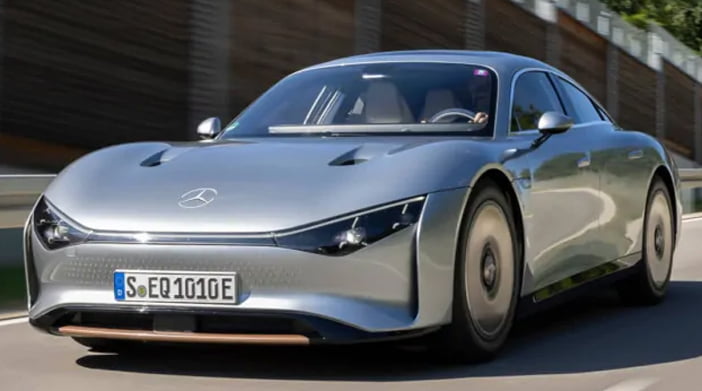
+++ When I drove the MERCEDES-BENZ Vision EQXX battery-electric concept over the summer, I learned this low-rise, hyper-efficient 4-door was the engineering laboratory for future Mercedes EVs. The EQXX won’t enter production, but EVs out of Stuttgart as soon as 2024 will benefit from advances made with the EQXX. The retail journey begins with a sedan to inaugurate Mercedes’ “entry luxury” brand of electric vehicles. The news came from Robert Lesnick, the automaker’s head of exterior design, who said the vehicle doesn’t have a name yet but it will be about the size of the current CLA at 4,7 meter. Based on the EQ series lineup we’ve seen so far, Mercedes will likely be pitching CLA sizing outside with C-Class room inside for a small family car designed to challenge the BMW i4, Polestar 2, and Tesla Model 3. The car will sit on the new Mercedes Modular Architecture (MMA). The sheetmetal’s EQXX aerodynamic inheritance will be clear, but the production car will make compromises for human livability. The technology connection will be more direct. That means lighter, more power-dense battery packs from battery partner CATL. The nearly 100 kWh pack in the EQXX is roughly half the physical size of the 107.8 kWh pack in the EQS, and two-thirds the weight. The motors dubbed eATS 2.0 for now will be lighter and smaller compared to motors of similar output, and superefficient. Malte Sievers, one of the Mercedes-Benz Vision EQXX’s project managers, said 95% of battery energy reaches the wheels. You can expect novel build techniques, too, with lightweight 3D-printed, carbon fiber, and biomimicking components bolted to enormous castings. Active aero will play its part, Autocar saying the AMG version of the entry luxury EV will get a version of the deployable diffuser from the EQXX. The new range could help Mercedes make a better and more profitable go at the entry-level end than it has with its traditional ICE offerings. The automaker refocused its ambitions on high-end luxury earlier this year, committing 75% of investment to high-margin offerings and saying it would offer 4 vehicles in the entry-level space instead of the seven on sale globally. We’ll learn more about how the automaker segment poles go electric in 2024, the battery-powered G-Glass due the same year as this EQXX-inspired sedan. +++
+++ The PORSCHE TAYCAN Turbo S is already the fastest production EV to lap the Nürburgring, but the Stuttgart-based firm is primed to unlock even more performance from its electric sports saloon. My spies have photographed a racy, bewinged Taycan testing on the infamous German circuit in pre-production form, and it could potentially arrive with over 1,000bhp to fight the Tesla Model S Plaid. I’ve already spotted the forthcoming facelifted Taycan on public roads, but these latest images reveal that an altogether more hardcore version will arrive as part of the revamp. With an aggressive front splitter, rear wing and diffuser package on show, it wouldn’t surprise us if Porsche is developing its first electric GT model. This would entail a firmer, track-biased chassis set-up, but rumours suggest that the powertrain will receive the most significant upgrade. Porsche’s current dual-motor hardware can only be pushed so far, so to provide over 1.000 hp to take on Tesla, the firm could adopt a triple-motor configuration for the new flagship. This would also unlock precise torque-vectoring capabilities on the associated axle, with the extra power and cornering performance likely to slash the Turbo S’s 7 minutes 33 seconds Nurburgring lap time. Lower down in the range, the updated Taycan will launch with minor design changes and possibly more tweaks under the skin to improve performance and range over the current model. Images of the disguised saloon and Sport Turismo estate models suggest that Porsche is aiming to refine the car’s styling rather than radically reinvent it. The lower front bumper has been reprofiled slightly and new, larger headlight units have been fitted. Sitting below these, the outer vent openings in the front bumper could also have been reworked, but it’s difficult to determine this from this camouflaged prototype. A new radar system looks to have been installed behind the windscreen of this test car, suggesting that the new Taycan could arrive with an improved suite of driver assist systems. New wheel designs are expected to feature as part of the facelift, but the rest of the design is almost entirely unchanged – save for camouflaged elements on the rear bumper which indicate further revisions here. The interiors of these pre-production models are undisguised, so changes inside will probably be mild. New trim and upholstery options could be available to lift the cabin, and software changes are likely for the Taycan’s triple-display infotainment setup. This comprises a 16.8 inch curved instrument panel, a 10.9 inch central display and a portrait-orientated climate control screen. At extra cost, buyers can specify an additional infotainment screen ahead of the passenger, while software revisions could improve the system’s features and responsiveness. Earlier this year, Porsche introduced an over-the-air software update to improve the Taycan’s real-world range, and while homologation rules prevented the firm from altering the car’s WLTP range figure, the updated Taycan will be officially tested as a new model. Given that it’s certain to adopt the recent software changes, the new Taycan may launch with a higher WLTP range than before, and Porsche could apply further hardware changes to squeeze more efficiency and performance from the car. No details have been revealed yet, but the firm could revisit the motor, battery and control electronics to remain competitive in the premium EV space. To improve the dynamics of the updated Taycan, Porsche’s engineers will have numerous tools at their disposal, including the calibration of the adaptive dampers, rear-wheel steering and torque delivery from the e-motors. The Taycan range kicks off with the entry-level rear-wheel drive version, and the new tri-motor variant should supersede the Turbo S as the fastest model available. Given the upgrades, we predict a slight increase over the Taycan’s starting price, with the upcoming flagship costing well in excess of the Turbo S. +++
+++ RENAULT said on Friday its sales rose to 9.8 billion euros in the third quarter as price increases allowed the French carmaker to more than offset a fall in the number of cars sold from the previous year. Overall group revenues grew by 20.5% when adjusted for the disposal of its former Russian unit Avtovaz, Renault said, adding that it had recorded its best-ever price effect as quarterly vehicle sales decreased by 2.4% from last year. Global carmakers are grappling with a semiconductor shortage, soaring energy costs in the wake of Russia’s invasion of Ukraine, supply chain bottlenecks and a looming recession in Europe. Renault’s third-quarter sales figure of 9.8 billion euros was in line with an analyst consensus provided by the company. The company, an early mover in the race to produce electric vehicles, is seeking to reposition itself as a more premium manufacturer with models such as Megane and Austral, while also striving to keep its customer base at the lower end of the market. Renault heads into the year’s final quarter with major challenges ahead as it is finalizing plans to split its thermal engine and electric vehicle departments into two separate units amid tense talks aimed at reshaping its strategic partnership with Nissan. Renault is Nissan’s largest shareholder with 43% while the Japanese automaker owns 15% in its partner. The 2 companies said last week they were in talks about a new phase in their partnership that could include Nissan investing in Renault’s new electric vehicle venture. Such a shift could mean the biggest reset in their relationship since the 2018 arrest of longtime chief executive Carlos Ghosn. Talks so far have included consideration of Renault selling some of its Nissan stake, sources have said. The French carmaker, which is due to hold an investor presentation on November 8, on Friday also confirmed its full-year outlook, including an operating margin target of over 5% compared with 3.6% in 2021. +++
+++ Elon Musk said that a shortage of carriers, trains, and boats has affected TESLA ’s ability to deliver its vehicles to customers during the third quarter of 2022. In the 3 months to September, Tesla produced 365.923 vehicles. During the same period, it delivered 343.830 to customers. That’s a new company record but fell below analysts’ expectations and the 22.000 deficit was a bigger gap than usual. “There weren’t enough boats, there weren’t enough trains there weren’t enough car carriers”, Musk told investors in results call. Musk has previously said that Tesla would produce more than 1.5 million vehicles this year. The latest results show it’s made 929.910 so far this financial year. Zachary Kirkhorn, Tesla’s chief financial officer, said the issue was particularly present for ships from Shanghai to Europe as well as “local trucking within certain parts of the US and Europe”. Musk said that Tesla is working to “smooth out its deliveries” to avoid having a “crazy delivery wave” at the end of each quarter. Automakers globally have been battling supply chain shortages, backlogs, and rising raw materials costs, especially for the precious metals crucial for making batteries. Tesla has cited global factors for hindering the company’s production and delivery in the last two quarters, including an enforced shutdown of its Shanghai factory and supply chain issues that have been exacerbated by Russia’s invasion of Ukraine. Despite a larger deliveries deficit than usual, Tesla enjoyed a bumper quarter. The company made a net income of nearly $3.3 billion, on revenues of $21.45 billion during the quarter. Nearly double its net income of $1.6 billion during the same period last year. Musk told investors the company had “excellent demand for Q4” and expected to sell every car they made. Musk announced in this week’s Q3 earnings call that the company has a new, smaller platform in the works that will eventually spawn a model to slot beneath the Model 3 and Model Y. Musk said this “next-generation” platform would be only “about half the cost” to produce compared to the company’s current compact architecture. It should be noted that production costs don’t scale directly with retail pricing, so it would be premature to assume that a new entry-level Tesla that costs half as much to build will also cost half as much to buy, especially in a climate where automakers are attempting to claw back more margin from production models that were priced before inflation swamped the market and the “S” in “MSRP” suddenly became incredibly relevant. On top of that, Musk gave no indication as to when this new platform might be ready for production. With the Roadster, Semi and Cybertruck already in Tesla’s slow-moving queue, it’s unlikely that we’ll be getting on Musk’s latest imagined ride in the foreseeable future. +++
+++ 6 VOLKSWAGEN investors filed a case against the carmaker this week for refusing to discuss at its annual general meeting (AGM) whether its lobbying activities could threaten their investments, the investors said. The investors (Swedish public pension funds AP7, AP2, AP3, AP4, Danish AkademikerPension and the Church of England Pensions Board) allege that the automaker’s lobbying via its membership of automotive and business associations runs counter to its public messaging on the importance of the green transition. This exposes the company, and their investments (representing around 0.1% of Volkswagen shares) to operational and reputational damage, they argued in a statement. While Volkswagen does disclose its trade association memberships, the investors have previously said it should go further and say whether the associations’ aims are compatible with the car manufacturer’s emissions-cutting targets. The case, filed at the Braunschweig court in Germany, will test whether companies have the right under the German corporate law to refuse to include an item on an AGM agenda and whether Volkswagen can keep it off next year’s agenda as well. A spokesperson for Volkswagen said that adding the provision under discussion to the articles of incorporation would interfere with the executive board’s management authority in an inadmissible way, so could not be solved in an AGM. “We share the view that aspects relevant to climate protection deserve even higher priority in reporting and are currently considering various approaches”, the spokesperson added. “It is worrying that our shareholder right to contribute to the annual meeting agenda has been refused. As a result, we felt the need to go to court to clarify this grey area for corporate law in Germany”, Emma Henningson of AP7 said. +++