+++ When the BMW X3 went through the dreaded moose test, it performed well by completing the manoeuvre at speeds higher than the benchmark figure. That said, I was expecting the same from the smaller X1, but this turned out to be false. The new X1 that was tested was the base 18d trim. It’s driven by the front wheels and uses the least powerful engine in the range. The set of 19 inch wheels was wrapped in Hankook Ventus S1 Evo3 rubbers, which was a summer performance type. At the benchmark speed of 81 kilometres per hour (which the X3 aced during its own moose test), the X1 didn’t complete the manoeuvre without hitting any cone. According to the tester, the X1’s stability control didn’t work as it was supposed to, which caused the SAV to lose trajectory. The test driver also tried a slightly lower speed of 78 km/h but the X1 still failed. The safest speed where the X1 completed the safety manoeuvre was 74 km/h. During this test, the stability control worked moderately. The driver also moved the steering wheel more smoothly at this speed. That said, the X1 can still be commended because the smallest SUV from BMW performed as expected from an SUV of its size. I just couldn’t help but compare this performance to its bigger brother. Then again, the X3 was configured differently, most notably with an all-wheel-drive system that could have affected the result. As a consolation, the new X1 performed well in the slalom test. It’s the fifth quickest vehicle the channel tested in its slalom course, tying the spot with the Nissan Ariya. +++
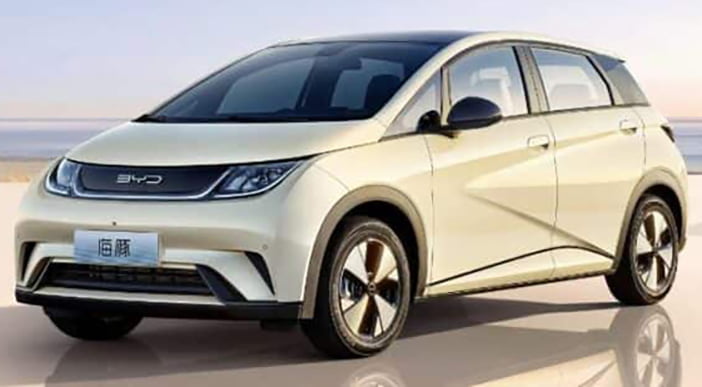
+++ This is the new BYD Dolphin, a compact electric hatchback aimed at young tech-minded folks. 3 models were launched with a price range of 116.800 – 136.800 RMB ($16,700 – $19,600). The Dolphin is based on BYD’s e-platform 3.0, powered by selfmade LFP Blade batteries. The Dolphin is the first BYD vehicle designed under the “Marine Aesthetics” design language, with lines that flow but that are sharp at the same time. The language was developed by BYD’s chief designer Wolfgang Egger. The Dolphin is available in 4 single-color and 3 dual-color bodies: Pupu Pink, Beibei Grey, Cheese Yellow (newly added color), Surfing Blue, Altantis Grey, Taro Purple (newly added color), and Black. Pupu refers to a style of Hawaiian/American-Chinese food. BYD’s image implies ‘pink’ comes from a sunset at a tropical shore. The exterior remains the same as the current model. In November, 26.029 units of the BYD Dolphin were sold, a year-on-year increase of 195.8%, according to BYD. The size of the car is 4.070 / 1.770 / 1.570 mm with a 2.700 mm wheelbase. Customers can choose from 16 or 17-inch wheels. The interior comes with a flat-bottom multi-function steering wheel, a 5-inch full LCD instrument panel and a 12.8-inch floating central control screen. The center console has 2 cupholders. The Dolphin is upgraded to offer real-time tire pressure monitoring, front seat heating, a 4-way electronically adjustable passenger seat, a 6-way electronically adjustable driver seat, a rear center armrest with a cup holder, a front parking radar, electric exterior mirrors, and a seatbelt warning light. In addition to the current three driving modes of energy saving, snow, and sports, the new BYD Dolphin offers a new comfort mode. Passengers in the rear seats also have access to two cupholders attached to a structure that can be latched down to a horizontal position. The new Dolphin is equipped with a front permanent magnet synchronous motor with 2 output options: 70 kW/180 Nm and 130 kW/290 Nm, with a corresponding pure electric cruising range of 420 km and 401 km. The 0 – 100 km/h acceleration times are 10.9 seconds and 7.5 seconds, respectively. The motor is mated to a 44.9 kWh BYD LFP Blade battery pack and supports 60kW fast charging. +++
+++ MARUTI SUZUKI has announced plans to introduce 2 new SUVs and an electric SUV concept at India’s Auto Expo. The automaker was coy on specifics, but CEO Hisashi Takeuchi said: “Auto Expo’23 is yet another opportunity for us to showcase our commitment towards the future of mobility through our range of sustainable and technology driven products”. The executive went on to say the company will use the event to highlight their commitment to a “cleaner, greener, sustainable and carbon neutral” future. He added the concept will be “futuristic” and “capture the imagination of enthusiasts”. While that’s not much to go on, the show kicks off next month and Maruti Suzuki will have a total of 16 vehicles on display. Besides the aforementioned models, the company will show a WagonR flex fuel prototype as well as the Brezza, Baleno, Ciaz, Ertiga, Grand Vitara and Swift. Maruti Suzuki didn’t go into many specifics, but the 2 new SUV models will be a 5-door Jimny and a crossover coupe based on the Baleno. The former was spied undisguised earlier this month and reports have suggested it will have a naturally-aspirated 1.5-liter engine with outputs of 102 hp and 108 hp; depending on the market. The concept, on the other hand, will reportedly preview a Hyundai Bajon-sized EV that will be built in Gujarat and go on sale by 2025. +++
+++ The tailspin in TESLA shares accelerated Tuesday as a report of a plan to temporarily halt production at its China factory rekindled fears about demand risks and put the stock on pace for its longest losing streak since 2018. Shares of the Elon Musk-led company fell about 8% to $113.13, for a 7th straight day of declines. The electric-vehicle maker’s market valuation has shrunk to roughly $372 billion, below that of Walmart and JPMorgan Chase & Co. The latest selloff will cost Tesla its position among the 10-highest valued companies in the S&P 500 Index, a distinction it has held since joining the benchmark in December 2020. News of reduced production in Shanghai comes on the heels of last week’s report that Tesla was offering U.S. consumers a $7.500 discount to take delivery of its 2 highest volume models before year-end, combining to intensify concerns that demand is ebbing. For Tesla, whose valuation is pinned on its future growth prospects, these worries reflect a significant risk. “Most of the stock’s weakness this year is due to indicators showing flagging demand globally”, said Craig Irwin, an analyst at Roth Capital Partners. Tesla’s estimated revenue growth “is still amazing, but not $385 billion market valuation-type amazing”, he said, referring to the value at the end of last week. Analysts on average expect revenue to grow 54% in 2022 and 37% in 2023, data compiled by Bloomberg show. The hope that Tesla will be the leading EV company in a future dominated by electric cars drove a spectacular 8-fold rally in the shares in 2020, earning its place in the S&P 500 and at one point making it the fifth-most valuable stock in the gauge. But this year the unwinding has come equally fast. It has lost about two-thirds of its value amid Musk’s Twitter takeover and related distractions, investor jitters about growth assets and most recently, worries that high inflation and rising interest rates will dampen consumers’ enthusiasm for EVs. Wall Street analysts have started flagging warnings about EV demand, with the average 12-month price target for Tesla falling 10% just this month. Meanwhile, the average adjusted earnings estimate for 2022 has declined over 4% from just 3 months ago. Still, analysts’ overall stance on Tesla remains bullish, with the highest share of buy or equivalent ratings since early 2015. “Despite the stock’s performance, Tesla’s innovation curve appears to be accelerating, a stark contrast to other large tech companies whose incremental product updates appear stagnant at best,” Canaccord Genuity analyst George Gianarikas wrote in a note last week. He added that “green shoots” of recovery may appear in 2023. +++
+++ VOLKSWAGEN plans to reduce the number of shifts at its Wolfsburg factory in January. A VW spokesman said the work stoppage would affect the late shift in Golf production for assembly line 3 and other adjacent areas from January 9 through January 27. The body shop, paint shop and other adjacent areas will be affected on a pro rata basis, he said, while the holding areas and maintenance necessary to supply the plant are excluded from the measure. The reasons for the stoppages are the Covid-19 pandemic and the war in Ukraine, which has disrupted supply chains. Earlier this month, VW brand chief Thomas Schäfer said in plant is building well under 400.000 cars a year, less than half its capacity, because of “flat-out chaos” in the supply chain. The plant employs about 60.000 workers building combustion engine models including the Golf, Tiguan and Touran. Volkswagen is adding production of two full-electric models at the factory: the ID.3 and a e-Tiguan. +++
+++ Perusing the database at the U.S. Patent and Trademark Office, a trademark application from VOLVO was found. The company filed for the term C60. Submitted earlier this month, on December 14, the mark would cover “Vehicles and Products for locomotion by land, air or water”. Sounds like a car to me. Knowing the way trademarks go — which means knowing we might never see them on a production vehicle — this could be Volvo hedging a very long bet. The easiest guess as to where C60 might fit in the lineup is as the crossover coupe version of the XC60 Recharge, following the mold of the XC40 Recharge and C40 Recharge. With the current, second-gen XC60 having arrived for the 2018 model year, we would think a C60 version waits until a heavy facelift or new generation to join the party, assuming it ever happens. What’s not hypothetical is Volvo’s long-term involvement with the C60 alphanumeric. Going deeper into the USPTO files, seems Volvo first applied to trademark C60 on September 5, 2001, the same day the automaker also applied to lock down C40. Volvo traded paperwork with the government agency until 2009, when the carmaker abandoned both C40 and C60 in March of that year. Oddly, 2 months before, in January 2009, Volvo had reapplied to trademark C40 and C60, then abandoned both again 7 years later, in July 2016. Again, oddly, 9 months before the second abandonment, Volvo had reapplied yet again to trademark both C40 and C60. That was in November 2015. The USPTO granted Volvo the rights to the mark at the end of 2016, and it remains valid. So Volvo’s latest submission is the continuance of the mark it’s owned for 6 years and been toying with for 21. Volvo owns the XC40 and XC40 Recharge trademarks, as well as C40, but it doesn’t own a C40 Recharge trademark, the latter being the name of the production model. It took 20 years from Volvo’s first idea of the C40 for us to get a production version. I don’t know what a potential C60 will be, but it shouldn’t be too far away. +++
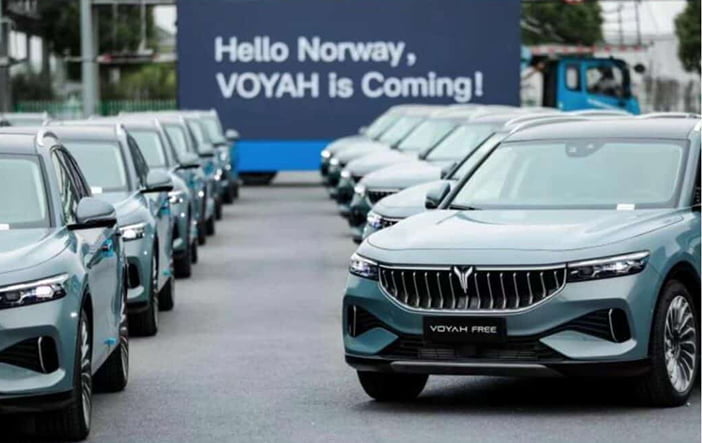
+++ On December 28, 2022, VOYAH announced that it started to deliver its Free pure electric SUV to customers in Norway. So far, a total of 136 vehicles have been delivered to customers located in Oslo, Trondheim, Hamar and Sarpsborg. At the end of November 2022, the first batch of 500 Voyah FREE pure electric SUVs arrived in Oslo, Norway. Voyah, a high-end EV brand from Dongfeng, is targeting other European countries and is only using Norway as the stepping stone. The Voyah FREE was first launched on December 2020. The FREE is the first car by Voyah to be exported to Europe, and, naturally, the brand chose to start with Norway. The Nordic country has the highest penetration of electric vehicles globally, with growing supporting infrastructure for EVs, such as chargers. Voyah FREE has opened reservations in Norway since June this year. There are 3 versions of the Voyah FREE: fully electric with rear-wheel drive, fully electric with all-wheel drive and ultra long-range. It is a high-end luxury car with a wheelbase of 2.960 mm and is 4.905 mm long, 1.950 mm wide and 1.660 mm tall. The starting price is 719,000 NOK (73,200) in Norway. The pure electric Voyah FREE is customized according to the local regulations and user needs of the Norwegian market. The car has a towing capacity of up to 2 tons. Norwegian car owners can also remotely operate the car control functions through the mobile app. In terms of performance, the car comes with front and rear dual motors, with a combined power of 360 kW and a peak torque of 720 Nm, powered by a 106.7 kWh battery for a 500 km cruising range under WLTP conditions. Its 0-100km/h acceleration time takes up to 4.4 seconds. Earlier in July, Voyah FREE obtained the European Community Whole Vehicle Type Approval (ECWVTA) which enables the vehicle to be able to register in all EU countries. After Norway, Voyah plans to enter Israel, Sweden, the Netherlands, and Denmark starting in 2023. +++