
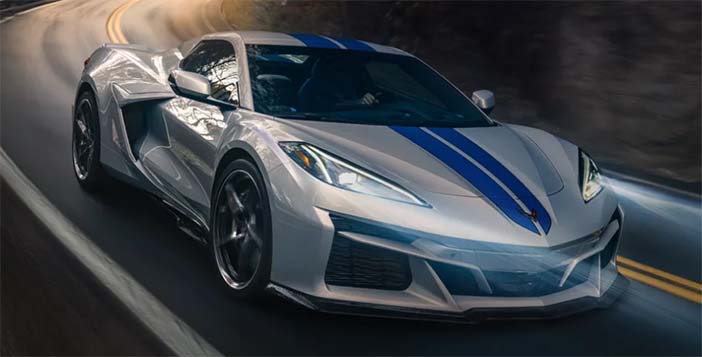
+++ Going mid-engined in 2020 was only ever the first step in a new direction for the CHEVROLET CORVETTE . Turning the Z06 into a genuine supercar rival was the second, and today we finally get a proper look at the third. This is the 2024 Corvette E-Ray, a new take on the C8 generation cart that fills 2 more lines on the Vette’s resume by bringing hybrid power and all-wheel drive to the model line. Introduced exactly 70 years after the original C1 made its debut at Motorama in New York City, the E-Ray slots into the Corvette lineup like the Turbo does in the 911’s. If the entry-level C8 Stingray is a Carrera and the Z06 shares the GT3’s love of revs, the E-Ray offers effortless performance and all-weather security with a combined output of 655 hp. And just like every other Corvette, it’s available in both coupe and convertible forms. At $104,295, the Corvette E-Ray costs significantly more than the $64,500 base C8, but only $1.005 less than the Z06, giving high-rolling Corvette fans a tantalizing choice with each of the 2 top cars having as many plus points as minuses. The 670 hp Z06 makes 15 hp more and pulls 1.22 g versus 1.1g in cornering, but the E-Ray cuts the Z’s dry-weather 0 to 60 mph (97 km/h) time from 2.6 to 2.5 seconds, and would literally leave it standing on a wet road, while the entry-level V8 was only thinking about starting its 2.9-second run. It’s the same story in the quarter mile, which the E-Ray demolishes in 10.5 seconds, a tenth ahead of the Z06. Visually, the E-Ray borrows some of the Z06’s styling cues, including its 91 mm wider body and longer, skinnier rear air vents, but at heart, it’s closer to the Stingray whose quad tailpipe setup it shares. That’s because the E-Ray doesn’t run the Z06’s rev-happy LT6 flat-plane crank 5.5-liter V8 but instead sticks with the base model’s 6.2-liter pushrod LT2. It makes the same 502 hp and 637 Nm, and drives the rear wheels through an 8-speed dual-clutch transmission, just like a regular C8. The difference is the single electric motor fitted to the front axle. Drawing from a battery located beneath the center tunnel, it sends 162 hp and 170 Nm to the front wheels, and on occasion allows the E-Ray to drive using electric power alone. That’s right, this is also the world’s first front-wheel drive Corvette. What it isn’t, is a PHEV. While Ferrari and McLaren have both embraced plug-in functionality with cars like the 296 and Artura, the Corvette team has opted for a more traditional hybrid that relies on regenerative braking and surplus engine power to recharge its battery. The downside of that decision is that you can’t cruise through an entire city on electric power, which might become more vital in the coming years if urban areas start banning combustion vehicles. A Stealth Mode does allow you to creep away from your house on electric power at speeds of up to 72 km/h when you’ve got a 5 AM rendezvous with a canyon road, but given the battery’s tiny 1.9 kWh capacity, I suspect you’ll be lucky to get a couple of miles of EV running out of it. Still, Chevrolet claims that they tuned the new E-Ray’s electric motor to extend the time the V8 can run on half its cylinders during low-load driving scenarios. On the positive side, not going down the PHEV route theoretically saves both money and weight, but to no one’s surprise, the E-Ray is still by far the lardiest Corvette you can buy. The addition of the electric motor and battery pack only reduces the luggage capacity by 2 liters, but it adds a stack of flab. Chevrolet gives the E-Ray coupe’s dry weight as 1.712 kg compared with 1.561 kg for the Z06 and only 1.530 kg for the base C8. Want an E-Ray Cabrio? That’ll run you another 37 kg. And these are dry weights, remember. An E-Ray is almost certainly going to top 1.800 kg at the curb. And that’s despite the Corvette team specifying a lightweight carbon ceramic Brembo brake package to ensure the fastest factory Corvette ever has the stopping power to match its go. Other chassis goodies include standard Magnetic Ride Control 4.0 dampers with 3 settings and wheels that make use of the Z06-spec wide fenders. Those wheels feature a twisted 5-spoke design that is exclusive to the E-Ray, and along with the extensive use of color coding and wider body will help you tell one from a Stingray when it passes you on the street. Another E-Ray-only feature is the optional Electric Blue stripe package that runs the full length of the body, while further options include carbon wheels, 2 carbon trim packages, 14 exterior colors and an Artemis Dipped green interior trim that will only be available on 2024 Corvettes. +++
+++ Back in 2020, FORD signed an agreement with Volkswagen to use the German automaker’s electric vehicle platform in some of its European vehicles. Now, before the first electric product of that collaboration has even been unveiled, the end is already being foretold. Starting in the middle of this decade, the automaker’s European branch will start using an EV platform that was developed by Ford instead of another brand. Engineering for the new platform is taking place in the U.S., Martin Sander, Ford’s European head of electric vehicles, told. The new platform will have “no kind of integration with VW, it is very versatile, very capable”, Sander said. “We are exploring all kinds of opportunities, how far can we go, what kind of segments can we cover with this”. Although Ford has not taken a final decision on the future of its relationship with VW, with which it said it would be collaborating on EVs, self-driving, and commercial vehicles, the American automaker currently has plans to only build two EVs on VW’s MEB platform, it would seem. According to Sander, though, that doesn’t mark the end of all collaboration with other manufacturers. Ford is open to building future vehicles on other manufacturer’s platforms, be that VW or “another company”. For now, the collaboration between Ford and VW continues in the realm of non-electric vehicles. Ford is still building the Volkswagen Amarok and a commercial van for the German automaker. With plans to phase out combustion engines by the end of the decade, though, it’s unclear how much longer it will be able to provide that service for VW. And although Ford said it would kill its internal combustion vehicle production by 2030 in Europe, the end could actually come sooner than that. “We keep them running as long as our customers want them”, said Sander. “If we see in 2028 that there is no demand for internal combustion engine products, then maybe we make a call. But at the moment our plan is to keep Puma and Kuga running until 2029, 2030”. +++
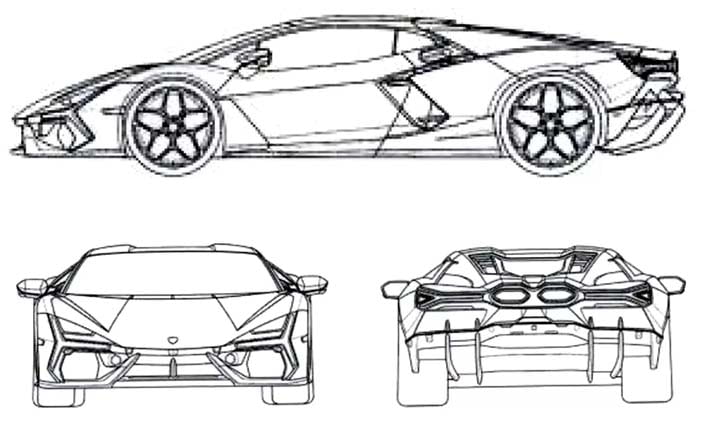
+++ Patent drawings filed with the Intellectual Property Office of the LAMBORGHINI Aventador successor have been shared online, possibly giving us our best look yet at the upcoming hybrid hypercar. Although the car will forge a new path for the Italian automaker in terms of drivetrains, it won’t be a massive departure in terms of appearance. These low-res patent designs, which appeared on several Instagram accounts, match everything we’ve seen from a number of different prototypes over the past year or so. As such, the Italian supercar has familiar, albeit updated looks, with a plurality of sharp edges, Y-shaped design cues, and tried and true mid-engine proportions. Even the engine cover will have louvers that are recognizable, though there will be a chasm in the middle, likely to show off the engine. As with prototypes we’ve seen testing under camouflage on public roads, this design patent has a pair of rather large, hexagonal exhaust outlets right in the middle of the car’s rear end. While they give the supercar an aggressive demeanor, they’re also a reminder of the fact it will still be powered by an internal combustion engine, even as Lamborghini attempts to keep up with the increasingly electrifying automotive industry. Although it will be powered by a hybrid drivetrain, Lamborghini has made a big deal about how important V12 engines are to it. Spy photos previously revealed that the hybridized 12 cylinder engine will have an 8.500 rpm redline, which should please owners searching for a high-pitched, Italian soundtrack. Lamborghini’s engineers will almost certainly use the assistance of electric motors to push this car’s power levels beyond the Aventador’s 770 hp. As a likely competitor to the Ferrari SF90, though, the automaker is expected to get the combined power output very close to quadruple digits. It is anticipated that Lamborghini will reveal its as-yet unnamed successor to the Aventador this year, and to sell it for the 2024 model year. +++
+++ LUCID MOTORS had lofty goals for 2022. It originally planned to build 20.000 vehicles during the year. But, due to supply chain issues and a shortage of parts, it had to revise down the target to between 12.000 and 14.000, and then again to between 6.000 and 7.000 units. Ultimately, though, Lucid ended up beating that annual guidance. The automaker says it built 7.180 vehicles in 2022 and it delivered 4.369 of them. During the October-December period, it produced 3.493 vehicles (an increase of 53 percent over the previous quarter) and delivered 1.932. The company started delivering the Lucid Air in Europe in December. We’ll find out more about what this means for Lucid’s bottom line when the company reveals its Q4 financial results on February 22nd. In any case, beating the annual guidance, even after it significantly slashed the target, is a positive sign that the automaker is overcoming its production issues. Meanwhile, Lucid will soon start taking reservations for its Gravity electric SUV, with deliveries slated to start in the US and Canada in 2024. +++
+++ PORSCHE is considering fully integrating Google software into its car cockpit, a source close to the company said on Thursday, marking a shift in strategy for the newly listed carmaker. The deal, which is only being considered for the Porsche brand and not the Volkswagen Group more widely, would enable Porsche customers access to Google applications like Google Maps and Google Assistant without needing to connect the car to an Android phone. Porsche chief financial officer Lutz Meschke said on a conference call last October that the company was in close contact with Google and Apple as well as Baidu, Tencent and Alibaba in China following the end of its cooperation with Volkswagen’s Cariad unit on software research and development. Porsche had previously been reluctant to use Google software because Google asked for too much data to be shared. Technology companies from Google to Apple and Amazon are in a race to control carmakers’ dashboards as software becomes an integral part of car design. Carmakers including General Motors, Renault, Nissan and Ford use embedded Google technology in their vehicles via a Google Automotive Services (GAS) package, offering features like Google Maps, Google Assistant and other applications. But some automakers are wary of allowing the tech giants unfettered access to the data generated by connected cars, or to allow them to displace the automakers’ brands with their own in dashboard displays. BMW, for example, was “definitely not taking the path” of integrating GAS into its cars, a spokesperson said on Thursday: “It is important to the company to keep hold of the customer interface”, they said. Porsche, which overtook its former parent as Europe’s most valuable carmaker after listing on the stock exchange last September, reported earlier on Thursday a 3% rise in deliveries in 2022. +++
+++ Wall Street is revisiting the key question when it comes to figuring out how much TESLA is really worth: Is it a stodgy automaker or a high-growth technology company? It’s a reasonable debate considering the challenges Tesla faces. And even after the brutal selloff in the stock over the past year, Elon Musk’s company still has a bigger market valuation than Ford, General Motors and Toyota combined. Now, analysts and investors are starting to doubt that this premium is justified. “There is growing debate among institutional investors on how to value Tesla: auto or tech? In our view, the answer lies with growth”, Wells Fargo analyst Colin Langan wrote in a note on Friday. “We are concerned that growth appears to have moderated in China and the US, likely explaining the recent price cuts”. Tesla shares sank as much as 6.4% to $115.66 in New York on Friday after the company slashed prices on its lineup in the US and Europe. Still, the stock is trading at 24 times its forward 12-month earnings estimates, not far from the average 21 multiple for the technology-heavy Nasdaq 100 Index. Meanwhile, GM is at 5.8 times estimates, and Ford is at 6.6 times. Concerns that demand for the company’s electric cars may be taking a hit surfaced after Tesla’s third-quarter deliveries fell short of expectations. But investors’ angst intensified amid a barrage of headlines in late December and earlier this month, including a temporary production halt in China, news of heavy discounting in the US and most importantly, the fourth-quarter deliveries that also disappointed. The prospect of a recession in the US also doesn’t help. Consumers, squeezed by persistently high inflation, rising interest rates and now the uncertain economic times, are expected to hold back on big-ticket purchases, such as cars. EVs, typically more expensive than gas-driven ones, are set to see demand weaken at least in the short term. Analysts’ average estimates now reflect an expectation for Tesla’s revenue to grow 33% in 2023, which while significant is still below Tesla’s own long-term outlook of 50% expansion. In comparison, GM’s revenue is expected to rise 2.6% this year, and Ford’s 1.6%. Once that aggressive growth also came with strong margins. But the latest price cuts show that is fast becoming a thing of the past. “Overall, heading into a challenging backdrop in the financial year 2023, we believe Tesla had to decide whether to sacrifice volume growth or gross margins, and based on pricing actions, the answer appears to be gross margins”, Guggenheim analyst Ronald Jewsikow wrote in a note Friday, while downgrading his recommendation on the stock to sell from buy. +++
+++ With inventory reportedly piling up, TESLA analysts and investors predicted price cuts were coming, and they were right. In addition to cutting prices for the Model 3 and Model Y in several European countries, Tesla cut prices for those models in a big way in the U.S., likely in the name of boosting demand and to bring these cars under the price caps for the Inflation Reduction Act’s EV tax credit. Wedbush analyst Dan Ives said the the cuts are the “right medicine at the right time”. In a note to clients today, Ives argued that lowering prices was the correct strategic move as demand may be waning and competition is heating up. while the lower prices are likely to boost volumes in Q1 tremendously, and bring more buyers from other EV brands back to Tesla, bigger concerns remain. The IRS’s new guidance on battery components and assembly are coming in March, and will likely cut the $7.500 tax credit by some amount as automakers scramble to fulfill those requirements. This would then make the Model 3 and Model Y, as well as other competitors, more expensive, thus pulling forward demand further in Q1. An even bigger concern is margin compression. Cutting prices from 6% all the way to nearly 20% is cutting deep into Tesla’s profit margins, which prior to these cuts was the envy of the automotive world (Tesla’s automotive gross margin was 27.9% in Q3 2022, the latest quarter). While the stock reaction today is reflecting that margin impact, Ives said it’s the right move, long term. “Tesla now has global scale (Austin, Berlin, further China build-out) it did not have a few years ago and has margin flexibility to make aggressive moves like this to gain further market share in this EV arms race”, he writes. Ives says the price cuts will spur demand by 12-14% globally in 2023, as Tesla and Musk go on the “offensive” in a softening backdrop. “This is a clear shot across the bow at European automakers and U.S. stalwarts (GM and Ford) that Tesla is not going to play nice in the sandbox with an EV price war now underway”, Ives said, as he maintains his outperform rating and $175 price target. +++
+++ TOYOTA says it is aiming to produce 10.6 million vehicles for the 2023 calendar year but remains wary of supply chain shortages. The Japanese car manufacturer says that the spread of Covid-19 throughout 2022 and continued shortages of parts including semiconductors prompted it to repeatedly adjust its production plans. Its approach for 2023 is to place the highest priority on safety and quality “while making every effort to deliver as many vehicles as possible to our customers at the earliest date”. Toyota notes that it has set a baseline production volume with a downward risk fluctuation of approximately 10 per cent. This helps communicate production plans to suppliers and other stakeholders and incorporates a range as there will be fluctuation risks to its production volume ceiling in the event of parts supply shortages as there were in 2022. “The situation this year remains difficult to predict due to factors such as semiconductor shortages and the spread of Covid-19”, Toyota added. “However, we will continue to carefully examine parts supplies and supplier situations to create more stable production plans and reduce supplier burdens, while considering all possible production fluctuation measures to ensure that we can deliver as many vehicles as possible to our customers at the earliest date”. This month, Toyota intends on building some 700.000 vehicles, with approximately 200.000 being built in Japan and the remaining 500,000 being assembled in overseas factories. +++