
+++ This year’s Monterey Car Week marks a significant and tearful moment for AUDI as it says farewell to the iconic R8 during the Rolex Monterey Motorsports Reunion at Laguna Seca. With 15 years of unparalleled power and performance, the R8, which shared 50 percent of its parts with the R8 GT3 LMS race car, is set to take its final laps around the famed track, driven by 9-time Le Mans winner Tom Kristensen. The R8’s departure is a celebration of its enduring motorsports legacy and a tribute to its racing heritage, and each R8 will debut a unique vehicle wrap created by Frank Lamberty, the designer of the first-generation Audi R8. The wrap features a split motif, highlighting the transition from an ordinary road car to a design reminiscent of the R8 GT3 race cars. Audi’s showcase at Monterey Car Week isn’t just a nostalgic glance at the past; it’s a thrilling glimpse into the future. The full Audi e-Tron model line, including an RS e-Tron GT, Q4 Sportback e-Tron, Q8 Sportback e-Tron and Q8 e-Tron SUV, will be on display. As Audi bids farewell to the R8, it also paves the way for a new era of performance and innovation, showcasing the company’s commitment to sustainability and electric mobility. The upcoming entry into Formula 1 in 2026 further emphasises this dedication, promising to bring an exciting new chapter to Audi’s racing legacy. If you’re planning on attending Monterey Car Week, be sure to witness this historic farewell to the legendary Audi R8. +++
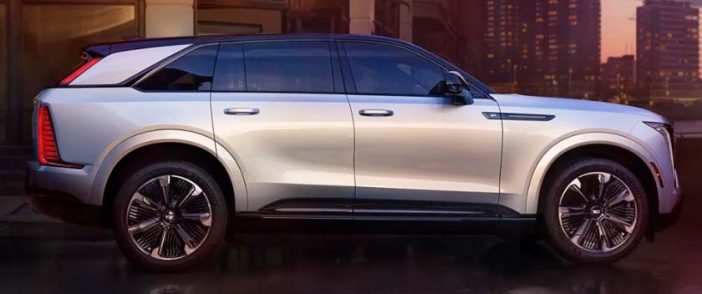
+++ CADILLAC has revealed a number of big-deal EVs as of late, first with its Lyriq and then the halo car Celestiq. Important as they are, this reveal, the Escalade IQ, is arguably moreso. That’s because the Escalade has been one of the biggest sellers and the de facto flagship for the luxury brand. And Cadillac seems to recognize that, making the electric IQ version big, bold, powerful, high-tech and, not surprisingly, expensive. From the outside, the Escalade IQ is easily identified with its full-size dimensions and relatively boxy and traditional shape, certainly compared to the sleek Lyriq and Celestiq. But what’s interesting is that compared with its platform-mates such as the Silverado EV and Sierra EV, the Escalade has a sleeker, cab-rearward shape, one that provides a long and lean nose. The shape is quite aerodynamic, too, as Cadillac says the IQ is the most aerodynamic full-size SUV General Motors has ever produced with a 15% lower coefficient of drag compared to the last most-aerodynamic full-sizer. Looking more closely, and the connections to Cadillac’s other EVs start to come through. The front fascia features familiar grille designs with illuminated detailing. The IQ’s led headlights of course are more vertically designed, though. And to go with them, there are tall, split taillights, again, like Lyriq and Celestiq, but just taller. The lower lights even have a piano-key texture to them. The rear-most pillar is thick and canted forward like the others, but (say it with me) taller. And while not strictly related to this styling critique, I have to note the enormous 24 inch wheels. Combined with the unique proportions, the Escalade IQ is the leanest, meanest looking Escalade yet. As big as the wheels may be, the Escalade IQ is still about the same size as a current gas- (or diesel-) powered Escalade ESV, which is the long version. At 224.3 inches long, the IQ is about 3 inches shorter than the ESV, though its 136.2-inch wheelbase is about 2 inches longer. The IQ is also about 4 inches wider than regular Escalades, and is about the same height. Cargo space isn’t as much of a priority as passenger comfort, though, since the IQ has more than 20 cubic feet less space in the cabin for cargo with the seats down than the ESV. At least the IQ boasts a frunk with 12 cubic feet to help make up for it, and it can tow up to 8.000 pounds like the ESV. The Escalade IQ has plenty of grunt for hauling you, your friends and family, their stuff and a trailer, too. It has a pair of electric motors with output mirroring the top-spec Silverado EV and Sierra EV Denali at 680 horsepower and 825 Nm of torque regularly, and then 750 horsepower and 1.050 Nm of torque in the Velocity Max mode. While that makes it the most powerful Escalade ever, it’s not quite the quickest. With an estimated 0-100 kph time under 5 seconds, I’m guessing it doesn’t quite match the Escalade V’s 4.4-second sprint. This is probably due to an unquestionably huge, but still undisclosed, curb weight. Power is supplied by a 24-module nickel-cobalt-manganese-alumin
+++ HONDA reported a 78% rise in quarterly profit on Wednesday, boosted by increased sales, especially in the North American market, and a weaker yen. Japan’s second-biggest automaker by sales said its operating profit totaled 394.4 billion yen ($2.76 billion) in the 3 months through June, handily beating the average 324.74 billion yen estimate in a poll of 10 analysts. That compared with a 222.2 billion yen profit in the same period last year. Like other automakers, Honda said it benefited from strong sales to retail customers in the key U.S. market, posting a 44.7% year-on-year jump to 347.000 units, as the impact of post-pandemic disruptions in the supply of parts and chips eases. That contrasted sharply with a steep 5% drop in sales in China to 309.000 vehicles that Honda reported for the quarter, faced with growing local competition and a rapid shift to electric vehicles in the world’s biggest car market. Business conditions in China had grown worse for Honda compared to when it issued its forecast of selling 1.4 million vehicles for the full year, a Honda official said. “We’re still operating amid some restrictions from semiconductors”, the official said. “If we were to revise our sales forecast in China, we’ll want to move ahead with considering whether we can distribute parts to and manufacture more in other regions”. Honda maintained its forecast for a 1.0 trillion yen operating profit for the current year, lower than the 1.117 trillion yen average forecast from 22 analysts. The company will weigh the need for an update to its full-year outlook including the benefits it sees from a weakening yen when it announces second-quarter results around the start of November, the official added. +++
+++ It’s a tough time to be an electric-vehicle startup, and luxury brand LUCID is no exception. The startup, founded by former Tesla chief engineer Peter Rawlinson, posted second-quarter results on Monday that once again fell short of analyst expectations. The company posted $150.9 million in revenue from the 1.404 vehicles it sold in the 3-month period. Coupled with a net loss of roughly $764 million, the results suggest a loss of more than $500,000 per vehicle. Still, analysts were encouraged by Lucid’s outlook for the rest of the year, as the company confirmed its full-year production target. “The tone of the call was notably more positive than we have heard recently”, Chris McNally, an analyst with Evercore, said in a Tuesday note. “With yesterday’s news of price cuts, investors will now question how much volume can grow on price reductions”. Amid a struggle to find enough buyers for its vehicles, Lucid had previously reported deliveries for the quarter of only 1.404 of the 2.173 cars it built during the period. In its most recent attempt to boost demand, Lucid is slashing the price of the Air by up to $12.400 through August 31 and the Air Pure AWD by $5.000. Profit losses on electric vehicle sales are nothing new. It’s a concept that legacy car companies like Ford and General Motors are also grappling with as they try to transition their fleets away from gas-guzzling vehicles. And an ongoing EV price war started earlier this year by Tesla’s Elon Musk, is forcing deeper losses as companies chase volume over profits in the EV sector. The outlook for startups like Lucid was never rosy for this year. EV newcomers face a market flooded with new competition, a brutal supply chain, a pending battery crisis, and rising interest rates that make raising money harder to do. Startups like Lucid and Rivian have struggled with overproduction for the past year, but Lucid appears to have the biggest inventory problem. In the second quarter, Rivian delivered roughly 90% of the vehicles it built, versus Lucid, which only delivered about 64% of what it built. Lucid is not alone in its inventory build-up. Ford is also struggling to gin up demand for its electric Mustang Mach-E, which some dealers say they are turning away. Ford recently adjusted its electric vehicle timeline to reflect this change in EV demand. After several years of rapid growth from eager early adopters to the electric vehicle segment, EV sellers are facing the first plateau. EV sales hit a high of nearly 6% in the US last year, bringing the segment closer to a predicted 7-10% tipping point. At this level of adoption, EV sales are expected to slow considerably. +++
+++ No surprise here: In Europe, the PORSCHE 911 is the most sought-after classic car. Surprise here: Slip-streaming the 911 in the most sought-after chart compiled by the Car & Classic marketplace is the Ford Mustang. Using the Google search engine as a means to pick the winners, as well as the average prices achieved on the ‘Car and Classic’ website, the venerable 911 was tagged 1.45 million times per month according to data stretching back 15 years. The number of 911’s sold though the C&C marketplace was 21.141, at an average price of $74.300. Ford’s pony car, still a popular choice for buyers in Europe, placed second on the list with 1.2 million monthly searches. The average sales price over 15 years was $39,570, and the number of older Mustangs sold reached a total of 8.332. Models that also finished among the charted top 10 include the Land Rover Range Rover, the Corvette, the ultra-classic British favorite Jaguar E-Type and the BMW 3 Series. “Whilst a 1973 Porsche 911 Carrera 2.7 RS could set you back the best part of $636.000), there are many more affordable models, which bring the average sale price of a 911 on Car & Classic to $73.800; the third highest average selling price of any make and model on the site”, explained Dale Vinten of Car & Classic. According to the site, the Jaguar fetched the highest average selling price: a whopping $113.000. But that’s peanuts compared to a Series 1 Roadster in excellent condition, said Vinten. For that, “you can expect to spend up to $318,000, A Series 2 or 3 will cost less, as they are not as desirable. Even a barn find 1969 E-Type Series 2 Roadster can set you back to the tune of $42.000″. Launched in 2005, Car & Classic is among Europe’s most popular classic car clearinghouses. It also runs a stand-alone auction site. +++
+++ Electric adventure vehicle maker RIVIAN reported second quarter results that beat estimates and, more importantly, raised its production guidance as well as narrowed its loss projection for the year. Rivian now sees an annual production target of 52.000 vehicles versus prior guidance of 50.000 vehicles. Rivian also narrowed its full-year adjusted loss to $4.2 billion, compared with the $4.3 billion it saw previously. The $4.2 billion loss projection Rivian now sees for 2023 is $1 billion less than the loss it reported in 2022. Rivian has also reiterated it expects to achieve positive gross profit in 2024. Rivian said in its shareholder letter that gross profit per vehicle improved by approximately $35.000 compared with the first quarter. “We remain confident in our ability to continue to drive our cost per vehicle lower by ramping production and leveraging our fixed costs, as well as our commercial, engineering design changes, and operational cost reduction efforts”, the company said in a statement. From a liquidity perspective, Rivian reported it had $9.26 billion in cash and cash equivalents, down from the $11.24 billion the company had at the end of the first quarter. For the quarter, the company reported revenue of $1.12 billion vs. estimates of $1 billion, and an adjusted EPS loss of $1.08 vs. $1.36 estimated. That revenue figure represents a 175% jump from the $364 million reported a year ago. On an adjusted EBITDA basis, Rivian reported a loss of $881 million vs. the $1.13 billion analysts were expecting. In July, Rivian reported second quarter deliveries hit 12.640 units, topping estimates and also representing a large improvement over first quarter deliveries of 7.946, which also topped expectations. 2 quarters of strong production and delivery figures were a shot of good news for investors weary of Rivian’s previous production setbacks. “Production coming out of the gate — it was excuses. It was 1 step forward, 2 steps back for 4 or 5 quarters. Now they finally turned the corner and I think the worst is in the rearview mirror”, Wedbush analyst Dan Ives said last month regarding Rivian’s second quarter deliveries. Many EV makers have been cutting prices and availing themselves of the federal EV tax credit of $7.500 when applicable as a way to gin up demand and boost sales. Rivian, however, builds trucks that are priced above the $80.000 price cap for the EV tax credit for trucks. Fellow EV-maker Lucid (LCID) just yesterday slashed prices of its Air sedan in order to boost demand for its relatively pricey EV, which is also priced above the EV tax credit threshold. +++