
+++ An all-new AUDI Q3 is in the works and it has been caught it in development for the first time. It’ll be one of the last cars from Audi to come with an internal-combustion engine, with an all-electric alternative provided by the similarly-sized Q4 e-Tron. The current Q3 launched in 2018 so a replacement is coming quite early. I expect the new car to arrive in early 2024 to sit alongside the incoming facelifted Audi A3. There should be the option of a standard SUV body style or a coupe-SUV Sportback. This might be the first time we’ve seen the next-generation Audi Q3 but we can already ascertain plenty of design information, despite the camouflage. The front end has a more aggressive look to it, provided by slimmer headlights and a wider, sleeker grille shape (it looks fairly similar to the upcoming Audi Q6 e-tron in this respect). A side profile shot of the car suggests it’ll be longer than the outgoing model, which should provide extra cabin space. To the rear we can see a roof spoiler and rear light clusters that are influenced by the new Q8 e-Tron; possibly without the rear led light bar that Audi likes to reserve for its EVs, however. Powering the new Q3 should be a selection of mild-hybrid and plug-in hybrid engines, potentially with diesel making a return too. The current Q3 comes with a 1.5-litre turbo petrol unit or a 2.0-litre petrol option and there is a plug-in hybrid. In order to compete with the facelifted Mercedes GLA and it’s new mild-hybrid engine offerings, we expect the Q3 to share engines with the upcoming A4, which would mean 48 volt mild hybrid technology and the option of a PHEV (plug-in hybrid) with its 14.4 kWh battery pack taken from the current Q5. +++
+++ BMW has revealed it will launch an even sportier version of the M4, called the CS. Like the previous-generation M4 CS, I expect the car to share upgrades with the new M3 CS. BMW also announced that facelifts for the M3 and M4 are due to arrive in 2024. The previous F82-generation M4 CS was launched in 2017, followed by the M3 CS. This order has been reversed for the upcoming car, however, with the current M3 CS having arrived earlier this year. I expect the new M4 CS to follow the same brief as the old one, providing more performance (and power) than the standard car. The engine should be the same as that used by the M3 CSL: a 3.0-litre straight-6 with retuned turbocharging for an extra 40 hp, taking the total outputs to 550 hp and 650 Nm of torque. With the aid of BMW’s 4-wheeldrive xDrive system, the M3 CS can go from 0 to 100 kph in 3.4 seconds; a figure that may be bested by the smaller and presumably lighter M4 CS. It won’t be just straight-line speed where M4 CS owners will see a benefit. The car should also perform better than a standard M4 in the corners thanks to the more aggressive camber set up, bespoke damping and springs, increased rigidity and track-ready tyres, as seen on the M3 CS. Carbon-ceramic brakes will probably remain an option, however. To help reduce weight, I expect to see a carbon-fibre roof, bonnet, front splitter, rear spoiler and air intakes. The old M4 CS retained its rear seats but we’ve seen BMW ditch the rear bench for bucket seats in the current M5 CS so we’ll have to wait and find out. BMW’s M division celebrated its 50th anniversary last year and it looks like next year will be a busy one, too. Alongside the M4 CS will be a new M5, available in saloon or estate guise and with hybrid power for the first time. BMW also confirmed facelifted (or ‘LCI’) M3 and M4 models will arrive, meaning we could see the M4 CS come with the standard car’s mid-life updates. In terms of pricing, the M4 CS should slot neatly between the range-topping CSL and the M4 Competition, so expect 182.000 euro in The Netherlands. +++
+++ In July, plug-in electric car sales in EUROPE noted the highest year-over-year growth rate so far this year, as both BEVs (Battery Electric Cars) and PHEVs were up. In July, 234.387 new plug-in electric cars were registered in Europe, about 48 percent more than a year ago. That’s about 23 percent of the total volume. All-electric car sales noted a 68 percent increase year-over-year, reaching 153.000 units and 15 percent market share (for reference diesel was at 14 percent). Plug-in hybrids also improved (up 22 percent year-over-year) to 81.500. So far this year, 1.670.953 passenger plug-in electric cars were registered in Europe (up 30% year-over-year), which is about 22 percent of the total market. BEVs sold about 1.09 million times and had a 15% share. PHEVs did 0.57 million and took 7% share. For reference, in 2022, more than 2.6 million new passenger plug-in electric cars were registered in Europe (about 23 percent of the total volume). In terms of best-selling models, in July the Tesla Model Y was the most registered plug-in model with 11.748 units. The Volkswagen ID.4 and the Skoda Enyaq iV also scored decent numbers: respectively, 8.681 and 7.228. Next came the MG 4 (6.433), the Dacia Spring (5.986), the Tesla Model 3 (5.773), the Volvo XC40 (2.383 BEVs + 2.979 PHEVs = 5.362), the Fiat 500 Electric (5.124), the Ford Kuga PHEV (4.838) and the Audi Q4 e-Tron (4.649). Thanks to the relatively strong July, the Volkswagen ID.4 jumped up 2 positions in the year-to-date rank, to the second place, slightly ahead of the Tesla Model 3. Results year-to-date sales results are: Tesla Model Y – 150.561, Volkswagen ID.4 – 50.414, Tesla Model 3 – 48.904, Volvo XC40 (30.029 BEVs + 17.540 PHEVs =) 47.569, Volkswagen ID.3 – 39.711, MG 4 – 37.774, Skoda Enyaq iV – 37.487, Fiat 500 Electric (37.413), Audi Q4 e-Tron (36.825) and Dacia Spring – 32.950. Tesla was the most popular plug-in car brand in Europe, by registration volume, but as an automotive group, it remains slightly behind Stellantis (when counting BEVs and PHEVs together). Top brands by share in the plug-in segment in January-July were: Tesla – 12.3%, Volkswagen – 8.6%, BMW – 8.0%, Mercedes-Benz – 7.5%, Volvo – 6.1%, Audi – 5.4%. Top automotive groups by share in the plug-in segment in January-July were: Volkswagen Group – 20.3%, Stellantis – 14.1%, Tesla – 12.3%, BMW Group – 9.6%, Geely–Volvo – 8.7%, Mercedes-Benz Group – 8.4% and Hyundai Motor Group – 8.3%. +++
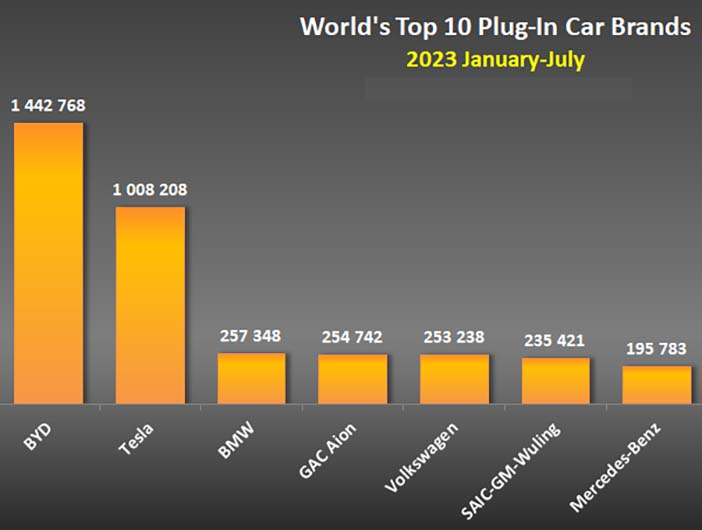
+++ In July, GLOBAL sales of plug-in electric cars exceeded one million units for the third consecutive time, suggesting that it might never go down to six digits again. In July, 1.104.592 new passenger plug-in electric cars were registered globally in July (41 percent more than a year ago). That’s about 16 percent of the total market. Together with some 900.000 non-rechargeable hybrids, roughly a quarter of the global car market is somehow electrified (BEVs, PHEVs, HEVs). All-electric car sales reached 759.000 units and represented 11 percent of the total volume alone. Plug-in hybrids noted 345.000 units and 5 percent of the market. So far this year, 6.937.134 plug-in electric cars were registered around the world (up 41% year-over-year), which is about 15 percent of the total volume. BEVs did 4.85 million and had a 10% share. PHEVs sold about 2.07 million, which meant 5.0% share. For reference, in 2022, more than 10 million new passenger plug-in electric cars were registered globally for the very first time. The Tesla Model Y without any surprise was the best-selling plug-in model in July with 77.289 units, significantly exceeding other models. Next, we can see the BYD Song and Qin families (BEVs and PEVs counted together), the Tesla Model 3, and another 4 BYD models. The top-10 for the month was: Tesla Model Y – 77.289, BYD Song Plus – (7.609 BEVs + 43.347 PHEVs =) 50.956, BYD Qin Plus – (11.462 BEVs + 30.705 PHEVs =) 42.167, the Tesla Model 3 – 36.231, the BYD Dolphin – 31.968, the BYD Yuan Plus (aka Atto 3) – 30.192, BYD Seagull – 28.001, BYD Han (11.794 BEVs + 11.149 PHEVs) – 22.943, GAC Aion S – 22.437 and Wuling Bingo – 19.782. After the first 7 months of the year, the Tesla Model Y expanded its advantage over other models, although the Tesla Model 3 must now watch its back because the BYD Song family (mostly PHEV) is pretty close. In terms of the most popular plug-in brands, BYD noted over 250.000 new registrations (new record). Tesla set its own record for the first month of a quarter (over 119.000 units), but it seems that BYD sold slightly more BEVs in July (probably over 125.000 registrations). That’s an interesting thing, although Tesla’s results happen to be inconsistent from month to month due to logistics, its average BEV sales are still noticeably higher than BYD’s BEV sales. Another finding is that SAIC-GM-Wuling, thanks to its all-electric micro cars, was able to beat Volkswagen for third place. The top 10 for the month was: BYD – 250.014, Tesla – 119.191, SAIC-GM-Wuling – 43.653, Volkswagen – 43.386, GAC Aion – 42.652, BMW – 35.786, Li Auto – 34.134, Mercedes-Benz – 30.133, Changan – 29.268 and Kia – 27.356. After the first 7 months, BYD (1.442.768) and Tesla (1.008.208) are in their own league, already counting sales in millions of units. Tesla is the #1 BEV manufacturer, although BYD is #1 in terms of PHEVs and plug-ins overall. 3 other brands recently exceeded 250.000 new registrations: BMW, GAC Aion and Volkswagen. Additional data related to the automotive group reveals the largest players when it comes to plug-in electric cars and specifically all-electric cars. The top automotive groups by share in the plug-in segment for the January-July period were: BYD – 21.8% (1.510.647 including Denza brand), Tesla – 14.5% (1.008.208), Volkswagen Group – 7.4% share (510.457), Geely–Volvo – 6.1% (426.480), SAIC: 5.6% (389.511 including SAIC-GM-Wuling joint venture), Stellantis – 4.7%, BMW Group – 4.2% and Hyundai Motor Group – 4.2%. For us, the most interesting thing is the all-electric segment and the difference between Tesla and BYD, which is around 250.000 units (25 percent of Tesla’s result) over a period of 7 months. The top automotive groups by share in the all-electric segment for the January-July period were: Tesla – 20.9% (1.008.208), BYD – 15.6% (754.322 including Denza brand), Volkswagen Group – 7.8% share (376.652), SAIC: 7.7% (373.301 including SAIC-GM-Wuling joint venture), Geely–Volvo – 6.7% (278.028) and GAC – 5.5%. +++
+++ The PORSCHE Taycan is one of my favorite EVs, combining the smooth, quiet refinement of an electric car with the sporty, driving dynamics you’d expect from the iconic German manufacturer. And these latest images show the new triple-motor variant, which is set to be revealed soon, testing without camouflage. I don’t know what this new model will be called just yet (the current Taycan range-topper is badged ‘Turbo S’ despite obviously not having a turbocharger). Whether or not this even more focused and more powerful variant will follow the 911’s style and delve into the ‘GT’ name remains to be seen. The spy shots show the new Taycan undisguised and we can see it will feature plenty of performance-focused exterior modifications. There’s an aggressive front splitter with a greater air intake area to help cool the additional motor and big front brakes, while the fixed rear wing and diffuser should work together to provide extra downforce to help put down the power. A new set of alloy wheels has also been added and the roll cage seen on previous test cars has been retained, although we’d be surprised to see this make its way to the production model, given it’s a full cage. We know Porsche isn’t afraid of ripping out the back seats in its more track-focused sports cars so this approach might apply to its four-door EV. Tesla and Porsche have been swapping the title of the fastest all-electric car to lap the Nurburgring, with the Model S Plaid and Taycan Turbo S recently rolling up their sleeves. Currently, the American firm holds the record, but we wouldn’t be surprised to see this new Taycan reclaim the title. A triple-motor set up should take the fight to the 1.000 hp Tesla Model S Plaid. Porsche’s current dual-motor hardware can only be pushed so far, and a triple-motor configuration for the new flagship would also unlock precise torque-vectoring capabilities on the associated axle, with the extra power and cornering performance likely to slash the Tesla’s 7 minutes 25 seconds Nurburgring lap time. A revised chassis and suspension setup are also expected to be designed specifically for the Taycan triple-motor model, to help ensure its extra power is transferred to the tarmac. A new radar system looks to have been installed behind the windscreen of previous test cars, suggesting that the new Taycan could arrive with an improved suite of driver assist systems. New wheel designs are expected to feature, which should be available on other models later as part of a mid-life facelift. New trim and upholstery options could be available to lift the cabin, and software changes are likely for the Taycan’s triple-display infotainment setup. This comprises a 16.8-inch curved instrument panel, a 10.9-inch central display and a portrait-orientated climate control screen. At extra cost, buyers can specify an additional infotainment screen ahead of the passenger, while software revisions could improve the system’s features and responsiveness. Given the upgrades, I predict the tri-motor Taycan to cost well over the Turbo S model’s price tag when it arrives in the coming months. +++
+++ TESLA has adjusted its plans related to the next-generation electric vehicles, which are expected to be produced at a rate of millions of units annually. According to an exclusive excerpt from Walter Isaacson’s biography of Elon Musk, published by Axios, Tesla has been weighing options over the past 2 years. Tesla’s CEO Elon Musk outlined in November 2021 a vision to develop a fully autonomous Robotaxi electric vehicle: smaller, less expensive and not as fast as the Model 3. However, his focus was to immediately go with the fully autonomous approach, meaning a vehicle with no steering wheel, pedals or mirrors. Musk also commented on the high volume, saying “Someday we want to be at 20 million a year”. “Let me be clear”, he said slowly. “This vehicle must be designed as a clean Robotaxi. We’re going to take that risk. It’s my fault if it f–ks up. But we are not going to design some sort of amphibian frog that’s a halfway car. We are all in on autonomy”. However, Musk’s vision appeared too risky for most of the other Tesla execs and engineers, who spent quite some time convincing him to work also on the affordable ($25,000; €33.500 in the Netherlands) electric car, based on the same next-generation platform. According to Walter Isaacson, at the end of the summer of 2022, Tesla chief designer Franz von Holzhausen, together with others, tried to persuade Elon Musk to “cover his bet”. Their arguments were that Full Self-Driving (FSD) might not be ready or if it was ready, there was still a chance that it would not be approved for use internationally by the law. Another thing was that there is a huge market for an affordable car, which also might be crucial to achieve the long-term goal of increasing the production volume by 50 percent per year on average. Elon Musk opted for “a historically mega-revolutionary product”, which would “transform everything” and potentially make “Tesla a ten-trillion company”, but maybe it’s still too early to exclude a more conventional approach. Ultimately, Franz von Holzhausen and others convinced Elon Musk to develop both (the Robotaxi and the affordable model) on the next-generation platform, rather than focusing solely on the Robotaxi. The models of the 2 new EVs were shown internally to Elon Musk in February 2023. The article notes that “Both had a Cybertruck futuristic feel”. Musk loved the designs. “When one of these comes around a corner”, he said, “people will think they are seeing something from the future”. Another important thing is where the new EVs will be produced. Initially, it was announced that Tesla would build a new gigafactory in Mexico to produce the next-generation EVs. However, it turned out that the company’s top engineers would have to relocate to Mexico to develop the manufacturing lines, which they are unwilling to do. Walter Isaacson noted that “Tesla engineering will need to be on the line to make it successful and getting everyone to move to Mexico is never going to happen”. Because of that, in May, Tesla decided to change the initial build location for the next-generation EV from Mexico to Austin. It seems that development and initial production will take place at the Giga Texas factory before the working production lines are copied to other places like Mexico and maybe somewhere else. It would also explain why the construction of the Giga Mexico did not start yet. The project appears delayed due to the lack of permits, according to some reports, but very likely also because of the changed plans. +++
+++ The car makers who bothered to show up at the Munich Motor Show fell into 3 camps: first, there were the German brands that had to be there; then there was Renault: boss Luca de Meo previously told me he made the decision in the hope the German brands would come to the following Paris show. Finally, there were the Chinese brands, eager to reveal their European plans at a major motor show. The impact the Chinese are having on western brands is huge: not only in terms of the threat to their sales numbers, but also how they do business. Especially when it comes to the speed of development; an approach that clearly hasn’t gone unnoticed at the VOLKSWAGEN headquarter. It’s something I brought up with Kai Grünitz, VW’s Head of Technical Development. “Usually we have a 54-month development process”, he told. “And the Chinese competitors do it in 32 to 38 months. We decided on 3 pilot projects with a development process of about 36 months, 1 of them is the ID.2. We started in late December with the first sketches and it’ll come to the road late in 2025 or early in 2026”. The new processes don’t come without risks, though. “It’s doable”, says Grünitz, “But you have to go a little bit more into risk because usually we define a new process standard. We try to develop new simulation tools and after checking simulations with the real world, we go on”. This new, more honest and, frankly, more likeable VW is open to learning from its mistakes, too. As Grünitz admitted, some recent models haven’t been up to scratch and they’re quick to fix that. VW is now, apparently, a ‘love brand’ that’s more in touch with its customers. But it’s the quality of product, too, that’ll be key in the battle against a growing number of increasingly impressive Chinese rivals. +++