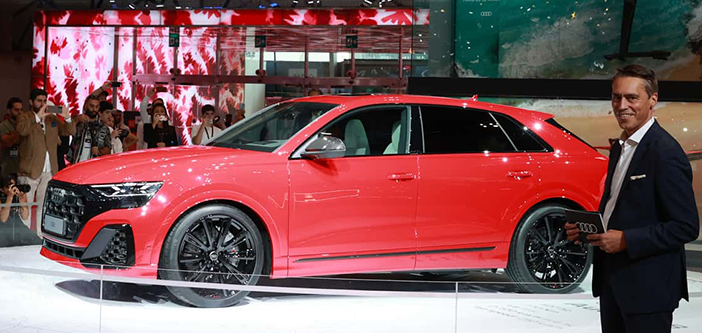
+++ AUDI ’s loaded version of its flagship gasoline-powered Q8, the SQ8, made its formal public debut at the Qatar version of the Geneva motor show, packed with several technology upgrades and flashing a hot fire-engine red exterior. Following the lead of the recently updated electrtc Q8 e-Tron, the German brand’s BMW X6 rival showed up in the desert with some subtle styling changes hiding its V8, a twin-turbo 4.0-liter engine producing 507 horsepower. The exterior gleams under smoother surfacing, larger front air intakes for a more aggressive look and a new exhaust system. At the front of the show car, there are optional Matrix headlights with a laser high beam while the taillights now employ oleds. The performance-focused SQ8 has bespoke exterior styling and 23 inch alloy wheels as standard, as well as Quattro all-wheel drive, adaptive air sports suspension and parking assistance. In the Netherlands, the Audi costs 194.350 euro. +++
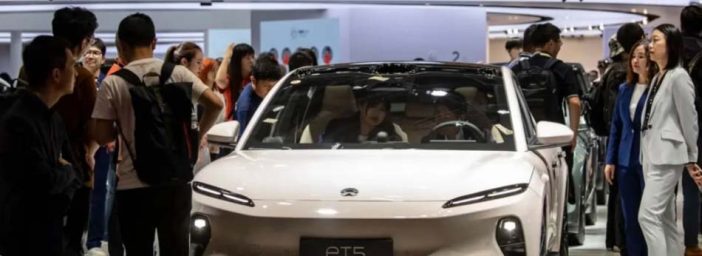
+++ Losing money on the cars they produce and sell isn’t a radically new concept for automotive manufacturers. But in CHINA , that economic conundrum has risen to something of an art form. A recent report takes a broad look at how builders of electric cars in China are able to stay in business despite losing money. The main reason? Robust government subsidies that allow the manufacturers to not only survive, but thrive. One new development (one that has likely in part prompted researchers to write the report) is an investigation by the European Union into the way that electric car manufacturers in China have received such subsidies; a step that could lead Europe to impose tariffs on the EVs that the country exports. In the report, Chinese company Nio is used as one focus of the story. Nio employs 11.000 people in research and development, but sells only 8.000 cars per month. As a consequence, Nio lost $835 million from April through June, or $35,000 for each car it sold. But Nio (photo) soldiers on, thanks to funds injected by government and state-controlled banks. Advanced technologies, especially centered on the batteries that power all EVs, is also at issue, as car makers in Europe try to make headway in their competition with the Chinese. “They have pioneered new battery chemistries that allow long-range driving at considerably reduced cost”, the author of the report says. “China also dominates electric motor production and is a leader when it comes to designing high-efficiency systems that tie together batteries and motors”. The global competition to achieve superiority in the electric vehicle marketplace has also created strange bedfellows, industry-wise. “China’s technological edge has convinced some European automakers that it makes economic sense to strike partnerships even though they compete with Chinese exporters”, the author writes. For instance in April, Volkswagen announced it would build a $1.1 billion car development center in the central China city of Hefei. And in July, Volkswagen paid $700 million for a 4.99 percent stake in XPeng, a money-losing Chinese electric car start-up, putting a valuation of $14 billion on this brand. +++
+++ Tesla has rejected claims by a labor union and recent media reports in GERMANY that health and safety provisions at its factory near Berlin were inadequate, stating that protecting workers’ health was a top priority. The U.S. electric vehicle maker came under scrutiny in the past fortnight after German media citing local authority documents in Brandenburg reported an unusually high number of work-related accidents requiring workers to take at least 3 days of sick leave were occurring at the plant, which employs around 11.000 workers. The report detailed accidents that included serious injuries such as burns from hydrochloric acid and amputated limbs. German union IG Metall said its membership numbers from Tesla workers were rising steeply amid concerns over health and safety as well as overwork. In a written statement, Tesla said workers received training on necessary safety measures, as well as protective clothing. The plant was subject to regular checks by local authorities that safety measures were being respected, it added. The company did not address the specific claims of the union or media reports regarding the number of accidents or workers off sick at the plant. The author of the report spoke to 12 workers at the factory. While 4 said they were satisfied with the working conditions, 8 said pressure for speed was too high, with some reporting high incidence of accidents and issues with receiving overtime pay. Brandenburg’s authority on occupational safety and health said it only held records of serious accidents at work resulting in over 6 weeks of inpatient treatment or permanent physical damage, of which there had been 6 at the Tesla plant in 2021 and 2022. The authority’s staff conducted weekly safety checks at the plant during its construction phase and now visited fortnightly, with unannounced checks every 6-8 weeks, it added. +++
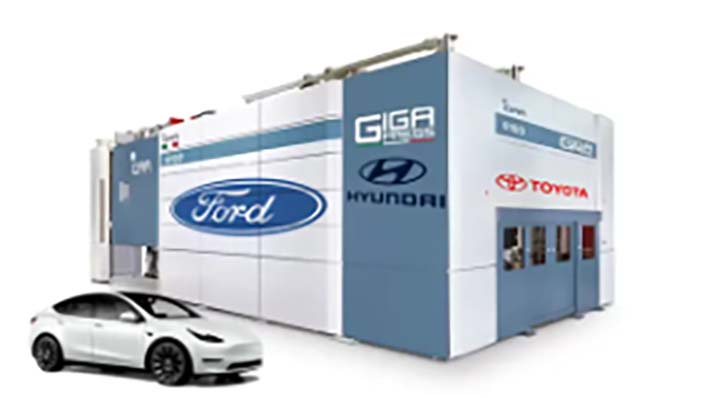
+++ Idra, an Italian aluminum casting machine maker and Tesla supplier, has added Ford, Hyundai and a European company to its customer base as more carmakers explore this manufacturing technique. Tesla has pioneered the use of massive casting machines, also known as GIGAPRESSES , to make large single pieces of vehicle underbodies, streamline production and reduce the work even of robots. Front and rear underbodies cast by gigapresses are combined with battery packs to form a 3-piece chassis for the Tesla Model Y. A ‘gigapress 6.100′, which produces a clamping force of 6.100 tons, with the Ford brand printed on it, had been assembled and was being tested in IDRA’s plant in Travalgiato, near Brescia, northern Italy during an industry event organized by the company. An even bigger press, the ‘9.000’ (IDRA’s largest and newest model which has the size of a small house or a tennis court) was being tested nearby but without the client’s name printed on it. A source close to the matter, however, said it would be shipped to the Hyundai Motor Group, adding both it and the one for Ford would initially be used only for R&D purposes. The source said IDRA was also about to sign a supply contract for 2 units of the ‘9.000’ press with a premium automaker in Europe, its first with a European group. Volvo and Toyota are among the companies exploring the process. Toyota recently showed off casting machinery that can make a third of a car underbody in 3 minutes. This normally requires 86 parts taking hours to assemble. IDRA has already shipped 14 presses to Tesla, including 2 units of the ‘9.000’ for Cybertruck production at the Austin plant, Texas. IDRA has so far signed orders for 25 presses, with 21 already produced and shipped, including to leading Tier 1 parts makers. +++
+++ KIA will launch a European-focused EV2 with a target price of around €28.000 in the Netherlands in 2026 as part of a major expansion of its bespoke electric vehicle line-up. The new machine, which was confirmed at the company’s first EV Day event in Seoul, South Korea, will follow the EV3 small SUV, EV4 saloon and EV5 family SUV, which will all go on sale within the next 3 years. The 4 models will join the existing EV6 and flagship EV9 in Kia’s range of bespoke electric cars using the Hyundai Motor Group’s E-GMP platform. They will be key to the firm’s ambition to reach 1.6 million EV sales annually by 2030. The production version of the EV3 will arrive next year, with the EV5 going on sale in 2025. The EV4 will follow in 2026, when the smaller EV2 will also launch. Kia has yet to give any details of the model beyond its name but has said it will be a compact model designed with a focus on the European market and manufactured at Kia’s plant in Slovakia. CEO Ho-Sung Song said producing affordable EVs is “very important” for the brand, “especially for the European market that is in need of smaller electric vehicles too”. The firm is working to a target starting price of $30,000 (€28.000), which would put it up against the BYD Dolphin. Song said the EV2 is a “very unique and important model for the European market”, adding: “This is a smaller size of EV; a very European-style dedicated model”. He said Kia has a “very concrete plan” for the machine. The European focus, price target and name (eventually allowing room for a smaller EV1) imply it is likely to be a small B-segment machine. That could suggest a hatch, although given the popularity of SUVs and Kia’s focus on them in its EV line-up to date, it is likely to have some rugged crossover design cues. It will doubtless get a different version of Kia’s ‘Tiger grille’ digital face, and a mix of sharp lines and smooth surfaces in keeping with the firm’s ‘Opposites united’ design strategy. Kia has not disclosed any technical information, although it will sit on the same E-GMP platform as the other bespoke EV models. That means it would be technically possibly for it to have single- and twin-motor powertrains, although given the packing challenges of a smaller car and the more urban-focused driving of likely buyers, a twin-motor set-up is uncertain. The EV3, EV4 and EV5 will all use a new version of the E-GMP modular architecture that runs at 400 Volt, in part to keep costs down, and this version is also likely to be used for the EV2. As a result, it wouldn’t be capable of ultra-fast charging, although this is unlikely to be a major requirement of family buyers travelling shorter distances. Notably, the EV2 will get a hot GT version: the firm has previously said it will offer a performance-led GT variant of every model in its EV line-up, and an official told that was still the intention, noting the popularity of performance cars with European buyers. Production of the new model is due to start in Kia’s Slovakia factory, currently home to the Ceed and Sportage, in 2025, ahead of deliveries beginning the following year. The machine will be produced at the plant alongside another model in Kia’s EV range, although which has yet to be finalized. Given Kia has said it will focus on building small and medium-sized EVs in Europe, it is most likely to be the EV3 or EV4. +++
+++ In the same way many carmakers have design studios in Southern California, they also have tech labs in Silicon Valley. There, engineers play with latest developments in the digital world. NISSAN recently revealed that their offices in the Bay Area have been using artificial intelligence to fast-track research in automotive materials. AI is a popular buzzword right now, but it can do more than write term papers for students and pretend to be celebrities. According to Nissan, the researching and testing of new materials for car parts used to take 20 years, with numerous cycles of trial and error. Now, AI simulations have cut that time down to just 2 years, which is 1.000 times faster. “With machine learning and AI, you can simulate the properties of materials for a lot more cases than you can test experimentally, in a short time”, said Bala Radhakrishnan, principal researcher, simulation. “It can help you sample millions of materials, and then screen for candidates based on the properties that you want”. Nissan explains that the AI they use is different from something like ChatGPT. ChatGPT is a form of generative AI, which creates new material by scraping existing knowledge off the web. Nissan’s AI is a form of machine learning, which simulates millions of, say, automotive materials, and runs tests on them to predict the most ideal properties (strength, temperature sensitivity, conductivity) for their applications. Humans are still an important part of the process. Once AI filters the best candidates, engineers still interpret the data and test the materials in the physical world. AI is merely a form of helping predict the most likely candidates and strip out the noise. In practical terms, one of the technologies AI has helped accelerate is solid-state batteries for electric cars. Nissan plans to bring those to market by 2028. +++
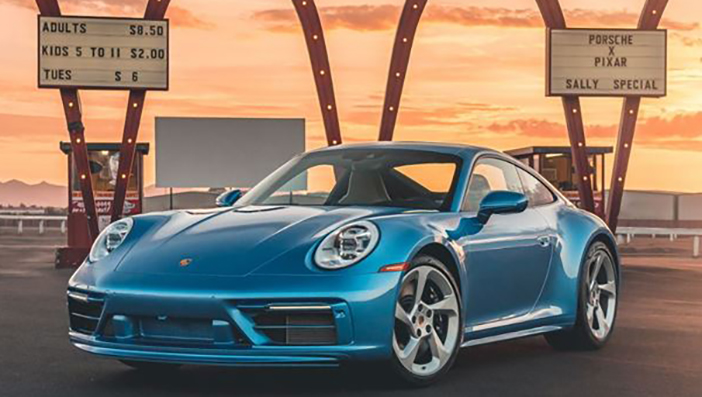
+++ Remember the one-off 911 Classic Club Coupe? Or perhaps more prolifically, the 911 Sally Special (photo)? Those are projects taken on by PORSCHE ’s wonderful and mysterious Sonderwunsch division. Sonderwunsch means “special wish” or “special request” when you translate it from German into English, and that defines the program perfectly. We’ve seen some of the division’s more recent creations, but at Rennsport Reunion 7, I got a chance to speak to Alexander Fabig, the vice president of individualization and classic at Sonderwunsch. Did you know that the waiting list for one-off creations is currently at 8 years? Or that you could bring Porsche an old car, tell them to paint it any new Paint-To-Sample (PTS) color you want, and they’d do it? And to take it even further, Porsche will print you an official, new monroney with the new color and upholstery. After all, it’s a factory build. Those fun facts and more are just the tip of the iceberg when it comes to what Sonderwunsch can do. It’s essentially a playground for the ultra-rich to design and customize the Porsche of their dreams. Fabig tells us that Sonderwunsch is currently working on 9 one-off projects in parallel, but with the high demand, Porsche hopes to extend output to 15 cars per year. That may not sound like a lot, but if you look at the complexity and custom work that comes with putting together a car like the 911 Classic Club Coupe, you’ll understand why it takes so long. Of course, the sheer cost of ordering a one-off through Sonderwunsch also helps to keep the demand at a doable amount. When you commit to a one-off car, you’re effectively hiring a Porsche team consisting of design, engineering, product leads and more. Put these people to work, and Fabig says you’re looking at a number of at least $100.000 once pen goes to paper for the 1-year design phase. How much higher it goes from there is entirely up to you and the sort of work that needs doing. Choose to have Porsche develop a new paint with fancy effects to it, and that’ll be $200.000. You can pay even more money to make sure that color remains exclusive to your car instead of ending up on the Porsche configurator one day. Ask for a special interior upholstery, and that’s another $50.000. The main point here is that you have to be ready to write a blank check to make that Sonderwunsch come true. Once the one-year design phase is done, it’s likely that you’ll be waiting another year or two for the car to actually be delivered. Every vehicle it delivers comes with the same factory warranty as any other Porsche, so the factory needs to do testing to ensure whatever the customer is asking for lives up to Porsche standards. And if you request unique materials or things that don’t, Porsche will tell you, and then it won’t be covered by the same warranty. As an example, Fabig says that certain interior material requests might not live up to Porsche durability testing, so it informs the customer that such a material is compromised. You can still ask Porsche to build the car like that, but if you go way out of touch, you’ll finally start running into the word “no.” Fabig says that Porsche won’t manufacture design bits that are obvious copies of other OEM design elements, nor will it put together any preposterous engine builds making wild amounts of horsepower. Assuming the customer is planning on driving the car on the road, Porsche is bound by road regulations, which is where a lot of roadblocks come up. Those sort of roadblocks are ones that Porsche stays in constant contact with the customer about. If you order a one-off, expect to have somewhat regular meetings with the Porsche team assigned to your build. Porsche says that some of its customers are constantly wanting to check in, while others stay hands-off and only chat a few times per year, but the company is happy to accommodate either level of involvement. And just like we alluded to, don’t think the Sonderwunsch program is only for new cars. There’s a 2-3-year waitlist to get your used car into the Porsche Classic division of the program, and the possibilities are similarly endless. Due to the high entry fee, the Carrera GT is a popular entry at the moment, and Porsche’s already delivered some of those completed cars back to customers. Imagine taking the Carrera GT, a car that had rather limited appearance options when new for a Porsche product, and opening the entire PTS and upholstery book for it. The possibilities are truly endless. Well, as endless as your bank account. And it’s more than just the headline cars like the 911 or Carrera GT that are getting attention from the Sonderwunsch program, too. Fabig says that there’s growing demand for its four-door cars and even the electric Taycan to go under the custom microscope. These cars are typically in the far less exclusive Sonderwunsch Porsche Exclusive category that limits customization to paint colors, stitching, upholstery colors and most other things that don’t involve fundamental changes to the vehicle itself. Those latter cars are part of the one-off build process that we’ve detailed throughout this story. As a parting question, we asked Fabig if we’ll be able to see all of these one-off builds as they get released, or if the owners are planning on keeping them secret. Thankfully, Fabig tells us that none of its customers are secretive to the point of not wanting the world to see the cars and that we should expect to see detailed photos and press releases about all of the one-off builds that are on their way. Now, we’ll just need to wait patiently as the Sonderwunsch team bolts them together. +++
+++ TESLA sold 74.073 China-made electric vehicles (EVs) in September, a 10.9% decrease from a year earlier, data from the China Passenger Car Association (CPCA) showed. Sales of China-made Model 3 and Model Y cars were down 12.0% from a month earlier. Chinese rival BYD, with its Dynasty and Ocean series of EVs and petrol-electric hybrid models, saw passenger vehicle deliveries grow 42.8% to 286.903 last month, from 200.973 in September last year. Tesla, along with its China challengers, is bracing for a revival in consumer sentiment, buoyed by deeper discounts and tax breaks for green vehicles amid signs of the economy stabilizing. The company missed market estimates for third-quarter global deliveries on October 2 as planned upgrades at its factories to roll out a newer version of the Model 3 mass-market sedan forced production halts. The U.S. automaker, which ships more China-made cars for exports at the beginning of each quarter while focusing on domestic deliveries at the end, almost doubled its China EV share from July to August. It unveiled in September a restyled Model 3 with a starting price of 259.900 yuan in China, which is 12% higher than the previous, and would start delivering in the 4th quarter. Its Chinese rival Xpeng also launched a revamped G9 to sell from 263.900 yuan, which is 15% lower than the previous. Tesla, the largest exporter of China-made EVs, is also facing a probe by the European Commission into subsidies for battery-powered cars from China, along with BMW, Renault and other automakers. Tesla’s deliveries of China-made vehicles hit a record 247.217 in the second quarter. +++
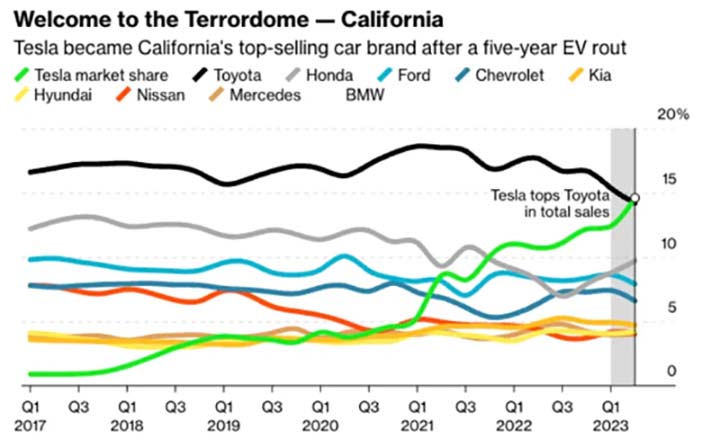
+++ After a decade of being trounced by Tesla, this was supposed to be the year that TRADITIONAL AUTOMAKERS finally put up a fight for electric cars. General Motors was committing its biggest brands to a new line of electric models, and Ford and Volkswagen were ramping up production of EVs designed for the masses. It was, many predicted, time for the automotive world order to re-assert itself. Things haven’t turned out that way. Ford’s vaunted F-150 Lightning has been outsold by the R1T from Rivian; a startup that sold its first vehicle just 2 years ago. General Motors’ lineup of new EVs has suffered crippling setbacks in battery manufacturing. In July, Volkswagen chief executive officer Thomas Schäfer succinctly summarized his own company’s EV competitiveness: “The roof is on fire”. With just 3 months remaining, 2023 has been less a redemption story for legacy automakers than further evidence of their quagmire. In the US, Tesla has been expanding production about as fast as all of its competitors combined. The Austin, Texas-based EV maker accounts for 61% of fully electric cars ever sold in the US, making it more dominant in EVs than Apple is in smartphones. No one can keep up with Tesla’s price cuts Tesla started the year with a dramatic salvo of price cuts that reset customer expectations across the industry. Before the changes, the cheapest version of the Model Y cost nearly $20,000 more than the average selling price of a new car in the US. By April, that differential had evaporated. The latest shot fired in Tesla’s price war came on October 1, when it introduced a new Model Y variant that starts at $4,000 less than the average selling price of a new vehicle in the US. The Model Y is on track to be the best-selling car in the world for 2023, even after the price cuts, it’s doing so with higher profit margins than most automakers make on their gasoline vehicles. Ford was first to respond with dramatic price cuts of it its own. But even a reduction of up to $10.000 for the F-150 Lightning wasn’t enough to keep EV expansion plans on schedule. By July, CEO Jim Farley throttled back production targets through 2026, saying the company expects to lose about $4.5 billion on EVs this year. “The pricing pressure has increased dramatically”, Farley said. General Motors, the biggest US automaker by vehicle sales, is also spinning its wheels. The company’s hopes are pinned to new batteries made by its Ultium LLC joint venture with Korea’s LG Energy Solution, which are expected to reduce costs. But delays have put in limbo the availability of GM’s new electric Chevrolet Blazer, Equinox and Silverado. Ford, GM and Stellantis, meanwhile, are now locked in contract negotiations with the United Auto Workers union, which may lead to higher labor costs during the cash-torching catch-up phase of the EV transition (Stellantis doesn’t plan to make its first electric Ram trucks and Wrangler Jeeps until the end of next year). There’s only one company that competes at Tesla’s scale on electric vehicles: China’s BYD. It’s also the first example of an incumbent that successfully transitioned from selling gas-powered cars to profitable electric vehicles. BYD’s history is itself unique. The company started off as a battery manufacturer, making tiny power packs for Nokia cell phones and Dell laptop computers in the 1990s. When it moved into autos in the 21st century, it did so with a battery-maker’s mindset. In 2009, while Tesla was gluing together batteries in Silicon Valley for its electric Roadsters, BYD was building electric buses in Hunan Province. Core to the problem for the incumbents is how they’ve largely become assemblers of third-party components. It was easy to assume that just as transmissions and infotainment systems could be outsourced, so could the building blocks for EVs: batteries, motors, software, charging infrastructure. But that hasn’t been a winning strategy. BYD didn’t become a dominant automaker in China until it decided in 2021 to stop making cars without plugs. The decision allowed the company to focus entirely on EVs and what was needed for their success. Within 2 years it dethroned Volkswagen as the best-selling car brand in China; in the third quarter of this year, BYD came within a whisker of delivering more fully electric vehicles globally than even Tesla. BYD’s dramatic rise shows that it’s possible for a traditional automaker to go electric, but it may require excising the very products and business practices that once made them successful. Few others have committed to doing the same, even within a 10-year timeframe. Tesla started this consequential year in EVs with a bang, and it may end it with another. 2 years behind schedule, the company is expected to finally start selling its first electric pickup, the Cybertruck, in coming weeks. A launch date hasn’t been announced. The truck is an alien-looking mass of stainless steel and glass; the most radical departure in both form and function that the pickup world has seen in generations. And while many in the industry have laughed it off, maybe they shouldn’t. Pricey pickups account for a fraction of US legacy auto sales but a majority of the industry’s profits. If trucks start to go electric as quickly as cars and SUVs have, then the electrification of the F-150, Silverado and Ram will be of existential importance to Ford, GM and Stellantis. Things aren’t off to a great start. The F-150 Lightning is the furthest along, but after 18 months it amounts to just 3% of traditional F-Series sales. GM sold just 18 of its delayed Silverado EVs in their third-quarter debut and the Ram 1500 REV is still at least a year away. Flourish or flop, the Cybertruck is something that could only have been conceived at a company wholly dedicated to EVs. It’s a swing for the fences, and the industry seems unprepared for the possibility that it connects. A Bloomberg survey of Tesla owners earlier this year found strong interest in pickups. Of 3.500 Tesla car owners who were in the market to buy another vehicle, 37% were considering a Cybertruck. The competition wasn’t close. About 2.1% of shoppers were looking at a Rivian and that was more than the next 3 pickups combined. While the survey population might not represent the broader pickup market, it’s at least a sign of where EV shoppers are engaged. The transition to electric vehicles is looking less like an orderly adjustment to a new type of vehicle hardware than the sort of market-scrambling Yahtzee toss that allowed Apple to take over the smartphone industry. To see how it could play out from here, just look at California, which is roughly 3 or 4 years ahead of the US as a whole in terms of EV adoption. In that time, Tesla went from struggling startup to toppling Toyota as the best-selling car brand in the biggest auto market of the US. Tesla’s lead is hardly insurmountable. Next year large swaths of its proprietary charging network will open up to other automakers, which could double their availability of high-speed chargers and limit one of Tesla’s biggest advantages. Just since 2020, more than $100 billion has been invested in US EV and battery manufacturing, showing the vast resources being deployed on electrification. It’s also still early. Tesla produces only a fraction of the cars bought by Americans: less than 5% of total sales so far in 2023. The assumption has always been that as EV adoption increases, incumbent automakers will mostly manage to regain their former places in the pecking order. Analysts estimated in June that Tesla’s share of the American EV market will drop to 18% by 2026. But so far the gap isn’t closing, and the task gets harder as each year passes absent a breakout electric model. With scale comes manufacturing efficiency; with efficiency comes additional scale. It’s the same virtuous cycle that helped a handful of powerful automakers serve as constant gatekeepers to the car industry for the last century. +++
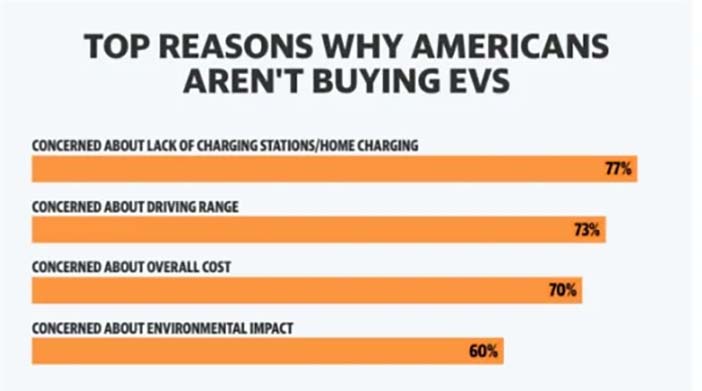
+++ The UNITED STATES is in the middle of an electric green wave. Electric vehicle sales are expected to reach 40% of total light vehicle sales by 2030, and some forecasters even see it topping 50% by the end of the decade. While it seems the transition from gas powered cars to electric vehicles is going to be a swift one in the U.S., new polling finds Americans are still very skeptical of that transformation. Consumers said concerns such as cost, range, available charging infrastructure and environmental impact weighed on their decision of whether or not to purchase a fully electric vehicle or plug-in hybrid. Yahoo Finance partnered with Ipsos to conduct a survey asking 1.025 Americans their EV buying preferences. The poll was conducted between September 29 and October 1, 2023. Overall, 57% of respondents said they were not likely to purchase an electric vehicle (defined as either fully electric or plug-in hybrid) the next time they purchase a vehicle. Only 31% of respondents were likely to purchase an electric vehicle, while 11% said they didn’t know. Looking at the demographic breakdown of those who would not buy an electric vehicle, 70% of those over the age of 65 would not, along with 60% of respondents that had an annual income below $50,000. In addition, 76% of those that identified as Republicans would likely not buy an electric vehicle. “I think there’s a lot of different factors”, Stephanie Valdez-Streaty, director of industry insights at Cox Automotive, told Yahoo Finance on what’s holding people back on electric vehicles. “I think it’s price, it’s infrastructure; I think that range anxiety is really infrastructure anxiety”. When asked what concerns them most about buying an electric vehicle, 70% of respondents in the Yahoo Finance/Ipsos poll were worried about overall cost, 73% were concerned about driving range, and 77% noted lack of charging stations on the road or charging at home. Despite this, states including California have topped 23% in terms of new EV purchases, whereas the national average is around 8%, according to Cox’s latest US sales report. Valdez-Streaty says state incentives and education about those incentives are a big factor in the state-by-state differences, with some states better than others at getting the word out. Indeed, while 52% of survey respondents support government incentive programs to encourage EV purchases, only 30% are familiar with programs like the federal EV tax credit. More confusion can be seen when asking about government programs, as is demonstrated by the fact that a majority of those polled said they supported government programs likely to reduce the country’s dependence on fossil fuels (54%), though at the same time nearly two-thirds (61%) opposed restrictions on the sale of new gas-powered cars. Conversely, of the respondents that said they would likely buy an electric vehicle or hybrid, those in the 35-49 age bracket were most likely to (37%), and 42% of those who made over $100K in income were also likely to purchase an EV as well. From a political affiliation standpoint, 41% of Democrats would purchase an electric vehicle, whereas only 17% of Republicans would. Respondents also had strong preferences for which automakers they would consider purchasing an electric vehicle from if they were to do so. Nearly one-third (30%) would most likely consider Toyota as their top choice for an electric vehicle, followed by Tesla at 23%, Honda at 20%, General Motors with 15% and Ford at 14%. With a White House goal of 50% EV sales by 2030, policymakers appear to have their work cut out for them in convincing more Americans to purchase EVs. Valdez-Streaty says pricing is key in making EVs more appealing to US consumers. “Affordability is critical”, she said, noting the federal tax credit is a great incentive, though fewer than a dozen vehicles are eligible at the moment, although that list will expand. “As we start to see more affordable vehicles under the $40.000 price point and more that are eligible for that EV credit, that’s going to be important”. Indeed, only 20% of buyers are familiar with recent price cuts of electric vehicles made most notably by Tesla and Ford, and the same small percentage (20%) are aware of recent charging deals that, for instance, will expand Tesla’s Supercharging network to EVs made by GM, Ford, Mercedes and others, addressing another major concern for buyers, which is charging infrastructure and range anxiety. +++