+++ Following the initial sales launch in South Korea, the new BMW 5 SERIES Sedan and the first i5 Sedan are now coming to dealers in numerous other markets. In Germany, the first vehicles will be delivered to customers from 21 October. The market launch also begins in the other European countries on the same day. 1 week later, on 28 October, the new edition of the BMW 5 Series will make its road debut in the USA. The other global markets will follow on 25 November. The 8th generation of the world’s most successful business sedan will also be offered for the first time as an all-electric BMW i5. Even before sales have begun, incoming orders show that this model variant in particular is meeting with high customer demand and will thus further accelerate the ramp-up of electric mobility pushed by BMW. Right from the start, customers can choose from 2 variants of the i5. The new i5 eDrive40 features an output of up to 340 hp and a range of 498 to 582 kilometers determined in the WLTP test cycle. The top model of the entire series is the i5 M60 xDrive with up to 601 hp. The new 5 Series Sedan emphasizes its progressive character not only with the two all-electric model variants, but also with innovative digital services for in-car gaming, audio and video streaming, among other things, as well as with particularly high-grade driver assistance systems. The highlight in the field of systems for automated driving and parking is the Highway Assistant, which now also enables drivers in Germany to take their hands off the steering wheel for a longer period of time at speeds of up to 130 km/h and place them in a comfortable position, provided they continue to keep a close eye on the traffic situation and are able to take over from the system again at any time if necessary. The intensive experience of semi-automated driving is complemented by the Automatic Lane Change. With this globally unique function, a glance in the exterior mirror is enough to trigger a lane change, which is then carried out automatically by the system. The new generation of the 5 Series Touring will celebrate its world premiere in spring 2024. The second body variant will be available with the same range of drives as the new 5 Series Sedan. This means that the new Touring is the first premium car of its kind to be offered with highly efficient combustion engines including 48 volt mild hybrid technology, plug-in hybrid systems and, for the first time, an all-electric drive. The unique combination of sporty elegance, modern functionality and locally emission-free driving pleasure is developed specifically for the automotive markets in Europe as well as in Japan and Taiwan. +++
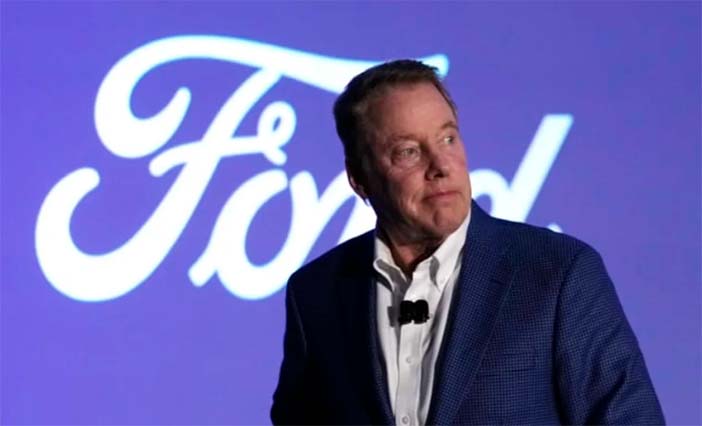
+++ FORD executive chairman Bill Ford has urged the United Auto Workers union to end a 32-day strike and reach a new labor agreement, and warned of the growing impact to the automaker and the U.S. economy. “We can stop this now”, Ford said of the strike that expanded last week to shut down the Kentucky Truck plant. “I call on UAW colleagues. We need to come together to bring an end to this acrimonious round of talks”. More than 34.000 union members working at Ford, General Motors and Stellantis are out on strike and Ford has furloughed 2.480 other workers, citing impacts of the strike. Ford, the great-grandson of company founder Henry Ford, said Toyota, Honda, Tesla and other automakers “are loving this strike because they know the longer it goes on, the better it is for them”. The UAW did not immediately comment on Ford’s remarks. The UAW’s walkout at Kentucky Truck, Ford’s largest and most profitable assembly operation globally, “harms tens of thousands of American workers”, Ford said. “If it continues, it will have a major impact on the American economy”. Last Friday, UAW president Shawn Fain accused Ford of trying to game the talks with inadequate offers and insisted Ford sharply boost compensation. Referring to Ford CEO Jim Farley’s lucrative pay package, Fain said Farley should “go get the big checkbook: the one Ford uses when it wants to spend millions on company executives or Wall Street giveaways”. Fain also vowed to strike additional plants at any time. Earlier, a senior Ford executive said the automaker was “at the limit” of what it can spend on higher wages and benefits for the UAW. Its latest offer includes a 23% wage hike through early 2028, which is higher than GM or Stellantis has offered. Ford has said the UAW’s proposals would have meant bankruptcy if implemented in 2019. Ford has long portrayed himself and his family’s company as the most union friendly in the industry, a message he repeated Monday. The union has called Ford “the enemy”, Ford said. “It should be Ford and the UAW against Toyota, Honda, Tesla and all the Chinese companies” that want to enter our market, he added. Harley Shaiken, labor professor at University of California Berkeley, said Ford was looking to speak directly to workers. “He’s doing it to move the talks in a way that he would find more desirable”, he said, but added, “This is likely not going to work”. He said UAW could be targeting and pressuring Ford because it has the best offer on the table and the union feels it can get the automaker to a deal that it could then pressure GM and Stellantis to match. GM and Stellantis did not immediately comment. +++
+++ LUCID posted a near-4% sequential increase in deliveries for the third quarter after the electric-vehicle maker offered a promotional price to aid demand for its Air. The carmaker produced 1.550 vehicles and delivered 1.457 units in the third quarter ending on September 30, compared with the 2.173 vehicles it made and 1.404 delivered in the 3 months to June. Lucid, backed by Saudi Arabia’s Public Investment Fund, slashed prices of its Air by as much as $12,400 as part of a special offer in August. Higher interest rates have caused a broader slowdown in electric-vehicle demand. Meanwhile, German luxury carmakers continue to see a rapid increase in their EV sales, with BMW and Mercedes more than tripling their third-quarter sales, according to a report from industry research firm Cox Automotive. Lucid, which went public through a SPAC deal in July 2021, said on Tuesday more than 700 additional vehicles were in transit to its new plant in Saudi Arabia for final assembly. The company had said in August it was on track to produce 10.000 vehicles this year and would need to make about 4.000 cars in the 4th quarter to meet its target. The company also said it had enough cash to start producing its much-awaited SUV next year and into 2025. Lucid will report its third quarter results on November 7 after markets close. +++
+++ MASERATI ’s 2-pronged march upmarket and towards full electrification will come to fruition in 2025 with the launch of an all-new interpretation of the legendary Quattroporte, which will be the brand’s first ever EV-only model. Speaking at the opening of the brand’s latest dealership in the United Kingdom, Bernard Loire, Maserati chief commercial officer, said: “You’ll see the first electric-only Maserati in 2025 with a new Quattroporte. You will see that it’s a real Maserati and a real Quattroporte”. Maserati is on a push to be parent company Stellantis’s luxury brand. As Loire explained: “Maserati is not aiming to be a volume brand. It’s aiming to provide exceptional cars with a very high level of quality and also making profit for the company, which has not always been the case. To do so, you don’t need to talk to everyone, but you need to be a bit different. And you will see the Quattroporte, which will be a full electric car only, it’s not going to look like an electric car at all. That’s the route that we are choosing”. Loire also confirmed that the rest of the Maserati range will follow the Quattroporte in moving more upmarket. “There will be a move up”, said Loire. “Today we have the lower entry point to the brand and we will move slowly up by the launches of new product. We started already with MC20 and GranTurismo because those cars are quite high price, of course, and they are quite unique. Grecale is very good at getting new customers to the brand. Electrification is also an important way to bring new customers to the brand. We need to get the new audience in, but in the future we are very much seeing ourselves moving up to products like Quattroporte, Levante and the sports car. So really getting to the luxury world”. Loire wouldn’t be drawn on what platform the all-electric Quattroporte would use, but it is expected it will be one of the first new models to make use of the advanced new Stellantis STLA range of platforms. In the case of the Quattropprte it’s most likely to be the Large version with a reported range of around 800 km. “Of course Stellantis offers us an opportunity of getting access to technologies and that’s extremely important when you know the investments that have to be made on the powertrains, on the batteries, on the software, et cetera”, said Loire. “For us it’s a chance to have access to that. And yes, we will try to build our cars on the most common platform taken from Stellantis, but it has to be kept as a Maserati. The way of managing platforms is more flexible than it used to be so we can different cars on the same platform. Of course, a Maserati has to always be a Maserati, so focused on the performance, on the driving pleasure and on the design. There won’t be compromise on that”. Following on from the Quattroporte will be an all-new, all-electric Levante, again likely to be based on the STLA Large platform. However, Maserati is avoiding the temptation to go larger with the Levante, with Loire firm that the brand will be avoiding the temptation to build a larger, 3-row SUV. “The product definition is not yet frozen, but certainly we are working on a new Levante. We are not going to build a boxy car just to have a roominess or package. We will build, in any case a Maserati; a compromise on the design won’t be made. And I’ve got a question for instance, will we have a 3-row Maserati? The answer is no. We would like to provide the fantastic dynamic with the design as an Italian car and we cannot make a boxy car. Then it looks like a station wagon and it’s not a Maserati anymore. I cannot talk about the dimension of the future, but the next Levante is not going to be that far away from the car of today”. Loire also promised that future Maseratis would feature plenty of technology, but in a restrained manner without resorting to multiple screens around the cabin. “If you take the GranTurismo, you have very high level of infotainment, but we are keeping the environment of the luxury Maserati interior”, he says. “So we have not an objective to put as many screens all over the place: these are vehicles that you love to drive. There is the necessary infotainment with the highest technology, but it has not to be defined by proving that we have as many screens as we can do. That’s not our design strategy. We always keep a kind of timeless design or something which is not going to be exaggerated. GranTurismo is exactly this expression where we are reinventing the GranTurismo but keeping the DNA, we are not willing to go for something which is not Maserati. We are Italian luxury the one representation of Italian luxury in the industry”. +++
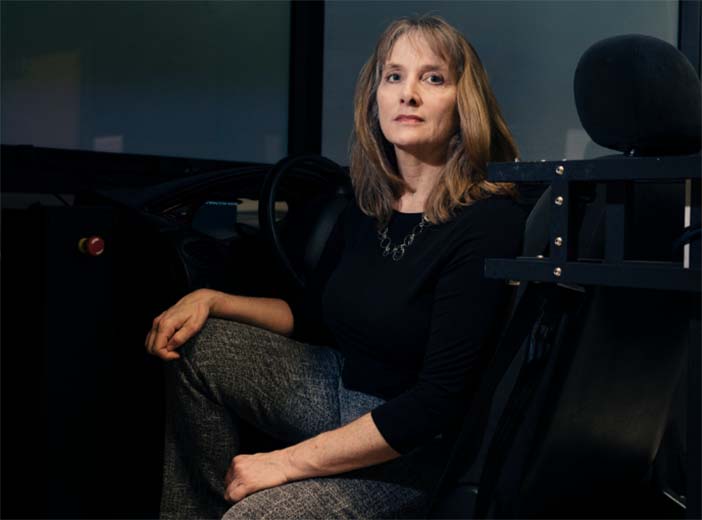
+++ In 2021, an engineer named MISSY CUMMINGS drew the ire of Elon Musk on the social network then called Twitter. A professor at Duke University, Cummings had conducted research on the safety of self-driving cars, and the findings led her to issue some stark warnings about Tesla’s driver-assistance tech. The cars, she wrote, had “variable and often unsafe behaviors” that required more testing “before such technology is allowed to operate without humans in direct control”. On the strength of her research, Cummings was appointed to the National Highway Traffic Safety Administration, to help with regulation of robot cars. Tesla fans reacted with their usual equanimity and sense of perspective, by which I mean they absolutely lost it. Their insistence that Cummings would attempt to unfairly regulate their boy Elon soon prompted Musk himself to join the thread. “Objectively”, he tweeted, “her track record is extremely biased against Tesla”. In response, Musk’s stans unleashed their full fury on Cummings: her work, her appearance, her motives. They accused her of conflicts of interest, signed petitions demanding her removal, and emailed death threats. But the thing is, Musk’s bros of war were messing with the wrong engineer. As one of the Navy’s first female fighter pilots, Cummings used to fly F/A-18s. She wasn’t intimidated by the dick-wagging behavior of a few people on Twitter with anime profile pics. She posted the worst threats on LinkedIn, hired some personal security and kept right on fighting. “I’m like, are you really going to do this?” she recalls thinking. “I double down. The fighter pilot in me comes out. I love a good fight”. She didn’t exactly win that particular engagement. A lot of whinging from Tesla pushed NHTSA to force Cummings to recuse herself from anything involving the company. But you know what they say about any landing you can walk away from. Cummings took a new gig at George Mason University and broadened her research from Tesla to the wider world of all self-driving vehicles. With companies like Cruise and Waymo unleashing fully roboticized taxis on the streets of San Francisco and other cities, the rise of the machines has begun, and Cummings is on the front lines of the resistance. In a controversial new paper, she concludes that the new robot taxis are 4 to 8 times as likely as a human-driven car to get into a crash. And that doesn’t count the way self-driving vehicles are causing weird traffic jams, blocking emergency vehicles, and even stopping on top of a person who had already been hit by a human-driven car. “In the paper that really pissed all the Tesla trolls off, I actually say that this is not just a Tesla problem, but that Tesla is the first one to experience the problems”. Cummings tells me. “For years I have been telling people this was going to happen, that these problems would show up in self-driving. And indeed they are. If anyone in the self-driving car community is surprised, that’s on them”. It turns out that serving in the Navy is a very good way to train for inbound ire from Muskovites. In her 1999 memoir, “Hornet’s Nest”, Cummings recalls how she loved flying jets, and says the excitement of getting catapulted off an aircraft carrier (or landing on one) never got old. But the environment was far from welcoming. Sexual harassment in the Navy was routine and male colleagues repeatedly told Cummings she wasn’t qualified to fly fighters simply because she was a woman. When she and another female officer showed up at a golf tournament on base, they were told to put on Hooters uniforms and drive the beer carts. Cummings declined. Flying tactical engines of destruction also provided Cummings with a firsthand lesson in the hidden dangers of machines, automation and user interfaces. On her first day of training, two pilots were killed. On her last day, the Navy experienced the worst training disaster that had ever taken place aboard a carrier. In all, during the 3 years that Cummings flew, 36 people died in accidents. In 2011, while conducting research on robot helicopters for the Navy, Cummings had an epiphany. Even surrounded by nothing but air, those helos were far from perfect and they relied on the same sensors that self-driving cars do while operating right next to cars and people. “When I got in deep on the capabilities of those sensors”, Cummings says, “that’s when I woke up and said, whoa, we have a serious problem in cars”. Some of the dangers are technical. People get distracted, self-driving systems get confused in complicated environments, and so on. But other dangers, Cummings says, are more subtle: “sociotechnical”, as she puts it. What she calls the “hypermasculine culture in Silicon Valley” intertwines with Big Tech’s mission statement to “move fast and break things”. Both bro culture and a disruptive mindset, as she sees it, incentivize companies to gloss over safety risks. All of which makes it even tougher for women when they level the kind of critiques that Cummings has. “When Elon Musk sicced his minions on me, the misogyny about me as a woman, my name: it got very dark very quickly”, she recalls. “I think the military has made a lot of strides, but I do think that’s what’s happening in these Silicon Valley companies is just a reminder that we haven’t come as far in our society as I thought we would have”. An example: Last month, the head of safety at Waymo touted a new study from his company on LinkedIn. The research was unpublished and had not undergone peer review. But Waymo used the study to argue that its robot cars were actually much less likely to get into crashes than cars driven by biological organisms like you and me. Cummings wasn’t having it. She had her new results (also still in preprint) which showed self-driving taxis to be way more crash-prone. So she went on LinkedIn, too, and said so. The response was familiar to her from her days in the Navy. Kyle Vogt, the CEO of Cruise, slid into the comments. “I’d love to help you with this analysis”, he wrote to Cummings, questioning her number-crunching. “Would be great to connect and discuss this further”. Cummings responded in kind. “I’d love to help you with your understanding of basic statistics, use of computer vision and what it means to be a safe and responsible CEO of a company”, she wrote. “Call anytime”. Women, she figures, caught her vibe. “Every woman who read that was like: Mmm-hmm, you go”, Cummings says. But men (friends in Silicon Valley) did not. They thought she had been too mean to Vogt. “He was just trying to help you”, they told her. “All the guys read it like: She’s such a shrew!” Cummings says. But, ever the fighter pilot, she was unfazed. “That’s how I got my call sign”, she says. “So I live with it”. So who’s right: Cummings, or the self-driven men of Waymo and Cruise and Tesla? It’s hard to tell, for a simple reason: The data on the safety of robot cars sucks. Take Cummings’ approach in her new paper. First she had to wrestle with NHTSA’s nationwide data for nonfatal crashes by human drivers, to get numbers she could compare to California, the only place where the robot cars run free. Then she had to figure out comparable nonfatal crash numbers and miles traveled for Waymo and Cruise, tracked by divergent sources. Her conclusion: Cruise has 8 nonfatal crashes for every human one and Waymo has 4; comparable to the crash rates of the fatigued and overworked drivers at ride-hail services like Uber and Lyft. The purveyors of robot taxis argue that Cummings is wrong for a bunch of reasons. Chiefly, they say, the numbers for human crashes are actually undercounts (lots of fender benders, for instance, go unreported). Plus, crash numbers for the whole country, or even just California, can’t be compared to those for San Francisco, which is way denser and hillier than the state as a whole. Looked at that way, Cruise argued in a recent blog post, its taxis have been involved in 54% fewer crashes than cars driven by humans. The company also maintains that ride-hail drivers get into one nonfatal crash for every 210.000 km of driving; 74% more collisions than Cruise’s robots. Cummings ain’t buying it. A blog post isn’t science; it’s a press release. “Every company has a fiscal interest in getting a paper out that makes them look good, and in the case of Cruise it makes rideshare drivers look bad”, she says. “So that’s what they’re doing”. This is exactly the sort of sociotechnical culture that Cummings is criticizing: that she’s uniquely qualified to criticize. Other experts also discount Cruise’s claims, coming as they do from folks who are incentivized to welcome our new robot overlords. “If we were to believe the numbers Cruise is putting out there for ride-hailing drivers, those drivers would be having on average 2 crashes per year,” says Steven Shladover, a research engineer at UC Berkeley’s Institute of Transportation Studies. “How many drivers have 2 crashes every year? That is pretty extreme”. But Shladover is also skeptical of the numbers crunched by Cummings. “Missy is assuming a human driver crash rate that’s too low for San Francisco and Cruise is showing a human crash rate that’s too high”, he says. “The reality is probably somewhere in between”. So maybe Cummings is right, and self-driving cars are a menace. Or maybe it’s not quite as bad as her new paper suggests. Until robot cars have traveled for hundreds of millions of miles, there’s no way to get a statistically significant, unequivocal conclusion. But the bottom line is: It shouldn’t matter. When the data on a product or device’s safety is equivocal, regulatory agencies are supposed to make and enforce rules that protect consumers, just as they do in other industries. If the data on robot cars is equivocal or incomplete, then those rules should keep them off the road. The burden of proof is on Waymo and Cruise and Tesla, not Missy Cummings. And if those companies want to put 2-ton robots on public streets, blogging about data benchmarks isn’t the way to show people they’re ready. “One of the big things I’m on about now, pulling from my aviation years, is that all these companies need a chief AI pilot”, Cummings says. “They need to have somebody, one person, who stands up and says, ‘I am responsible’. We do that right now for aviation. That’s why so many heads rolled with the problems that happened with the Boeing 737 Max. They got complacent. They lost their safety culture”. Cummings is a careful researcher. She’s also, as one transport-safety researcher put it privately, “provocative”. She is more than happy to strafe companies like Tesla and Waymo and Cruise, and to argue that tech bros need to be brought inside a stricter regulatory framework. In a sense, she’s Elon Musk’s worst nightmare. She has repeatedly and routinely risked her life to test the incredible capabilities (and the lethal limits) of human-machine interfaces. And she did it in an environment where the stakes are far higher than the battlefields of Twitter and LinkedIn. To her, the safety of self-driving cars is not an abstract question. It’s a matter of life and death. “I’m a tenured professor. My work speaks for itself. I’m trying to save your life, right?”, Cummings says. “And there’s the side of me where I’m like Don Quixote on steroids. There’s no windmill I don’t want to tilt at”. +++
+++ TESLA ’s latest price cuts are continuing to blow even its gas competitors out of the water. Last month, new cars saw an average transaction price (ATP) of $47.899 in the United Stets. New car prices have slowly but surely been improving as of late, but are still pretty costly. But with Tesla’s most recent price cuts, the base-level Model 3 is now priced at a significantly lower $38.990. The cheapest Model Y is now going for $43.990. After the $7.500 federal tax credit, the Model 3 comes out to $31.490 while the Model Y could go for $36.490, not to mention a slew of possible state incentives. Both are a whopping several thousand dollars less than the average vehicle. It’s important to note the nuance here: List prices might differ slightly from the average price vehicles actually sell for, especially as manufacturer incentives average about 4%. In Tesla’s case, the trim level options could bring its average up or down, but its sticker prices are essentially its transaction prices. Just last month, the Model 3 saw an ATP of $41.484 (still substantially below the overall average) while the Model Y transacted, on average, for $53.069 (above the average, but relatively close). Those will likely shift with the latest cuts. Tesla vehicles overall saw a $50,931 ATP; a number driven up by its more costly Model S and Model X, but down almost 25% from a year earlier. That means Tesla ATPs as a whole are now lower than luxury competitors Acura, Lexus, Infiniti and Volvo. Vehicle pricing has dominated headlines in recent years. The pandemic sent new and used vehicle prices soaring for months on end. Just now are car shoppers starting to see small signs of respite, though it’s hard to say if those signals will last. To be sure, new car pricing is relatively flat year-over-year (down just $360 from September last year), while used car pricing is more nuanced. Certainly, the ongoing UAW strikes could eventually have an impact on the market and upend any pricing (and inventory) progress the industry’s been able to make this year. EV prices, in particular, have been up for debate. An EV changed hands for $50.683 on average last month; down from a whopping $65.000 just a year earlier. Tesla is largely to credit for that 22% decline in EV prices overall. There are less expensive EVs on the market, but much of the new electric product thus far has been geared toward higher-end buyers. The company’s price cuts have been an effort to stoke demand as it sees incremental drops in market share as more electric competition enters the market. Tesla’s third-quarter production and deliveries dropped after record numbers over the previous few quarters. Still, Tesla remains the dominant player in the EV market. Elon Musk’s firm may be losing money with each cut it makes, but it’s all in the name of price parity. The closer the price EVs get to the price a car buyer would pay for an internal combustion engine vehicle, the more likely they are to consider going electric. Today, luxury gas cars and luxury EVs cost about the same, but there’s still a long way to go for mainstream EVs to match the cost of their gas counterparts. +++
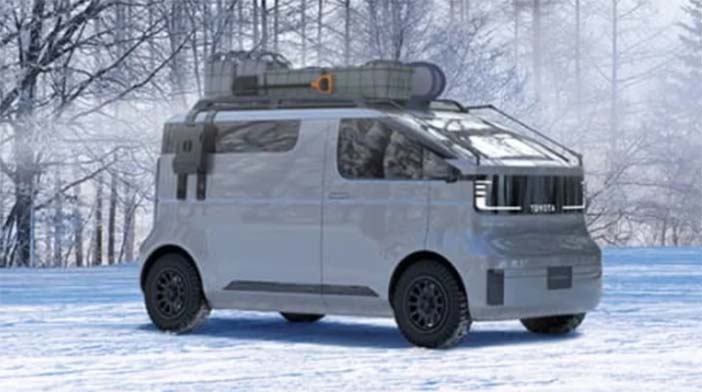
+++ Despite its image as a somewhat conservative automaker, TOYOTA ’s designs have pushed the envelope of style versus substance. The outgoing Prius wasn’t pretty by any standard, but nobody can deny its curb presence. Moving to electrification opens other avenues to explore packaging and design, and Toyota’s latest concept shows its vision for an emissions-free urban future. Called Kayoibako, the concept takes the shape of a small boxy van, which isn’t surprising when you know that the name means “configurable shipping container” in Japanese. The automaker said that the vehicle is intended to be a “quality base unit” that can be customized based on the need. It will also be able to form a part of the power grid and will have hardware and software to manage the integration. In commercial settings, the vehicle will help with “last-mile” logistics, moving cargo from large transport vessels to the final destination. Toyota said the van can also be customized with shelves and other gear to become a rolling shop or bus. Private owners will also be able to customize the van, and its design will enable more convenient wheelchair access. The Kayoibako has a 2.800 mm wheelbase. Its role as an urban appliance likely plays a role in that number, as shorter wheelbases make it easier to navigate tight spaces. We will likely see more of these “do-it-all” vehicles as companies dive deeper into electrification. The flexible skateboard chassis that underpin modern EVs are flexible and can be adapted to a wide range of vehicle types. While funky, small utility-adjacent vehicles like this could become much more popular as automakers discover efficiencies from the scale they can achieve with a modular EV platform. +++