
+++ BMW ’s honchos have given the official “Ja!” to an M3 CS Touring. It will debut next summer. When the wicked-up wagon materializes, it will be a limited production offering like every other CS. There will be no more than 2.000 units for sale. Each one would follow the usual aspects of the CS recipe, like supplemental boost from the twin-turbos feeding the 3.0-liter inline-6 that push output to 550 hp, up from 510 hp in the M3 Competition. Some extra carbon fiber bits, additional structural bracing, mild weight savings of around 35 kilos should make cameos, too, and perhaps a special launch color.At least 7 new or updated M models are coming next year, including a more powerful M2 that won’t be called “Competition”, mid-cycle refreshes for the M3 plus M3 Touring and M4; an M4 CS and the new M5 plus M5 Touring. What M cars won’t do next year is get BMW’s latest iDrive 8.5 and iDrive 9 for some reason, a product planner telling there’s no plan to roll out the new infotainment to the tuned cars nor the 2 Series, 3 Series or 4 Series. BMW accountants are likely all smiles anyway, the production engineers are likely not getting as much sleep as they’d prefer. +++
+++ Despite already committing to fully electrified models in other parts of its catalogue, LAMBORGHINI will continue to take a watching brief when it comes to BEV super sports cars, and will only commit to them as and when decisions are made about the future of synthetic fuels. Lamborghini Chairman and CEO Stephan Winkelmann told that his company “can afford to leave the door open for a few years yet”. He explained: “Synthetic-fuelled sports cars would be an easier leap for us, but we have to wait and see what the legislators decide about them, and whether we can get global agreement on their viability”, Winkelmann said. “We are a global company, so it’s no good if they are only allowed in one area. They have to be real and flying everywhere. The plan is for our everyday cars (the Urus and new Lanzador) to both be fully electric by the end of the decade. For the super sports cars, we will be hybridized; and those cars will live for 8 or 9 years from now (until the early 2030s). And so, given that a typical development cycle for a new sports car is 4 years, we have some time yet to watch and wait until the picture becomes a clearer”. “We certainly see a clear trend from our younger buyers towards sustainability”, Winkelmann went on. “The overall footprint of our brand in terms of the by-volume emissions of our cars is negligible; but our sense of social responsibility for the brand is much bigger, and we have to honor that”. “The truth is, we just don’t know how much of our existing sports car customer base might already consider a BEV alternative. We’re not even asking yet. First, we have to prepare them in a way that is credible. You have to do things in the right order. With Lanzador, for instance, we came with a concept, a vision: something real. Only once people have seen it can you really judge if the market is ready”. Winkelmann says he’s not daunted by the idea of Lamborghini going fully electric, even across its wildest and most enthusiast-targetted models, however. “When I look back 5 to 6 years, when we took the decision to go hybrid, it was a tough decision. Nobody thought it would be accepted. So you have to think of public opinion as a film, not a snapshot”. “Clearly, there will be a moment in time when full BEV sports cars can be even more emotional than ICE. The power output is already so amazing. What we have to prove is not the performance, but the handling dynamism and the excitement. In fact, we can already see the time when battery energy density will allow to make even more agile EV supercars than the ICE ones we have today. With enough reassurance from us, we can make those cars even more emotional for our owners, too. Winkelmann added the technology was for the firm to develop and prove, rather than waiting for other brands to move ahead. “We know we are already not the first ones, but when we get there, we want to be the best ones”, he said. “For me personally, I have not decided whether I prefer e-fuel or BEV for the super sports cars. For the daily driver models, there’s really no alternative to EV. My doubt on synthetic fuels is only to do with scalability. Come 2035 there will still be billions of cars on the road with combustion engines, and if we want to make the biggest difference to global emissions, the best way to do it, in theory, is with e-fuel. But I’m not convinced that’s viable. Right now, the whole industry is already investing in battery technology. So as an industry, and clearly not only for the benefit of brands like Lamborghini, we need greater consensus and focus”. +++
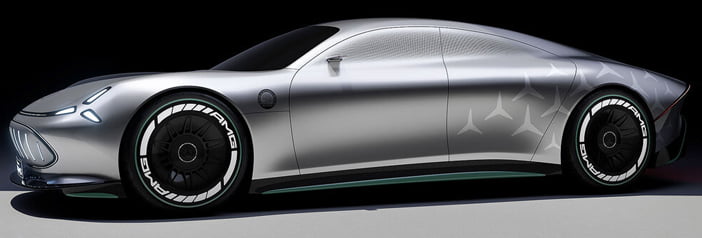
+++ MERCEDES-AMG is poised to begin advanced development of its first bespoke electric sports car, which will arrive in 2025 with innovative drivetrain technology that is likely to make it the firm’s most powerful road car yet. Serving as an electric alternative to the snarling, V8- engined GT 63 4-Door Coupé, AMG’s first bespoke electric car will be tasked with taking on highly acclaimed and big-selling EV sports saloons such as the Porsche Taycan, Audi e-Tron GT and Lucid Air. AMG has already turned its hand to the Mercedes EQE and EQS duo to create warmed-up, 53-badged sports saloons with huge power outputs, but this new model will be designed from the ground up as a performance car. As such, it is expected to place as much emphasis on dynamic performance and engagement as it does straight-line speed. It will be the first car to use a bespoke performance-oriented EV architecture known as AMG.EA. This is understood to have been designed and engineered with an eye on facilitating the low-slung, sleek silhouettes that currently define AMG’s combustion sports cars. Central to establishing this platform as a dedicated sports car architecture will be the deployment of highly advanced electric motor technology from British firm Yasa, acquired by Mercedes in 2021. The Oxfordshire outfit’s disc-shaped axial-flux units, to be built at scale by Mercedes in Berlin, Germany, tout much higher power- and torque-density figures than conventional, sausage-shaped radial-flux motors. As a result, they can weigh less, take up much less space and operate more efficiently. AMG has yet to give any indication of the precise implications of this technology for its upcoming production cars, but Yasa boss Tim Woolmer confirmed that a motor bound for one of the German firm’s production cars weighs just 24 kg yet produces 800 Nm of torque and 490 hp of power in its own right. If used in tandem as part of a twin-motor system, it seems likely that the axial devices will result in a dramatic power boost over even the 760 hp AMG EQS 53 4Matic, potentially edging towards the 1.000 hp and 1.350 Nm marks. For reference, AMG competitors BMW M and Audi have access to EV platforms capable of handling upwards of 1.320 hp for their own next generation of sports EVs but they have yet to give specific details of their own direct rivals to AMG’s new super-saloon: the next-generation M3 and the RS6 e-Tron. Notably, a recent concept from Mercedes (the retro, wedge-shaped One-Eleven) houses both of its electric motors on the rear axle, suggesting four-wheel drive is not a given for AMG’s next-generation sports cars. At its unveiling, bosses highlighted the packaging benefits of both twin motors featuring at the rear: the front end is able to be brought as close as possible to the ground for optimal aerodynamic efficiency, but the motors’ compact footprint means there is still room for a sizeable rear luggage area. This suggests that any new electric saloon using such an arrangement can, in theory, tout the same practicality credentials as its V8-engined predecessor, making it a bona fide super-tourer. Prototypes for the electric GT 63 replacement are expected to start hitting the road in the coming months as the EV gears up for a market launch in 2025. Our best look so far comes courtesy of the rakish, motorsport-themed Vision 2025 concept (photo) that AMG revealed last year, which is understood to be a close preview of the model’s shape, size and positioning. Measuring 5.100 mm long and with a wheelbase of 3.000 mm, the concept is well placed to succeed the similarly sized GT 63. Its proportions hint at a focus on interior space while maintaining handling and aerodynamic performance, with its wheels pushed into the corners and its silhouette defined by various wind cheating elements, including active aero components. Mercedes exterior design boss Robert Lesnik said the Vision 2025 takes “full advantage of the new AMG.EA platform in both the design and the proportions”. He added that the plan for the production version is to create “a low and sleek saloon with outstanding aerodynamics and the space to accommodate four adults in comfort”. Central to this pledge will be a new type of slimline, energy-dense battery design bespoke to AMG EVs. Mercedes-Benz has confirmed it will use a new silicon anode material from US firm Sila. This is said to offer a 40% improvement in energy density over existing graphite anodes and thus substantially boost range, with the added benefit of freeing up room in the interior. New-era AMG cars will follow the lead of their Benz-badged counterparts in adopting a bold cabin design centred on a full-width high-definition screen, as alluded to by the Concept One-Eleven. The 2025 saloon is described as a four-seater, but no doubt larger successors will make space for a third seat in the rear. +++
+++ The SKODA ENYAQ will enter its second generation in 2028 as the Czech brand’s first car to use the Volkswagen Group’s new SSP electric car platform. Skoda CEO Klaus Zellmer confirmed that Skoda will start using the SSP platform (set to eventually underpin 80% of Volkswagen Group cars) towards the end of the decade, with the new Enyaq the first to make the switch from the current MEB platform. Skoda’s first SSP car will arrive in 2028 or 2029, he revealed, at around the same time as Volkswagen uses the architecture for an electric successor to the Golf. “This is when the Enyaq (which, by the way, will be built in Mlada Boleslav in the Czech Republic) will be on SSP”, said Zellmer. Asked if the new Enyaq will be tangibly different from today’s car, Zellmer would only say: “We are still working on that”. Given the success of the current Enyaq (Skoda’s first bespoke electric car), the brand is unlikely to stray too far from the formula as it gears up to launch a replacement model. Last year, Skoda shipped nearly 54.000 Enyaqs and recorded a 41% year-on-year increase in the first half of this year, during which period the Enyaq was Europe’s 9th best-selling electric car. Expect a trademark focus on practicality to remain the prevailing theme but also for the second-gen Enyaq to adopt a radical new look in line with Skoda’s rugged ‘Modern Solid’ design ethos, which will make it an obvious sibling to the upcoming Space BEV electric 7-seater. The next Enyaq will also benefit from wide-reaching technological advances due to be rolled out to VW Group production cars in the coming years. The SSP structure (a highly adaptable modular architecture that can host various drivetrains and batteries according to the needs of each Volkswagen Group manufacturer) promises drastic improvements in range, efficiency, power and affordability compared with the current MEB structure, which is used by EVs from VW, Skoda, Cupra and Audi. Chief among the technical changes is the introduction of a new ‘Unified’ battery structure, developed in-house, which will be shared across most VW Group model lines in the name of scale-led cost savings. Early details suggest 800 Volt compatibility will give a 10-80% charging time of as little as 12 minutes on average (compared with around 35 minutes for the current Enyaq) but specific capacities and ranges have yet to be confirmed. Volkswagen Group CEO Oliver Blume has previously suggested that this new modular approach (under which a much higher percentage of components will be shared between cars and brands) means “most” SSP-based EVs can achieve cost parity with current combustion cars. So it is reasonable to expect that the next Enyaq will come down in price to roughly match the 5-seat Kodiaq. Another crucial upgrade for the SSP era will be the introduction of a new software stack, dubbed 2.0, which will bring (among other usability and functionality upgrades) the capacity for hands-free driving up to Level4. +++
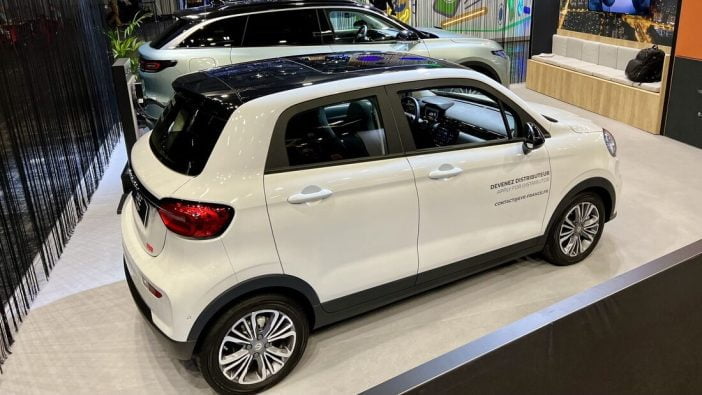
+++ Global motoring powerhouse STELLANTIS will ship and sell vehicles from fast-growing Chinese car maker Leapmotor in Europe as part of a €1.5 billion investment deal. Taking a 20% stake in the firm (which gives it 2 board of directors seats), the move also creates the Stellantis-majority-owned Leapmotor International, under which the models will be sold outside of China. Shipments are expected to begin in the second half of 2024. Stellantis (which owns, among others, Citroën, Peugeot and Opel) has told that “there are no plans about models at this stage” when asked to confirm which Leapmotor vehicles will be sold in Europe. Currently, Leapmotor (which sold 111.000 cars in 2022) offers the Fiat 500-rivalling T03 city EV (photo) for the equivalent of €15.000, the Tesla Model Y-rivalling C11 (€39.000) and the BMW i4-rivalling C01 (€45.000). +++
+++ A jury on Tuesday handed TESLA another win after siding with the automaker over allegations that its Autopilot advanced driver assistance system led to a death. The case, which was being tried in the Superior Court of California, County of Riverside, was filed by 2 passengers who survived a 2019 crash and alleged that Tesla knew its product was defective. The 2 survivors sought $400 million in damages for the loss of the driver’s life, physical injury and mental anguish. Tesla argued the crash, which resulted in the death of the driver Micah Lee, was the result of human error; the same stance it’s taken in other Autopilot lawsuits. While Tesla has won other lawsuits, including a California jury trial earlier this year that determined the automaker’s Autopilot system was not to blame for a 2019 crash. In that case, the jury awarded no damages to Los Angeles resident Justine Hsu, who sued Tesla in 2020 alleging negligence, fraud and breach of contract. The Molander v. Tesla case that wrapped up Tuesday was the first jury trial involving a fatality. Tesla still faces a number of other lawsuits in California, including a wrongful death suit that was filed by the family of Walter Huang, an Apple engineer who died after his Tesla Model X with Autopilot engaged crashed into a highway median. The State of California Department of Transportation is also named in the lawsuit. That wrongful death lawsuit, filed in California Superior Court, County of Santa Clara, alleges that errors by Tesla’s Autopilot driver assistance system caused the crash that killed Huang on March 23, 2018. Huang, who was 38, died when his 2017 Tesla Model X hit a highway barrier on Highway 101 in Mountain View, Calif. A jury trial is expected to begin next year in that case. Tesla is also facing scrutiny from federal and state regulators, all of which are related to Autopilot and its upgraded version known as Full Self-Driving. Tesla vehicles come standard with a driver-assistance system branded as Autopilot. For a $6,000 upgrade, owners can purchase Enhanced Autopilot, which includes several other features, including an active guidance system that navigates a car from a highway on-ramp to off-ramp, including interchanges and making lane changes. For an additional $12.000, owners can buy “full self-driving”, or FSD (a feature that CEO Elon Musk has promised for years will one day deliver full autonomous driving capabilities). Tesla vehicles are not self-driving. Instead, FSD includes a number of automated driving features that still require the driver to be ready to take control at all times. It includes everything in Enhanced Autopilot and is supposed to handle steering on city streets and recognize and react to traffic lights and stop signs. +++
+++ TOYOTA is on track to put its steer-by-wire technology into production by the end of 2024 after making a significant upgrade to the system. The key change to the steer-by-wire system, which means there is no mechanical link between the steering wheel and the wheels, is a new 200 degrees ratio instead of a 150 degrees ratio before to give the steering a smoother and more natural feel. Toyota engineers working on the system, which is also known as One Motion Grip, said the new ratio gave the system an “easier, more familiar feel” for customers. The Japanese company has had “hundreds” of people from inside and outside the company test the system to ensure it is as intuitive as possible to drive. Steer-by-wire is initially set to be offered on Toyota electric cars, including the Toyota BZ4X and the Lexus RZ. The technology has been developed to meet the world’s strictest legislation around by-wire steering systems, which had been Europe but has recently been surpassed by China. Europe has created its own certification programme for by-wire steering systems, removing the need for a mechanical link between the steering wheel and the wheels as had previously been law. The system is already legal in Japan, while in the US, no such legislation exists. The UK would most likely follow the EU legislation, but this is not yet known. Over-the-air software updates would be possible for the steering system. However, such remote updates are not currently allowed by legislation. Engineers confirmed that the steer-by-wire system is also earmarked for the new modular architecture that will underpin Toyota and Lexus electric cars from 2026, starting with a new Lexus saloon inspired by the LF-ZC concept at the Japan Mobility Show. Lexus design chief Simon Humphries said the adoption of steer-by-wire opened up huge possibilities for interior design. “We want the interior to be as open as possible,” he said. “You can get rid of the ‘bits and pieces’ and interior panels don’t have to cover anything. Go steer-by-wire and there are fewer mechanical bits to hide. It gives more and more freedom”. Toyota is also undergoing a further development of the steer-by-wire system called Neo Steer, which moves the accelerator and brake controls onto the steering wheel. This is the early stages of development, with no production date set, and the idea behind it is to provide ‘mobility for all’ for drivers who cannot use foot controls. A previous drive of a One Motion Grip system on a Lexus RZ left me impressed with the technology but hesitant as to whether it had a future because it was so far removed from steering as we know it today. It was too quick, too urgent and often left you having to apply lock on multiple occasions in the same corner; either adding more or taking it off. This was with the old 150 degree ratio but the new 200 degree ratio makes it a lot easier and more intuitive to drive and you can at last see a way to production, where it can benefit the way people steer rather than have to relearn and compensate for something overly hyperactive. The new ratio makes the steering feel less nervous and urgent while also keep its low-speed manoeuvrability. It’s all very natural and you quickly learn to place the car with precision and ease. It’s much easier to reverse the car now than with the old ratio too, the system responding as you’d expect to small inputs. I also got to try the Neo Steer system, which uses a paddle behind the wheel to brake with your left hand and an actuator for your right thumb to accelerate. This is far less mature and harder to drive anyway, with a much quicker 90 degree steer-by-wire ratio. The accelerator and particularly the brake controls were not linear either and it’s easy to get in a muddle. The sentiment behind the system is fantastic and Toyota will soon hand a prototype over to a Japanese Paralympic athlete it works with for some real-world testing to further develop the system. +++
+++ The VOLKSWAGEN GOLF GTI is being prepared for one final outing with petrol power as the firm begins laying the groundwork for the hallowed performance badge’s electric future. After VW revealed the striking ID GTI concept as a near preview of its first EV hot hatchback, based on the upcoming ID.2, its petrol forebear is gearing up for upgrades that look set to bring more power alongside dramatic technological advances and a wide-reaching interior rethink. Due to be revealed early next year as part of the facelifted Golf line-up, the ‘Mk8.5’ GTI is tipped to stick with pure-combustion power, even as Volkswagen ushers in new mild-hybrid and longer-range plug-in hybrid versions of the standard Golf. The hot hatch’s EA888 2.0-litre turbocharged 4-cylinder engine produces 245 hp in the current car, giving it a 0-100 kph time of 6.3 seconds and a governed 250 kph top speed. But that engine is tipped to be significantly updated for its final years in production, with the GTI Clubsport ramping output to 300 hp and the 4-wheeldrive Golf R touting 333 hp in its most potent form. The standard GTI’s focus on delivering ‘everyday performance’ means such lofty figures will remain the preserve of those range-toppers, but VW has confirmed the new Tiguan and Passat will be offered with a version of the petrol four-pot that lifts output to 265 hp. Given the Golf uses the same MQB Evo architecture as those larger siblings, the possibility for that more potent motor to be used in the GTI is evident. VW has yet to detail exact performance figures, but a 20 hp increase (along with an expected hike in torque to around 400 Nm) could drop the GTI’s 0-100 kph time below 6 seconds and make it a closer match for the newer and faster Honda Civic Type R. The power increase will come alongside revisions to the GTI’s chassis in pursuit of keener dynamics and enhanced rolling refinement. The latest iteration of the MQB platform, as used by the Tiguan and Passat, brings a stiffer rear axle carrier that’s claimed to improve rolling refinement and cornering performance, as well as a more advanced version of the DCC adaptive suspension system that made its debut underneath the current GTI. Called DCC Pro, it allows for much more precise control of the compression and rebound of the 2-valve dampers, which boosts isolation over rougher surfaces while allowing better absorption of road surface imperfections, even while cornering. Also in the frame is a reprieve for the manual Golf GTI, in line with relaxations to the impending Euro 7 emission regulations that had previously threatened the stick-shift car’s viability. Autointernationaal.nl previously revealed that the original plans for the new rules (initially set to be introduced in 2025) would force the retirement of the 6-speeder from the whole Golf line-up in a move to reduce VW’s fleet emissions. But with the European Commission poised to relax the emissions testing requirements and delay their implementation, the route could be paved for a comeback. Notably, though, the manual GTI is no longer on sale, so it seems more likely the uprated hot hatch will be equipped exclusively with a 7-speed DSG gearbox. More certain is a wide-reaching revamp of the Golf’s cockpit and infotainment suite, aimed at rectifying the usability and reliability problems that have plagued the hatchback since its 2020 launch. The Golf line-up will get the expansive new 12.9 inch touchscreen that has been introduced in its newer stablemates, together with a new-look 10.4 inch instrument display. Both are expected to usher in simplified menu structures, quicker response times and improved functionality. As part of the overhaul, VW will also introduce light-up touch sliders for the climate controls, making them easier to operate at night. The haptic controls on the steering wheel, another gripe, will be replaced by conventional switches and buttons, and the Golf will follow the recently refreshed ID.3 in adopting higher-quality materials throughout. The exterior revisions will be more subtle but massaged bumpers and reshaped headlights will be the key differentiators. Looking further ahead, 2026 will mark the 50th anniversary of the GTI, which means one of the final entrants into the Mk8 family is highly likely to be a commemorative model to follow in the footsteps of the 2021 track-honed Clubsport 45 special edition. The GTI ‘Edition 50’ will be conceived to showcase the GTI at its best, with bespoke styling, a power boost and an uprated chassis geared towards rapid lap times. 2 years later, in 2028, Volkswagen will reveal the 9th generation Golf as an EV (the first in its line-up to use the new SSP architecture) complete with an uprated GTI hot hatch. +++