+++ The FORD PUMA will gain an electric variant in 2024 to rival the Opel Mokka Electric and upcoming Mini Aceman. Due to go into production early 2024 in Craiova, Romania, it will share its platform and powertrain with new Ford E-Transit Courier. Ford said it’s working on only one battery version, which, based on the fact that a 100 kW charger will give a 10-80% top-up in less than 35 minutes and can add 85 km of range in 10 minutes, is expected to be around 55 kWh in capacity. This would be enough in theory for a competitive range of around 400 km. If the E-Puma uses the same 136 hp motor as the E-Transit Courier, it should be able to go in 9.0 seconds from 0-100 kph. Ford of Europe boss Martin Sander is keen to position the Puma as the “practical version” of the Fiesta, saying that it will remain on sale “for many years” following the introduction of the EV version, suggesting a 2029 end-of-sale date. It will be priced above the current Puma. Expect prices to start at around the €39.000 mark in the Netherland. The Puma was Ford’s best-selling car for the past two years running, having dethroned the soon-to-retire Fiesta, which suffered a drop in sales when heavily impacted by semiconductor shortages and factory closures. The E-Puma is the latest step in Ford’s electrification strategy, which will involve an investment of $22 billion through 2025. The firm has already electrified several of its most important vehicles, including the Mustang, F-150 and Transit, and recently revealed the new Explorer. +++
+++ A pre-production prototype of the upcoming HYUNDAI IONIQ 7 has been pictured testing on public roads in Germany, ahead of a launch next year. The electric SUV, which will share much of its underpinnings with the recently revealed Kia EV9, will arrive as the third car in the brand’s futuristic line-up of electric cars. It will sit above the Ioniq 5 and Ioniq 6 to provide a long-range rival to the Mercedes-Benz EQE SUV. Despite much of the car’s design being obscured by fabric, the Ioniq 7 clearly shares many characteristics with the Hyundai Seven concept, which was revealed and presented to the public in the US in 2021. Aspects derived from the concept are likely to include its large rear window, headlight details and wing mirrors. Back in 2021, the Korean marque labelled the concept as a “category-bending” electric SUV, highlighting its aerodynamically optimised styling and extended wheelbase as departures from the design norms of conventionally fuelled contemporaries. Given the Ioniq 7 and EV9 are both based on the Hyundai-Kia E-GMP platform, it’s likely they both share the same powertrain set-up. The EV9 is powered by a 99.8 kWh battery, offering 505 – 563 km of range. Other markets get an entry-level car with a 76.1 kWh battery. It also features a choice of two powertrains: a rear-wheel-drive set-up with 204 hp and 350 Nm of torque, and a 384 hp, 600 Nm version with dual motors and 4-wheel drive. In its most powerful spec, the EV9 can hit 0-100 kph in 6.0 seconds. Hyundai planned for its first 3 bespoke EVs to have highly individualized styling, and indeed the Seven concept adopts a radically different silhouette (“divergent from a typical SUV”, according to the firm) and a raft of new design cues to mark it out from both its range-mates and its fuel-burning forebears. We can see the Ioniq 7 features a ‘Parametric Pixel’ design for the front and rear light clusters, a motif common to each of Hyundai’s bespoke EVs, including its Heritage Series reborn classics, and is said to blend elements of “digital and analogue styles” and highlight the rigorous approach of its designers, who “considered every aspect of Seven’s design, down to a single pixel”. Sitting atop Hyundai’s EV-specific E-GMP architecture, the Ioniq 7, like the Seven concept, will benefit from a flat floor, short overhangs and bonnet, and, at least on the concept, a 3.200 mm-long wheelbase; roughly as long as that of even the largest version of the Mercedes-Benz S-Class. These are all features that allow for a much more spacious cabin environment than offered by Hyundai’s existing SUVs. It is in this respect that the production-spec Ioniq 7 will differ most obviously from the concept, which ditches a conventional three-row seating layout in favour of a more “fluid” format comprising a pair of movable, swivelling armchairs (complete with footrests) and a curved corner sofa-style arrangement at the back of the cabin. On the Seven concept, a retractable joystick replaces the steering wheel, for example, and in place of a conventional dashboard, a sleek digital control panel spans the width of the cabin (an evolution of the set-up shown in the Prophecy concept) while a huge OLED screen in the ceiling serves as a sort of virtual sunroof with customisable displays. With the front seats turned rearwards, the Seven is transformed into a mobile lounge, with ambient lighting supplied by distinctive tube-shaped devices in the door panels, an in-built fridge and even dedicated shoe care compartments. Which of these, if any, will make it to production remains unclear, but Hyundai design boss SangYup Lee said the Seven “paves the way forward for what an SUV needs to become in the EV era”, suggesting a similar ethos will be applied to production cars. Also representative of Hyundai’s wider approach to sustainability is the ‘bio-paint’ exterior finish, recycled interior materials and focus on hygiene. For instance, an aircraft-inspired airflow system operates either horizontally or vertically to reduce cross-contamination between passengers, and once the vehicle is empty, UV lights run over all surfaces to eradicate bacteria and viruses. +++
+++ The most expensive LUCID Air, the Dream Edition, will run Dutch customers at least €220.000. Now, for a car with 1.126 hp and the mantle of being the world’s most powerful production 4-door saloon, it’s probably a fair price, but certainly not for everybody’s budget. If you can live with a little less unhinged speed, a Lucid Air Pure starts at €115.000. And the new Lucid Gravity SUV that was unveiled at the Los Angeles Auto Show this week is expected to start under €120.000. Both Lucid models are a bit more reasonable than being out a quarter of a million dollars for your next electric vehicle purchase. But let’s face it: this California startup doesn’t make cheap cars. That won’t always be the case, Lucid’s design boss Derek Jenkins told me in Los Angeles this week. Much to the surprise of many who have a perception of Lucid as a high-end, luxury automaker, the company has plans for a wider portfolio and range of prices. “It’s important to understand that we’re not just here to make luxury vehicles”, Jenkins said. The long-term goal is to achieve excellence across the full range of vehicles from top to bottom”. Jenkins brought this up when I asked about Lucid’s long-awaited EV that’s due to cost around €67.000, which CEO Peter Rawlinson has alluded to in the past. Jenkins also confirmed it would be a “crossover-type vehicle”, which makes sense; that’s what people are buying right now and that’s what any EV maker needs to succeed with volume. Just look at the Tesla Model Y, which is not only the world’s best-selling EV but ostensibly the world’s best-selling car in certain markets. “All I can say about that is the attributes that have proven to be our strengths, and how we go about that, will find its way into this product family”, Jenkins said. Jenkins didn’t elaborate on what other models Lucid aims to do; the Lucid pickup truck clay seen recently appears to be just that, at least for now. As a car designer, Jenkins has an astoundingly high batting average. He’s the guy behind the Audi A8, the Mazda MX-5 and now Lucid’s 2-car lineup. Both of those EVs get high marks for styling. But styling hasn’t been Lucid’s problem over the past few years. Technology isn’t either; the cars have some of the best electric range to be found anywhere. Instead, demand for its Air saloon, production costs, the usual EV startup headaches and high price tags have been. The automaker is said to have lost $430,000 for every car it sold in the third quarter of this year, while the Air has seen slowing sales for months. That’s part of why the new Gravity SUV is such a big deal for Lucid. The 3-row, 7-seat SUV may not have some fire-sale price tag, but it’s designed to appeal to mainstream buyers in a way that the Air saloon hasn’t really been able to. It’s an SUV world, and the Air has just been living in it. The Gravity, which is due to make 700 km of range on some trim level, aims to make up for that. It’s sized a little smaller than a BMW X7 or Audi Q7, about as long as a Range Rover, and not as tall as any; it’s almost a large estate in many ways. “The luxury SUV segment has diverged into so many different categories, but the one thing you always realise is that even in the luxury segment with affluent families, the SUV tends to be the primary vehicle”, Jenkins said. But Lucid thinks the Gravity can appeal to more than just families. “For sure, those active professionals that do a lot of stuff on the weekends need to move gear, or have friends have business partners,” he said. “Then, of course, there’s a status set that just likes the utility. And I feel like the accessibility of good driving dynamics and range attracts people who may or may not need the space”. Jenkins also said that the Gravity ended up being less of an “Air crossover” than many people, myself included, believed it would; while it uses many components from the saloon, it’s actually on a different platform that includes a new suspension. “Aspects of this it will definitely evolve into other models”, Jenkins said. As far as future Gravity trims and options go, Jenkins was more cagey. He said that there will be a launch model of the SUV called the Dream Edition and that will make up the first few cars, “but then we’re going to move down as quickly as we possibly can”. He added that a rear-wheel-drive version is unlikely for the foreseeable future. In the meantime, Lucid officials said, more emphasis will be on selling the entry Lucid Air Pure until the Gravity goes into production in late 2024. +++
+++ The electric successors to the PORSCHE 718 Boxster and Cayman, due to launch in 2025, will be built on the same production line as the combustion-engined models. The Stuttgart manufacturer has just begun a major €250 million upgrade to its main Zuffenhausen production plant, with a major focus on the production line where the current boxer-engined 718 models are built. It will be transformed into what Porsche calls a ‘flexiline’ using new autonomously guided vehicles, which will allow 2 different generations of vehicle using 2 different powertrains to be built alongside each other. The confirmation that the next full-electric 718 generation will be made alongside the ongoing petrol versions showcases how the machines are tipped to maintain similar size, styling and philosophy; similar to how Porsche is launching a new Macan that is a wholly different model from its ICE sibling. Prototypes of the next-generation 718 Cayman and Boxster have previously been spied testing. The machines are set to adopt a bespoke electric sports car platform that is designed to mimic the current combustion cars’ mid-engined characters and that could go on to underpin future Audi and Lamborghini models. It has been confirmed that Porsche intends the next-generation 718 duo to be offered exclusively with electric drivetrains and to be on sale by the middle of the decade. The electric 2-seaters will be the third electric model line in the Porsche line-up, joining the Taycan and the Macan EV. A Cayenne EV is set to follow in 2026. Porsche’s earlier Mission R concept gave clues as to the company’s plans for electric sports cars, and indeed the lighting details seen on these prototypes bear a resemblance to that car, but the side profile is much closer to the Boxster, which has been on sale since 2016. The company is aiming for pure-EVs to account for 50% of its global sales in 2025 and 80% in 2030. Using a novel battery arrangement referred to as the ‘e-core’ layout, Porsche’s entry-level sports EVs will offer as low a seating position and centre of gravity as possible, in line with their dynamic billing. Porsche has admitted that the Mission R reflects work being done in parallel in the firm’s design studio on future EVs, hinting that certain styling elements will in due course be seen on production models. The car is also close in dimensions to the current 718 Cayman and Boxster. Porsche used a reworked version of the 718 Cayman chassis to make the Mission R concept, but when asked about a possible production version at its unveiling, company boss Oliver Blume said: “When we electrify a model, we won’t do a carry-over of the combustion engine platform because there are too many compromises. When we are looking to future sports cars, we would develop its own platform but connected with some modules coming from other cars. But the platform will be unique”. The Mission R is designed to mimic a mid-engined sports car design by placing the batteries (the heaviest element of the vehicle) behind the driver but ahead of the rear axle where the engine would usually lie. Porsche technical chief Michael Steiner said the decision to adopt the unusual layout had been driven by a need to make the car as low as possible in order to reduce drag, but that approach prohibits the traditional EV ’skateboard’ chassis with underfloor batteries. That design is featured on Porsche and Audi’s shared J1 architecture, used by the existing Porsche Taycan, and the forthcoming PPE platforms. “With a typical 2-door sports car, you see the car is really low because to reduce drag you want the silhouette as low and flat as possible”, said Steiner. “To do that you should have the driver sitting as low as possible, and if you do that, there is no space for a battery below the seat of the driver. It’s the same reason why a lot of super-sports cars today have a mid-engine design, with the engine behind the driver. With today’s battery cell technology, the batteries are the biggest and heaviest part of the car (and this could be true for the next decade or so) so we developed what we call the e-core battery design. Packaging-wise and centre of gravity-wise, it’s more or less a copy of a mid-engine design”. Steiner added that the design also aids the weight distribution and balance, especially with the Mission R concept’s two electric motors (one on each axle) biased towards rear-driven power. But while the Mission R concept uses a specially adapted platform, Steiner echoed Blume by ruling out such an architecture for production models. “There is no platform unchanged by electrification, but the only platform within our portfolio that might not change that much would be for mid-engined cars like the Boxster and Cayman”, said Steiner. “10 years ago, we started with prototypes of electrification with this mid-engined layout because you could use the space of the engine and transmission for the battery. But we decided within Porsche, starting with the Taycan, that we will do no conversion-type design, with space for an internal combustion engine, plug-in hybrid or fully electric options, because there is always some compromise in weight, package and other dimensions. So even for mid-engined cars, we still see a good reason to just design a full-electric platform. That might change, but not in the next few years”. Steiner said Porsche was investigating ‘mid-engined’ battery design ahead of trying to mimic a rear-drive car such as the 911 because, with current EV technology, the firm wanted to keep the batteries within the central crash structure of the car for safety reasons. Steiner hinted that such a platform layout could also be used for higher-performance cars in future, perhaps from sibling brands Lamborghini and Audi, noting that you could develop a concept such as the Mission R with a layout “in the direction” of a super-sports car. “This is not only driven by technology”, he added. “Often, the main direction comes from what we expect the market would favor, and then we try to develop the technology in that direction”. Asked if there was customer acceptance for an electric Porsche similar in performance to the 718 Cayman, Steiner said: “I would say yes, but this needs weight reduction. If you drive and push a real sports car on the race track, you would still feel this weight. You might not notice it on the highway, but a real sports car has to perform on the race track”. The Volkswagen Group is currently developing the SSP platform, which in effect fuses the Volkswagen-led MEB and Audi/Porsche developed PPE architectures and features a skateboard chassis-style design with underfloor batteries. The group is also working on a unified battery cell design, which it says could be used for more than 80% of the EV models it produces. However, that would still leave significant room for cars using a different design of battery, which might be required to fit the ‘mid-engined’ layout of the potential new platform. +++
+++ The final production version of the new RENAULT 5 will be revealed at the 2024 Geneva Motor Show in February, the French car maker has confirmed. Announced at the brand’s Capital Markets Day event where it also revealed the revival of the Renault Twingo as a sub-€20.000 electric city car, it also confirmed pre-orders would open early next year. The Renault 5 is being developed to be the most fun small electric car to drive, according to Renault boss Luca de Meo and his fellow company executives. “The Renault 5 is the car that everybody wants. It’s a legend that inspired all generations and everyone is looking forward to it”, De Meo said at the event. “The final car will be revealed in February at Geneva. I’ve already test-driven it, and I can’t wait to open pre-orders”. Its CMF-B EV platform (which is also set to underpin the Renault 4Ever) includes a suite of technologies aimed at providing enjoyable handling. Chief among these is a multi-link rear axle, claimed by Renault to be the only one used by a B-segment electric car. Multi-link suspension typically provides a better balance between ride and handling than the torsion beams used by the Zoé. This is because it provides engineers with finer control over the 2 parameters separately from each other, minimizing the compromises inherent to less complex non-independent suspension. Asked to clarify what cars the 5’s dynamics are being benchmarked against and how “fun” is being defined, Renault executives wouldn’t comment on the competition. However, Jean-Sébastien Blazy, vice-president for vehicle performance, said: “The R5 will be totally comparable in terms of vehicle dynamics with the Mégane E-Tech”. He also said: “Thanks to the rear axle, we had the opportunity to have this multi-link and to put a lot of understeering behavior on the rear axle. It’s thanks to that you have a very good stability of the car, because safety is key for sure. But with this rear axle, you can have a very dynamic steering without compromise on safety. So, this is our secret in order to give our car very good agility and very good steering response and to ensure the stability of the car in extreme manoeuvres, like avoiding a kid or an event or on the road”. Blazy also emphasized the role to be played by the platform’s all-new brakes, which are being developed to more smoothly blend the hydraulic and regenerative systems. “Drivers will not feel the recovery of energy in our future car through the brake pedal”, he said. Minimizing weight will also be key to the 5’s claimed dynamic prowess. Its battery, for example, uses a new layout with cells split into four square ‘big modules’. This is said to improve energy density and therefore reduce weight by 15 kg compared with the Zoé’s 52 kWh pack. The 5 will also receive new motors that omit magnets and integrate the charger, power converter and auxiliary power-management box, cutting a further 20 kg compared with the Zoé. Renault confirmed in July 2022 that this motor will produce 136 hp and that it will be produced at the firm’s historic Cléon factory, which currently produces electric powertrains for the Mégane. Although the 5 is claimed to be a technological leader in its segment compared with current alternatives, Renault is aiming for the model to be priced below its competitors, including the outgoing Zoé. For reference, the Zoé starts at €34.790 in the Netherlands, while the new Volkswagen ID.2all has a target price of €27.500 when it arrives in Dutch showrooms in 2026. Key to this in the 5 will be the reuse of 70% of the components from the ICE variant of the CMF-B platform, which underpins the Captur, Clio, Nissan Juke and more. The CMF-B EV platform will eventually spawn a “complete family” of cars, according to Renault B-segment EV director Jérémie Coiffier. Gilles Godinot, CMF-B EV platform manager, said: “It’s really flexible in terms of track and wheelbase, and overhang of course, but mostly the track and wheelbase are really flexible”. The 4Ever, a crossover, is set to launch in 2025, a year after sales of the 5 hatchback begin. As previously reported by Autointernationaal.nl , Renault-owned performance brand Alpine is developing a 5 hot hatch, fitted with a shortened version of the 218 hp motor from the Mégane. The new 5 concept was first revealed at the announcement of the Renaulution plan devised by Renault Group CEO Luca de Meo in 2021. He hailed it as a key part of Renault’s push for 30% of its sales to be of EVs by 2025. The model takes its inspiration from the original 5, which was produced over 2 generations between 1972 and 1996, with references including the headlights and square daytime running lights. De Meo, who during his time at Fiat was key in reviving the Fiat 500, said: “I know from experience that reinventing a cult products lights a fire under the whole brand. This is a cult vehicle at a price many can afford. And this is only the beginning for the whole Renault brand”. The original Renault 5 was launched in 1972, designed to fill the sizeable gap between the Renault 4 and the Simca 1100 in the French car market. Renault engineers were given a brief to develop a small car that would meet the needs of the widest range of the French car buying public possible. The final design remained close to the original sketches from designer Michel Boue, with a slightly unconventional design. Under the bodywork, the R5 used many of the mechanicals from the Renault 4 and Renault 6, and featured front-wheel-drive with a choice of 2 engines. The car was a huge hit: by 1980 it was one of the bestselling cars in the world. In 1976, it also spawned the 5 Alpine, one of the world’s first true hot hatches. That was followed in 1980 by the R5 Turbo, a cult classic rally homologation special that featured a mid-mounted turbocharged engine in the passenger compartment behind the driver. The second generation of the 5, known as the Supercinq, was launched in 1984 with a revised look and built on a new platform. It was effectively replaced as Renault’s lead supermini by the Clio, which was launched in 1990, although the Supercinq remained on sale in some markets until 1996. +++
+++ A reborn TOYOTA Celica is being debated as part of a new era of electric sports cars from the Japanese manufacturer that will also include the return of the MR2. A more diverse range of new Toyota and Lexus models, encompassing everything from small ‘mid-engined’ sports cars to vast crossovers, has been made possible by a remarkable new modular electric car architecture that brings with it a level of flexibility never before seen in the industry. The first model to use the new architecture will be a low, sleek Lexus saloon, which is due in 2026 and was previewed by the recent LF-ZC concept car at the Japan Mobility Show in Tokyo. Alongside it at the show were three other concept models, each illustrating just how versatile this as-yet-unnamed architecture is. Included was the Toyota FT-Se concept, a 4.4-metre-long sports car that previews a new ‘mid-engined’-style sports car in the mould of the MR2; an imposing 5.2-metre-long luxury flagship Lexus crossover concept called LF-ZL; and the Toyota FT-3e, a more conventional large SUV that sits a class above the existing RAV4. Late in 2021, Toyota chairman and then CEO Akio Toyoda showed glimpses of 15 of the 30 EVs Toyota aims to have on sale by 2030 as part of its plan to sell 3.5 million EVs globally per year from then. The unveiling of so many new cars at once (part of an 11-digit investment in EVs by Toyota) was in response to claims at the time that the firm had been slow off the mark in developing electric cars. The 4 cars at the Tokyo motor show are part of that future 2030 line-up, as are others seen at the 2021 unveiling, including everything from small cars to pick-up trucks, and from coupés to large SUVs. Yet details of the new architecture lay bare just how free Toyota’s hand is in creating models of different shapes and sizes, as it has done in the internal-combustion era, and how truly low sports cars (at 1.220 mm tall, the FT-Se is 75 mm lower than a Porsche 718 Cayman) can be realized. The new architecture is based on three modular sections: front, centre and rear. Each component (notably the e-axles and HVAC system) that then goes into the hardware of the car has been downsized as much as possible. The structure’s front and rear modules are mirrors of each other, with ‘gigacasting’ construction reducing 86 different steel component parts (that would be welded together now) down to one die-cast aluminium piece. These house the e-axles and suspension and can be scaled up or down based on a car’s size. The centre module houses the battery, which is integrated into the floor. The battery pack is new: a ‘Performance’ prismatic battery that doubles the potential range over Toyota’s current BZ4X battery pack for 20% less cost while also being considerably smaller. It is available in 2 sizes, one as low as 100 mm, which helps unlock the potential for lower models, and it can be scaled up and down in size to fit wider- or longer-wheelbase vehicles. The 3 modules are then bolted together, and serviceable crash structures are attached onto the modules in a way that minimises repair costs. Breaking the architecture into these 3 modules (rather than having one fixed platform with ancillary components) “allows us to be more extreme” with the vehicle types that can be created, according to Shinya Ito, general manager of Lexus Electrified, who has been involved in the development of the new modules. It also unlocks manufacturing benefits including reduced complexity, greater efficiency and enhanced productivity, ultimately shortening and simplifying the process. Such is the commonality, in theory even the most radically different cars on this architecture could be built on the same production line. The starting point for any new model is the need to accommodate passengers and where they sit (for instance, low in a sports car or up high in an SUV) and the modules are sized and chosen around that. Toyota’s R&D boss Hiroki Nakajima said it was the low height of the battery pack that means electric sports cars can ape familiar ‘ICE-style’ proportions. “Battery height is key for a low Lexus saloon and a Toyota GR sports car”, he said. “Then, how can we maximise the downsizing of each component? Battery development allows us to expand our output of more types of cars, reduce their height and change the shape and size. Downsized technology can do shapes you have never seen. By minimizing the e-axles and HVAC, you enhance the product”. The platform hardware is then integrated with Toyota’s Arene software platform. In the case of performance cars, Arene would allow owners to download different performance packs for their cars, with examples given including the performance of the Lexus LFA and the steering feel of the Toyota GR86. The firm’s ‘manual’ transmission for battery-electric vehicles, including a clutch, will become a staple offering of fun electric cars, said Nakajima, who added that such cars should “not just be high-torque, high-power, but the goal is how we can provide that fun-to-drive image”. Toyota’s steer-by-wire system will also be offered in the new EVs. While the MR2 will return for the electric era (as will the Lexus LFA, which was also previewed as one of the 30 models arriving by 2030) a return for the Celica has now also been mooted. Chairman Toyoda, who no longer has executive responsibilities at Toyota but still retains huge influence over the company and its strategy, told Toyota’s internal news outlet Toyota Times that he would like to see a return for the Celica and he would let Toyota executives know of his wishes, although he noted they are free to disagree with him, and if they did agree: “I don’t know what name it will come out under”. Given the GR86’s production life is limited, there would be room for a ‘front-engined’- style sports car model in Toyota’s future range, and the new EV architecture can accommodate rear-wheel drive as well as front- and all-wheel drive depending on the vehicle type. As such, an electric return for the Celica as has been done with the MR2 becomes easy to realise. No Toyota executive would comment on the Celica (Nakajima smiled at the mention of it when pushed) but all agreed the platform “opened up lots of different possibilities”, as one put it. Speaking more generally on electric sports cars, Lexus’s chief branding officer Simon Humphries said: “Lots of people are worried that the electric era produces cars as a commodity. Akio said ‘no way’ and is pushing us to have no commodities”. In 2017, Toyoda famously issued a decree that, under his stewardship, Toyota would launch “no more boring cars”. As a racing enthusiast, he was a driving force behind the formation and expansion of the Gazoo Racing performance division, which has launched the GR Supra, GR Yaris, GR Corolla and GR86 to critical acclaim in recent years. Despite the push to electric cars, Toyota remains committed to the development of hybrids, plug-in hybrids and internal-combustion engines due to its size and scale as a global car maker in markets of different levels of maturity and readiness for electric cars. Indeed, even 3.5 million EV units would represent just 35-40% of Toyota’s projected sales by 2030. +++
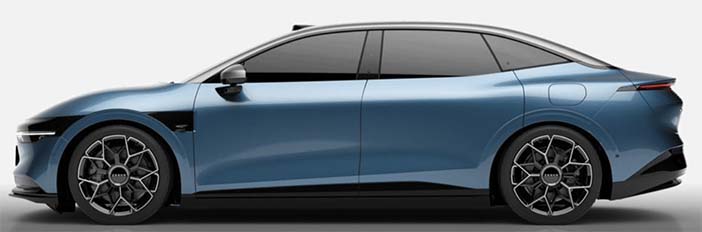
+++ On November 19, ZEEKR announced that the pre-sale volume of its 007 pure electric sedan exceeded 20.000 units within 48 hours after pre-sale started at the Guangzhou Auto Show, which opened on November 17. The official launch and delivery are scheduled to be in early January 2024. Its price starts at 229,900 yuan (€43.000). Customers who pay a deposit of 1.000 yuan before launch will receive a 6.000 yuan deduction for the final payment of the car. Positioned as a medium-sized sedan, the Zeekr 007 measures 4.865 x 1.900 x 1.450 mm, has a wheelbase of 2.928 mm and a curb weight of 2.150 kg. It is designed based on the new Hidden Energy language, which Zeekr claimed to be a minimalist luxury design. It is worth pointing out that the front features the Stargate all-in-one 90-inch long smart light screen composed of 1.711 high-power LED lamp beads, with a maximum brightness of 10.000-nit. The Zeekr 007 runs on dual-color multi-spoke rims and Michelin Pilot Sport EV tires, size 255/40 R20. 4 exterior body colors are available, namely, brown, white, gold and gray. Consumers can choose between 2-wheel drive and 4-wheel drive. The first version has a rear 310 kW Silicon Carbide (SiC) motor and takes 5.4 seconds to accelerate from 0–100 km/h. The 4-wheel drive model has 165 kW at the front and 310 kW at the rear. It needs 2.84 seconds to accelerate from 0–100 km/h. The standard version offers a optimistic 688 km CLTC cruising range while the ultra-long-range version offers an 870 km CLTC cruising range, provided by a ternary lithium battery and lithium iron phosphate battery pack, respectively; supplied by the CATL-Geely joint venture and Quzhou Jidian Electric Vehicle Technology, respectively. In addition, the entire series comes standard with an 800 Volt charging platform, which can replenish the range to 610 km with just 15 minutes of charging time. Furthermore, the Zeekr 007 Performance version comes in a yellow exterior body, with an official 0–100 km/h acceleration time of 2.84 seconds. At the same time, the car is equipped with one lidar, 12 high-definition cameras, five millimeter-wave radars, and 12 ultrasonic radars as well as a Nvidia Orin X chip to realize advanced driving assistance capabilities. Inside, the interior comes standard with a Qualcomm Snapdragon 8295 chip, a 35.5-inch AR-HUD, and a 15-inch OLED central control screen, and features Nappa leather seats, ambient lighting, and a panoramic sunroof. +++