
+++ The legendary BMW M1 might have only been around for a few short years, but its impact has been massive. It has been nearly half a century since the wedge-shaped, mid-engined supercar entered production, but it is one model that even today’s BMW executives can’t stop thinking about. “I’m in love with the original M1, but I would love to do a new one”, said Frank van Meel, BMW M’s boss, in an interview. Oliver Heilmer, the head of M Design, echoes similar sentiments. While BMW has never made a proper M1 successor, the automaker has considered it on several occasions and even came close to producing a new one based on the 2019 Vision M Next Concept. It has a 600 hp 4-cylinder plug-in hybrid hypercar that was “95 percent finished”, according to Van Meel. +++
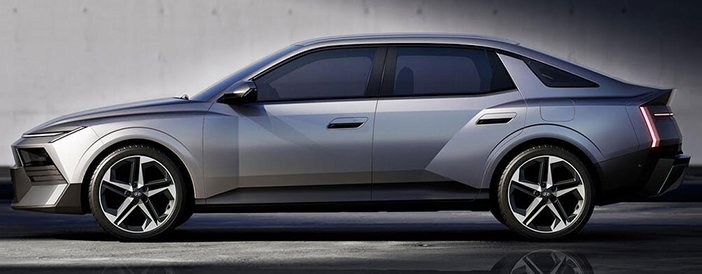
+++ Disappointed the HYUNDAI Vision 74 Concept never materialised? Don’t worry, the new Avante looks nearly as good…and this one might come to Europe. This is the brand’s core medium-sized saloon that sells in massive numbers across the United States and Asia, effectively acting as a 4-door alternative to the i30 that operates in the same class in Europe. However, with the demise of the i30, and Hyundai now fitting the Avante with more Euro-friendly hybrid powertrains, the funky-looking saloon could be on its way back to showrooms on this side of the Atlantic. This new 8th generation model is a very different creature to the last medium-sized saloon Hyundai sold in Europe. To start with, it’s much bigger at 4.765 mm long (that’s about the same size as an Audi A5 Sportback) and it looks it, too, with much more grown-up proportions and scalpel-sharp styling. Coming from Hyundai’s Korean studio, the new Avante features the brand’s Art of Steel design language. This will also be applied to future models such as the next Tucson and Kona, but here is an aggressive saloon with bulging wheelarches, a low-set and pointy nose and razor-sharp lighting. In fact, the h-pattern lighting design will be one that’ll spread to most, if not all, combustion-powered Hyundai models moving forward. Inside, the Avante’s cabin features the new Pleos Connect infotainment system that combines a 14.6-inch touchscreen (or a 12.9-inch unit on entry-level models) with a row of physical controls underneath. The dashboard architecture and its high-mounted driver’s display are also similar to those in the new Ioniq 3, with a comfortable ‘living room’ ambience a core deliverable for the overall design. Under the bonnet, there’s a choice of a pair of engines, one of which is the new 1.6-litre hybrid that’s expected to be fitted to several model (including the Kia Seltos). It may also hold the key to Hyundai’s decision to bring this model over to Europe, as it’ll fill the gap that’s been vacated now the i30 has ceased production. Adding further fuel to that fire is the fact Hyundai has been captured testing this new Avante out of its R&D base in Germany, meaning that European compliance could be on the cards and, by extension, a possible reintroduction into the UK market. While the medium-sized saloon market isn’t a huge one, the car would give the Korean brand a non-SUV model in the critical C-segment now that the i30 is gone. However, even if we don’t see the new Avante in Dutch showrooms, it is a very clear vision ahead of what Hyundai’s other next-generation models will look and feel like. Over to you Hyundai… +++
+++ In the United States, Ford is the undisputed recall king as the company conducted 153 campaigns last year. 2026 is shaping up to be slightly better as they’ve issued 51 recalls so far, although this puts them well ahead of Stellantis (19), GM (17) and Toyota (15). While the recall crisis is widely known, the Blue Oval is celebrating today as they were the highest mainstream brand in JD Power’s latest INITIAL QUALITY study. The automaker only had 152 problems per 100 vehicles, which put them ahead of Nissan (156) and Buick (162). Ford also received 3 awards for having the highest ranking vehicle in their segment. Honors went to the F-150, the F-Series Super Duty and the Mustang. The automaker noted they had 41 fewer problems per 100 vehicles compared to last year. That’s a significant improvement and Lincoln climbed 2 spots to take sixth place among premium brands. Ford credited the strong showing to years of hard work and to improve the infotainment experience. The company also brought various teams together and had suppliers come into the fold earlier to reduce problems at launch. The efforts seem to be working and CEO Jim Farley said: “Many doubted that an American company with a huge American workforce could compete with the world’s best on quality, let alone reach the top. But we put our heads down and worked together every day to deliver for our customers. Today, Ford is not only the most American automaker but also the gold standard for new vehicle quality”. While Ford placed third overall, Porsche took top honors as they only had 138 problems per 100 vehicles. Furthermore, the 911 was named the vehicle with the highest initial quality overall. The model also beat the Chevrolet Corvette to win the “premium sporty car” segment. Porsche Cars North America CEO Timo Resch remarked, “Winning this award speaks to the painstaking focus on even the smallest details that our engineers put into each of our vehicles to give our customers the standard of quality they rightly expect from Porsche”. Putting the stars aside, there were a handful of surprises as Genesis came in second place with 151 problems per 100 vehicles. That’s a big jump as the company came in 10th place last year at 183 problems. Lexus fell from first to fourth, while Land Rover went from well-below average to slightly above. The British car brand had 173 problems, which was down from 208 last year. Audi came in dead last in 2025 with a staggering 269 problems per 100 vehicles. The luxury brand slashed that number to 225 this year, but it only bumped them up 3 spots. Speaking of last place, that dubious honour went to Infiniti as they had 235 problems per 100 vehicles. That’s down from 242 last year and we can expect their ranking to improve now that the dated models are toast. While we’ve already mentioned some award winning vehicles, there are plenty of others. Cars that took home top honours include the Kia K4, Hyundai Sonata and Cadillac CT4 as well as the BMW 2-, 5- and 8-series. On the crossover and SUV side, mainstream winners include the Nissan Rogue (X-Trail), Chevrolet Blazer, Hyundai Venue and Subaru Ascent. The Chevrolet Tahoe and Toyota Sequoia also tied for top honours in the Large SUV segment. Premium models with the best initial quality include the Cadillac XT5 and Lexus NX as well as the BMW X2, X6 and X7. The Kia Carnival was named best MPV, while the Hyundai Santa Cruz got the nod for midsize pick-up trucks. The study examines problems experienced in the first 90 days of ownership and JD Power said overall new-vehicle quality “improved sharply this year, with fewer problems cited across 9 of 10 categories evaluated”. In fact, the average fell from 192 to 175 this year. That being said, it’s important to remember quality may not mean what you think it does. A good example of this is that cup holders were the “biggest single contributor to the year-over-year improvement in initial quality based on more accessible location and capacity to hold a variety of sizes of cups/water bottles”. As for the biggest detractor, that was infotainment systems as “connectivity issues continue to strain the customer experience”. The number of reported problems climbed this year and issues with “Android Auto and Apple CarPlay connectivity account for an increase of 1.4 PP100 in reported problems, the largest single contributor to the year-over-year decline in infotainment quality”. Of course, automakers probably shouldn’t be blamed for issues with technology from Apple and Google. However, they’re a part of modern cars, even if a few companies try to squeeze them out. +++
+++ Honda, Nissan and Mitsubishi could move to standardized electronic control units (ECUs) in their next-generation models, a cost-cutting play as the 3 automakers from JAPAN fight to stay relevant in a market that grows harder to survive in by every passing quarter. It’s understood that the new ECUs will include all the necessary autonomous driving and onboard infotainment functions for future software-defined vehicles (SDVs). These will be used by both hybrid and electric models, and while some details about the deal still need to be finalized, an agreement could be reached in a matter of weeks. The framework for development and procurement still needs to be ironed out. The ultimate hope is that expanded procurement of common parts will help Honda, Nissan and Mitsubishi reduce costs and better compete with Chinese brands and Tesla. Shared ECUs may be only the start. Honda and Nissan are also said to be weighing a move toward common onboard software and operating systems for their software-defined vehicles down the road. Honda and Nissan were close to merging roughly 18 months ago, but that deal spectacularly failed just as it seemed to be on the verge of being set in stone. Despite this, the 2 car manufacturers have continued to work together on several projects. For the past 6 months, they have been looking to establish a joint production partnership in North America, although an agreement has yet to be finalized. A partnership could see Nissan supply pickup trucks to both Honda and Mitsubishi, while the companies may also collaborate in the development of future large vehicles. According to a March report, Nissan would make Honda pickup trucks at its Canton Assembly plant, which hasn’t been operating at capacity since Nissan scrapped plans last year to build 2 electric sedans at the site. +++
+++ A mysterious and rather angry-looking new version of the LAMBORGHINI URUS will be revealed on 1 July, and it could see the Performante name return to the flamboyant super-SUV’s line-up. Lamborghini has released a teaser image of the new model, which shows it will have 2 sizable spoilers: one on the roof with extra fins, and another even larger one on the bootlid. Of course, this being a Lamborghini, it’s been finished in a ‘tasteful’ neon green paint colour. The Italian supercar maker hasn’t confirmed this is the Performante, but based on other images I’ve seen, the newcomer shares similar tweaks to the old Urus Performante and looks set to occupy the same spot at the top of the SUV’s line-up. The model will duke it out with other super-SUVs including the V12-powered Ferrari Purosangue, Aston Martin DBX 707 and the storming Bentley Bentayga Speed. Prototypes of the new Urus Performante which were spotted testing featured aero upgrades that hint at an upgraded powertrain. The front has a fresh bumper with redesigned air intakes and an extra lip below. As well as the extra spoilers, the rear will probably get a new diffuser design. These changes will certainly help stand this version apart from the regular Urus SE, but there should be some performance improvements, too. The old Performante’s aero kit provided a 38 percent increase in downforce over the rear axle, while there was also a 20 mm lower ride height, wider track widths and a 47 kg weight reduction. I expect similar results on the new car. The new Performante should feature the same plug-in hybrid powertrain as the Urus SE, which uses a 4.0-litre twin-turbocharged V8, one electric motor and a 25.9 kWh battery. However, it’ll almost certainly be more potent, and the standard model already delivers 800 hp. Whatever the final figure, it’ll be a significant bump over the previous Performante, which didn’t have any hybrid assistance, just a 665 hp twin-turbo V8. That said, the addition of the PHEV system will make the new model considerably heavier than its predecessor, so it’ll be interesting to see how Lamborghini’s engineers counteract that. +++
+++ In late 2023, LEXUS pulled the wraps off its innovative LF-ZC concept, a high-riding sedan riding on a new electric platform, with a launch planned for this year and the BMW i3 in its sights. The timeline slipped to mid-2027 before Lexus killed the program outright last month, ending a project that never made it past the concept stage. Scrapping the LF-ZC doesn’t mean Lexus is walking away from electric cars. Much of the engineering created for the concept survives and heads to production anyway. That includes the gigacasted modular structure, which splits the body into separate front, center and rear sections that bolt together as one. In addition, the electrical and electronic platform used for new advanced driver-assistance systems will reach production, as will the concept’s prismatic battery cells. We may not have to wait long to see them reach the road. Toyota vice president and chief technology officer Hiroki Nakajima says Lexus has already settled on a “successor vehicle” to take the place the canceled LF-ZC left open, which means the replacement was decided before the original was even cold. “We did indeed discontinue development”, he told. “It was at a point where we needed to make significant investments, such as arranging molds and mass production equipment for the LF-ZC. However, many new technologies cultivated during the development of the LF-ZC, such as Gigacast, a new electrical and electronic platform for advanced driver-assistance systems (ADAS), miniaturization and weight reduction, have already been completed. We will develop a successor vehicle that utilizes these new technologies”. Nakajima-san went on to reveal that Lexus approved a “successor” to the LF-ZC on the same day it canceled development of that model, agreeing to repurpose the LF-ZC’s technologies for this new model. We don’t yet know what form this new EV will take. The safe money points to an electric crossover or SUV, on the logic that either would move more metal than another sedan. The new BMW iX3 and Mercedes-Benz GLC EQ just hit the market, and it’s possible Lexus may fancy its chances in developing a competitor to them. +++
+++ Volkswagen isn’t the only automaker eyeing increased competitiveness as MERCEDES is giving German employees the shaft. On top of that, they’re reportedly asking them to work longer hours for free. That’s a terrible combination, but the company has decided to suspend a bonus, which was a “component of the collectively agreed salary”. This isn’t pocket change either as the reward is said to be 18% of a worker’s monthly pay. The money was originally scheduled to be paid out in July, but workers were recently told the bonus would be delayed until next year. This is said to impact around 90,.000 employees and the automaker allegedly decided to delay the payment without consulting union officials. To further rub salt into the wound, the company is considering switching from a 35- to 40-hour work week. That’s not even the worst part as the change would reportedly come “without additional pay”/ This means employees would end up working 260 additional hours per year for nothing. Needless to say, the union isn’t happy and Works Council chairman Ergun Lümali said: “This is not a convincing concept for the future”. He went on to slam the suggestion that the company could increase their competitiveness by forcing employees to work longer hours and not get paid for it. Lümali also suggested that Mercedes needs innovation, attractive products and a skilled workforce. Like a number of automakers, the company is struggling due to a multitude of issues ranging from tariffs and slower than expected electric vehicle demand to woes in China. In 2025, adjusted earnings before interest and taxes at Mercedes-Benz Cars fell from €8.7 billion to €4.8 billion. Overall Group earnings also dropped from €13.7 billion to €8.2 billion. +++
+++ With the way things are going, it almost feels like there’s no escaping electrification. Granted, there are still some markets that sell ICEs by the boatload, but hybridization has practically become the norm and EVs are mainstream in several countries. Even the supercar world isn’t spared. That said, there are still some holdouts, including PAGANI . Throughout its history, it’s only been V12s that resided under the clamshells of its cars. After all, this is the company that will still build you a Zonda; a car that first came out at the tail end of the 20th century. But at one point, there was actually a plan to build an EV, as confirmed by the company’s founder and namesake, Horacio Pagani. Pagani told about that time the company drummed up plans for an electric supercar. At the same time, he told the reasons why it simply never happened, starting with the complexity. While Pagani builds exotics, it simply doesn’t have the financial might of, Ferrari or Lamborghini. Its expertise has always been in internal combustion and developing a powerful EV powertrain from scratch as reliably as possible was always going to be a monumental task. Still, it was worth a punt and the project kicked off around the same time as the Utopia’s development. However, the resources just weren’t there, as Pagani explained. Translated from Italian, he said, “We worked on it until 2022. For me, it was a much more difficult project and we ended up spending more time on the electric car than on the one with an internal combustion engine”. Still, there are projects worth the hardships, but what sealed the electric Pagani’s fate was the lack of demand for a battery-powered supercar. “No one showed any interest in this idea. I would have liked to see it come to fruition, if only to recoup the investments we’d made. We’re too small a company to work on projects that don’t pan out”, said Pagani. The company’s founder isn’t anti-EV by any means. Instead, he’s simply being practical, citing his customers’ lack of interest in an electric model. Again, why build something no one wants? It’s pure business sense. In the end, the EV Pagani never went past the drawing board, although the founder himself said that he’s not closing the door on it completely just yet. He praised the Pininfarina Battista, calling it “high-performance and successful”, suggesting there is a market for its electric supercars. Right now, Pagani customers aren’t into it, however. +++
+++ When a petrol car dies unexpectedly, there’s often a roadside fix that gets it limping again. When an EV quits on you unexpectedly, call a tow truck. That’s what tens of thousands of SUBARU and TOYOTA (and Lexus) drivers might be forced to do. Those automakers just issued a recall covering almost 21,.000 electric cars that could flatline without warning. The recall covers the Toyota BZ4X, the Lexus RZ and the Subaru Solterra built between April 2025 and April 2026. All affected vehicles use a battery ECU supplied by Denso and equipped with specific software that can trigger the defect. At the center of the issue is the battery management system. Toyota says the battery ECU contains 2 integrated circuits that can occasionally overwrite data in the same memory location. When that happens repeatedly, the ECU can fail an operational check. Drivers would first see an “EV System Malfunction” warning message along with multiple warning lights, but if enough failures occur, the electric drive system can shut down entirely. Power steering and brake assist remain functional, but propulsion does not. The timeline is also interesting. During development work on a plug-in hybrid model in 2025, Toyota identified a similar memory-overwrite condition but concluded that the same issue wouldn’t affect its battery-electric vehicles because their operating cycles were different. Then, during a planned review of remote diagnostic data in April 2026, engineers found evidence suggesting otherwise. Additional testing revealed that under certain conditions, including increased CPU load that can occur at low battery state-of-charge, the memory conflict could happen. Toyota found that the resulting malfunction could occur at any speed and might also affect systems such as Pre-Collision System (PCS) and Vehicle Stability Control (VSC). The automaker says it has received one related warranty claim in the U.S. but no field reports connected to the issue. Owners don’t have to stop driving or park outside or anything of that nature, but they will need to go to a dealer to get a software update. +++