
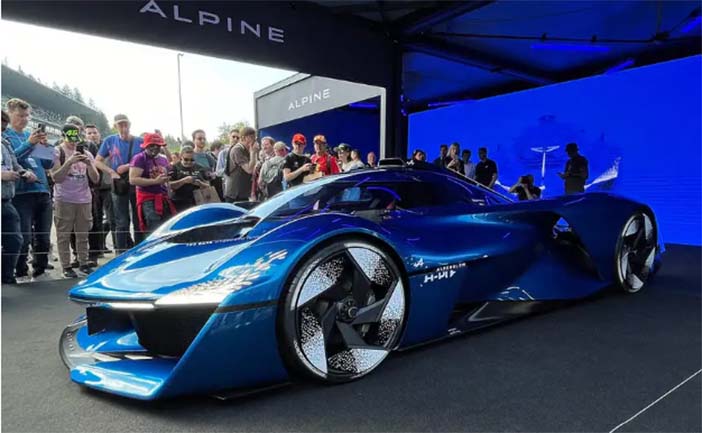
+++ Contrary to its chemical properties, hydrogen has been a slow-burner in the car industry so far. Only a few manufacturers have actually created cars powered by the fuel but ALPINE could be looking to change that, starting with the Alpenglow Hy4. If that name sounds familiar then you’d be right. Back in 2022 Alpine unveiled the Alpenglow concept: a striking hypercar powered by hydrogen. The Alpenglow Hy4 is also a concept, but Alpine claims it’s a rolling model and will be shown-off to the public prior to the 6 Hours of Spa-Francorchamps endurance race. The Alpenglow Hy4 features a 2.0-litre, 4-cylinder turbocharged engine with 340 hp and a maximum of 7.000 rpm. It’s powered exclusively by hydrogen stored in 3 tanks located in the side pods and behind the cabin. Power is sent through a sequential gearbox and Alpine claims a top speed of 279 kph. The ‘Hy4’ name comes from ‘hydrogen’ and ‘4-cylinder’. Alpine claims it will present an all-new V6 engine powered by hydrogen before the end of the year in a second working version of the Alpenglow. This concept’s exterior is similar to the 2022 Alpenglow concept with a few tweaks coming in the form of a larger cabin (now accommodating 2 seats), raised ride height, wider track and a new roof scoop to help with cooling. The Alpenglow utilizes an LMP3 carbon chassis with carbon material also used for the bodywork. Alpine says the 4-cylinder engine ‘roars’ thanks to a set of vertically stacked titanium exhaust tips. Although we can’t see them here, the Alpenglow features butterfly-style doors and inside there are moulded bucket seats with a racing steering wheel adorned with switches and a small screen embedded within it. The bright triangle ahead of the occupants changes colour and can display various readouts like speed or g-forces. Alpine says it’s still looking into hydrogen power and how it can be integrated into cars while its Alpine Racing motorsport outfit is “paying close attention to changes in competition regulations”, noting the authorisation of hydrogen-powered cars from the 2027 24 Hours of Le Mans. Alpine’s parent company Renault says “the hydrogen-powered internal combustion engine is a tremendously promising solution for racing and road use”. +++
+++ The BMW iX might be one of the more controversial car designs in recent memory, but BMW is sticking to its guns with the all-electric SUV’s facelift. These spy shots might be our first look at the updated iX, but we can already clearly make some of the new styling cues. The gestation period of the BMW iX was pretty long, the car having been previewed by the 2018 Vision iNext concept before launching in 2021. A facelift arriving in late 2024 would seem appropriate for the iX’s lifecycle, especially with BMW next generation of electric cars sitting on its Neue Klasse platform set to arrive from 2025. The blanked off grille will remain the same size and shape, although a central trim piece where the radar system goes has been given a new pattern. The headlights also remain the same except that the running light signature has changed to vertical bars instead of the current car’s horizontal ones. Camouflage covers the front bumper and here we expect to see a new design with a tweak to the side air intakes and lower intakes for better efficiency. While the rear lights look unchanged from before, there’s a huge mould added to the bumper suggesting a complete change there. Inside, the twin 14.5-inch screen setup will remain. The screens will feature the latest BMW iDrive infotainment system, however. For a large SUV, the iX has an impressive range of up to 633 km in xDrive50 form with its 105.2 kWh battery while lesser models get a 71 kWh unit with 433 km of range. While we don’t expect to see new batteries fitted to the iX, we should see increases in efficiency and range for the new model to keep pace with the newer, smaller BMW Neue Klasse X SUV. Pricing will probably increase throughout the iX’s range, keeping it as BMW’s close competitor to the Mercedes EQE SUV, Audi Q8 e-Tron and the upcoming Polestar 3. +++
+++ HONDA on Friday logged a record annual profit thanks to improving global vehicle sales, but issued a cautious outlook for the current fiscal year. The company said net profit for the year to March soared 70 percent to 1.1 trillion yen on sales of 20.4 trillion yen, up 20.8 percent from the previous year. Honda has made big outlays as it aggressively pursues a target set 3 years ago of achieving 100 percent electric vehicle sales by 2040. Its 2023-24 results come 2 weeks after it announced the largest automotive investment in Canada’s history for a new $11 billion EV battery and vehicle assembly plant. The company already has a partnership in electric vehicles with Sony, and is exploring collaboration with arch-rival Nissan as they face a “once-in-a-century” upheaval in the car industry; a move analysts say is aimed at catching up with Chinese EV competitors. Honda said global vehicle sales were up, thanks largely to its vehicles’ popularity in the United States. Sales volume was down in China, however. Price increases and the weak yen boosted profits overall, Honda said. For the year to March 2025, the company expects net profit to fall 9.7 percent to 1.0 trillion yen on sales of 20.3 trillion yen, down 0.6 percent. Rising costs and changes to forex rates may put pressure on company results going forward, it said. Vehicle sales in the United States and the Japanese markets are expected to grow, Honda said, but it predicted sales in the rest of Asia would ease. +++
+++ TOYOTA said that it achieved a record net profit of 4.94 trillion yen in the year to March on revenues of 45.1 trillion yen, which was also an all-time high. But the world’s largest automaker by sales warned net income would fall 27.8 percent this financial year to 3.57 trillion yen because of investments, according to a statement. The results for 2023-24 were helped by foreign currency effects, in particular the weak yen, as well as brisk sales, notably of hybrid vehicles. They exceeded the firm’s forecast given in February of net profit of 4.5 trillion yen on revenues of 43.5 trillion yen. Toyota’s previous record annual net profit was 2.85 trillion yen in 2021-22. For revenues it was 37.15 trillion yen the following fiscal year. Last month Toyota said it sold 11.1 million vehicles across all brands in the 2023-24 fiscal year, up five percent and the first time they have exceeded 10 million. A big factor was a 31-percent jump to 3.7 million in sales of hybrid vehicles (combining internal combustion engines and batteries) like the Corolla and the RAV4. Sales of purely electric car sales were a much more modest 116.500. Toyota pioneered hybrid cars with its popular Prius model, but critics say the company has been slow to embrace purely battery-powered engines, even as demand soars for low-emission vehicles. Japanese automakers are now attempting to play catch-up, with Toyota aiming to sell 1.5 million EVs annually by 2026 and 3.5 million by 2030. The company is also hoping to mass-produce solid-state batteries, a potentially hugely important technological breakthrough that could mean faster charging times and greater range. In 2023, China overtook Japan as the world’s biggest vehicle exporter, a change fueled by the country’s dominance in electric cars. Toyota was also left standing by Elon Musk’s EV giant Tesla in terms of market value, although the gap (almost $1 trillion in 2021) has narrowed sharply. Toyota’s market capitalization has soared 34 percent this year, while that of Tesla (which sold 1.8 million vehicles last year) has dived 28 percent over the same period. In China, the world’s biggest electric car market where local firms such as BYD dominate, Toyota only sold 1.9 million vehicles, a rise of 1.4 percent. +++
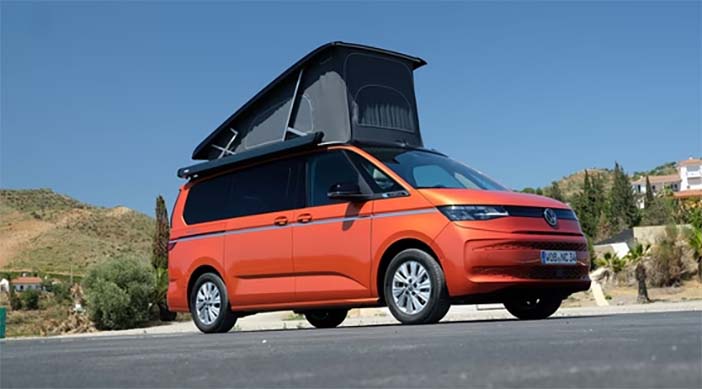
+++ The boss of VOLKSWAGEN Commercial Vehicles has revealed plans to extend the reach of its popular California brand, by launching an entire range of campers based on its next-generation electric vans. An ID.Buzz California is also in the works, but its viability apparently depends on “customer response”. Speaking from the reveal of the all-new, T7 Multivan-based California, CEO Carsten Intra told that every model in the popular California campervan range will eventually be reinvented for the electric era. The process could start within the next couple of years, in line with the brand’s plans to completely overhaul its commercial vehicle line-up. “The new generation will be an all-electric model line, called Space”, Intra told. “In the Space we are going to have the all-electric campervans, from the Grand California down to the smaller ones; the next generation will be a really huge step. From the second half of this decade we are going to have the Crafter replaced and then it will go step by step”, he said. “That will have camper versions as well. Not the very first step, but for sure we are going to do it”. In contrast, Intra told that preparations for an camper converted version of the popular ID.Buzz are ongoing, but that they were waiting to determine customer appetite for the EV. “We are working on it,” Intra told. “We did not announce a specific date for the ID.Buzz yet, because we are waiting for the customer response on it. Today we don’t have this push for an all-electric camper”. Volkswagen Commercial Vehicles is working on a range of accessories to help existing owners make better use of their electric ID vans, however. “What we are testing right now is the ‘Night Package’: you can sleep in it, everything is in it; it offers a lot of space for 2 people”, Intra told. “That was the first use of the T3 and T4 models: people working with the car day by day, and at the weekend they went to a festival or something and slept in it. So that is already done in the ID.Buzz and now we’re waiting for the response, and if the response is good, we can accelerate the timeline”, he said. With the latest T7-based California only just revealed and deliveries not due until later this year, it’s likely any forthcoming EV versions will be sold in unison with the petrol, diesel and plug-in hybrid versions, boosting the choice for VW’s loyal camper customers. Volkswagen is already dipping its toe in the water with its first ever California plug-in, Intra told us the California PHEV will use “second-generation” technology, with a larger 21 kWh battery than is currently offered in the Multivan. This should allow an electric range of up to 100 km. +++
+++ An all-electric VOLVO EX60 is coming next year as a zero-emissions-only replacement for the hybrid-powered XC60 Recharge. It’ll be based on a development of the flagship EX90’s architecture, with the possibility of batteries measuring up to 100 kWh. When it arrives, the EX60 will slot neatly in between the EX40 and EX90 in Volvo’s growing electric-car line-up. That means it’ll rival the likes of the Audi Q6 e-Tron, Porsche Macan Electric and Tesla Model Y, as well as new versions of the BMW iX3 and Mercedes EQC. The EX60 will sit on what Head of New Car Programs and Strategy, Erik Severinson, calls an evolution of the Volvo-developed platform, specifically, the one used on the 7-seat EX90. Visually, the EX60 is expected to draw several elements from both the compact EX30 and the large EX90. Buyers can expect the same 8-bit-style Thor’s-hammer LED headlights as both of those cars, as well as features like flush door handles, a blanked-off grille and aerodynamic alloy wheels. Volvo was unable to confirm whether the advanced Lidar driver-assistance tech on the EX90 would filter down to ‘lesser’ models such as the forthcoming EX60, but Severinson did tell us that the brand is experimenting with “different kinds of safety sensors going forward”. What will truly set the EX60 apart from other electric Volvos will be its “structural” battery pack. This technology has already been adopted by the likes of Tesla and BYD, and essentially bonds the battery pack with the floor of the car. The result, Severinson told, is “improved energy density” and, given the extra structural rigidity, “great driveability”. The larger EX90 will be offered with a huge 107 kWh (netto) battery pack when it arrives towards the tail end of this year, offering a range of 585 km on a single charge. Given the EX60’s smaller size, we expect to see a slightly smaller, lighter battery fitted to top-spec models. The increased energy density of its structural battery pack could see range figures approaching the 640 km, however. The incorporation of this new kind of cell technology is thanks in part to the EX60’s megacasted rear underfloor. Unlike most cars, which have rear undercarriages constructed using a multitude of different parts, the EX60 will instead get a single unit cast out of aluminium. I visited the factory in Gothenburg, Sweden, which will assemble the megacasted floor of the EX60; a car that Volvo currently describes as an “as-of-yet unannounced new model”. Essentially following the same manufacturing processes used to build 1:64-scale model cars but greatly enlarged, megacasting is a relatively new concept in the automotive sphere, with Tesla being the only other mainstream manufacturer currently adopting it, along with several Chinese brands such as Nio, Zeekr and XPeng. Volvo says the new rear floor weighs “15-20 percent less” than a traditional stamped equivalent and that it offers “just as good, if not better safety and durability”. There are other incidental benefits from the process, too, including an increased boot capacity and faster production times. A megacasted floor takes 120 seconds to build, as opposed to a full hour for a multi-piece stamped floor. Plus, while Volvo’s production process currently uses 20 percent recycled aluminium, the goal is to increase this figure and fully recycle the megacasted floor at the end of the car’s life. We expect the new EX60 to go on sale next year, in line with when the company says its megacasting production will commence. A full unveiling could possibly take place before the end of this year, though, with prices and specs being confirmed further down the line. +++
+++ ZEEKR Intelligent Technology Holdings successfully listed on the New York Stock Exchange in the US, raising 441 million on IPO. It is a company under Geely Group, a privately owned Chinese automaker that owns Volvo. This financial boost will help Zeekr to enter overseas markets and broaden its model line. Zeekr is a high-end electric brand under Geely Group that was launched in 2021. In a few years, it turned into one of the bestselling domestic EV brands. In 2023, Zeekr delivered 118.685 cars. It has also entered European, Central Asian, and South East Asian markets. Currently, the Zeekr mode line comprises 4 vehicles: the X crossover, the 001 liftback, the 007 sedan and the 009 minivan. Soon, it will also launch the Mix MPV and the CX1E SUV. Zeekr has officially become a public company. Zeekr issued 21 million American depositary shares for $21 per share on the New York Stock Exchange. As a result, it raised $441 million, which is $73.5 million more than previous predictions from financial experts. This increase was caused by oversubscription. Moreover, Zeekr will be able to expand to 24.15 million American depositary shares in the future. It will allow Zeekr to raise $507 million. Zeekr CEO An Conghui mentioned that Zeekr has set a record for the fastest time from launch to IPO among new energy vehicle brands. It took Zeekr only 37 months to list on NYSE. According An Conghui, Zeekr’s secret is combination of Geely Group’s car manufacturing experience and global resources. Zeekr officials shared that the increase of the equity capital from public investors will allow this brand to achieve global compliance, transparent and sustainable development, and provide Investors stable long-term value by developing low-carbon manufacturing and corporate ESG. After the IPO, Geely Group founder Li Shufu owns 74.6% of Zeekr shares, and Zeekr CEO An Conghui holds 2.8% of the stock. +++