
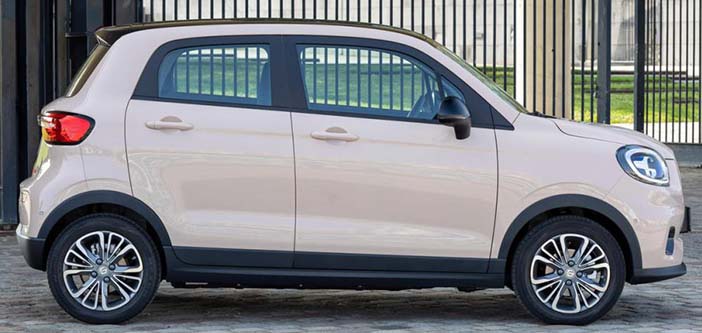
+++ Chinese electric car maker AIWAYS is preparing to formally exit its home market and focus its global operations on Europe, with an expansion of its European headquarters in Germany and plans to introduce a new entry-level crossover. Sources close to Aiways say the major change in the firm’s global strategy comes as it gears up to go public with a listing on the Nasdaq stock exchange, via a merger with a special purpose acquisition company (spac) by the end of 2024. “The centre of Aiways global sales operations will switch to Europe, and more specifically Germany, following the listing. There are no plans to remain in the Chinese market, due to the intense pricing pressure and competition there”, a source told. The management structure of Aiways is expected to remain unchanged following the listing, with CEO Hugo Zhu set to drive the company’s further development and increased focus on its overseas business activities. +++
+++ FERRARI has invested heavily in making its V12 compliant with new emissions regulations without the need for turbocharging, and the brand is committed to keeping its largest engine breathing freely well into the future. The 12Cilindri has been revealed as the firm’s new GT flagship, using an evolved version of the 6.5-litre V12 that featured in its 812 Superfast predecessor. Bosses say making the engine compliant with incoming Euro6e emissions legislation was a significant (and costly) part of the new car’s development process, and as a result it does not need to force induction to cut emissions. “It is possible to keep selling the car all over the world for the time being and then we will see what happens in the future”, said chief commercial officer Enrico Galliera. The work that has been done on this engine to remain performant and compliant with the regulation is absolutely stunning, which is probably one of the reasons why there are not many manufacturers that keep investing in the V12 engine”. When asked whether a turbocharged V12 would be better than not having a V12 at all, if the firm was ultimately forced to make that decision, product development boss Gianmaria Fulgenzi was candid. “I’ll try to be polite: V12 turbocharging is not in my mind”, he said. “The V12 is a naturally aspirated engine for many reasons. We use turbochargers when we reduce the displacement of the engine. Of course, we need the same power. The V12 is natural. It is something that creates emotion, sound and acceleration from a low RPM to maximum RPM. That’s the product we wanted to deliver”. Ferrari is now the only car maker with a naturally aspirated, non-hybridised V12 in series production; Aston Martin’s equivalent engine breathes through a pair of turbochargers, and Lamborghini’s is now only available as part of a hybrid drivetrain. Gordon Murray’s new T50 hypercar uses an atmowpheric V12, but is limited to just 100 units. Ferrari has not yet given any clues to future V12 models beyond the 12Cilindri, but it is possible the upgraded engine will be introduced in the closely related Purosangue in due course. +++
+++ In April, 243.000 new passenger cars were registered in GERMANY , the most significant European auto market; up 20% from the previous year. 29,668 were all-electric vehicles (BEV), which accounts for 12.2% of the market share; mostly flat from the same month of the last year. Chinese brands registered 3.580 electric cars in Germany, which accounts for 12% of BEV sales in Germany. 15.135 were plugin hybrid vehicles (PHEV), which accounted for 6% of the market in April in Germany, up 28% from the previous year. The data are published by the German Federal Motor Authority (KBA), which tracks new car plate registrations in the country. The first spot goes to Geely & Mercedes-Benz joint venture Smart, which registered 1.532 EVs in Germany; up 2% from 1.497 units in March but 1.8% down from April the previous year. Between January and April, Smart registered 5.414 EVs; up 9.6% from last year. Geely-made Smart EVs are co-engineered with Mercedes-Benz. According to official information, the EVs under the Smart brand are designed by the Mercedes-Benz global design team, while Geely is responsible for the engineering and development of the new models. All Smart cars are produced in China. Smart unveiled its third car, the #5 SUV concept, at the Beijing Auto Show last month. Smart produces only BEVs. The second spot goes to SAIC-owned MG, which registered 1.304 cars; down 16% from 1.559 units in March and up 12% from the same month the previous year. Between January and April, MG registered 5.745 cars; up 15.2% from last year. GWM registered 247 cars, a 20% decrease from 307 units in March. However, compared to the same month last year, GWM’s registrations increased by 145%. Between January and April, GWM registered 810 cars, a growth of 192.4% from the same period last year. Great Wall Motor sells its all-electric car in Germany under the Ora brand. Polestar registered 206 cars, a 42% decrease from 357 in March and a 62.1% decrease from the same month last year. However, between January and April, Polestar registered 837 cars, a 47% decrease from the same period last year. BYD registered 183 cars, showing a 14% increase from 160 units in March and a 289.4% increase compared to the same month the previous year. Between January and April, BYD registered 576 cars, indicating a substantial growth of 418.9% from the same period last year. Nio registered 53 cars, a 10% increase from 48 units in March and a 112% increase from the same month last year. However, between January and April, Nio registered 155 cars, a slight decrease of 3.7% from the same period last year. Lotus registered 26 cars, a 37% increase from 19 units in March but a 29.7% decrease from the same month last year. Between January and April, Lotus registered 89 cars, an increase of 3.5% from the same period last year. Lynk & Co registered 20 cars, indicating no change from March but a decrease of 89.7% from the same month the previous year. Between January and April, Lynk & Co registered 27 cars, showing a decline of 97.9% from the same period last year. Lynk & Co is a brand under the Geely umbrella and the only Chinese brand that sells PHEVs in Germany. Recently, the spy shots of its first all-electric model, Zero, were revealed in China. Maxus registered 7 cars, indicating a 133% increase from 3 March and a 250% increase from the same month the previous year. Between January and April, Maxus registered 21 cars, up 600% from the same period last year. Aiways registered 2 cars, up from 1 car registered in March. For comparison: Tesla registered 1,637 cars in Germany in April; down 32.4% from March. Between January and April, Tesla registered 14.705 cars, down 36.3% from the same period last year. +++
+++ The HYUNDAI MOTOR GROUP has achieved a historic milestone of surpassing Volkswagen Group for the first time in quarterly operating profit, rising to become the world’s second-most-profitable carmaker, according to data and industry officials. Hyundai Motor Group’s 3 carmaking affiliates (Hyundai, Kia and Genesis) achieved a combined operating profit of 6.98 trillion won ($5.08 billion) in the first quarter. This slightly exceeds that of Volkswagen Group, which had an operating profit of around 6.78 trillion won during the same period. Toyota maintained its lead with a considerable margin of more than 2 trillion won compared with the runner-up. But Hyundai outdid Toyota in operating profit margin. The figure for Hyundai Motor Group came in at 10.4 percent, topping the list among global carmakers. That of Toyota reached 10 percent, followed by General Motors and Volkswagen Group, which had operating profit margins of 8.7 percent and 6.1 percent, respectively, during the same period. The latest achievement was driven by Hyundai Motor Group’s diversified vehicle lineups and expanded sales for its profitable luxury vehicles. “The sales portions of the group’s SUV lineup and Genesis-brand vehicles have increased, helping rev up its sales growth”, said Kim Sung-rae, an analyst at Hanwha Investment & Securities. The carmaker will keep improving its profitability by developing new small hybrid vehicles and manufacturing more hybrid cars by transforming part of its electric vehicle (EV)-dedicated manufacturing facility in North America, according to Kim. The carmaker recently shared its plan to produce hybrid cars at its Hyundai Motor Group Metaplant America in Georgia, which is scheduled to start operation in the 4th quarter of this year. The decision reflects the growing demand for hybrid vehicles as the global EV industry enters an early phase of chasm. Other experts also shared optimistic outlooks on the Hyundai Motor Group from a longer-term viewpoint, as the carmaker bets big on future mobility (such as EVs) and takes the technological lead in related sectors. “Hyundai Motor Group’s core strength lies in its complete vehicle portfolio, ranging from cars with internal combustion engines, EVs and even hydrogen-powered cars”, said Kim Pil-soo, an automotive technology professor at Daelim University College. “Hyundai Motor Group is de facto the only global carmaker that can mass-produce all of the vehicle segments at a decent level. In particular, Hyundai Motor’s technological prowess in EVs remains unmatched”. +++
+++ JLR had its most profitable year since 2015 last year off the back of soaring sales for the high-margin Defender and Range Rover model lines. The firm generated £2.2 billion in profit from a record £29 billion in revenues in the 12 months to 31 March 2024. The company’s operating margin was 9.2%; a full 2.7 percentage points higher than the previous financial year, which it attributes to increased sales volumes and reduced material costs, though it said this growth was partially offset by a ramp-up in marketing spend. The company sold 401.303 cars in the full financial year, of which more than a quarter were Defenders. The big Range Rover models accounted for nearly 130.000 sales. The firm still faces a towering order book of 133.000 vehicles; 76% of which are for the Range Rover, Range Rover Sport or Defender, and says it will “focus on brand activation to maintain the order book” going forward. +++
+++ Stellantis will bring Chinese electric car maker LEAPMOTOR ’s T03 supermini and C10 SUV to European markets beginning in September. The multinational giant paid €1.5 billion for a 21% stake in the eight-year-old Chinese firm and exclusive export rights late last year. The T03 and C10 are the first of a wave of Leapmotor models planned for export from China, with “at least 1 new model to be introduced every year in the next 3 years”. Leapmotor International (a new company set up by the 2 firms for global sales) plans to be selling cars at 200 dealerships across Europe by the end of 2024. It will then target the India and Asian-Pacific, Middle East and African and South American markets. The C10, a 5-seat rival to the Tesla Model Y with a claimed 380 km range and up to 231 hp, will be imported from Leapmotor’s factory in Hangzhou, eastern China, but Stellantis is likely to build the European-market T03 itself in Tychy, Poland. The city-focused supermini will be built alongside the Jeep Avenger, Alfa Romeo Milano, Fiat 600e, and combustion-powered Fiat 500, although it isn’t yet confirmed whether production of the ageing Italian city car will be affected. Recent reports suggested that Fiat plans to replace the 17-year-old 500 with an ICE version of the far newer 500e and could build both variants on the same line in Turin, Italy. Asked if the 500 will make way for the T03 in Poland, Stellantis CEO Carlos Tavares said: “We do not assign vehicles to plants where there is no capacity available, so it’s quite clear that whatever we decide in terms of allocation will be in a plant that has the capacity available to support the sales. The case that you mentioned is one possibility. Of course, it is a plant that is meeting all the quality criteria and the cost-competitiveness criteria. Now, of course, if we do that allocation, it’s because there is available capacity”. Measuring just 3.620 mm long and having only around 100 hp and 270 km of range, the T03 will be a close match for the Dacia Spring. Stellantis hasn’t yet given any indication of pricing, but it is possible that the T03 will claim a significant price advantage over its rival by not being shipped over from China. Stellantis says the Leapmotor cars are “considered complementary” to those offered by its existing brands in Europe, suggesting there are no plans to replace any model lines. Launching these Leapmotor EVs in the UK will go some way to helping Stellantis avoid penalties imposed by the new zero-emission vehicle mandate, under which all major car makers must achieve an EV sales mix of 22% in 2024 and 28% in 2025, on the way to 80% in 2030 and stopping ICE sales entirely in 2035. Tavares recently branded this scheme “terrible” and warned it could “kill” the UK’s automotive industry by forcing manufacturers to sell EVs at a loss. Confirming the Leapmotor expansion plans today, Tavares said: “The creation of Leapmotor International is a great step forward in helping address the urgent global warming issue with state-of-the-art BEV models that will compete with existing Chinese brands in key markets around the world. Leveraging our existing global presence, we will soon be able to offer our customers price competitive and tech-centric electric vehicles that will exceed their expectations. Under founder and CEO Tianshu Xin’s leadership, they have built a compelling worldwide commercial and industrial strategy to quickly ramp-up the sales distribution channels to support Leapmotor’s robust growth and create value for both partners”. +++
+++ The upcoming MERCEDES-AMG CLE 63 will receive a twin-turbocharged 4.0-litre V8 petrol engine developing up to 600 hp, senior officials at the division’s Mercedes-Benz parent company have confirmed. The decision reverses an earlier plan to give the hot new coupé and cabriolet the same 680 hp plug-in hybrid drivetrain as the latest C 63 and GLC 63, due to slow sales of the saloon, estate and SUV. Despite its class-leading performance, traditional AMG buyers haven’t taken to the E-Performance PHEV drivetrain, which combines a turbocharged 2.0-litre 4-cylinder petrol engine and a rear-axle mounted electric motor. Sales of the models are currently well below those of their V8 predecessors across AMG’s global markets. The latest version of AMG’s M177 V8 engine, which features mild-hybrid technology, will power the most potent versions of the new CLE as a result. Those models will be positioned above the CLE 53 Coupé and Cabriolet, which run a turbocharged 3.0-litre 6-cylinder petrol engine that produces 449 hp. The move comes as Mercedes’ performance car division sets about establishing the CLE as a direct rival to the BMW M4, which offers up to 550 hp from a twin-turbo 3.0-litre straight-6 in its most potent form. Mercedes sources say the decision to provide the CLE with V8 power is related not only to the lukewarm response to the PHEV C63 and GLC 63 models but also to feedback from its global dealer network. Dealers had suggested the possible positioning of a 4-cylinder CLE 63 range-topper above the 6-cylinder CLE 53 would lead to confusion among potential customers. Markus Schäfer, head of Mercedes-Benz’s R&D operations, has indicated the company is monitoring closely monitoring sales of the C63 and GLC 63 amid calls for them to return to V8 power. Speaking at last month’s Beijing show, Schäfer said it will be “up to customers to decide” whether AMG continues with its downsized petrol-electric drivetrain. He added: “We will stay close to the feedback of people and customers, and then we will go from that”. Schäfer said the powertrain had been inspired by the downsized hybrids used in Formula 1, mixing “a high-performance internal combustion engine with a strong electrical side”. He said it delivered “stunning, stunning performance”, but even so, the firm is still continuing to launch V8-powered AMG models too, including the new SL, the GT and the S 63.“We decided for the C-Class to go with the 4-cylinder and a strong electrical side”, Schäfer said. “We decided for the GT and the S-Class to go with the 8-cylinder with the same electric side. We have to see what the customer ultimately decides”. Schäfer admitted that in conversations ahead of the Beijing show, Chinese customers “didn’t understand” the concept of the new C 63’s drivetrain. He added: “But we explained the concept, the rationale and where it came from, especially with reference to F1, and they started to understand what the idea behind it was”. +++
+++ NIO , the Chinese electric vehicle manufacturer, achieved a significant milestone as it produced its 500.000th car. The occasion was celebrated at the Xinqiao Intelligent Electric Vehicle Industrial Park in Hefei, capital of the Anhui province. Various dignitaries, many government and industry leaders, and William Li, the Founder and CEO of Nio, attended the event. Liu Qingfeng, the Chairman of iFlytek and the user of the 500.000th Nio vehicle delivered a speech. Before the event, many attendees visited the assembly workshop of Nio’s second advanced manufacturing base and tested some of the new vehicle models. They gained detailed insights into the company’s technological research and development, production, and market sales. Han Jun, Secretary of the Provincial Party Committee, emphasized that electrification, intelligence, connectivity, and sharing are the major trends driving the development of the automotive industry. He said that “as a globally leading intelligent electric vehicle company, Nio should seize the opportunities brought by the automotive industry’s transformation. It should prioritize innovation capacity building, continuously make breakthroughs in key areas such as powertrain, autonomous driving, and artificial intelligence, accelerate the iteration and upgrade of existing models, and develop high-quality vehicle designs. Furthermore, Nio should strive to build a comprehensive and sound automotive industry ecosystem”. Han Jun expressed his hope that the production of the 500.000th vehicle would serve as a new starting point for Nio, enabling it to aim for higher goals, establish ambitious aspirations, expand its market share, and continuously enhance its comprehensive strength and competitiveness. During the event, participants, user representatives, and frontline technical workers jointly lit up a column, symbolizing the completion of the 500.000th Nio vehicle. Since establishing its headquarters in Hefei in April 2020, Nio has successively completed the establishment or relocation of various core business entities, including research and development, sales and service, key component development and manufacturing, and autonomous driving. It has implemented 12 full-stack technology layouts and obtained over 8.700 patents. In 2023, Nio achieved a revenue exceeding 55.6 billion yuan, representing a year-on-year growth of 12.9%. William Li stated in his speech that the production of Nio’s 500.000th vehicle signifies the company’s solid position in the high-end intelligent electric vehicle market. He emphasized that the Anhui province has a favorable business environment and great development potential, and Nio will remain firmly rooted in Anhui. He said the “company will continue to launch new technologies and vehicle models, helping the province become the best place globally to experience intelligent electric vehicles and to establish a global innovation and industrial highland for intelligent electric vehicles”. +++
+++ NISSAN said it nearly doubled its full-year net profit in 2023-24, weathering challenges in the Chinese market, but forecast a dip of around 10 percent for the current financial year. The Japanese automaker said demand was rising at home as well as in North America, Europe and China, where it has struggled to compete with fast-growing electric vehicle firms backed by Beijing. Net profit totaled 426.6 billion yen, up 92.3 percent on-year, though Nissan expects that to fall to 380 billion yen in 2024-25. Operating income rose more than 50 percent on-year, the company said, citing “an increase in sales volume, improved net sales per unit, and disciplined management of fixed costs”. “We expect demand for refreshed and new models to drive sales growth of more than 7.5 percent to 3.7 million unts this financial year”, Nissan said. The weak yen provided a “short term” boost to profits, CEO Makoto Uchida said. “But in the mid and long term, whether it’s a strong or weak yen… volatility in forex markets is not very beneficial. It will be a challenge”, he warned. The results struck a different tone to an announcement last month when Nissan trimmed its sales and profit outlook for 2023-24, predicting a more modest net profit of 390 billion. “The increase in operating profit and net income compared to the April 19 forecast revision is due to the reversal of previously recorded litigation provision”, Nissan explained. Uchida said earlier this year that Nissan has struggled with sales in the Chinese market, where capacity is “excessive” despite improvement in recent months. China overtook Japan as the world’s biggest vehicle exporter last year, helped by its global dominance in electric cars as firms such as BYD speed ahead of international rivals. “How to compete with China in the Asian market is an underlying theme” for Nissan as well as Toyota and Honda, said Satoru Takada, an auto analyst at research and consulting firm TIW. But Nissan has made it clear “it is not slowing down” on efforts to expand its EV market, Takada told. Uchida said in March that Nissan was “focused on providing what Chinese customers want” as the firm pledged to slash production costs for next-generation EVs by 30 percent. Nissan and Honda have said they are exploring a strategic partnership in EVs to face up to a “once-in-a-century” upheaval in the car industry. Like Honda, Nissan is signaling that it is “more and more optimistic about developing solid-state batteries and putting them into use”, Takada said. CEO Uchida did not rush to give details about the partnership, saying discussions had a “wide scope” and that “as soon as possible, we would like to reach a good conclusion for both parties”. Going forward for Nissan, “another focus is how they will manage to offset the rising costs linked to inflation”, Takada noted. +++
+++ TESLA boss Elon Musk said Friday the electric vehicle manufacturer would invest over $500 million this year to install new superchargers, just days after a report of massive layoffs in this branch of the company. “Just to reiterate: Tesla will spend well over $500 million expanding our Supercharger network to create thousands of new chargers this year,” Elon said on X. “That’s just on new sites and expansions, not counting operations costs, which are much higher”, he added. Earlier, it was said Tesla was moving to disband its supercharger department, laying off most of its 500 workers as well as its senior director. The revelation raised questions about the future development of Tesla’s network of over 50.000 fast chargers (the most extensive in the world, according to Tesla) which can add 320 kilometers of range in a quarter of an hour. The fear of insufficient charging infrastructure is one of the reasons why sales of electric vehicles are progressing less rapidly than expected in the US and Tesla’s well-developed network was seen as key to reassuring customers. In the spring of 2023, several competitors (Ford, General Motors, Rivian) entered into partnerships with Tesla so that their vehicles could use its fast-charging network in Canada and the United States. A few weeks later, 7 automakers (BMW, General Motors, Honda, Hyundai, Kia, Mercedes-Benz, Stellantis) announced the creation of a joint venture to install, from this summer, at least 30.000 fast chargers in North America, accessible to all electric vehicles. The reported layoffs came shortly after Tesla reported a 55 percent drop in quarterly earnings to $1.1 billion, reflecting the decline in EV sales. +++