
+++ AUDI said on Monday it would jointly develop a new China-specific platform for intelligent and electric vehicles with its Chinese joint venture partner SAIC. The move, coming about 10 months after Volkswagen Group’s landmark Chinese partnership deal, highlights mounting pressure on western brands and legacy automakers to rejig to survive an intensifying EV race in the world’s largest auto market. Audi has lagged far behind Tesla and other Chinese rivals in EV sales amid a protracted EV price war. Audi and SAIC will develop models built on new architecture called the Advanced Digitized Platform, which “enables Audi to significantly reduce time-to-market by more than 30%”, the German premium marque said in a statement. The first of 3 EV models to run on the new platform is expected to hit the market in 2025, according to the statement. The announcement shed light on plans for further cooperation between Audi and SAIC that VW announced in July when it said it would buy 4.99% of Xpeng for around $700 million along with plans to jointly launch 2 Volkswagen-branded EV models by 2026. In another example of Europe’s growing reliance on Chinese expertise in EVs, Franco-Italian automaker Stellantis said earlier this month its venture with Chinese partner Leapmotor would start selling 2 Leapmotor models in Europe from September. Audi has used VW’s EV-dedicated MEB platform for 2 EV models in China, the Q4 e-Tron and the Q5 e-Tron, through its 2 ventures, one with SAIC and another with FAW, while concurrently developing a new EV platform with Porsche. Audi will start making the first EV built based on the Premium Platform Electric (PPE) architecture developed by its headquarters from 2025 at the earliest in China at its joint venture with FAW. The Audi Q6L e-Tron will be equipped with Huawei’s advanced driving assistance system (ADAS) in China. Sales of Audi’s 2 EV models on offer in China totalled 6.420 in the first 4 months, accounting for 0.45% of total EV sales. +++
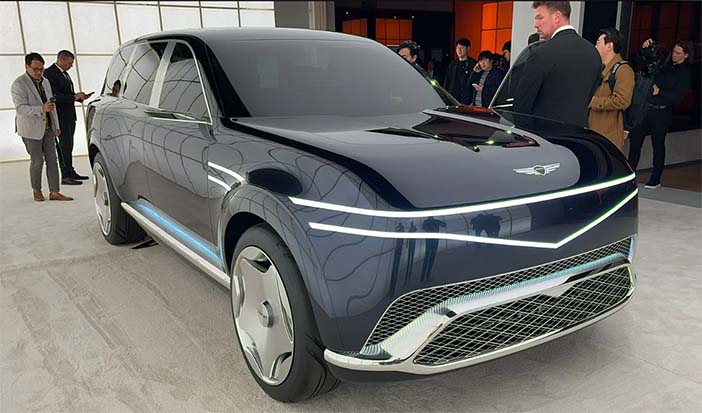
+++ The GENESIS Neolun concept, which debuted at the New York Auto Show, is going to turn into a GV90 flagship SUV in early 2026. All-electric of course, since Genesis so far remains committed to new models being EV-only after 2025. It will be the first vehicle to come out of the Hyundai Group’s new plant in Ulsan, South Korea, dedicated to electric vehicles. I’m told that Genesis successfully lobbied the mothership to move the GV90 upscale from its original luxury segment, so now the SUV’s being benchmarked against the Bentley Bentayga, Range Rover and Rolls-Royce Cullinan. The Korean brand spent much of last year putting its sights on such super-luxe rides, from rumours about a production version of the Genesis X Convertible concept to its One of One program launch in Dubai. In New York, public made note of Neolun features like the coach doors, the large, flexible infotainment screen that could be unfurled from the instrument panel, and swivelling front seats. Genesis hinted that some of the Neolun’s intriguing design elements could make production; coach doors will be one of them. Supposedly, a few months after the launch of the standard GV90 in June 2026, Genesis will produce a limited-edition trim with coach doors and other exclusive touches. The doors are reportedly possible thanks to the Hyundai’s new electric vehicle platform called “eM” and its new electrical architecture and modular motors. This will eventually replace the e-GMP platform current Hyundai Group products are built on and enable vehicle features such as a pop-up display, a swivel seat in the first row, a long-sliding seat in the second row, a built-in air purifier, Level 3+ autonomous driving, Remote Smart Parking Assist 3 (RSPA3), OTA updates for vehicle control modules and AI-supported real-time battery diagnostics. Hyundai brought some battery development in-house and the eM architecture could be the first beneficiary of that by utilizing a lithium-iron-phosphate chemistry in cell-to-pack (CtP) battery technology. Instead of today’s method of combining cells into modules and modules into packs, CtP skips the modules to “directly bond batteries to the pack housing’s cooling plate”. The arrangement uses fewer parts and saves space, the extra space potentially turned into weight savings or used for more cells. Initial estimates say Hyundai Group will standardize 9 battery variants and 5 motor types. The GV90 is thought to get a 113.2 kWh pack. And not long after all this kicks off, a second-generation battery-electric GV80 hits the market, reportedly entering production in May 2026, putting market launch around late 2026 or early 2027. +++
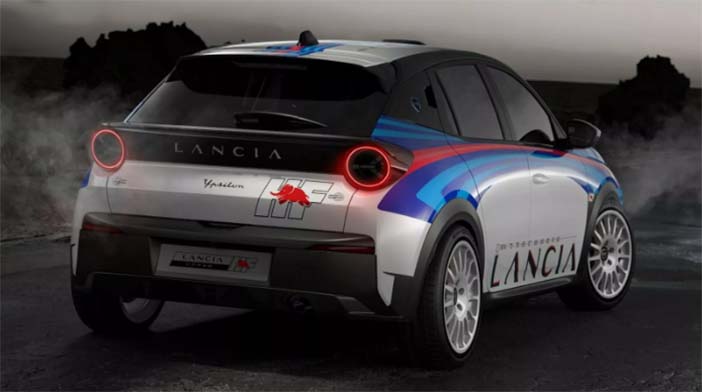
+++ LANCIA unveiled the first hot hatch of its new era, the Ypsilon HF, ahead of its market launch in May 2025. This fully electric model combines 240 horsepower with a redesigned body kit and a sharper chassis setup. They’ve also confirmed that the HF treatment will be applied to all future Lancia models, including the Gamma crossover and the Delta hatchback. Alongside the road-going EV, Lancia also previewed the ICE-powered Ypsilon Rally 4 HF, marking its much-anticipated return to motorsports. Returning to the sporty Ypsilon, the HF logo with the red elephant is mounted on a new front bumper featuring larger and more angular intakes. The profile showcases wide fender extensions that accentuate the version-specific alloy wheels with a six-spoke design. Although Lancia didn’t provide a glimpse of the tail, we anticipate a similar treatment, possibly including a rear spoiler and a diffusor. The subcompact hatchback is equipped with a single front-mounted electric motor producing 240 horsepower. It accelerates from 0 to 100 km/h in 5.8 seconds, significantly quicker than the standard EV and mild-hybrid variants. The powertrain is complemented by a lowered suspension and wider tracks, aimed at bolstering its road-holding capabilities. Signaling its much-anticipated return to motorsports, Lancia has unveiled the Ypsilon Rally 4 HF, a new contender for the R4 rally class. The highlight is the stunning new interpretation of the iconic Martini livery, reminiscent of the championship-winning Lancia 037 and Delta Integrale models. Beyond the eye-catching livery, the Rally 4 boasts a functional roof-mounted scoop, a pair of hood vents for improved engine cooling, and a set of white multi-spoke alloy wheels. It also borrows the aggressive bodykit from the Ypsilon HF, completing the motorsport-ready look. Unlike its road-going counterpart, the Rally 4 utilizes a beefed-up version of the turbocharged 1.2-liter 3-cylinder petrol engine, churning out an impressive 212 hp of power. A 5-speed gearbox sends power to the front wheels with the help of a limited-slip differential for enhanced traction. We can also expect rally-tuned suspension and brakes to maximize performance for its competitive role. Additionally, Lancia unveiled the Lancia Corse HF logo, which will be used for its future racing cars. While Lancia hasn’t yet announced a specific date for the Ypsilon’s rallying debut, we expect to learn more details in the coming months. This highly anticipated return comes from a brand steeped in motorsport history. Lancia holds the record as the most successful brand in rallying, having secured a staggering 15 WRC titles, 3 Constructors & Endurance World Championships, 1 Mille Miglia victory, 2 Targa Florio wins and 1 Carrera Panamericana trophy. +++
+++ The job cuts continue at LUCID as the company has announced another restructuring. This time around the automaker aims to eliminate approximately 400 employees, which is approximately 6% of its workforce. The cuts are slated to take place by the end of the third quarter and Lucid expects to take up to a €23 million hit. This will largely come in the form of severance payments, employee benefits, employee transition and stock-based compensation. Lucid added the move is designed to optimize their “operating expenses in response to evolving business needs and productivity improvements”. In an e-mail to employees, CEO Peter Rawlinson said the cuts will hit white collar employees at “all levels, including leadership and mid-level management”. He went on to say, “Letting go of our talented team members is difficult and a decision we did not take lightly”. However, he noted “we must remain vigilant about costs” and they aren’t “generating revenue” from the Gravity SUV yet. Rawlinson claimed the “future is bright at Lucid” and said “I am confident that we will only continue to grow stronger”. He went on to encourage employees to sell Air sedans, focus on getting the Gravity into production, and keep their mid-size vehicle on track for a 2026 launch. The latest restructuring comes roughly a year after the last one as Lucid announced plans to cut 18% of their workforce in March of 2023. That effort eliminated approximately 1.300 employees, so the latest cuts likely aren’t going to help morale. Lucid produced 1.728 vehicles in the first quarter of the year and posted revenues of €159.1 million. Despite putting a positive spin on those numbers, the company couldn’t hide the fact that they had a net loss of more than €627 million. +++
+++ Chinese car manufacturer SAIC says it will start mass producing SOLID STATE BATTERY packs around 2026, meaning it could be the first automaker to commercialize the new form of batteries. During a recent technology event in China, SAIC said it would start deliveries of the new IM L7 sedan in October. This car features semi-solid-state batteries using a liquid electrolyte and other products from SAIC will get similar batteries in 2025, including models from MG, Baojun, and Wuling. However, it will be in 2026 when things get exciting. True solid-state batteries are viewed by many as the next step in electric vehicles and SAIC is targeting mass production of them in 2026. It’s unclear which of SAIC’s dizzying array of models will be the first launched with a solid-state battery or if the new pack could debut in an all-new model. SAIC is far from the only car manufacturer working on solid-state batteries. Last February, a consortium of Chinese brands, including CATL, BYD, CALB, Nio and others, was formed to build a supply chain for solid-state batteries by 2030. Toyota has also been working on the technology for many years and holds more patents on solid-state batteries than any other company. It is working with oil refiner Idemitsu Kosan on the new packs and will launch its first EV with a solid-state pack in a couple of years. It plans to increase production to the tens of thousands by 2030. Nissan said it too is well progressed on solid-state batteries and plans to start launching EVs with them by the 2028. SAIC isn’t just working on solid-state batteries. During the same technology event in China, the company said it has upgraded its full-stack technology solution for intelligent vehicles and will develop a new platform with Audi for the Chinese market. +++
+++ Nvidia boss Jensen Huang believes TESLA ’s full self-driving (FSD) system is the most advanced system out right now. It also just so happens that Tesla’s FSD is powered by Nvidia’s chips. “Tesla is far ahead in self-driving cars”, Huang said in an interview. “One of the things that’s really revolutionary about version 12 of Tesla’s full self-driving is that it’s an end-to-end generative model”, Huang added. “It learns from watching videos (surround video) and it learns about how to drive end-to-end, and using generative AI, predict the path and how to understand and how to steer the car. So the technology is really revolutionary and the work that Tesla’s doing is incredible”. Tesla’s latest FSD, version 12, is currently in beta mode and was rolled out in 30-day free trials to new owners earlier this year. FSD currently costs $99 a month or $8,000 up-front. Tesla reported in April that FSD had over 1.3 billion cumulative miles driven since its debut in March 2021. FSD is still considered a Level 2 autonomous system, meaning it requires supervised use, and has been subject to recalls and government inquiries into its capabilities. In the first quarter, Nvidia reported automotive revenue of $329 million, a small sliver of the $22.6 billion in its data center business but up 17% sequentially and up 11% year over year. Nvidia chief financial officer Colette Kress said on the company’s earnings call she expects automotive to be the “largest enterprise vertical within the Data Center segment this year”, and a potential multibillion-dollar business for the company. Most of Nvidia’s Data Center revenue, which tallied $22.6 billion the first quarter, came from consumer internet customers. Cloud providers, or the so-called hyperscalers like Amazon, Alphabet and Microsoft, accounted for a “mid-40s percentage” of this segment’s revenue. Huang also told he expects one day “every single car” will have some level of autonomous ability; a development that will require huge amounts of computing power. “This technology is very similar to the technology of large language models, but it requires just an enormous training facility”, Huang said, referring to Tesla’s FSD system. “And the reason for that is because there’s videos, the data rate of video, the amount of data of video is so, so high”. For example, in order to boost Tesla’s ability to process that amount of data, Nvidia said it helped the company expand its FSD training AI cluster to 35.000 Nvidia Hopper H100 GPUs. In addition to Tesla, Nvidia’s other automotive sector clients include Mercedes, Jaguar Land Rover, Volvo and Hyundai, as well as Chinese EV upstarts like BYD and NIO. Wall Street is also bullish on Nvidia’s automotive business. In a note published Thursday, analysts at JPMorgan boosted their Nvidia price target to $1.150 from $850, modelling the chipmaker’s data center business with a 20-30% annual growth rate with Nvidia monetizing “an incremental ~$14 billion of auto revenue pipeline” over the next 3 to 4 years. +++
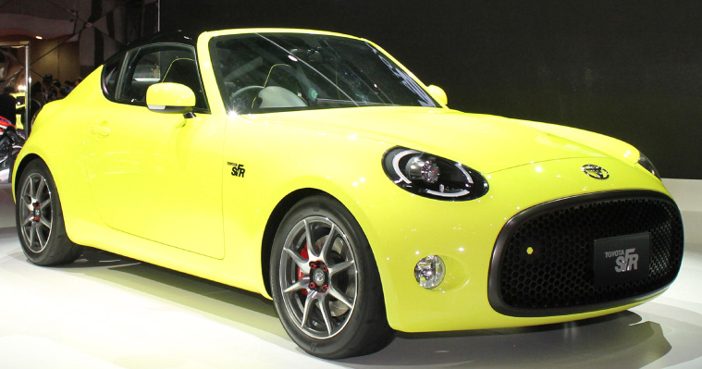
+++ Supercars are nice and all, but but for many gearheads worldwide, the idea of an affordable and reliable petrol-powered sports car from Japan holds greater allure. Thankfully, recent rumours hint that the previously overlooked TOYOTA S-FR concept (shown in 2015) might just evolve into a production model. The S-FR concept was thought to be nearing production status when it premiered at the 2015 Tokyo Auto Salon, followed by the track-focused S-FR Racing concept in 2016. However, as years elapsed without updates from Toyota, speculation arose that the project had been shelved. Now, there’s a glimmer of hope. Inside sources at Toyota report that the S-FR could come to fruition through a collaborative effort involving Daihatsu and Suzuki. A recent report about the potential revival of the Starlet hatch has further fuelled speculation surrounding a production version of the S-FR. Both models could share the same turbocharged 1.3-liter 3-cylinder engine, expected to deliver at least 152 horsepower. This strategy would enable Toyota to rationalize the research and development costs for a detuned variant of the 1.6-liter engine featured in the GR Yaris and GR Corolla hot hatchbacks. While all rumours should be taken with a pinch of salt, the prospect of a collaborative development project with Toyota’s partner companies appears feasible, especially in light of Daihatsu’s rear-wheel drive Vision Copen concept at the 2024 Tokyo Auto Salon. This model, purported to preview a rival to the Mazda MX-5, shares strikingly similar proportions, footprint, and styling cues with the 2015 Toyota S-FR concept. Furthermore, it features a 1.3-liter powertrain, although Daihatsu has not provided detailed specifications. Suzuki could also find value in this collaboration by introducing a new roadster that revives the Cappuccino moniker from the ’90s. Given Toyota and Suzuki’s track record of successfully rebadging each other’s models in different markets worldwide, they could seamlessly incorporate a fun-to-drive offering into their line-up. Expect the trio of sportscars to have a compact footprint, positioning them comfortably below the 4.265 mm length of the Toyota GR 86. For comparison: the 2024 Daihatsu Vision Copen measured 3.835 mm long with a wheelbase of 2.415 mm. The Toyota S-FR shared a similar width but was slightly longer at 3.990 mm, with a wheelbase of 2.480 mm. In terms of styling, Toyota designers are likely to refresh elements of the S-FR concept to match their latest offerings. Nevertheless, the production model may preserve some of the concept’s unique characteristics, as indicated by our speculative rendering. While nothing is official yet, the report suggests that the baby Toyota rear-wheel-drive sports car could arrive as early as 2026 or 2027. It also indicates that the S-FR, or whatever else Toyota names it (potentially after the GR division), could be priced at around 3.5 million yen ($22,500) in Japan. However, unless Toyota plans to discontinue the GR86 or elevate the next generation in terms of pricing and performance, it wouldn’t make much sense for Toyota to offer the S-FR at this price range. After all, the GR 86 starts from as low as 3.15 million yen ($20,100) in Japan. +++
+++ In the UNITED STATES , sales of new battery-electric vehicles saw a slight increase at the end of the first quarter, but according to the latest information from S&P Global Mobility, new Tesla registrations have dropped for the second consecutive month. With competition in the U.S. EV market growing by the month, Tesla has seen a downturn in new car registrations. And even after multiple price cuts, it would appear that cheaper sticker prices aren’t enough to arrest the downward trend. The data shows that Tesla’s slice of the U.S. new EV pie has shrunk from 61.5 percent in March 2023 to 52.4 percent for the same month this year. The 12 percent drop in new registrations isn’t quite as bad as in February, which witnessed a 25 percent decline in registrations from the year prior. Tesla has dominated the electric vehicle market in the U.S., for years, accounting for 80 percent of sales in 2020. Registration data is the best way to measure EV adoption, as Tesla doesn’t individually account for U.S. sales, and some automakers don’t report EV sales by model. In March, U.S. sales of electric vehicles per brand were as follows:
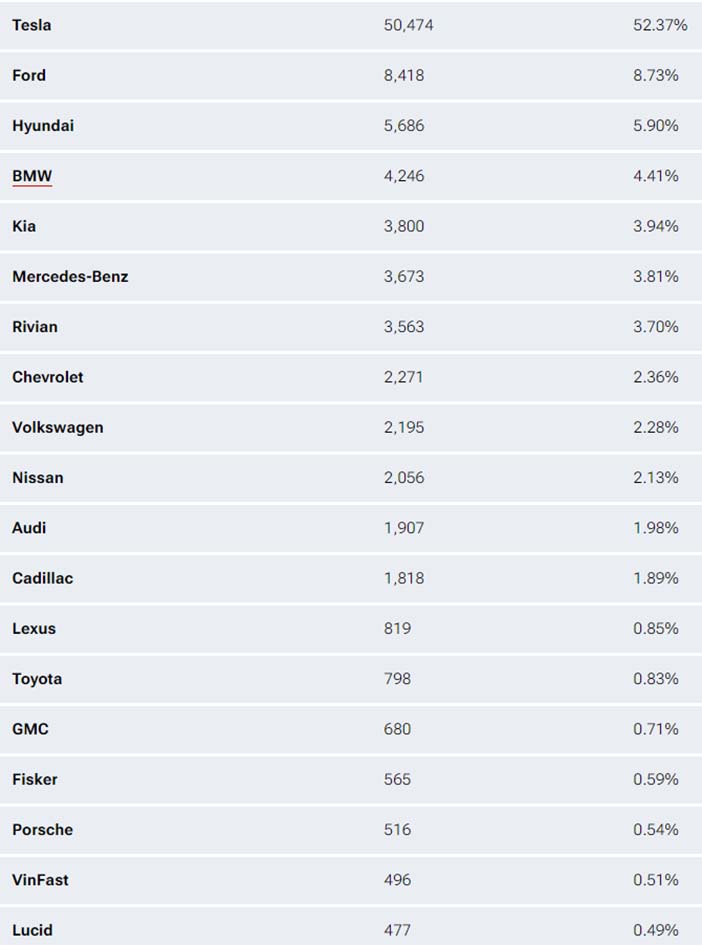
Car brands with smaller marketshares were: Subaru (427 0.44%), Volvo (317 0.33%), Mini (315 0.33%), Genesis (304 0.32%), Polestar (287 0.30%), Jaguar (127 0.13%), Rolls-Royce (59 0.06%), Fiat (9 0.01%) and Mazda (7 0.01%). While Tesla is in no danger of losing market-leader status just yet, there should be no cause for panic from the greater EV fold. While it’s true that the EV market has cooled since it recorded a 52 percent gain in the 2023 calendar year, March still signaled growth that is somewhat skewed by Tesla’s decline. Although total EV registrations in the U.S. rose by a meager 3.8 percent to 96.385, the increase in EV sales from non-Tesla brands was a rather impressive 28 percent. So, who exactly is capturing that extra market share from Tesla? Well, while Ford still significantly trails Elon Musk’s car company (8.418 vs. 50/474), the Blue Oval’s EV registrations were still triple what they were the year before. Growth was driven by 4 times more Mustang Mach-E’s being registered in March 2024 vs March 2024, while the F-150 Lightning was the best-selling EV pickup. Hyundai and Kia saw strong growth, too, doubling their registration numbers. Iconic 5 sales were up by 53 percent and Kia’s newly launched EV9 helped bolster numbers. Meanwhile, BMW (new i5) and Mercedes-Benz (EQE and EQS crossovers) managed double-digit growth. Tom Libby, associate director of industry analysis at S&P Global Mobility, thinks Tesla may be able to fight back soon. Telsa reported that first-quarter deliveries were tight as production was ramped up on the refreshed Model 3, the second most popular car in their line-up. April also saw the launch of a new Model 3 version that takes advantage of the federal EV incentive, which was lost in January due to stricter battery sourcing regulations. +++