
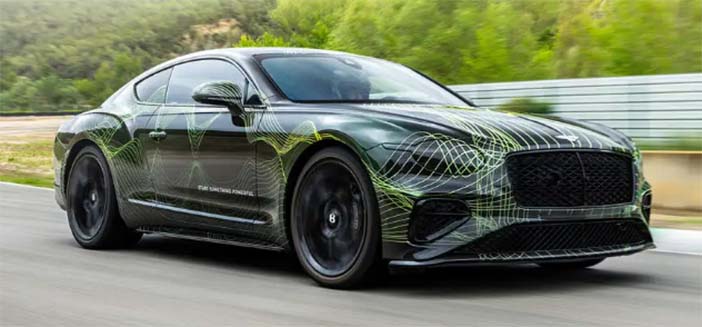
+++ The new BENTLEY CONTINENTAL GT SPEED will be revealed on 25 June with a storming 780 hp plug-in hybrid powertrain replacing the retired W12 motor. Bentley has confirmed this most powerful PHEV version of the fourth-generation Continental will wear the hallowed Speed moniker previously reserved for the top-rung W12 car. The final and most potent Speed-badged W12 car was revealed last year with 659 hp, 900 NM and a 0-199 kph time of just 3.6 seconds. Despite dropping 4 cylinders, the new PHEV powertrain comfortably outpunches its pure-ICE predecessor with its generous power reserves supplemented by a whopping 1.000 Nm of torque, to shave 0.4 seconds off the 0-100 kph sprint time. Bentley has also already confirmed that the new Speed will be able to travel up to 80 km with the engine off, courtesy of a 25.9 kWh battery under the boot floor. Full technical specs will be given at the reveal event, along with the Continental’s new look, heavily inspired by the limited-run Bacalar and Batur coachbuilt creations. +++
+++ BMW has given the green light to new electric i1 and i2 models, according to sources close to the German car maker. Already in development at the company’s FIZ R&D centre in Munich, the 2 new models will be sold alongside updated versions of today’s combustion-powered 1 Series and 2 Series when they arrive later this decade. The intention is to provide prospective customers with more affordable alternatives in BMW’s electric car line-up, which currently opens in the Netherlands with the €48.475 iX1. The new i1 is expected to be sold as either a hatchback or a saloon, while the i2 will be a compact crossover with the option of a coupé bodystyle. Insiders describe the i2 as a spiritual successor to BMW’s debut electric car, the i3, launched in 2013 and discontinued in 2022. BMW remains committed to the 1 Series and its derivatives and sees its future operating in all major segments; a stark contrast to rival Mercedes-Benz, which will retire the A-Class for good in 2026. BMW product boss Bernd Körber told recently that the brand wants to grow in all markets and “connect with the younger generation”, and having entry-level models like the 1 Series and 2 Series is essential to do that. Körber added: “Of course they have lower profitability but they also fulfil a different purpose in getting younger customers and developing BMW in certain markets. So yes, they are still part of our strategy and it’s good that we have two brands in the segment, with of course Mini playing a big role”. Körber agreed with the notion that the A-Class bowing out presented an opportunity for BMW to grow market share with the 1 Series. The company plans to launch the electric i1 in 2027, with the more sporting i2 set to follow in 2028. But while the updated 1 Series and 2 Series remain on the existing FAAR platform, the 2 new compact EVs have been conceived around the new dedicated Neue Klasse electric car architecture. As previewed by the Neue Klasse saloon and Neue Klasse X concepts, the new structure supports an 800 Volt electric architecture designed to accommodate single-, dual- and quad-motor electric drivetrains. My BMW sources confirm there are 2 distinct variants of the Neue Klasse platform: the NBx, denoting front- and four-wheel drive; and NAx, for rear- and four-wheel drive. NAx also forms the basis of a larger NDx platform for luxury-class models, as well as a weight-optimised ZAx platform reserved exclusively for future electric sports cars from BMW’s M division. Initial models will use NAx (including the second-generation iX3 suv and i3 saloon based on the Neue Klasse concepts) and give the choice of rear- or four-wheel drive. However, the new i1 and i2 are set to become the first BMW models to be based on the NBx platform, with either standard front- or optional four-wheel drive. Plans exist for the electric iX1 and its Mini Countryman sibling to also switch from the 400 Volt FAAR platform to the 800 Volt NBx platform as part of efforts to achieve greater economies of scale. The Neue Klasse architectures are set to introduce new cylindrical battery cells. With a standard diameter of 46mm and 2 different lengths (either 95 mm or 120 mm) the sixth-generation battery has been developed with revised cell chemistry that is said to provide future models with much-improved performance. The Neue Klasse range of models remains on track for launch in 2025 and BMW plans to build 6 new cars on this electric architecture within the following 24 months. Körber confirmed that insiders call the i2 the spiritual successor to the i3 hatch Neue Klasse will not be a consumer-facing brand or name and the models launched off the architecture will take regular model names like 3 Series and X3. He added that BMW will “not change its naming logic” for its models, as Audi has done in making electric cars even-numbered and combustion ones odd-numbered. The first Neue Klasse models are now in their “final stages” of development, said Körber, and being readied for production. “We have built the first pre-series cars and have driven them”, said Körber. While Neue Klasse includes an all-new bespoke electric architecture, it also encompasses next-generation software and connectivity functionality that will be rolled out across all future BMW models regardless of their underpinnings, said Körber. It also refers to a new styling theme that will be applied to all future BMW models and the electric cars will not be differentiated, as with the likes of the 4 Series and 5 Series sharing the same basic look as their related i4 and i5 models. “We will change the entire portfolio within a relatively short period of time, so that it has one look and feel and also the same capabilities,” said Körber. “Our ambition is that we unify that in a way that ideally one push of the button and your entire portfolio gets updated”. +++
+++ FORD hasn’t offered a 4-door sedan for several years. The discontinuation of the Mondeo spelled the end for the Blue Oval’s traditional 3-box sedans, with consumer preference for SUVs and crossovers cited as the reason. It was said that Ford lost a lot of money on propping up the traditional yet under-performing sedan nameplates. However, whispers that Ford may return to the segment have been heard for some time now. 2 years ago, an official sketch of a 4-door Mustang was released to the public. Then, Ford’s CEO, Jim Farley, expressed his openness to the idea of a 4-door Mustang in May. Now, in an interview, Farley was asked why Ford no longer sells sedans while other automakers continue to do so. “We didn’t say that no one wants to buy sedans”, said Farley. “Sedans are a really popular type of silhouette. I was the Toyota Camry product planner in the early 90s; you’re looking at like someone who loves sedans. The reason why we’re not selling any sedans is very simple: we lost billions on them, and we are not in a position to lose billions on vehicles anymore”. Farley made it clear that we won’t be seeing a return of cars like the Focus sedan, even if there was money to be made. The reason? Options like the Kuga. “As we lower our cost and improve our quality, Ford may have the opportunity to enter this vehicle segment”, said Farley. “But most Kuga customers are hatchback customers”. So, what may a future 4-door Ford look like? This time, a Mustang sedan wasn’t mentioned. However, Farley hinted at the potential for an electric sedan, reasoning that the body style is inherently aerodynamic. “The bottom line is sedans are very aero. In a world where batteries are expensive, a super aero car like a sedan or a hatch is a great silhouette for aero”. Farley expressed admiration for Mazda’s direction of car creation, labelling the Japanese automaker a business that doesn’t treat car design with a “commodity approach”. Relating that to Ford and a possible sedan, Farley said “If we do one, it’s probably going to feel, look, and smell a lot different than other people’s. We don’t want to do generic vehicles”. +++
+++ JLR (Jaguar Land Rover) will resurrect the Freelander name for a new line of electric cars in China and it plans to eventually export them worldwide. The new models will be built on architecture supplied by the company’s joint-venture partner, Chery, which currently builds the Land Rover Discovery Sport, Range Rover Evoque, Jaguar E-Pace and long-wheelbase versions of the XF and XE saloons. The 2 companies have been partnered for 12 years and will now “strengthen” the Chery Jaguar Land Rover (CJLR) product offering with a new range of bespoke electrified models built in the city of Changshu in east China. “The new model of collaboration leverages fully both parties’ complementary strengths”, JLR said, “with Chery holding a leading automotive market position in China while JLR has unrivalled heritage and design strength, creating mutually beneficial prospects for the future”. Under the Freelander brand, these new models will be seen as “independent from both Chery’s existing portfolio and JLR’s modern luxury House of Brands”. JLR will still launch electric Land Rover models for other global markets using the MLA and EMA modular platforms, and Jaguar will introduce a new line of luxury EVs using the bespoke JEA platform. Freelander EVs are described as being designed and engineered for the “mainstream”, and while they will be sold exclusively in China initially, JLR says they will be exported globally “over time”, without giving further details on planned markets or timelines. JLR CEO Adrian Mardell said: “Today we are taking this important strategic step for JLR, one which underlines our ongoing commitment to China and complements our existing business in China. “We believe that working together to develop new models of collaboration for the world’s largest and fastest-growing electric vehicle market, combined with the appeal of the Freelander brand, promises a very exciting future for CJLR”. Neither company has given any technical details, but widespread reports in Chinese media say that the platforms will be shared specifically with Chery premium brand Exeed, which itself plans to launch in Europe by 2026. One of these, reports say, will be the M3X platform developed in partnership with Magna International. This structure (used by the Exeed RX and Chery Fulwin T10 SUVs) can accommodate both pure-combustion and plug-in hybrid powertrains, but it is expected that Freelander cars will offer only the latter. Chery’s latest ‘Super Hybrid’ PHEV drivetrain combines a petrol engine with a pair of electric motors in the gearbox (a set-up Chery refers to as a world first) with a large-capacity battery supplying an EV-only range of up to 160 km. The other architecture is known as E0X and is engineered for battery-electric and range-extender drivetrains, with an 800V charging architecture and the option of front-, rear- and four-wheel drive. Both architectures have a variable wheelbase and can be used for both crossovers and lower-slung models, but JLR has yet to confirm whether Freelander will remain an SUV-only brand. Chery’s range-extender (REx) technology is likely to have been particularly attractive to JLR, given the surging popularity of the format in China. From January to September last year, sales of REx cars (known there as extended-range EVs or EREVs) soared by 157% to 400.000 units. Conventional PHEVs remain more popular outright, but REx sales are growing more quickly, in part because buyers can take advantage of many of the same incentives as pure-EV owners, while retaining a combustion engine for added range. JLR is one of several Western car manufacturers moving to strengthen their footing in China by working with local manufacturers and using China-dedicated vehicle platforms. Volkswagen, for example, will launch a pair of mid-sized EVs in China using Xpeng’s platforms in 2026, and sibling brand Audi has agreed to use architecture from SAIC premium brand IM Motors for its own range of Chinese EVs. The original Land Rover Freelander (a family-focused SUV) was replaced in 2016 by the Discovery Sport and the name has not been used since. +++
+++ The premium electric saloon battle is about to heat up with an all-new MERCEDES executive EV gearing up to go head-to-head with the production version of BMW’s Neue Klasse. Just like the BMW, the C-Class sized model will arrive in 2026, with Merc’s full engineering might behind it. The new model is destined to ride on Merc’s all-new MB.EA Medium platform, a next generation architecture that’ll also support an SUV model, which we’ll likely see as early as 2025. As a result, we can see some fundamental changes to this new saloon compared with the current EQS and EQE saloon models. This starts with a comprehensive re-think of the car’s overall proportions, as the windscreen has been pulled back into a more traditional and upright position. The nose is still relatively short in comparison to Merc’s traditional ICE models, but the changes should help improve front visibility and reduce the size of the dash; 2 common complaints with the existing electric EQ models. While the prototype does feature lots of shape-hiding camouflage, the body does look to be production-relevant, and reveals that the new electric model will probably feature a traditional front bonnet, rather than the fixed front clamshell of the current EQ cars. The upright headlights will probably be joined at the centre by a daytime running light. The shape from the A-pillar back is more familiar from existing Mercedes EQ models, with a gently sloping roofline and shallow rear windscreen. It’ll also feature a traditional bootlid, rather than a larger hatchback, and also looks to have a slightly longer rear overhang to help balance the car’s overall silhouette. Under the skin, Merc’s next generation platform will move to an 800 Volt electrical architecture, with corresponding enhancements to the charging capability and efficiency. I also expect to see further improvements to battery weight and density, with the battery itself sitting under the cabin in a skateboard-style layout. This chassis configuration will support both single and dual-motor powertrains. This new MB.EA Medium platform should not be confused with the MMA architecture that’s under the forthcoming electric Mercedes CLA that we’ll see later this year. The MMA platform will underpin a range of smaller Mercedes models including 2 new SUVs and a shooting brake estate. While efficiency and tech will obviously be key to the overall development of this new C-Class sized model, Mercedes doesn’t appear to be wasting any time in creating high performance Mercedes-AMG variants, as that’s what this particular prototype is likely to be. Elements such as the large wheels, high-spec Michelin tyres and large brakes all reveal the car’s true identity, so expect some extreme performance figures from with we expect to be a dual-motor layout. We still have a little time to wait until this next generation Mercedes saloon will be revealed in full, with the SUV variant expected first. It will, however, more than likely coincide with BMW’s plans with its new Neue Klasse models, which will be similar in size, shape and specification. +++
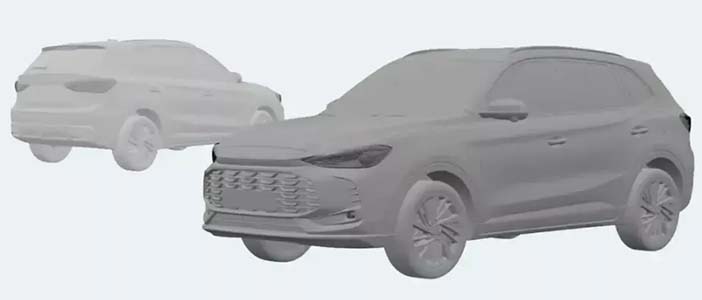
+++ MG ’s ZS small SUV is proving to be a huge hit with European buyers, even topping the charts as the best-selling car in Spain in December last year. It has also been highly popular in Australia, where it claimed the top spot in its segment. Offering excellent value for money, the ZS has certainly captured the market’s attention. However, the current model is getting long in the tooth, and patent images of its successor indicate a new generation ZS is just around the corner. The next ZS is part of MG’s ambitious plan to launch 8 new models by 2028, reflecting the Chinese automaker’s commitment to market expansion. Let’s explore everything we know to date further. The ZS’s styling ethos mirrors that of the new MG 3. It features a completely reimagined front fascia with a redesigned grille and a sportier bumper. The LED headlamps are sleeker, while the bonnet now appears longer, giving the crossover a more robust and aggressive stance. Moving to the side, the profile is more upright, aiding visibility and interior volume. It has a distinctive shoulder line curving upwards towards the rear, accentuating its dynamic posture and making it look more agile and ready for action. From the patent images, we see that the rear remains sharp and modern, featuring led taillights, a redesigned tailgate and a sportier bumper. These elements create a cohesive and more striking rear profile that complements the new MG ZS’s overall contemporary aesthetic. Details about the next-generation’s interior remain under wraps, but it’s expected to mirror the smaller MG 3 Hatch. Buyers can look forward to a higher-quality cabin featuring a digital instrument cluster and a generous 10.25-inch infotainment system with built-in satellite navigation, Android Auto, and Apple CarPlay compatibility. Advanced driver assistance features will include autonomous emergency braking, lane-departure warning, lane-keep assist, adaptive cruise control and traffic jam assist. Platform-wise, it’s likely based on the Modular Scalable Platform that underpins the ‘4’, yielding packaging and safety benefits. Although MG has not released specific powertrain details for the new ZS, the SUV will offer various options to cater to different markets and preferences. It includes petrol, electric, and hybrid variants. For reference: the current EV version employs a 50.3 kWh battery pack and a 163 hp / 280 Nm single motor setup powering the front wheels. The hybrid is expected to use a 1.5-litre Atkinson-cycle 4-cylinder petrol engine with 102 hp of power and 128 Nm of torque, mated with a 1036 hp / 250 Nm electric motor for a total system output of 192 hp. The small SUV segment is highly competitive, and the ZS will compete with rivals such as the Nissan Qashqai, Renault Captur, Hyundai Kona, Kia Seltos, Honda HR-V, Mazda CX-30 and more. A global debut of the all-new MG ZS is anticipated later this year. +++
+++ Elon Musk teased a few new TESLA cars during the company’s annual stockholder meeting on Thursday. The CEO was visibly jubilant after shareholders voted through his enormous $56 billion pay package. The teaser came at a good time. Facing a stale vehicle line-up and stagnating sales, Tesla is in desperate need of a winner on the product front. Musk said new vehicles are in the works, showing a slide with illustrations of 3 vehicles under white sheets. But he didn’t mention any details about what’s to come. “Obviously we’ve got some new products that we’re working on under the covers”, Musk said. “I think these are going to be pretty special”. 1 of the vehicles appeared to be a tall, boxy van of some type. The 2 others looked lower and sleeker. Tesla plans to reveal its long-hyped robot taxi on August 8, so one of the models under wraps could be that. In April, the electric automaker also said it’s accelerating the launch timing of new models, including more affordable vehicles. Those, Tesla said at the time, should arrive in late 2024 or early 2025. Tesla shared similar images of 2 secret vehicles last April in its Master Plan Part 3. In that document, the company said that equivalents of a compact car, a commercial/passenger van and bus will debute soon. The mention of new models, however vague, is likely music to the ears of some Tesla fans and investors. For some time, industry analysts have warned that Tesla’s line-up is aging and that the popular Model 3 and Model Y couldn’t shoulder the company’s growth indefinitely. After years of gangbusters growth, deliveries dropped 8.5% in the first quarter of this year. That’s not great for EV adoption as a whole in the U.S, since Tesla makes up such a large part of the EV market in these relatively early days. Despite the pressure, Musk has stalled on introducing a cheaper model that could drive higher sales. Instead, Tesla in recent years focused its efforts on launching the Cybertruck, an extreme-looking, expensive pickup truck that auto industry experts say is unlikely to sell in serious volumes. Musk himself has said it won’t make a large impact on the company’s bottom line this year. Meanwhile, he has appeared increasingly bored of the car business altogether, choosing instead to double down on Tesla’s efforts in self-driving cars and robotics. Tesla’s CEO breezed by the slide on upcoming models, but spoke at length this evening about robot taxis, a Full Self-Driving feature (which isn’t actually autonomous yet), artificial intelligence and the Optimus humanoid robot. Musk claimed Tesla could one day make 100 million bots per year, netting it an unfathomable $1 trillion in profits. That was based on an assumption that there would be a humanoid robot for every human on earth, an extraordinarily optimistic expectation. Musk also said Tesla’s robot and robot taxi businesses could be worth something like $30 trillion someday. That’s about 10 times the current market cap of Apple, the U.S.’ most valuable public company. But at the end of the day, Tesla is a car company that makes the bulk of its profits selling cars. To grow that business and expand access to EVs, it needs concrete plans for new models, not just vague allusions to them. Otherwise, aggressive newcomers to the EV space like Hyundai Motor Group and China’s BYD will happily fill the gap. +++