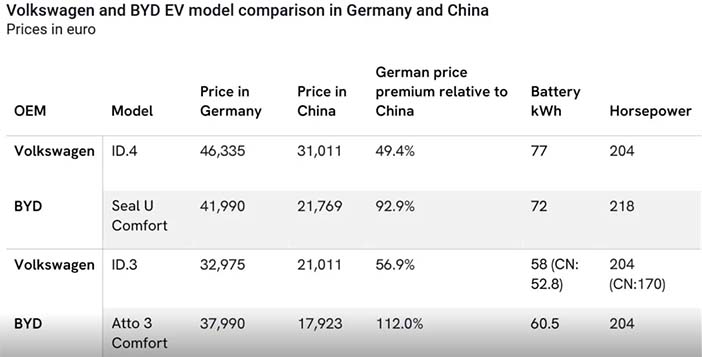
+++ BYD makes a profit of $15.400 on the Seal U in Europe, compared to $1.400 in China. This means BYD makes $14.000 more profit, referred as EU premium, on every Seal U model sold in the European Union, according to a report by Rhodium Group. Earlier this week, the European Commission (EC) investigation revealed that China’s battery electric vehicles (BEVs) and supply chains receive unfair subsidies. As a result, the EC has introduced provisional import duties on Chinese-made EVs, ranging from 17.4% to 38.1%, depending on the manufacturer. These new duties are in addition to the existing 10% tariffs. According to Rhodium Group, the 30% duty on the BYD Seal U would not be enough to make the profits on the car equal between the European Union and China, meaning the playing field would still be uneven. A 30% duty would still leave the company with a 15% EU premium in relation to its China profits. This means BYD would still make over $5.000 more on Seal U sold in the European Union than in China. That would keep the exports to Europe highly attractive. Moreover, duties at this level would provide BYD with space to lower its prices in order to gain market share in Europe. “Our analysis of several other models sold in China and Germany indicates that even after a 30% duty, many Chinese EV models would still enjoy a strong EU profit premium”, Rhodium notes. The report suggests that higher tariffs, possibly as high as 45% or even 55% for very competitive producers like BYD, might be needed to make exporting to Europe less attractive. However, the tariffs might have an unwanted effect on Western automakers. Duties ranging from 15% to 30% could harm the business models of foreign companies like BMW or Tesla, which use China to export to Europe. For BMW’s iX3, the EU premium (after considering costs like shipping) is just 9%. This means that if duties exceed 9%, BMW would earn less from selling in Europe than in China. Higher duties could also disrupt the plans of companies like BMW, Honda and Volkswagen to increase their use of China as an export hub for the EU market. BMW-Brilliance (BMW’s Chinese joint venture) and Tesla are subjected to additional tariffs of 21% as they cooperated with EC during an investigation. Moreover, Tesla applied for further individual evaluation. The price difference between foreign and Chinese producers is because Chinese producers get more subsidies than foreign ones, even though both get support from the Chinese government. Also, Chinese companies are more vertically integrated, meaning they handle more parts of the production process themselves, which lets them buy things at lower prices than foreign companies. For example, BYD not only makes cars but also owns lithium mines, builds its own batteries, develops its own e-motors, owns large ocean carriers for export, and even owns a vehicle insurance company. Moreover, the fierce price war is pushing the EV price down in China for all automakers, especially legacies that struggle to compete with new Chinese EV startups. Volkswagen ID.4 is 70% more expensive in Europe than in China. Chinese EV makers are poised to ramp up exports despite potential EU duties. Factors driving this trend include slowing growth and tighter profit margins in China’s NEV market, as well as incentivizing exports. China is eyeing the European Union as a primary export destination due to its attractive market conditions and ambitious targets set by companies like BYD and SAIC-owned MG to capture a significant market share in Europe. +++
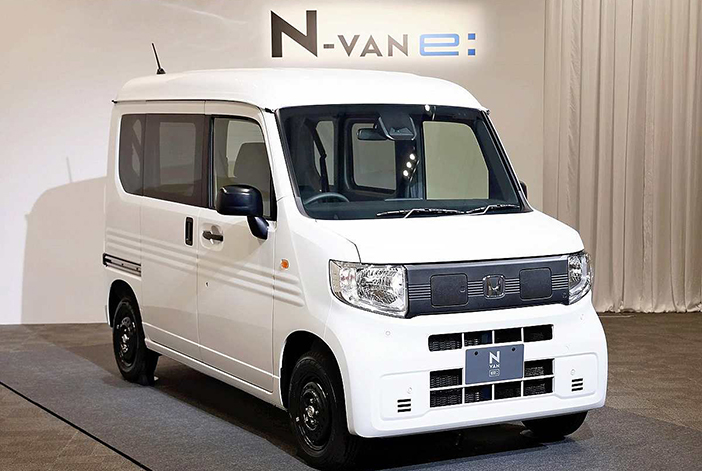
+++ HONDA said Thursday that it will release a new electric commercial minivehicle called N-Van e: in Japan on October 10. The Japanese automaker positions the N-Van e: as its flagship model for the domestic electric vehicle market, of which Nissan’s Sakura minivehicle controls some 40%. The N-Van e: can travel about 245 kilometers on a single charge and starts at about ¥2.43 million. It was developed based on the N-Van commercial minivehicle, which was put on sale in 2018. The new model will help Honda “lead an expanding EV market where demand for tough commercial vehicles is emerging”, a company official said. +++
+++ HYUNDAI is looking to sell a stake of up to 17.5 percent in the planned initial public offering of its India unit to raise up to $3 billion, 3 sources familiar with the matter said, in what could be India’s biggest ever IPO. Hyundai is expected to file papers for the listing with the stock market regulator as early as Friday, the sources said. Once approved by the regulator, Hyundai can list in Mumbai. Hyundai Motor India Ltd, India’s second-biggest carmaker behind Maruti Suzuki, will not issue new shares in the IPO which will involve its South Korean parent selling part of its stake in the wholly owned unit to retail and other investors via a so-called “offer for sale” route, the sources said. Hyundai Motor India declined to comment. The issue will be Hyundai’s first such listing outside South Korea, with the sources saying the company aimed to raise between $2.5 billion and $3 billion from the stake sale in the offer. Hyundai is seeking approval to sell an up to 17.5 percent stake in the IPO to investors, but the final percentage could be lower, the sources said. Sources previously estimated Hyundai’s India unit to be valued at up to $30 billion. The India IPO is aimed at accelerating Hyundai’s expansion in a country where it has operated for over 25 years and where its affordable cars like the Santro and Creta are popular with Indian buyers. The listing will reduce Hyundai Motor India’s dependence on its Korean parent for funds, giving it the financial muscle to take on local rivals such as Tata Motors and chart its own growth plans in a market that accounts for 14 percent of Hyundai’s total global sales. The company has plans to sell locally made electric vehicles in India, as well as set up a charging network and a battery facility. It also plans to expand its manufacturing capacity in the country. In its planned filing with the Securities and Exchange Board of India, Hyundai was required to list “risk factors” for investors in the IPO and cited its dependence on its South-Korean parent as well as related party transactions within the Hyundai Group, the sources said. Hyundai also said that unavailability or reduction of incentives from the Indian government, currently available to EV makers, could be a potential risk, the sources said. Hyundai plans to issue up to 142 million shares in the IPO, out of a total 800 million outstanding shares, the sources said. +++
+++ Chery chairman Yin Tongyao confirmed previous rumours about JAGUAR LAND ROVER ’s adoption of Chery’s platforms during an interview. JLR’s future PHEV and BEV models will stand on M3X and E0X modular architectures that underpin such cars as the Exlantix ET, Luxeed 7 and Chery Tiggo 9. Chery and Jaguar Land Rover have a 12-year friendship story in China. Back in 2012, these companies formed a joint venture in China to manufacture Jaguar Land Rover cars. The jointly-owned factory started operating in 2014 and is still in business. JLR engineers helped Chery a lot with the suspension setup. Moreover, Land Rover cars became a huge inspiration for Chery designers. And now it is Chery’s turn to help JLR. Chery’s high-end brand Exeed recently shared that it has signed a strategic cooperation agreement with Jaguar Land Rover. This agreement allows JLR to use Exeed’s platforms to create its future vehicles. Formally, it is an agreement between JLR and Exeed. However, that Chinese brand is fully owned by Chery Group. So, frankly speaking, we can call it an agreement between Indian Tata Motors and Chinese Chery Group. Regarding the topic, Exeed confirmed that JLR will use 2 main platforms designed by Chery engineers. The first one is the M3X modular architecture. Its second generation is also known in China as T2X. Chery developed it with help from German Bentler. It is the platform dedicated to ICE vehicles and PHEVs. Of course, Jaguar Land Rover is mostly interested in the adoption of plug-in hybrid tech as it lags behind the NEV industry. The M3X architecture can be equipped with Chery’s Super Hybrid powertrain. It comprises a petrol-powered ICE paired with 2 electric motors via a 3DHT165 gearbox. A few years back, this transmission was the world’s first gearbox to adopt 2 e-motors in one body. The main benefits of this DHT hybrid are 9 operating modes, 11 gear combinations, over 1.000-km range and a thermal efficiency of 44.5%. The M3X (T2X) platform with DHT hybrid underpins such cars as the Exeed RX PHEV and Chery Fulwin T9. The second modular architecture that Jaguar Land Rover cars will adopt is the E0X. It was developed jointly by Chery and Huawei. This chassis currently underpins 4 vehicles: Exlantix ES, Exlantix ET, Luxeed S7, and Luxeed R7. This platform covers various body shapes. It is suitable for both BEV and EREV cars. Other benefits of E0X are the utilization of the 800 Volt high-voltage system, the stated energy consumption of 12 kWh/100 km, and advanced autonomous driving tech. E0X can also be equipped with air suspension. Overall, it is a high-end platform suitable for JLR’s electric cars and range extenders. Indian-owned Jaguar Land Rover lags behind the trend for new energy vehicles. Its only BEV, the Jaguar I-Pace, was launched 6 years ago. At the same time, JLR’s sales volume slowly declines. This problem is especially acute in China since there is a huge trend for NEVs. This is why the Tata-owned automaker asked for Chery’s help. Most likely, M3X and E0X-based Jaguars and Land Rovers will sell exclusively in the Chinese market to satisfy local buyers’ needs. Worth mentioning Jaguar Land Rover isn’t the only automaker to adopt Chinese modular architectures to build NEVs. It is a growing trend among lots of automakers. For clarity, Mitsubishi Airtrek adopts GAC’s GEP. Smart and Lotus EVs are underpinned by Geely’s SEA platform. Renault cars will adopt Geely’s CMA. Volkswagen agreed to use the E/E platform from Xpeng. Future Audi vehicles will be underpinned by iO Origin platform from SAIC. +++
+++ In JAPAN , the transport ministry has concluded that 6 cases of misconduct by Toyota related to vehicle certification may violate not only domestic standards but also United Nations vehicle regulations, it has been learned. The U.N. vehicle regulations are international safety and environmental standards that have been adopted by 62 countries and regions including Japan, South Korea and Europe. Given that Japan’s domestic regulations for cars accord with those of the United Nations, the irregularities are highly likely to result in manufacturers being barred from mass-producing the vehicles involved in the scandal in Europe and elsewhere. It has been almost 2 weeks ago since the Land, Infrastructure, Transport and Tourism Ministry announced 4 vehicle manufacturers had engaged in misconduct over model certification; a requirement for the mass production of automobiles and motorcycles. The ministry will use the results of on-site inspections conducted at each company to consider administrative action based on the Road Transport Vehicle Law. According to the ministry, because Japan has adopted the U.N. vehicle regulations, any vehicle manufacturer that obtains model certification in Japan is automatically eligible for the same certification in 61 countries and regions, including Britain, Germany, France, Italy and South Korea, without completing additional certification tests at each location. This procedure (called mutual recognition) helps reduce the burden on manufacturers operating overseas. Irregularities were found in 6 tests at Toyota, including the following: (1) offset frontal collision tests, which evaluate the degree of passenger protection; (2) pedestrian head and leg protection performance tests; (3) rear collision tests; and (4) engine power tests. These tests are also included in the U.N. vehicle regulations, which means the irregularities at Toyota violate not only domestic but also the U.N. regulations. While Toyota claims that it conducted some tests under stricter conditions than the national requirement, the ministry concluded that was not necessarily the case. Concerning pedestrian protection tests aimed at measuring the impact to the head of a pedestrian hit by a car, Toyota said at a press conference on June 3 that the company had used its development test data, which utilizes an impact angle of 65°rather than the required 50°. While the company apologized and said it should have conducted the test once more with an impact angle of 50°, it claimed that 65° was a stricter test. However, according to sources close to the government, the strictness of a safety test depends on such factors as the shape of the car’s hood; the difference in the angle alone is not a determining factor. Toyota also claimed that other tests were conducted under stricter conditions than required. However, the government believes it is impossible to say whether that was true in all cases. Instead, it is highly likely that Europe and other regions will consider Toyota’s misconduct to be a violation of regulations. In the wake of the scandal, some manufacturers have called on the government to streamline the system of vehicle certification itself to ensure international competitiveness and for other reasons. However, the transport ministry is highly concerned that reducing domestic standards that accord with those of the United Nations will lead to a loss of mutual recognition for domestic manufacturers, which would adversely affect their overseas operations. The 4 companies (Toyota, Mazda, Honda and Suzuki), insist that the 38 models involved in the scandal meet domestic standards and that people can continue to drive them without a problem. However, the transport ministry plans to perform its own tests on these models. The discovery of a deviation from government standards may trigger a recall in and outside Japan. +++
+++ JEEP will launch an all-new electric version of its Renegade globally by 2027, with a starting price of less than €24.000 in the Netherlands. Jeep will use a lithium-iron-phosphate (LFP) battery to bring the cost of the small SUV down, Stellantis CEO Carlos Tavares told journalists on a call. “It has to use LFP technology” to get to the targeted price, he said. The new Renegade will come “soon”, Jeep CEO Antonio Filosa told investors in the US on Thursday, without giving a timeline. Previously, Jeep has indicated 2026 as a potential launch date for the second-generation Renegade. A budget Renegade would undercut the current Jeep Avenger Electric baby SUV, which costs from €36.000 euro. The switch to LFP instead of the pricier nickel-manganese-cobalt (NMC) chemistry used by the Avenger indicates the new Renegade could be built on the Smart Car platform, which underpins the new Citroën ë-C3, which costs €24.290. The new Citroën C3 Aircross, Fiat Grande Panda and Opel Frontera also use the platform, which uses cheaper LFP batteries. Tavares didn’t respond to a question from Autointernationaal.nl as to whether the Renegade would be built on the Smart Car platform. However, he said that “many other” vehicles would use it. “That platform has the capability to be sourced all over the world, with simpler solutions that make it much more cost-competitive than anything else we can find in the western world”, Tavares said. Stellantis has previously indicated the Renegade would be built on the upcoming STLA Small platform, but no details were available about the platform at the investor day. The Renegade will be 1 of 6 new Jeep EVs available globally by 2027, the American company said. Others include the flagship Wagoneer S, Recon off-roader and an unnamed “mainstream” mid-size SUV. Jeep is also working on a new Compass, due before 2027. It’s also planning range-extender (REx) vehicle by the same date, according to the investor day presentation. No more details were available, but the Jeep REx would be likely to use the same STLA Frame platform as the upcoming Ram 1500 Ramcharger REx pick-up truck. The new Renegade EV and ICE versions will spearhead Jeep’s new global push that aims to increase sales from 1 million in 2023 to 1.5 million by 2027. The brand is looking to build more than half its cars in low-cost countries, up from around a third now. European production will increase from around 150.000 units per year to 170.000 by 2027. The decade-old current Renegade is built in Italy, but sales this year have slowed as attention focuses on the Avenger, which is built in Poland alongside the new Alfa Romeo Junior and Fiat 600e, with both EV and ICE options. The new Renegade won’t be built in Italy. +++
+++ KGM (KG Mobility), former known as SsangYong Motor, has refuted the results of a recent re-enactment test conducted to determine the cause of a suspected unintended acceleration accident involving a company-produced vehicle that led to the death of a teenager. The accident occurred in December 2022 in Gangneung, Gangwon Province, when a KGM driven by a grandmother spun out of control, purportedly due to the sudden unintended acceleration of the car. It resulted in the death of her grandson, who was also in the vehicle. The family of the deceased teenager has filed a damages suit against KGM, seeking approximately 760 million won ($552,407) in compensation. In a re-enactment test of the accident conducted by a court-appointed expert in April, results supported the claim that the grandmother did not press the accelerator pedal during the accident. The plaintiffs argued that the acceleration was caused by a vehicle defect. In response, KGM refuted the objectivity of the re-enactment test. It claimed the re-enactment test was carried out under conditions presented by the plaintiffs and added, “Various conditions, such as acceleration circumstances, differences between the incident vehicle and the test vehicle, and differences in road conditions, do not align with the National Forensic Service’s analysis results and verified objective data”. KGM also argued the test was conducted under the assumption that the driver pressed the accelerator pedal 100 percent for approximately 35 seconds in all driving sections. It also noted that the accident occurred on an uphill road, but the test was conducted on flat ground. The company also claimed some data and the method of interpreting the transmission patterns derived during the re-enactment test were not properly communicated to the expert. It also argued that the family’s independent examination conducted last month regarding the vehicle’s automatic emergency braking (AEB) system was not warranted by the court and that such a test not conducted under the court’s supervision cannot be considered objective evidence. +++
+++ TESLA shareholders approved CEO Elon Musk’s $56 billion pay package, the electric vehicle-maker said on Thursday, a big thumbs-up to his leadership and an enticement for keeping his focus on his biggest source of wealth. Shareholders also approved a proposal to move the company’s legal home to Texas from Delaware, Tesla said at its annual shareholder meeting in Austin, Texas. They also approved other proposals including the re-election of two board members: Musk’s brother Kimbal Musk and James Murdoch, son of media mogul Rupert Murdoch. Shareholders did increase the level of investor control by passing proposals in favour of shortening board terms to one year and lowering voting requirements for proposals to a simple majority. “We’re not just opening a new chapter for Tesla, we’re starting a new book”, Musk said on stage at the meeting. Musk had tipped off late on Wednesday that the proposals were garnering huge support and thanked shareholders. A chart on his social media platform X showed the resolutions were set to pass by wide margins. The approval also underscores the support that Musk enjoys from Tesla’s retail investor base, many of whom are vocal fans of the mercurial billionaire. The proposal passed despite opposition from some large institutional investors and proxy firms. The Tesla CEO could still face a long legal fight to convince a Delaware judge who invalidated the package in January, describing it as “unfathomable”. He may also face fresh lawsuits on the package, which would be the largest in U.S. corporate history. Shareholder approval for the compensation serves as both an endorsement of Musk’s tenure and an acknowledgment that investors do not want to risk the company’s future. In January, Musk threatened to build AI and robotics products outside of Tesla if he failed to gain enough voting control, which essentially required the 2018 pay package to be approved. He shifted the company’s focus to robottaxis, shelving cheaper mass-market electric cars, to the concern of some investors who feared the autonomous technology will be hard to perfect. Tesla’s share price has dropped about 60% from its 2021 peak as EV sales have slowed and Musk’s attention has wavered between Tesla and other companies he runs. The stock closed up 2.9% on Thursday. “This vindicates Musk and allays some investor concerns around his waning interest in Tesla”, said Sandeep Rao, senior researcher at Leverage Shares, which owns Tesla’s stock. The board had said that Musk deserves the package because he hit all the ambitious targets on market value, revenue and profitability. Large investors including the California Public Employees’ Retirement System had called the pay package “excessive”. “Elon Musk and Chair Denholm have made this about CEO loyalty and presented the votes as a decision about whether the company can keep Musk. That is a lot of pressure”, Ivan Frishberg, chief sustainability officer at Amalgamated Bank, told. The bank voted against the pay proposal, citing concerns about lack of independence and corporate governance at Tesla. Tesla had been drumming up support for Musk’s pay package, especially from retail investors, who make up an unusually high percentage of its ownership base but who often do not vote. Company executives have posted messages on X, saying Musk is critical to Tesla’s success. Tesla has run social media ads, and Musk has promised a personal tour of Tesla’s factory in Texas to some shareholders who cast votes. While Musk is undoubtedly Tesla’s driving force, and is credited with much of its success, the company’s sales and profit have slowed. There are concerns that he is spreading himself too thin. Musk has added two more companies to his roster since the pay package was approved in 2018. He now runs or owns six firms, including rocket-builder SpaceX, social media giant X and the artificial-intelligence firm xAI, which Musk created in 2023. The approval suggests shareholders “think he’s the only person with the best strategy to implement going forward”, said Jason Schloetzer, a business professor at Georgetown University with expertise in corporate governance. “They are brushing aside essentially key man risks, where Tesla has become even more dependent on Musk going forward”, he said, citing high-profile executive departure in the past few months. The Delaware judge who ruled against the package criticized Tesla’s board for being “beholden” to him, saying the plan was proposed by a conflicted board with close personal and financial ties to its top executive. The board held the shareholder vote as a way to bolster its appeal of the ruling, in which the judge cited the board’s failure to fully inform shareholders before approving the pay package in 2018. +++
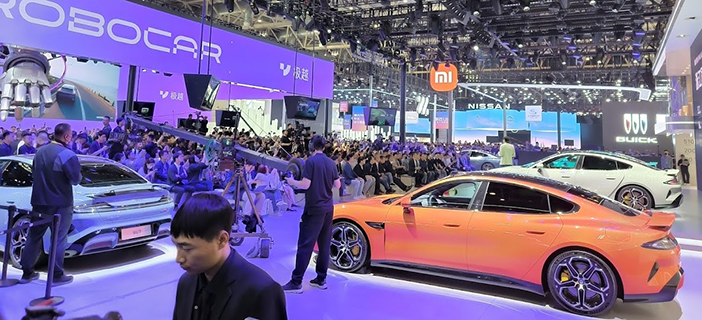
+++ XIAOMI has delivered its 20.000th SU7, about 2.5 months after the March 28 launch, the company announced. Xiaomi expects to deliver 120.000 units of SU7 in 2024. Despite the production challenges in their new Beijing factory, Xiaomi delivered 20.000 SU7s in 77 days since launch, which is 260 cars on average every day. However, those numbers include the about 5.000 SU7s Founders Edition, which were assembled before March 28. Xiaomi also has announced that it expects to exceed 10.000 unit deliveries in June. In May, the consumer giant sold 8.646 SU7s. “Yesterday, cumulative deliveries of Xiaomi SU7 exceeded 20.000. I appreciate your support”, Xiaomi posted on Weibo Friday. The SU7 offers 3 versions: Standard, Pro, and Max. The top trim level has an 800 km range and 663 hp. As usual for Xiaomi, the SU7 sparked a lot of hype in China, which resulted in 50.000 pre-orders in 27 minutes after the launch. Deliveries of the standard and Max versions began on April 3, while the SU7 Pro deliveries started in May. On May 15, Xiaomi EV reported its 10.000th SU7 delivery. Despite its popularity, the SU7 faces production capacity issues. According to the Xiaomi website, customers need to wait 30 weeks for the Standard model and 35 weeks for the Max variant. Last week, registrations in China for the Xiaomi SU7 saw 2.100 units, down from 2.200 in the previous week and 2.700 the week before. Concerns about declining sales sparked a response from Xiaomi’s management. Wang Hua, general manager of Xiaomi Group’s PR department, assured that while order volumes are increasing, delivery capacity is strained due to the limited capacity of delivery centers, trying to emphasize that problem is on the production and delivery capacity side, not on the demand side. To mitigate these issues, Xiaomi started double-shift production in June in its Beijing plant. Furthermore, on June 7, it was reported that Xiaomi’s car factory was recruiting more workers to achieve its yearly delivery objectives. +++