
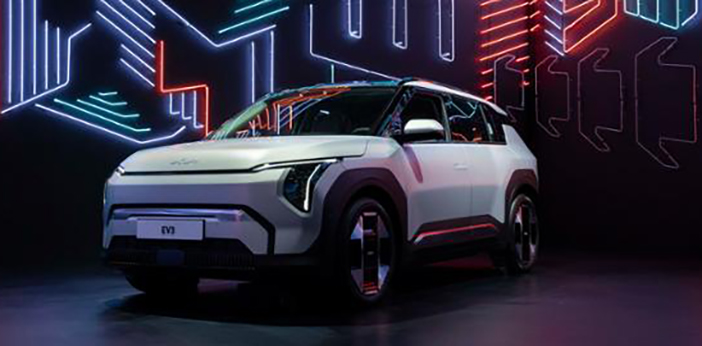
+++ Hyundai, Kia and BMW have placed a strategic focus on compact electric vehicles (EVs) by showcasing their new lineups in the category at this year’s BUSAN MOBILITY SHOW , in an effort to overcome the frozen sentiment in the global EV market. As the EV industry progresses toward widespread public adoption, hybrid cars are currently bridging the gap. However, carmakers have shown a strong commitment to expanding their EV line-ups with smaller, more affordable models. Hyundai drew attention at the mobility fair on Thursday with the world’s first launch of the Casper Electric. This marks the debut of the brand’s smallest-ever SUV in an all-electric version. The vehicle is equipped with a 49 kWh battery, allowing it to travel up to 315 kilometers on a single charge. “Casper Electric, unveiled for the first time in the world here, will drive the mass adoption and popularization of EVs”, Chung Yoo-seok, vice president and head for Hyundai’s domestic business division, told reporters. The compact EV has secured enhanced marketability, as its battery can be charged from 10 percent to 80 percent in only 30 minutes according to Hyundai, which added that this is fit for typical city drives. The vehicle will be priced at less than 30 million won ($21,600). Kia displayed its full EV line-ups (the EV3, EV6 and EV9) during the fair, in a show of its determination to lead the upcoming EV era. Kia also focused on promoting the EV3 out of the line-ups by running a special EV3-dedicated zone (photo). The compact electric SUV was unveiled in May. Genesis, the luxury brand from Hyundai, displayed its facelifted Electrified G80 mid-sized sedan for the first time. BMW Korea showcased its iX2 and a set of other vehicles, including ones from its Mini brand. The company was the only imported carmaker to set up a booth at the mobility show. Many other foreign carmakers opted out of participating this year due to declining popularity and minimal marketing impact of the event. But BMW reiterated its strong will to give back to regional societies by widening its corporate activities for the co-prosperity with them. “BMW Korea will set a new stepping stone to realize sustainable corporate activities with regional communities”, BMW Korea CEO Han Sang-yun said. +++
+++ BYD launched its third electric vehicle in Japan, a sedan that will be its most expensive model so far in a market where consumers have long favoured domestic brands. The Shenzhen-based automaker said it had started taking orders for its flagship Seal in Japan from Tuesday, setting the suggested retail pricing for the rear-wheel-drive version of the vehicle in the country at 5.28 million yen. The model starts from 179,800 yuan ($24,759.70) in China. The expansion of BYD, which stands for Build Your Dreams, in Japan could become a worry for domestic automakers, which are struggling in China against BYD and other Chinese EV brands. The automaker has only rolled out battery-powered cars for the Japanese market, but not vehicles with other powertrain technology such as plug-in hybrids, in which it is a big player in China. BYD’s sales in Japan have lost some momentum in April-June compared with last year, BYD Auto Japan president Atsuki Tofukuji said at a Seal launch event in Tokyo’s Shibuya district. Sales were down 28% in May compared with last year, after a 26% decline in April. A big reduction in the Japanese government electric-vehicle subsidies the company’s models qualify for in the business year that started in April put a drag on sales, he told reporters. The company will offer a rear-wheel-drive and an all-wheel-drive version in Japan that will both come with a 83 kWh battery pack, the company said in a news release. The rear-wheel-drive version has a cruising range of 640 km, while the 6.05 million yen all-wheel-drive version can drive 575 km on a single charge. BYD launched the Atto 3 and Dolphin in Japan last year, selling about 2.500 units since opening its first Japanese dealership in Yokohama in February 2023. It said it plans to add at least one new model to its line-up in Japan each year. +++
+++ HYUNDAI and its labor union on Friday reached an agreement to hire 1.100 new manufacturing workers by 2026. The agreement was reached in the 10th round of negotiations related to wages and working conditions held at the company’s plant in Ulsan, 299 kilometers southeast of Seoul. The 2 sides previously agreed to hire 300 new production workers next year. On Friday, they agreed to increase the company’s plant workforce by an additional 500 workers next year and by 300 in 2026. The union has been demanding an increase in hiring, considering how around 2.000 production workers retire each year, and to prepare for the company’s launch of a new electric car factory in Ulsan next year. The latest round of talks came after nearly 90 percent of unionized workers earlier this week voted in favour of a walkout following a collapse in the annual wage negotiations. The union has yet to decide whether to actually carry out the strike. If executed, the walkout would be the first for the company in 6 years. Hyundai’s union has not carried out a strike in the past 5 years, taking into consideration various factors, such as the Covid-19 pandemic and national trade issues. +++
+++ The HYUNDAI MOTOR GROUP is strengthening its electric vehicle (EV) battery supply chain and internal production capacity, as the world’s third-largest auto group seeks to present price-competitive EV models with better driving ranges. Last week, SQM, a Chilean lithium mining company, announced that it reached a long-term agreement with Hyundai and Kia to supply lithium hydroxide to the Korean automakers. The SQM deal marked Hyundai’s third lithium hydroxide supply contract signed this year after the ones with Chinese companies Ganfeng Lithium and Chengxin Lithium Group announced in January. Lithium hydroxide is used in high-priced ternary batteries, such as NCM (nickel-cobalt-manganese) batteries, which are high in energy density. NCM batteries are relatively expensive but allow for a long driving range per charge for EVs compared with the more broadly used LFP (lithium iron phosphate) batteries. Auto industry observers see Hyundai Motor Group’s recent lithium hydroxide supply deals as a sign that the group is focusing on adopting high-capacity NCM batteries to boost the driving range of its future EV models. Anxiety over the driving range of EVs is often cited as a key hindrance in the mass adoption of electric cars, with many drivers remaining unconvinced that EVs offer enough mileage per charge. The Casper Electric, Hyundai’s yet-unveiled sub-compact electric SUV, boasts a maximum driving range of 315 kilometers on a single charge thanks to its NCM battery, whereas the comparable Ray EV by Kia has a range of 205 kilometers due to its LFP battery. The Casper Electric, which will be badged as Inster in Europe, debuted at the Busan International Mobility Show this week. The EV3, Kia’s new dedicated EV SUV to be sold starting in July, will also be equipped with an NCM battery instead of an LFP battery. The long-range trim of the EV3, fitted with a high-capacity 81.4 kWh NCM battery, has a driving range of up to 501 kilometers on a single charge. Given its higher price tag, Hyundai Motor Group is seeking to lower its EV customers’ NCM battery cost burden by internalizing production. This year, the Korean auto giant began production at its battery plant in Indonesia established jointly with LG Energy Solution. Kia will use the NCM batteries produced at the Indonesia plant in the upcoming EV3 units. Song Ho-sung, CEO and president of Kia, last month stressed the importance of ensuring the long driving range of EVs, suggesting that Kia will expand its adoption of NCM batteries. “Based on our analysis of customer expectations for EVs, we determined that the driving range needs to be at least 450 to 500 kilometers”, Song said during a media conference last month, adding, “From this perspective, we ended up deciding on adopting NCM batteries for the EV3”. Industry observers say the introduction of models that boast better batteries and higher ranges, while also being reasonably priced, is necessary in order for the industry to overcome the so-called EV adoption chasm, especially when the government is considering further cutting electric car subsidies due to fiscal constraints. “In order to overcome the sector’s growth stagnation, EVs need to offer great value propositions in terms of both pricing and performance”, an industry official said, adding, “Manufacturers also need to better diversify their battery-related supply chain in order to lower costs”. +++
+++ KG MOBILITY is facing difficulties in obtaining the trademark rights for its Korean name, not just for its English name and the 3-letter acronym KGM, according to the nation’s intellectual property office. The Korean Intellectual Property Office (KIPO) notified the carmaker on June 17 of the reasons for refusing the registrations of the company’s name written fully in Korean and the one that combines “KG” written in the Latin alphabet with “Mobility” written in Korean. The main reason for its refusal was a Turkish trademark troll, Cihan Turan, who had registered “KG Mobility” in the European Union in March last year when KG Group decided to rename SsangYong to KG Mobility after the chemical giant acquired the debt-ridden carmaker in 2022. Because KIPO prioritized Turan’s applications based on the Paris Convention, the Korean firm was not allowed to secure the trademark for its English name last September. “This applied trademark is similar to another person’s trademark applied earlier, in terms of name, concept and designated goods”, KIPO said in documents sent to KG Mobility. Due to the dispute, KG Mobility has advertised its vehicles here and overseas by using “KGM” as an alternative to its full name. However, the firm failed to register the “KGM” trademark in Turkey, one of its most important export markets. The Turkish Patent and Trademark Office refused the registration of “KGM” because the Turkish government-run General Directorate of Highways, which is written as “Karayollari Genel Mudurlugu” in Turkish, had already been using the same acronym. Even in Korea, the trademark for “KGM” is also under KIPO review, following an objection filed last year by KTM, an Austrian motorcycle manufacturer, which says consumers are likely to be confused by the 2 similar acronyms. KG Mobility was reportedly asked by Cihan Turan to pay a significant amount of royalties. In addition, another trademark troll named Erhan Turan registered the “kg mobility” trademark in Turkey in January last year. The company has said that there will be an amicable agreement, denying the possibility of the trademark dispute affecting its exports. +++
+++ Toyota has announced that electric vehicle charging stations currently only available to LEXUS owners will be opened up to other EV users. Toyota has 2 stations: one in Chiyoda Ward, Tokyo and the other in Karuizawa, Nagano Prefecture. Charging costs ¥120 per minute and users must make a reservation online. Sevices such as refreshments are available for people while they wait for their vehicles to be charged. Toyota plans to open additional Lexus charging stations in Osaka Prefecture and Nagoya by the end of March next year, with about 100 locations set to be added across the country by 2030. +++
+++ NISSAN will close its passenger car factory in Jiangsu province, China, people familiar with the matter said, as the Japanese automaker faces intensifying price competition and the rising popularity of electric vehicles made by local brands. Like its Japanese peers, Nissan has been struggling with declining sales in the world’s largest auto market. Limited options in all-electric cars have been a major setback for Japanese companies as China is experiencing a rapid shift to EVs. The plant in Changzhou is capable of building about 130.000 units annually, accounting for approximately 10 percent of Nissan’s production in China, the sources said. The factory, which came online in November 2020, is scheduled to stop operations on Friday, and the production of SUVs made there will be transferred to a different Nissan plant in China, according to the sources. Nissan operates eight factories in China through its partnership with state-owned Dongfeng Motor, with a total production capacity of about 1.6 million units per year. +++
+++ POLESTAR said, after months of delays in turning in its financial reports, that its 2023 revenue fell and its losses widened as it grappled with slowing demand for its higher-priced models. U.S.-listed shares of the company fell 3.1% to 80 cents. The stock has slumped more than 63% this year as of Thursday’s close. The tense anticipation leading to Polestar’s earnings announcement was fraught with hurdles, including reduced investment from major backer Volvo Cars and slower-than-expected demand for electric vehicles. Polestar said it will report its first-quarter results and second-quarter volumes on July 2 before the market opens. Demand for EVs has suffered as range anxiety, higher-for-longer interest rates, and attractive lower-priced hybrid vehicles have weighed on consumer demand. The company had postponed multiple quarterly financial reports, citing accounting misstatements in 2021 and 2022, and has rectified metrics in its 2023 annual results statement. Polestar reported revenue of $2.38 billion for fiscal year 2023, down 3% from $2.45 billion from 2022, citing higher discounts and lower sales of carbon credits. The company reported a gross loss of $414.7 million for the year, compared with a gross profit of 98.4 million a year earlier. The EV maker said after an analysis conducted in 2023, it had to lower the value of its assets related to its Polestar 2 model by $329.7 million, resulting in an impairment charge of $240.5 million. Polestar said it incurred a further charge of about $120 million due to lower-than-expected demand in some markets, which led to a drop in the value of its unsold cars. Net loss widened to $1.17 billion in 2023 from $481.5 million, in the prior year. +++