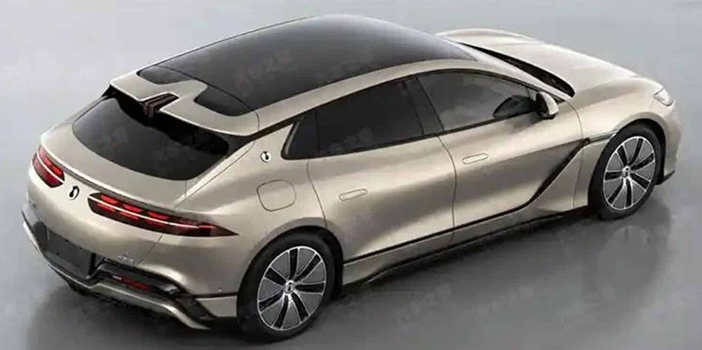
+++ BYD’s expansion strategy in Europe will no longer be limited to its electric and hybrid cars from the now well-known brand. In fact, the Chinese group has decided to introduce a series of DENZA labelled cars (also electric or hybrid) on the Old Continent’s markets. The cars were already presented in Europe at the recent Munich Motor Show. On the BYD stand was a Denza D9, an ultra-luxurious MPV (multi-purpose vehicle) that aims to compete with the Mercedes V-Class and others. But the debut here is now official and will see the arrival of a whole series of cars. The first to make its debut is expected to be the Denza Z9 GT, a luxury estate focused on comfort and performance. A launch date for Western markets has not yet been set. The head of European operations, Yi Sun, told that the brand was currently concentrating on setting up a suitable dealer network. The idea is in fact to position Denza (a brand born of a 50/50 joint venture between BYD and Mercedes and now 90% owned by BYD) as a direct competitor to other top-of-the-range brands such as BMW, Audi and Mercedes. Under the Denza brand, BYD also intends to sell cars known in China as Fangcheng Bao, whose production focuses on square-shaped models with strong off-road qualities. Back to the Denza Z9 GT. This model is enjoying a degree of success in China thanks to a number of factors that are much appreciated in the land of the Dragon. The first is rear-seat space, and the second is the fact that, among the equipment on offer, there are 2 fridges, one of which, with a capacity of 10 litres, is specifically for those sitting in the second row of seats. Will they also make an impression in Europe? It’s hard to say. The needs of Chinese motorists are different, as are their tastes in cars and options. It is interesting to note, however, that as well as cooling, the 2 compartments can also heat food and drink (up to 50 degrees). The Denza Z9 GT is 5.18 metres long and has a wheelbase of 3.13 metres. It is available in a fully electric or hybrid version. The former, whose exact battery capacity is not known (a new BYD Blade Battery gives a range of 1.000 km), has 3 electric motors (1 at the front and 2 at the rear) and a power output of 965 hp. The plug-in hybrid, which is powered by a 2.0 turbo petrol engine, is equipped with a 38.5 kWh Blade Battery that provides a range of over 150 km without emissions, and is similar in power to the BEV version. +++
+++ Perhaps many have asked themselves this question, but no one has the answer (yet): Will the FORD Capri have to change its name? Remember the Alfa Romeo Milano scandal? Minister Adolfo Urso screamed scandal about the “Made in Italy” regulation, because a car not produced in Italy cannot have a name that recalls Italian geographic locations, regardless of the fact that the regulation was created to protect the country’s food and wine heritage. So an emergency meeting in Alfa Romeo headquarters and the announcement of the birth of Alfa Romeo Junior was the answer. Should we expect the same process for the Ford Capri? A few days after the presentation, no one in the ministry said a word, even after the press asked the ministry. In the meantime, Alfa Romeo gives Ford’s colleagues some advice to avoid trouble. With a simple post on Instagram, Alfa Romeo offers the answer to Minister Adolfo Urso in case of controversy over the Capri name. The electric coupé SUV is not inspired by the famous island in the Gulf of Naples, but instead the people from the Blue Oval wanted to celebrate the South African Capri, a small village south of Cape Town. To help the people of MIMIT, geographical coordinates were also given. So all doubt is dispelled and the Ford Capri, which is produced in the German plant in Cologne, has all the credentials to avoid hasty rebranding operations. A dig at Minister Urso and his imposition that led to the name change for the Milano, and moreover, after months of teasing and official announcements that had made the Lombardy capital official as the name of the Biscione’s new SUV, the question remains. What will the ministry do? Will it overlook it or will it ask Ford to rename its coupe SUV? +++
+++ HONGQI , the oldest Chinese car brand, is set to introduce another pair of electric models in 2026. The firm, whose name translates ‘red flag’, was founded in 1958 (before private car ownership was legal in China) and is known for its line of vehicles used by the president of China, along with state and local dignitaries. It’s owned by Chinese manufacturing group First Automobile Works (FAW) and offers a range of luxury and premium executive cars and SUVs. Hongqi began to expand overseas in 2018 and currently offers EVs in The Netherlands, Denmark, Sweden and Norway. It’s now aiming to substantially expand its presence in Europe, which it sees as a key market for high-end and luxury vehicles. It laid out its ambitious plans with a large presence at the 2024 Goodwood Festival of Speed. “Hongqi is a household name in China, and we want to make a new start in other regions”, said Yang Dayong, FAW’s president of overseas operations. “We understand European customers value high product quality and we believe Hongqi can exceed those expectations”. Hongqi’s European expansion will initially be focused on its 2 new EVs, the EH7 saloon and EHS7; a SUV. Both feature significantly different styling from the firm’s petrol and hybrid models, which reflects an intent to target a younger audience.
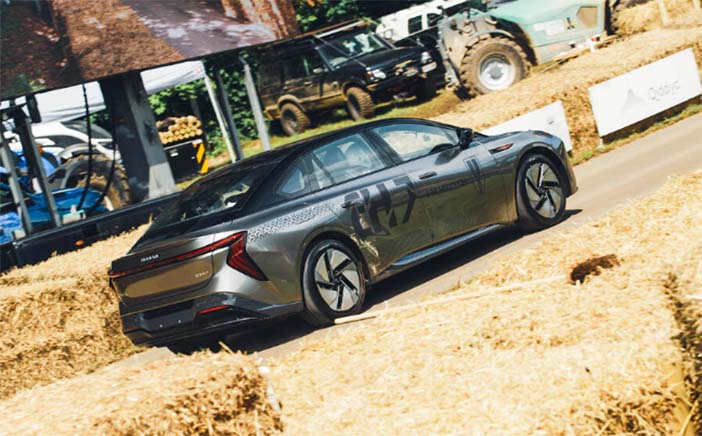
The EH7 is close to 5 meter long with a 3 meter wheelbase. Like the similarly sized, EHS7 it sits on a bespoke EV platform and features Hongqi’s own software architecture. Asked what position it will take in the market, Taylor told: “These are premium offerings, and when we designed the car, we thought of it as a BMW 5 Series competitor”. The top-end versions of the EH7 and EHS7 share a dual-motor powertrain that offers 610 hp and 750 Nm. This gives the saloon a 0-100 kph time of 3.5 seconds and the SUV a time of 3.9 seconds. Single-motor, rear-wheel-drive versions will also be offered. The EH7 and EHS7 are sold in other European markets with a choice of 85 kWh and 111 kWh batteries, with the latter in dual-motor form giving an official WLTP range of 575 km for the saloon and 520 km for the SUV.
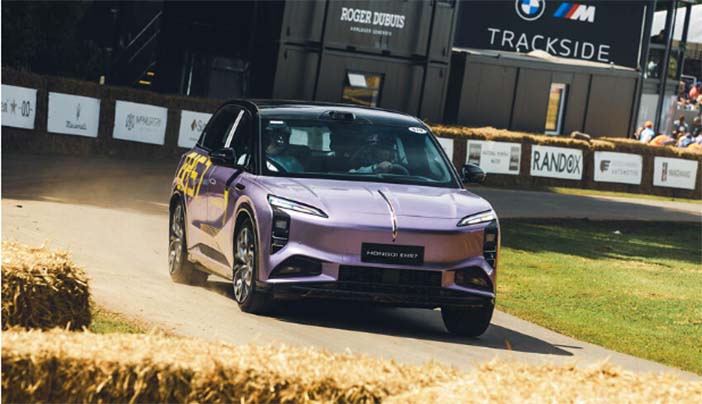
Hongqi said the EVs will both be capable of fast-charging at speeds up to 246 kW. They will also offer rear-wheel steering and air suspension. Inside, as befits the brand’s premium brief, passenger space has been maximised, particularly in the rear. Taylor added: “In Europe, for us to put our head above the rest, bespoke and customisation has to be part of our brand USP. We’re the oldest luxury brand coming out of China, so we have to offer a level of personalisation to customers”. Hongqi has outlined plans to launch 12 new products in overseas markets in the next 5 years, although it has yet to confirm which of these will reach Europe. While Hongqi won’t launch any pure-petrol cars over here, such as the Rolls Royce-rivalling ultra-luxurious Golden Sunflower limousine, it’s likely to offer hybrid models in time. “The EV models are the vanguard, but we will bring the hybrids in eventually, given the current market conditions”, said Taylor. While the focus will be on the premium-level cars initially, Taylor said that luxury cars such as the Golden Sunflower could eventually be offered in Europe when they have suitable hybrid powertrains. +++
+++ SELF-DRIVING CARS may be at the bleeding edge of today’s technology, but a new study has found that travelling in one can be summed up in one word: boring. Yes, that’s right; an investigation by the University of Nottingham analysed the behaviour of 17 motorists (each accompanied by 1 passenger) when behind the wheel of a driving simulator, designed to replicate an SAE Level 3 autonomous vehicle. It found that the lack of stimulation for the driver, derived from not providing as many control inputs, resulted in a lack of attention and interest. For those unaware, the Society of Automotive Engineers (SAE) compiled a series of levels to describe autonomous car technology. Under this scale, an SAE Level 3 autonomous vehicle is described as ‘conditionally’ automated. What does that mean? Well, it means that in situations like traffic jams and when cruising on the motorway, the car can take full control, with little to no input from the driver. However, the driver is required to be available to take back control when the need arises. During the experiment, participants spent most of their hands-off time chatting to the passenger, scrolling on their phones and watching videos, with one participant even playing online chess. However, such a lack of attention during this period harmed each participant’s driving performance when the simulated car requested driver intervention. Researchers commented how “vehicular control during the ten seconds immediately after resuming manual driving was generally poor in the case of all participants”. This saw drivers accelerating and braking harshly, as well as “wavering in their lanes”. In fact, some participants got so heavily distracted during the experiment that they ended up missing several turnings and directions on the pre-designated route. However, it was observed that passengers were keen to encourage the driver to pay attention to the road, telling researchers that they were “acutely aware of the potential distraction they posed to the driver, recognising that the driver was ultimately in control of the vehicle”. The study was funded by the RAC Foundation, with director Steve Gooding calling for automotive engineers to “develop systems that recognise how people, with all their foibles and fallibilities, are likely to react in the real world with all its distractions”. “The irony is that whilst fully self-driving cars aim to do away with human input, semi-autonomous vehicles will still demand that people have some control”, he continued. “Unfortunately, this study show[s]that the handover process between human and machine is less than smooth and far from quick, raising serious questions as to whether this sort of intermediate technology will ever become commonplace, let alone safe”. University of Nottingham Professor and Senior Research Fellow, David R Large, observed that while passengers are typically deemed as ‘distracting’ in manually-driven cars, “the study highlighted the distraction that passengers continue to pose inside these vehicles, but also the value they can offer. We observed passengers providing help and assistance to drivers during manual takeovers of the vehicles, and sharing the responsibility of keeping the focus on the road when needed”. Even with the technology available to us today, it remains a while before we can expect to see fully autonomous machines populating our streets. In May, the outgoing Conservative administration’s Autonomous Vehicles Act reached Royal Assent, paving the way for driverless cars on UK roads as soon as 2026. One of the stipulations in the new set of laws places legal culpability in the case of an accident firmly on the automotive manufacturer, with the driver instead being deemed as a ‘user-in-charge’ whenever fully autonomous settings are active. +++
+++ SMART could give the green light to an electric Fortwo successor in a matter of months, its European boss has revealed, but it must be proved profitable before getting approval. The Fortwo (the firm’s first model and one of the smallest cars sold in Europe) retired recently after 26 years of production, with no immediate successor lined-up, but Smart Europe CEO Dirk Adelmann has confirmed that plans are afoot for an electric replacement. “We are working on that one”, he told. “The run-out of the current Fortwo was 2 months ago, now. It would have been great to have a direct successor – we don’t, but we’re working on it”. He acknowledged the strong business case for a new-era compact city car “not only in Europe but particularly for Europe, so it would make sense to bring it to sale”. Proposals already exist for the city car, dubbed ‘Project 2′ internally and expected to take the #2 name into production. Addressing the potential confusion that could arise from it being much smaller than the #1 crossover, Adelmann explained that the number 2 has been reserved “on purpose” as it is an “iconic number” for the brand and should be used for a Fortwo successor. As the Smart line-up expands, he said, a pattern will emerge whereby odd numbers are used for SUV and SUV-coupés and even numbers are for “other products”. But more important than defining the EV’s shape and styling is ensuring that it can be sold profitably, and for that Smart is looking to identify a partner firm with whom it can share development and production costs. “The city car segment is not huge in Europe; the best year for Fortwo was around 100.000 units, and that’s not enough to justify a platform”, Adelmann said. “If you share this platform with partners, we’re still in evaluation, then you can also share the investment costs and the production site etcetera, and it starts making sense. The last thing we want to do is produce a vehicle where nobody is earning money, because that vehicle will not last for long. We want to have a positive business case for us, for our retailers and in the end for our customers”. Smart is 50% owned by China’s Geely, which owns a range of car brands spanning a huge variety of sizes and segments. It remains unclear whether one of these could partner with Smart for a city car, but the closest match for the original Fortwo in size terms from across the Geely portfolio would seem to be the Geometry Panda: a 3-metre urban electric car with 4 seats and a range of 200 km. +++
+++ It seems like TVR can’t catch a break right now. The latest bit of bad news for the famous British sports car brand surrounds its failed factory in Wales, which, it seems, could result in a multi-million Pound bill for taxpayers. The auditor general for Wales, Adrian Crompton, has written a letter to the Welsh parliament in response to concerns raised over the risk to public funds invested in the TVR factory project. He stated that the Welsh Government spent over £14m in its ultimately failed attempt to attract TVRA (TVR Automotive) manufacturing to Wales. The breakdown of that funding included the £4.75 million fee for buying the Ebbw Valley factory in South Wales and a further £7.6 million spent on the site’s refurbishment. A loan of £2 million spread across 5 years coincided with a £500,000 investment directly from public funds that was made in the hope TVR could start making cars for the first time since 2006. The target was 2.000 cars per year by 2020, along with the creation of 150 jobs at the factory, however neither of these goals came to fruition. Earlier this year, TVR announced that it would no longer lease the factory in Wales, eyeing-up a new base in Hampshire instead. According to the letter from Adrian Crompton, the Welsh government decided in 2023 to sell the factory at a potential loss of £4.85 million to the taxpayer. No formal offers for the property have been received since. The Welsh government still holds 1.6 percent of shares in TVRA. According to the letter from Crompton, the government is currently weighing up whether to sell back the shares to TVRA or retain them “in the hope that the share price might increase from the current valuation”. +++
+++ VOLKSWAGEN GROUP subsidiary PowerCo has teamed up with QuantumScape to industrialise solid-state batteries. In what could be a landmark agreement for the Volkswagen Group’s electric future, PowerCo will be able to produce solid-state batteries for passenger electric vehicles with a target of up to 1 million batteries per year. PowerCo, a company set up in 2022 which handles the production of batteries used in VW Group vehicles, has agreed a non-exclusive licence to use Californian company Quantumscape’s solid-state battery technology. Volkswagen says Quantumscape’s battery can provide “exceptional energy and power density, fast charging and a robust safety profile”. Frank Blome, CEO of PowerCo said, “We have been collaborating and testing QuantumScape prototype cells for years now and we are looking forward to bringing this technology of the future into series production”. “Electric vehicles are the future of mobility, and this agreement with QuantumScape will ensure the Volkswagen Group’s global fleet has access to this groundbreaking battery technology for years to come”, said Thomas Schmall, Volkswagen Group Board Member for Technology. However, Volkswagen has not specified a date for when to expect this new technology in production cars. Under the licence agreement between the companies, PowerCo will be able to manufacture up to 40 gigawatt-hours per year with the option to expand to 80 gWh. In comparison, Tesla’s existing ‘gigafactory’ in Nevada is planning to produce 100 gWh per year, but of the American car company’s next-generation cylindrical battery rather than a solid-state battery like PowerCo’s. +++