+++ AUDI will expand and upgrade its hybrid offering over the coming years because the transition from combustion cars to EVs will take “longer than initially thought”. The company is sticking to its previously announced goal of having an all-electric model range from 2033, but it will expand that line-up gradually, offering a combustion and EV option in each of its core segments until then, as it does already with the Q5 and Q6 e-Tron, for example. Other companies, including Mercedes, BMW, Ford, BYD, Kia and Stellantis, have also voiced long-term commitments to hybrid powertrains in recent weeks for the same reasons. Audi CEO Gernot Döllner said the firm’s strategy is “future-proofed for the next 10 years”, which, he predicts, will be an extended “transition phase” between combustion and electric vehicles. “Within the Volkswagen Group, we recognised early on that plug-in hybrids were a relevant project technology and now we see that the bridge is longer than we initially thought”, he told reporters. In recognition of the increased demand for hybrids, Audi has engineered a new family of combustion engines for its next generation of PHEV models, which will be able to travel up to 100 km (or a bit more) on electric power thanks to a significantly larger battery. The new PPC versatile architecture that underpins these cars (beginning with the A5 revealed last week) can also accommodate range-extender powertrain arrangements, though the firm has yet to confirm plans in this area. Despite Audi’s renewed focus on hybrids, though, Döllner said the company’s long-term view is that EVs will become mainstream. He said: “We see right now a slowly negative trend in battery-electric vehicles, but there are still positive growth rates regarding battery-electric vehicles, so it’s just that the growth rates have have slowed down. But we believe, especially with the gradient of the innovation in the battery-electric segment, that the battery-electric vehicle is superior. For the next 10 years at least, we will have a transition phase with three relevant drivetrains: that’s highly efficient ICE drivetrains, plug-in hybrids (especially becoming important in China and North America), and battery-electric vehicles. The positive message is that we are flexible”. Döllner said Audi’s “first-generation” electric car line-up will be complete in 2027, a year after the launch of its final combustion model which, based on estimated launch timings, is likely to be the next-generation Q7 that has been spotted testing recently. The company currently sells four electric cars and will soon reveal the new A6 E-tron ahead of a launch later this year. The new A4 E-tron is expected to follow next year, and electric equivalents to the A3 and A8 are also known to be in the works. +++
+++ The EUROPEAN UNION is considering drastically reducing the heavy tariffs applied to a pair of models built by BMW and Volkswagen in China and imported to Europe, but one of those carmakers thinks lawmakers should scrap the tariff system altogether for an entirely different reason. BMW’s new electric Mini and VW-owned Cupra’s Tavascan are both produced in plants in China and have been subject to the maximum 37.6 percent tariff since the new rules came into force in early July. But the European Commission is willing to virtually half the tariff to 20.8 percent for both cars. The Commission’s tariffs operate on a sliding scale. BYD’s cars escape with a relatively light 17.4 percent, because it cooperated with the investigation and was judged to receive less state aid than some other automakers. SAIC, however, the parent company of MG, was slapped with the maximum 37.6 percent rate in part because it didn’t cooperate. But the investigation didn’t deal with every single car built in China and imported to Europe, and those that weren’t covered, like the Mini and Tavascan, were automatically given the harshest penalty. The EU is willing to reclassify BMW and VW as cooperative parties and reduce their tariffs to 20.8 percent. How it arrived at that figure isn’t yet clear, but if both are now judged to be cooperative, the fact that neither enjoys tariffs as low as BYD suggests that each firm receives financial help from the Chinese state. The Commission’s report published earlier this month explained that state aid came in a variety of forms including cheap loans, discounted land and subsidised batteries. Ironically, BMW is one German car brands who has opposed the tariffs, and not because they make importing its own China-built cars to Europe more expensive. A bigger concern is that China could retaliate, making lucrative exports from Europe to the country far less profitable. German automakers generated one third of their overall sales in China last year. EU member states are also split in their attitude to the merits of the tariffs. Though the duties took effect from July 4, they’re only provisional for the first four months, and the Bloc must still vote on whether to make them more permanent. In a recent provisional vote by the 27 EU member states, 12 came out in support of the tariffs, 4 voted against and 11 abstained. That would still be still be enough to make the policy law if members vote the same way later in the year, but it reveals a lack of unity on the topic of how to deal with the economic threat posed by China’s rapidly expanding auto industry. +++
+++ FORD is nothing if not consistent. The American arm of the company got the quality control wooden spoon in 2023 for the third year running based on both the number of recalls it announced and the number of cars caught up in those campaigns. So we thought we’d do a mid-year check, and it turns out things look even worse for 2024. The Dearborn team issued 54 recalls covering 5.692.135 vehicles across the whole of 2023, but with only 6 months of this year gone, Ford (and its Lincoln subsidiary) has already announced 31 recalls that affect 3.660,752 cars. It could be that Ford has simply been unlucky in the first half of this year, but it’s going to have to go back in time and start building Toyotas if it’s to have any chance of the full-year figures not coming out worse than the 2023 total. Ford does, of course, sell more vehicles than any other automaker, putting 1.9 million new ones on the road last year. But Toyota was only a hair’s breadth behind at 1.89 million and Chevrolet and GMC together built over 2.2 million, yet Ford issued far more recalls for more vehicles than GM, Honda, Toyota, Nissan, VW and BMW combined. Some of Ford’s biggest recalls so far in 2024 include over half a million F-150 trucks needing a software calibration to stop them unexpectedly shifting into first gear, and almost as many Bronco Sports and Mavericks that needed to return to dealers because their 12 volt batteries could be overused due to an electrical glitch. Tesla is the next-worst offender after Ford. It has issued eight recalls for 2.552.178 vehicles, a poor result considering how few cars it sells versus Ford (1.8 million globally in 2023). If there’s any kind of silver lining here it’s that some of those recalls were handled by simple over-air updates, so they weren’t recalls in the traditional sense. Chrysler came close to topping Tesla, and issued 20 more recalls than Elon’s company, though the number of affected cars was lower at 2.247.965. Kia, Honda (including Acura) and Toyota (including Lexus) all recalled just over 1 million cars, but just look at how much better GM fared than any of them. The General has only recalled 655.867 vehicles in the first 6 months of 2024, putting it 8th on the leaderboard of shame. +++
+++ Hyundai’s Ioniq 5 N is one of the hottest performance cars on the planet right now, irrespective of power source, and one of of the reasons it’s proved such a hit is the option to switch to a simulated seven-speed paddle-shift transmission with a press of a button on the fat steering wheel. The KIA EV6 GT cousin was launched more than a year earlier and doesn’t have the N-eShift transmission feature. But it will get it later this year, a source close to the Korean automaker told. Kia has already shown images of a facelifted EV6 line-up (minus the GT) in its home country, and it’s believed that the GT upgrade will be part of the mid-life refresh when the new-look EV6 is released to the rest of the world within the next few months. Kia mentions a battery upgrade from 77 to 84 kWh. But the GT “won’t get all” of the Ioniq 5 N’s features when it’s facelifted, our source told us, because it’s “intended as more of a GT car” whereas the N is like an overgrown hot hatch and can get away with being a little crazier. So what does the Ioniq 5 N currently have that the GT doesn’t apart from the fun-times transmission? Most obviously, it makes up to 650 hp to the EV6 GT’s 585 hp, though that’s an over simplification. The N really only delivers a constant 609 hp, but can throw in an extra 40 ponies for 10-second bursts if you press the red N-Grin Boost button on the steering wheel. I’m just speculating here, but it’s possible that the GT might get the 609 hp upgrade but not the 40 hp N-Grin top-up. The Hyundai also has manually selectable front:rear torque distribution and an N Drift Optimizer function, which is more sophisticated than the GT’s basic Drift Mode. It includes a Torque-Drift-Kick feature that simulates the clutch kick action traditional ICE-powered pro drifters use to initiate sideways action. My guess is that Kia might leave some of that stuff out. One thing we hope it does improve on is the Ioniq 5 N’s simulated engine sounds. There are 3 to choose from (or you can switch them off altogether) and they’re not great, though that doesn’t stop you having fun bouncing the fake engine off its fake limiter. +++
+++ MERCEDES will extend the life cycles of its plug-in hybrid A-Class, B-Class and CLA after ailing EV sales have “prompted a change in planning”, sources at the car maker have told. This new lease of life for the MFA-based cars will bring increased battery capacities and a rise in electric-only range. This decision represents a slight backtracking from the German car maker, which planned to cull various compact models, including the A-Class, to free up production capacity for its new line up of EVs from 2025. One source said: “Slower than expected sales of electric models has prompted a change in planning of the compact car line-up. Internal-combustion-engine models based on the MFA platform will receive a longer life cycle than was originally envisaged”. Official information has yet to be released, though from September, all compact Mercedes-Benz plug-in hybrid models will receive a 13 kWh battery in place of the current 11.6 kWh unit used today. The revised battery is said to use the same casing and have the same volume as today’s unit, boosting the electric range by around six miles in each model. This should extend the WLTP electric range of the A 250e beyond 100 km. Other affected models include the B 250e, CLA 250e, CLA 250e Shooting Brake and A 250e Limousine. The decision reflects a change in Germany’s car leasing law. The change calls for an increase in the electric range of plug-in hybrids from 60 km to 80 km and/or a CO2 emission figure of below 50 g/km to achieve a certain tax threshold. Meanwhile, separate sources reveal that Mercedes-Benz plans to increase the battery capacity of the electric-powered EQA 350 4Matic and EQB 350 4Matic, also from September. The two models will receive a 70.5 kWh battery instead of the 66.5 kWh one used in European-market models until now. The larger-capacity battery, which is already offered as standard equipment in the North American-market EQB 350 4Matic, is claimed to provide the EQA 350 4Matic with an increase in WLTP range from 455 to 474 km, with the EQB 350 4Matic’s range rising from 453 km to 462 km. +++
+++ The MINI COUNTRYMAN could soon gain a special off-road-focused variant and give customers of the brand another new exciting model to choose from. A rugged Countryman could also help the brand celebrate its history of rally racing, although it’s unclear how far Mini is willing to go. During the recent Mini Takes the States rally for owners across the United States, Mini of the Americas vice president Michael Peyton was asked why Mini hasn’t offered its customers a rugged version of one of its vehicles. “You might see an off-road Countryman soon”, he responded. Peyton failed to provide any more details about this potential new model, and it’s unclear whether it could be a production car or presented as a concept. The closest Mini has come to offering an off-road-focused Countryman was the special ‘Powered by X-raid’ model launched in late 2020. Mini’s partnership with X-raid in the Dakar Rally expanded to the road-going Countryman, making it a little more rugged and capable. The special Countryman featured a revised suspension with an increased ride height of 40 mm (1.6 inches), drastically improving its approach and departure angles. X-raid also installed new wheels clad in Cooper Discoverer AT3 tires and added bright orange decals. No changes were made to the engine, meaning the 2.0-liter turbocharged unit still made 190 hp and 281 Nm of torque. The current version of the Countryman is available in ICE and all-electric guises. Those interested in a combustion model can choose between the standard Countryman S with a 2.0-liter turbocharged four-cylinder with 242 hp and 400 Nm, or the John Cooper Works version with the 2.0-liter offering 313 hp and 400 Nm. A rugged version of either of these models could prove popular among enthusiasts Mini buyers. +++
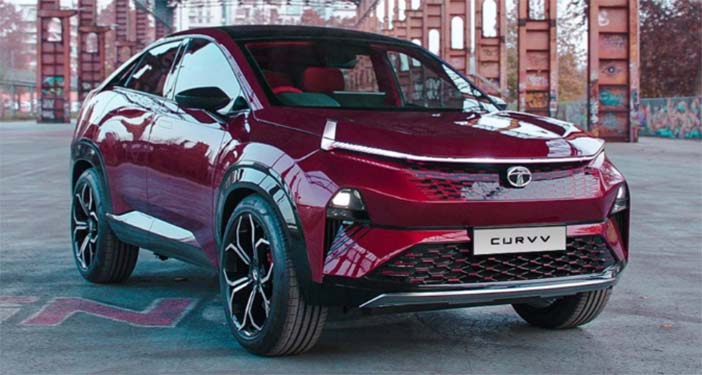
+++ TATA unveiled the production version of the Curvv. The coupe-SUV will be available in both EV and ICE forms, with the market launch in India scheduled for August. The Tata Curvv concept was introduced in EV form in April 2022, with the ICE-powered equivalent following in January 2023. The production versions look very similar, with only a few toned-down features. The highlight is the sloping roofline, making it look like a cut-price BMW X6. Notable changes include the redesigned full-LED headlights above a slightly tweaked grille, bringing the Curvv more in line with other Tata models. The SUV also received conventional mirrors, smaller wheels, and a more discreet rear spoiler, while retaining the flush door handles. The main differentiation point between the EV and ICE models is the grille-less look, bumper-mounted charging port, and EV badges of the former, as the sheet metal on the profile and tail appears to be identical. The electric version also gets a different set of alloy wheels for better aerodynamics. Tata didn’t publish photos of the interior, but the dashboard is carried over from the Nexon, including a 12.3-inch infotainment, a 10.25-inch digital instrument cluster, and touch-sensitive controls. Curvv buyers will also get to choose between different interior colours and accents. The Curvv is based on Tata’s Gen 2 architecture and is expected to share its powertrain options with the Nexon subcompact SUV. The company didn’t get into specifics at this point, but the ICE-powered Curvv is expected to be offered with a turbo 1.2-liter petrol engine and possibly a 1.5-liter diesel in the future. On the other hand, the EV will reportedly be available with 2 battery options, offering up to a claimed 500 km of range. The detailed technical specifications of the Tata Curvv will be announced on its formal debut on August 7, along with pricing for the Indian market. +++
+++ TESLA ’s 4680 battery cells were supposed to revolutionize the company’s EVs, cutting costs, providing more range, and benefiting from improved charging. However, Elon Musk could be getting ready to throw in the towel and give up on them, according to a new report. One of the key advancements of the 4680 cell is the use of a dry coating on the cathode. This eliminates the wet coating method and was expected to be a significant contributor to the cells’ enhanced performance. While Tesla has successfully implemented this process on the anode, it hasn’t done so on the cathode, meaning the cells have yet to reach their claimed full potential. As it stands, the Tesla Cybertruck is the only model from the automaker currently using the new battery cell. Briefly, the Model Y manufactured at the Texas Gigafactory also used these cells. Elon Musk instructed the team behind the 4680 cell that costs need to be cut and that scale needs to ramp up by the end of the year. Additionally, the cells are said to be prone to collapsing on themselves while in use and that’s something Musk also wants remedied. 2 unnamed sources claim Tesla might abandon efforts to scale production of the 4680 cell if engineers cannot resolve the issues by the end of the year. Tesla announced the new cells in 2020, stating they would be key to building a $25,000 EV for the masses. However, it now appears the company did not anticipate the development issues that have arisen. Reports about hurdles in mastering the new cells first emerged late last year. Producing batteries at scale generates a lot of heat, which could melt the glue of the dry coating on the cathode. As of December, Tesla was also thought to be struggling to ramp up electrode production but retains the ambition to have eight lines producing 4680 cells by the end of 2024. Curiously, and despite reports about imperfections with the cells, a report from China says that Tesla could start mass-producing the new 4680 cells in the local market by the end of this year. +++
+++ VOLVO ’s EX90 flagship could be delivered to customers without key features such as smart charging, Apple CarPlay and some safety functions, the brand has confirmed. Instead, any missing features will be added “later via an update”, the Swedish car maker has told customers, without confirming a date. European examples are affected and owners been contacted by the firm. This is the latest setback for the brand, which earlier this month refunded some EX30 owners over issues such as screens going black and steering-wheel buttons not responding to cars not charging. Arriving in the European showrooms this October, the US-built EX90 may not be equipped with 2 advanced driver assistance systems (ADAS) that detect hazards at junctions and then automatically apply the brakes. Some lidar features, such as use at night, aren’t expected to make those first examples either and nor will the car’s automatic ability to slow down for corners when using cruise control. Some of the seven-seater’s premium features will also be missing, most notably Apple CarPlay. The infotainment will also use only a dark theme. Smart charging, bi-directional charging and plug and charge (which pays for public charging automatically through an account linked to the car) will not be included at launch too. The car could also drain 3% of battery per 24 hours (up to 72 hours) while parked, Volvo says, but the future update will tweak the core system’s need to run in the background. In response, a Volvo spokesperson told in a statement: “Introducing a new generation of technology comes with inherent challenges and we need additional time in software integration to release a few missing features and functionalities, and prepare for continuous improvement. The EX90 is designed to become better over time, and customers can expect updates and upgrades that will improve functionality and add features to their car”. They added: “Customer satisfaction and product quality remain our top priorities as we start deliveries of our new fully electric flagship SUV”. Speaking to journalists today, Volvo CEO Jim Rowan downplayed the delays. “The whole point of a software-defined vehicle that has over-the-air update capabilities is to continually upgrade that software. We can do that”, he said. “I think that customers who invest in advanced technology products like the EX90 understand this fully and they will reap the benefits over time”. +++
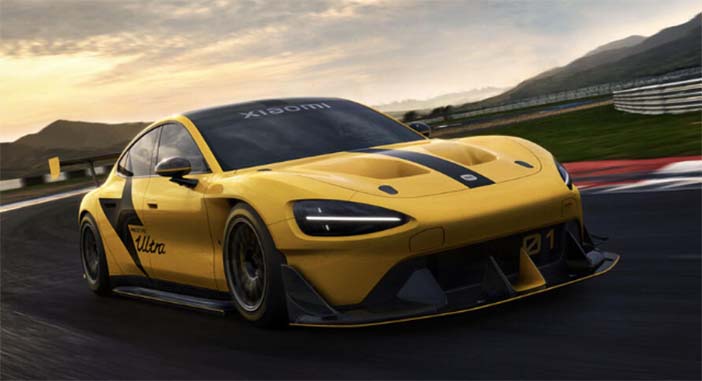
+++ Chinese phone maker XIAOMI has unveiled a track-focused version of its first car, the SU7 super-saloon, which packs 448 hp more than the Porsche Taycan Turbo GT. Named the SU7 Ultra, it has been designed to challenge for the lap record for series-production electric cars at the Nürburgring Nordschleife, aiming to beat the Taycan Turbo GT’s 7 minutes 5.55 seconds. To that end, the SU7’s rear axle has been fitted with a pair of Xiaomi’s new ‘V8s’ electric motors, each putting out 585 hp and 620 Nm of torque. Up front is an uprated version of the firm’s more compact ‘V6s’ unit, giving a total combined output of 1540 hp; 450 hp more than the Turbo GT. Xiaomi claims the Ultra will achieve 0-100 kph in 1.97 seconds and a top speed north of 335 kph. It also gets uprated AP Racing brakes and sticky Pirelli P Zero rubber, giving a 100-0 kph braking distance of 25 meter. A touring-car-like carbonfibre bodykit is said to generate 2.145 kg of downforce, doubtless improving the cornering performance of the 1.900 kg saloon. The prototype, pictured here, will challenge the non-production EV record at the Nürburgring (6min 5.336sec, set by the Volkswagen ID R) in October. An attempt by the production-ready SU7 Ultra will follow next year. Xiaomi’s first car into has sent ripples through the global automotive industry. Reports of crowds queuing outside the company’s shops circulated at the car’s launch earlier this year and Xiaomi claimed to have taken 50.000 deposits within the first 30 minutes of order books opening. Renault Group chief Luca de Meo hinted at the impression made by the Chinese firm. Although he did not strictly confirm Xiaomi was the subject of discussion, he said: “In China, creative genius exists. Some cars are useless, but some are amazing. I met a guy whose company had just built his first car, a Porsche Taycan rival. He admitted he started the project with no passion for cars; he’d been making mobile phones. But he tested more than 70 cars to get his product right. I tried it and couldn’t find one mistake. He was getting ready to sell it for €35,000! What do you say to a guy like that? Do you tell him not to sell it? Of course not. I say well done, or ‘chapeau’ as the French say”. Xiaomi said it had already delivered 30.000 cars as of 19 July, prompting it to up production. It aims to have sold 100.000 by November. +++