
+++ Mitsubishi will join the Honda – Nissan ALLIANCE . The tie-up, whose members sell more than 8 million vehicles worldwide, will consolidate the domestic market into 2 forces: the Toyota Motor Group and the Honda-Nissan-Mitsubishi alliance. Tesla and Chinese automakers are investing heavily in electric vehicles (EVs), and Japanese automakers can’t compete in terms of scale and supply chain. The major shift in the auto industry will drive a major reorganization including other sectors in Japan. Honda and Nissan announced a comprehensive cooperation agreement in March, but no decision had been made on what to do with Mitsubishi, in which Nissan holds a 34.01% stake. Mitsubishi will join the framework of the Honda-Nissan alliance and the 3 companies will work together to enhance their competitiveness in order to survive in the highly competitive market. Mitsubishi signed a nondisclosure agreement with Honda and Nissan and began discussions. Honda and Nissan are the second and third largest automakers in Japan, respectively, with global sales of 4.1 million and 3.44 million units in the fiscal year ending March 2024. When Mitsubishi’s 810.000 units are added, the group will have sales of 8.35 million vehicles. Toyota, the largest automaker, has been making alliances in Japan. It has formed a tie-up with Daihatsu, Suzuki, Subaru, Mazda and Hino Motors, bringing the five automakers’ combined sales volume to 16 million units. Mitsubishi Motors will work with Honda and Nissan to finalize specific details of the alliance. The 3 companies intend to standardize the in-vehicle software that controls the vehicle. Nissan and Honda are expected to jointly develop the basic software, and will discuss its use in Mitsubishi vehicles. In-vehicle software can be updated using a bidirectional communication function between the vehicle and the outside world to improve performance even after the vehicle is sold. This will affect the competitiveness of next-generation vehicles, but it will cost an enormous amount of money to develop. The company will introduce high-performance technology while keeping costs down and redirecting management resources to other electrification-related fields. The companies will also consider complementing each other’s vehicle line-ups. Honda does not manufacture plug-in hybrid vehicles (PHV) or pickup trucks in Japan. Mitsubishi, which has strength in this field, will discuss OEM (original equipment manufacturing) supply. In the future, the 2 companies will also seek collaboration in the area of mini vehicles. Behind the alliance between Honda, Nissan and Mitsubishi is a sense of crisis over a major shift in the auto industry, which is said to occur only once every 100 years. As the shift from engine-powered vehicles to EVs continues amid decarbonization, Japanese automakers are lagging behind due to the rise of emerging powers. In 2023, Nissan and Honda sold only 140.000 and 19.000 EVs worldwide, respectively, while Tesla and BYD were far ahead with 1.8 million and 1.57 million units, respectively. In China, the world’s largest car market, Honda and Nissan were forced to change their expansion path as they struggled against the low-priced EVs of the local market. +++
+++ FORD reported a dip in second-quarter adjusted profit on Wednesday as the automaker continues to battle costly quality issues and an EV business that is weighing on its bottom line, sending shares tumbling 12% in after-hours trading. The Detroit automaker earned an adjusted profit of 47 cents per share, significantly missing analysts’ expectations of 68 cents, according to LSEG data. Ford CEO Jim Farley has made fixing the automaker’s quality problems a priority since he took the helm in October 2020. Since then, Ford has hired a new executive director of quality and transformed some of its production practices to avoid errors, but has still topped the industry in number of recalls. Ford’s chief financial officer, John Lawler, said most of these warranty expenses were related to older vehicles launched before 2021. Warranty expenses went up $800 million in the second quarter compared with the previous quarter, Lawler told reporters. The CFO said field service actions in the quarter were a one-time cost increase for the older vehicles and Ford expects the second half of year to match its warranty cost expectations. The carmaker maintained its projected annual guidance of $10 billion to $12 billion in earnings before interest and taxes. Legacy automakers have scaled down their EV ambitions amid easing demand, a shift to hybrids and stiff competition from Tesla and Chinese EV makers in global markets. Earlier this month it shifted plans for a Canadian assembly plant that was expected to build a 3-row EV, instead saying it would produce Ford’s flagship F-150 pickups. Farley said the company was struggling to meet soaring demand for the gas guzzlers. On the battery-powered front, Farley is directing the company’s efforts to ramping up hybrid production as well as developing a platform for a lin-eup of affordable, smaller electric vehicles, which Ford is doing out of its California-based “skunk works” team. Ford recorded a $1.1 billion operating loss for its electric-vehicle and software division in the second quarter, adding to its $1.3 billion loss from the first quarter. Executives expect this section of the company to sustain a pre-tax loss of up to $5.5 billion for the year. Crosstown rival General Motors reported second-quarter profit and revenue on Tuesday that beat Wall Street’s expectations, buoyed by strong pricing and demand for petrol-powered trucks. The company raised its annual forecast for the second time this year. Tesla on Tuesday also reported a second quarter profit that was down from the same period last year. +++
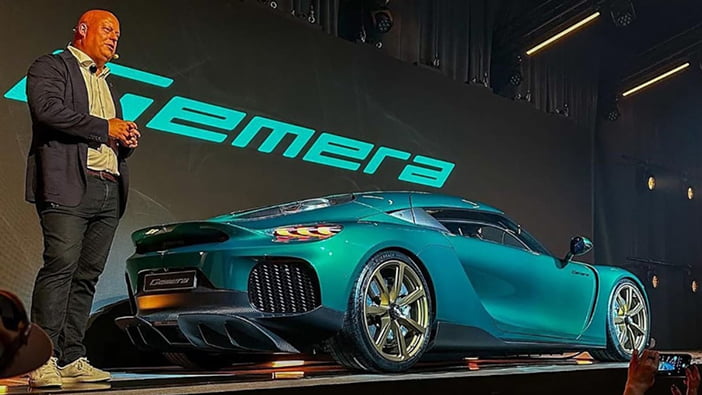
+++ It’s been more than 4 years since KOENIGSEGG debuted the Jesko and Gemera just ahead of the 2020 Geneva Motor Show. The Gemera was the first home for a few of Koenigsegg’s pet projects, a hybrid powertrain based around a twin-turbocharged 2.0-liter 3-cylinder dubbed the Tiny Friendly Giant (TFG). The engine featured cam-less Freevalve technology and was assisted by 3 electric motors. The Swedes claimed a combined 1.676 horsepower and 3.400 Nm of torque (592 hp and 600 Nm) and a 0-to-100-kph sprint in 1.9 seconds. Those 3 e-motors, one on the crankshaft and two at the rear, helped deliver all-wheel drive, all-wheel torque vectoring, and all-wheel steering. And it’s all gone. Not the Gemera, but the Tiny Friendly Giant. 2 years after the Gemera appeared, Christian announced that the automaker found a way to fit the Jesko’s twin-turbocharged 5.0-liter V8 into the Gemera’s tighter bay. Once that happened, Koenigsegg said most customers switched to the V8; reportedly a $400.000 option. “There were so few left that asked for a 3-cylinder”, he said, “we managed to convince almost all of them to go for the V8 instead. So for the time being, it the Gemera is V8 only”. We could frame this as conservative buyers rejecting ingenious novelty, but that wouldn’t be true. This is buyers giving up one ingenious novelty for another ingenious novelty with more familiar bragging rights. See, to get the Jesko’s V8 to work, Koenigsegg engineers redesigned the castings, heads, intake, exhaust and sump. They shelved the direct-drive transmission from the Regera they’d originally fitted, and created what they call the Light Speed Tourbillon Transmission (LSTT). This was an evolution of the nine-speed direct-drive Light Speed Transmission developed for the Jesko, but smaller, lighter, better. Then the whitecoats created a new 6-phase e-motor to replace the original trio of 3-phase Quark e-motors that had been paired with the TFG. This 1 motor to rule them all is called Dark Matter, designed as a blend of radial flux and axial flux topologies called “raxial”. In the original powertrain, 2 of the Quark motors on the rear axle could each make a maximum 500 hp and 1.000 Nm of torque, the third Quark on the crankshaft made 400 hp and 500 Nm. Their combined output when working together rang in at 1.100 hp. The Dark Matter makes 800 hp and 1.250 Nm. Pairing a single Dark Matter with the LSTT makes the TFG powertrain lighter and smaller again, after the transmission gains, further improving acceleration and performance. New control logic means the Dark Matter can drive the Gemera on its own, the TFG can power the car, or both can be called to action. And the fastback sedan retains its all-wheel drive, 4-wheel steering and 4-wheel torque vectoring. With the hybridized V8, final output comes to 2.268 hp and 2.700 Nm of torque; 600 more horses but 700 Nm fewer torque than with the TFG. So we can’t be mad at buyers. I would love to see Koenigsegg fit 2 Gemeras with these respective powertrains to gauge performance. One day, it might happen, Christian telling TG the TFG tech “is still interesting, we’re still working on it…. We might eventually do it in the Gemera one day in some version, but it just took over with the V8. I understand that”. +++
+++ Toyota Motor plans to build a battery plant for electric vehicles in the southwestern prefecture of Fukuoka and supply its batteries to a factory that makes luxury LEXUS brand cars. The world’s top-selling automaker would seek to make the island of Kyushu where Fukuoka is located a central part of its supply chain for battery-powered vehicles and an export base for Asia. Toyota has been taking various initiatives to strengthen its EV battery production capacity. Toyota makes Lexus vehicles at the Miyata plant of its subsidiary Toyota Motor Kyushu. The automaker has previously said it will introduce EVs employing next-generation batteries globally from 2026, manufactured by its EV-focused unit BEV Factory. The company is targeting sales of 3.5 million EVs annually by 2030, with just under half of those made by the BEV Factory unit. It sold 104.000 EVs in 2023. The amount Toyota would spend on the battery plant and the start date for its construction have yet to be finalised. The plant will be operated by Primearth EV Energy, another Toyota subsidiary that specialises in making batteries for hybrids, plug-in hybrids and purely battery-powered vehicles. +++
+++ LOTUS could push back the launch of its long-awaited Type 135 electric sports car until smaller, lighter batteries become available, so it can be as close in spirit to the Elise as possible. According to the most recent scheduling, the Type 135 was due on sale in 2027 at an estimated Dutch price of €90.000 as a replacement for the petrol-powered Emira. While that is still the target, Lotus Group design boss Ben Payne has hinted it could be held back until next-generation EV technology comes on stream. Payne said that launching the electric 2-seater remains important because “the Elise is the go-to touchpoint for Lotus”. But the packaging constraints of current EV hardware would not allow the firm to stay true to the principles that defined the original car. “The technology right now does not really allow you to recreate that product in a convincing way”, said Payne, referring to the generally taller silhouettes and higher kerb weights of today’s EVs that are a product of their underfloor batteries. “The archetype of the moment is the larger, higher product, because you can very simplistically package the required technical elements into that size of vehicle more easily”, he continued. Lotus’s first electric cars (the Emeya and the Eletre) are significantly larger and heavier than any of its combustion-engined cars. That makes it difficult, suggested Payne, for any sports car produced using the same hardware to ape the characteristics of the original Elise, which embodied the purist view of a British sports car. Payne added: “It’s fun to drive, super-engaging, very connected; just an utterly appealing driver’s product”. Lotus has previously revealed a dedicated lightweight architecture for future electric sports cars, beginning with the Type 135. Dubbed ‘E-Sports’, it features a rear subframe structure that is said to be 37% lighter than that of the petrol-powered Emira and designed to allow the batteries to be stacked in the middle of the chassis. That arrangement would allow an electric Lotus sports car to sit as close to the ground as the Elise and have its mass centralised for optimal dynamics. However, Payne suggested the advent of lighter, more compact battery technology would allow the firm to bring the car to fruition. Asked whether solid-state batteries (which are far more energy dense and thus smaller and lighter than today’s conventional technologies) could facilitate the compact silhouette and low weight of a driver-focused sports car, Payne said: “They do. The physical size shrinking, and inevitably the mass coming down, allows you to go back to the core values. For a brand like Lotus, being able to reduce everything to the minimum and then shrink wrap the car around it is the core philosophy of founder Colin Chapman”. British engineering firm Nyobolt has recently showcased high-density battery tech in a concept based on the original Elise. It has a 35 kWh battery pack but weighs just 1.246 kg and is no larger than the original car. Payne refused to confirm whether the car’s planned 2027 launch could be delayed but said: “These things need to dovetail in the right way”. He added it would be “100%” possible to ready the car by 2027, but “you need to look at the business level factors on top of that. It’s a difficult job”. +++
+++ MASERATI posted disappointing sales and revenue figures shortly after Stellantis CEO Carlos Tavares warned that the group can’t afford to have brands that don’t make money. While nothing is set in stone, one of the group’s executives said that selling the brand isn’t off the table. Maserati sold approximately 6.500 cars globally between January and June 2024, down from around 15.300 units during the same time period in 2023. It posted an adjusted operating loss of €82 million during the first 6 months of the year, compared to a profit of €121 million in 2023. “The first half has been disappointing”, admitted Natalie Knight, the chief financial officer at Stellantis, on a call with journalists. She pointed out that the drop can be partially attributed to Maserati discontinuing three models: the Ghibli and the Quattroporte retired in late 2023, and production of the Levante ended earlier in 2024. This leaves the brand with the Grecale, the MC20, the MC20 Cielo, the GranTurismo and the GranCabrio. Of the bunch, only the Grecale can be expected to generate volume, and European sales dropped by about 42%. New models are in the pipeline, but they’re not exactly around the corner. What that means for the Italian brand is up in the air. It’s planning on replacing the Levante with an electric model tentatively due out in 2027, and the next Quattroporte will get electric power as well when it lands in 2028. Both models have already been delayed, and the publication learned from insiders that the timing might get switched around; the next Quattroporte could end up arriving before the next Levante. “The future is about how we maintain best value. There could be some point in the future when we look at what’s the best home for Maserati”, Knight said. Her comments hint that a sale, while not confirmed, isn’t unthinkable. +++
+++ MAZDA may soon be updating its logo, or at least adding a new version of it. On Monday the company entered a trademark application to the Japan Patent Office showing a new design for its “flying M” badge. The logo was granted a trademark in Japan, and appears to be a flattened version of its current logo. The 2D look is trending these days, as 3D badges make way for logos projected onto screens. A recent concept has already used a 2D version of the current crest. The Arata concept, unveiled in China and which looks like a next-gen electric CX-5, uses an illuminated logo on a solid panel where a traditional 3D logo and grille would be. 2D-logos are preferred in tech, where its appearance on a screen takes priority over a physical badge. Skeuomorphic design, which translates a traditional 3D emblem into a 2D image, can present its own problems because fake highlights and shadows must be designed into the flat likeness. However, the result can look a bit plain to those accustomed to traditional badges. Mazda is just the latest company to simply and flatten its logo. Mini, Volkswagen, GM, Nissan and Honda have all altered their logos in recent years to go from a 3D symbol to an anti-skeuomorphic image. Mazda’s plans for the logo aren’t certain yet. It could be EV-only applications, or it may replace the chrome badge throughout the line-up. +++
+++ NISSAN cut planned production by a third at its top Japanese plant this month, a move that will also see it slash output of a flagship crossover model, 2 sources said, as it struggles with weak U.S. demand for its aging line-up. Nissan’s share price was down 3% in trading on Friday. The Japanese automaker on Thursday reported an almost complete wipe out in April to June profit and cut its full-year outlook after it was forced to offer deep discounts in the U.S., highlighting the deepening risk it faces in its largest market. Unlike rivals Toyota and Honda, Nissan doesn’t offer hybrid models in the U.S. and therefore hasn’t benefitted from recent upswing in demand from U.S. consumers for hybrids as enthusiasm around EVs has cooled. The car maker now plans to produce just under 25.000 vehicles at its Kyushu plant in southwest Japan this month, according to 2 people with knowledge of the situation. Both declined to be identified because the information isn’t public. Nissan was not immediately able to comment, a spokesperson said. The company expects to make around 10.000 of the X-Trail for export at the plant, half of what it had previously planned to make this month of the popular car, the sources said. In addition to Kyushu, Nissan also makes the X-Trail in Smyrna, Tennessee. Line workers in Kyushu were now working fewer than the usual 8 hours a day due to the scaled-back production, and were clocking a little more than seven hours a day, one of the people said. Nissan had been left with a build-up of 2023 models of the Rogue in the US, and those were getting harder to sell with the roll-out of the 2024 model, a second person said. It had to offer aggressive incentives to clear out the 2023 model, while holding back on aggressive promotion of the higher-margin 2024, the person said. Nissan said in March it would launch 30 new models over the next three years and aimed to raise its global sales by 1 million vehicles while cutting costs to improve profitability. In 2023 it sold around 3.4 million vehicles globally, up 5% from a year earlier. The target may now be a stretch, said Seiji Sugiura, an analyst at Tokai Tokyo Intelligence Laboratory. “Even if Nissan tries to sell luxury or expensive cars, it doesn’t have that kind of brand power in the United States. You can see that when you look at the prices of used cars”, he said. “They have to give discounts, they have to sell with incentives”. Although Nissan sells 2 electric vehicles in the US, it has been caught out by not offering hybrids in that market, betting instead that U.S. consumers would be interested in gasoline-powered cars or EVs. That is likely to continue to weigh. “The overall U.S. market is seeing a shift in demand toward hybrids”, analysts at Goldman Sachs wrote in a note to clients, adding Nissan’s hybrid launch wasn’t expected in the U.S. until 2026. Nissan has said that of its 30 planned new models, 16 would be electrified, including 8 EVs and 4 plug-in hybrids. CEO Makoto Uchida told a briefing on Thursday the company would look to strengthen its line-up in North America, including with plug-in hybrids, but declined to give specific timing. It will be “some time” before the stock market factors in the company’s envisioned margin expansion based on new models, Goldman Sachs said. Globally, Nissan’s inventory now stands at 640.000 vehicles, the highest level in more than 4 years. The state of its U.S. business marks another complication for an automaker that is already dealing with years of shrinking market share in China. The U.S. and China are Nissan’s two biggest markets, and the rise of powerful new players in China like BYD could mean the Japanese automaker ends up being even more dependent on the US as prospects in China shrink. +++
+++ STELLANTIS is ready to “fight” for its place in Europe’s electric vehicle market against strong competition from Chinese carmakers, its CEO Carlos Tavares said, as the group presented its new EV production line in Serbia. “We are going to be challenged and I would say brutally challenged by the Chinese offensive on the European market”, Tavares said. “At Stellantis we are ready for the fight. We are going to demonstrate to them that we are hard-working, we are going to demonstrate to them that we have the right technology, we are going to demonstrate to them that we are a very fierce competitor”, he said. Serbia, which is pushing to become a key European supplier of more sustainable row materials, batteries and electric vehicles, signed a 190 million euro deal with Stellantis in 2022 for the production of an electric vehicle at its car manufacturing plant in Kragujevac. The plant is seen as a generator of growth for the entire region. “This is a huge opportunity for us. We are the only country in the Western Balkan region that has electric car production”, Serbian president Aleksandar Vucic said at a ceremony to present the new production line. As part of its drive towards more sustainable economy, Serbia has reinstated a license for Rio Tinto to develop Europe’s biggest lithium mine in a potential boost to the continent’s electric vehicle industry and. It is eyeing annual lithium output of 58.000 tons, enough for about 1.1 million electric vehicles or about 17% of the European market. +++
+++ TOYOTA chairman Akio Toyoda said he may not be reelected as a director if shareholder support for him continues to fall at the pace it did this year, according to an interview published on Monday. Shareholder backing for Toyoda slid to 72% at the company’s annual general meeting last month, following proxy advisers’ recommendations to vote against his re-election. That compares to the support of 85% in 2023. Last month’s result marked the lowest support rating ever for a director in Toyota’s history, the 68-year-old grandson of the company’s founder said in an interview by the automaker’s own news outlet. “If it continues at this pace, I can’t be a director next year”, Toyoda said. His support rating among foreign institutional investors was particularly weak at 34%. Ahead of the meeting, proxy advisers Institutional Shareholder Services (ISS) and Glass Lewis both took issue with the way Toyota has dealt with certification testing violations. Toyoda’s support among domestic institutional investors stood at around 55%, compared to 70% or more in the previous year. That indicated half of them were asking him to step down because of his behaviour over the past year, Toyoda said during the interview. The weaker support among institutional investors contrasted sharply with a nearly 99% approval rating among retail investors. +++