
+++ 3 electric vehicle makers from CHINA hit record sales numbers at the end of June, which could spell trouble for Tesla. China’s biggest EV manufacturer, BYD, sold nearly 1 million electric and hybrid cars in the second quarter of the year. Nio said it delivered over 57.000 vehicles (a 144% year-over-year rise) during the same period. Geely Automotive-owned Zeekr, which listed in the US in May, had a record June with over 20.000 deliveries; an 89% year-on-year increase. Despite concerns about tariffs from the U.S. and European Union, sales for the 3 producers were boosted by price cuts, the introduction of cheaper models and Chinese EV demand from Russia, where Western competitors exited. These numbers may make Tesla, and its once-dismissive-of-Chinese-com
+++ INEOS is the latest carmaker to delay the launch of an electric model. Citing a drop in demand for EVs and tariffs-related concerns, the British company announced that the Fusilier it unveiled in 2024 as a smaller alternative to the Grenadier won’t enter production in 2027 as planned. “We are delaying the launch of the Ineos Fusilier for 2 reasons: reluctant consumer uptake of EVs and industry uncertainty around tariffs, timings, and taxation. There needs to be long-term clarity from policymakers”, the company told. It didn’t provide a new timeline, so it’s too early to tell when the SUV will launch. While technical specifications weren’t announced during the unveiling, Ineos said it planned to offer 2 variants of the Fusilier: an electric model and a version powered by a plug-in hybrid drivetrain that relies on a small, gasoline-burning engine as a range extender. There’s no word yet on whether both drivetrains have been delayed, or if the plug-in model will enter production by the end of 2027 as expected. As of writing, Ineos has only shown the Fusilier as a design mock-up and as a series of computer-generated images; the model features rugged styling and looks like a scaled-down Grenadier. It sounds like the EV was delayed relatively early in the development process. Austrian engineering firm and contract manufacturer Magna had already been enlisted to help design and build the SUV, however. This is the same company that makes the Grenadier. It also builds the Mercedes-Benz G-Class and the Toyota Supra, among other models. Ineos should provide more details about what the future holds for the Fusilier project in the coming months. In the meantime, the brand has started building its first pickup, the Grenadier-based Quartermaster, in the Hambach, France, factory that used to make the Smart car. The unstable EV market and a tariffs war have forced the majority of carmakers to rejig their launch plans in recent months. Volvo recently delayed the launch of the EX30 on the North American market to 2025 “due to changes in the global automotive landscape”. Nissan stopped developing a pair of electric sedans “until further notice” and postponed a $500 million investment in its Canton, Mississippi, plant meant to turn the facility into an EV hub. Volkswagen’s ID.7 has been indefinitely delayed, Ford delayed 2 EVs and General Motors is delaying additional EV production. +++
+++ One of the most popular talking points from EV evangelists is that they require less maintenance and are cheaper to operate than gas vehicles. The 2024 INITIAL QUALITY STUDY from J.D. Power suggests that might not be the case, however, as EV owners report many more problems than their gas-owning counterparts. The organization rates vehicles based on the number of problems there are per 100 units (PP100). This year, the 38th year of the study, petrol and diesel vehicles averaged 180 PP100, compared to 266 PP100 for EVs and PHEVs.
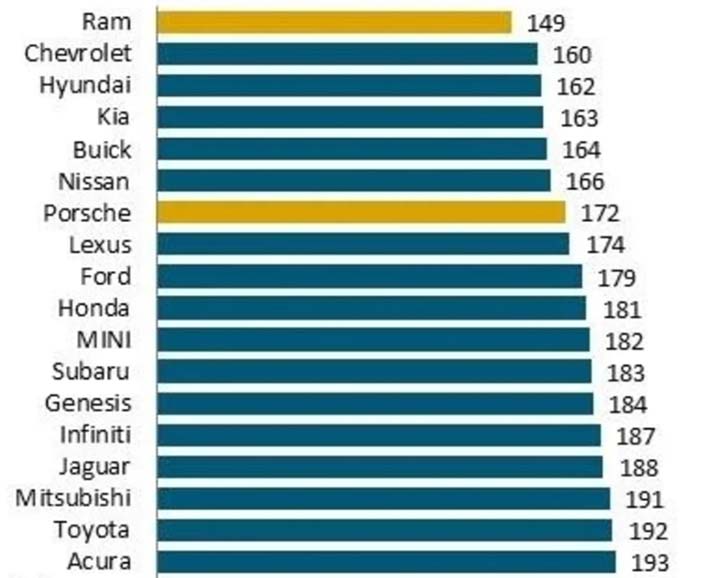
J.D. Power noted that even Tesla, the EV juggernaut, failed to perform well in this year’s study, as its customers report issues with funky turn signals and wiper controls. Ram was the top brand overall for initial quality, and Porsche was the top luxury brand. Electric vehicles often have more advanced tech features than petrol models do, which can complicate the early ownership experience. EVs clocked many more in-vehicle technology problems than similar petrol vehicles, with 30 percent more problems reported for things like controls, infotainment, and more. Other issues caused problems for both petrol and electric vehicle owners. Advanced driver assistance systems (ADAS) can cause false warnings, irritating drivers and causing stress unnecessarily. Rear-seat reminders, which sound an alert to check for pets, kids, and other items, added 1.7 PP100 to vehicle scores across the survey, and some owners reported thinking that the reminders related to seatbelts, not forgotten back-seat passengers. Additionally, Apple CarPlay and Android Auto (2 of the most popular new-vehicle features) were in the top-10 problems for new vehicle owners. Buyers said they’d had difficulties connecting their phones or keeping them connected, a significant issue when more than half of Apple users and 42 percent of Samsung users said they used the technologies.
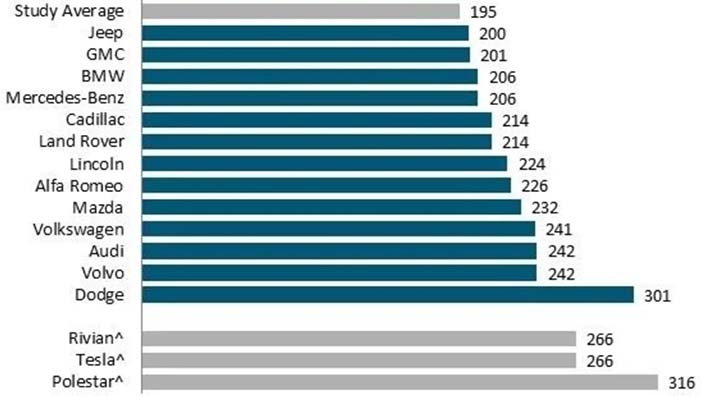
While the survey illustrates that EVs are not problem-free, it shouldn’t be taken as an indication that the electric powertrain is the cause of the somewhat negative responses. Automakers pack electric models with the latest tech and go over-the-top with design and ergonomics to make them feel more futuristic and appealing, which can complicate the ownership experience. The trend shows no signs of slowing down, but J.D. Power’s study showed that it might be a good idea for automakers to pump the brakes a bit. +++
+++ MCLAREN ’s on-again, off-again SUV is happening. It’s referred to as a “shared performance vehicle” internally, and the sharing might not be limited to the cabin. McLaren confirmed it’s open to collaborating with another brand, such as BMW, to plant its stake in the SUV segment. The project remains at the embryonic stage of development, and it sounds like not much is set in stone at this point. Piers Scott, the head of global communications for McLaren’s automotive division, told that executives are still “exploring a wide variety of different options” for the car. One of the questions that haven’t been answered yet is the body style: it could have either 2 or 4 doors. McLaren CEO Michael Leiters previously indicated that his team could join forces with another carmaker instead of developing a platform from scratch, and his comment spawned a long string of rumours. Could it be Tesla? Could it be Lucid? No, and no; Scott revealed that BMW is one of the contenders. While this is pure speculation, the German firm’s CLAR platform is modular enough to accommodate anything from a relatively compact model such as the 2 Series to a big SUV like the X7. Clearly, there’s potential for McLaren to build something on it. Powertrain details remain under wraps as well, and this point will influence the platform. BMW builds EVs, hybrids, and non-electrified cars on its CLAR architecture. Scott added that, if McLaren decides to make its SUV purely electric, the platform could come from an unnamed partner in Southeast Asia. That’s unlikely to be the case, however, as Scott told that McLaren sees “no market interest” in an electric SUV with a price tag that hovers around $500.000. He expects this will change later in the 2020s as battery technology advances. The idea isn’t to take, say, the BMW XM and re-skin in into something that merely looks like a McLaren. The model would likely feature a brand-specific chassis setup plus a host of changes to keep weight and structural rigidity in check. It will need to feel and drive like a true McLaren. The idea is to make something along the lines of the Ferrari Purosangue, not a higher-volume model like the Lamborghini Urus. McLaren hopes to find a platform for its SUV by the end of 2024, according to the report. Until then, the brand has a lot on its plate: It will start to deliver the 2025 Artura Spider in the coming months, and it’s allegedly working on a long-awaited successor to the P1 hypercar. +++
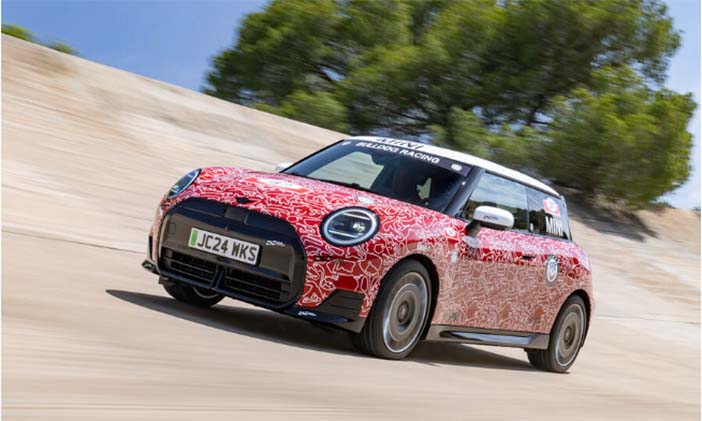
+++ MINI will showcase the EV future of its John Cooper Works programme at next week’s Goodwood Festival of Speed with the new Mini Cooper JCW E. A camouflaged version of the electric hot hatch will run up Goodwood’s famed hillclimb. The JCW E is said to feature an “advanced electric powertrain”, suggesting it will pack more power than the 218 hp Mini Cooper SE. Further technical details are expected to be revealed at the event, which comes after a prototype petrol-engined Cooper JCW won its class in the recent Nürburgring 24 Hour race, also wearing camouflage. Mini product line boss Stefan Flöck previously told that the JCW E would be engineered to offer similar performance to its ICE counterpart. For reference, the Cooper SE dispatches the 0-100 kph sprint in 6.7 seconds and the previous-generation petrol JCW did it in 6.1 seconds. Flöck implied that the JCW E would remain front-wheel-drive with a single motor, saying: “The most important thing when it’s a front-driven car is that on one side you have a big benefit, because the centre of gravity is lower, because you have the battery in the bottom”. Although he said that the Cooper EV platform could accept dual-motor powertrains, it hadn’t yet been confirmed which powertrain the hot hatch would use. Flöck added that Mini had worked to develop the “go-kart feeling” that defines the British brand. “You also have a good balance with the weight balance in the front and back of the cars”, he said. “So the genes (a low centre of gravity and 50/50 weight balance) is better for driving dynamics. “On the other side, you have a bit higher weight. So to deal with the higher weight, it’s a question of tyres for driving dynamics. So we will put different tyres on the car to handle this, which are a bigger diameter”. The JCW E will be unveiled in full this autumn. +++
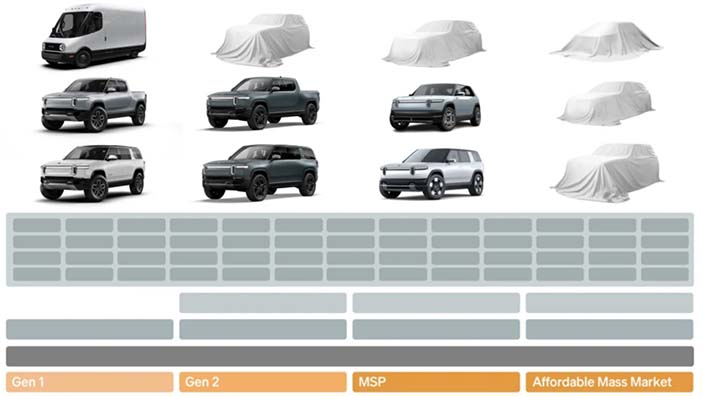
+++ RIVIAN will soon receive a $5 billion investment from the Volkswagen Group, and it already knows what it’s going to do with the money. The company announced plans to launch 5 new or updated electric models in the coming years, including 3 so-called mass-market cars. The announcement was included in a slideshow that Rivian put together for investors. It lumps the brand’s models into 4 categories: Gen 1, Gen 2, MSP and Affordable Mass Market. We already know the Gen 1 cars: they’re the R1T, the R1S, and the electric panel van that Amazon has been using to deliver parcels for the past couple of years. Gen 2 refers to the recently-updated variants of the R1T and the R1S as well as a mysterious third model shown as a silhouette under a sheet. Is the sheet hiding a refreshed version of the delivery van? It’s certainly possible. I don’t think the silhouette corresponds to the body style because the exact same shape appears in another column. MSP stands for “midsize platform”, which is the new architecture that will underpin the R2, the R3 and the R3X. These 3 EVs were introduced earlier in 2024, though they’re still a few years away from reaching production. The chart also suggests that Rivian will build a third model on the MSP architecture. Here again, we have no idea what we’re looking at. Maybe a small truck positioned below the R1T? Finally, the third column shows 3 cloaked vehicles that will presumably slot at the bottom of the Rivian range. No details are available, and the term “affordable” is highly relative (especially when we’re talking about EVs), but keep in mind the upcoming R2 will start at roughly $45,000. That means the R3 will be cheaper than that, and the entry-level cars should cost even less. We might need to wait a while to see them, however. R2 deliveries won’t start until the first half of 2026; the R3 will come after, though no timing has been announced. The entry-level cars will presumably be the last to hit the road. Expect more details about Rivian’s future range to emerge in the coming years. +++
+++ SMART could start building electric cars in Europe in a bid for increased efficiencies as it ramps up its global expansion plans and fleshes out its line-up. After production of the Fortwo ended earlier this year at Ineos’s factory in Hambach, France, Smart now builds all its cars in Xi’an, China. But with sales increasing in other markets and the increased costs of exporting worldwide, the brand is considering localised production in other territories to better cater to demand, with the added benefit of avoiding the EU’s new tariffs on Chinese EVs. Smart Europe CEO Dirk Adelmann told that the brand being co-owned by Mercedes-Benz and Geely gives it potential flexibility to globalise its operations: “We have a parent company based in Germany with production basically all over the world, but also Geely with other daughter companies has production in Europe and other places in the world”. He said building locally is “a good idea, if the cost structure is comparable to the cost structure you already have”, and that with Smart entering new international markets “comes the need to at least think about a diversified production footprint, but nothing is decided yet”. +++
+++ It turns out there’s an asterisk to the news of VOLVO commencing production of the EX90 at its South Carolina plant this month. The automaker sent an e-mail to customers awaiting delivery that certain features won’t be installed on some delivered units, and posted a notice on its customer help site listing the 10 features that could be missing. Four are safety and ADAS features, one of those related to the lidar system, one of Volvo’s primary talking points concerning the EX90. The automaker says the “Lidar first safety scenario” will get an “update that increases the car’s abilities, even in darkness, and emergency steering is primed if needed to avoid a collision”. It sounds like this means there will be some lidar capability, just not the planned breadth. Four more items deal with the battery and charging. The most unwelcome might be a battery drainage issue while parked, Volvo saying that for the first three days the EX90 is parked without charging it will lose around 3% of battery charge. This is because the core computing system needs to remain on to run the car’s “highly advanced functions” (whatever that means) when the SUV isn’t being used. After 72 hours, the EX90 “will go into a deep sleep mode to conserve battery power”. Why can’t the EX90 enter a deep sleep mode an hour after the car is parked? Because software is hard. Smart charging and Plug & Charge could also be lacking, those features making charging less costly or more convenient without extra steps needed from the driver. Bi-directional charging won’t come at first, either, so EX90 buyers should hold on to those portable battery banks. The 2 final software puzzle pieces are Apple CarPlay, out to lunch for now, and the one we consider most surprising item on the list, a light theme for the driver cluster and infotainment. On delivery, owners should expect a dark theme only on the digital displays. EX90 deliveries aren’t slated to begin until later this year, though, so the OTA list could shrink (or grow) before then. +++
+++ Sales of ZEEKR electric vehicles have shot up in Russia in the last year, putting Chinese carmakers ahead of local competition in Russia’s small but rapidly expanding electric vehicle (EV) sector. Chinese carmakers have already seized more than half of Russia’s car market since Western competitors pulled out, taking their technology and know-how with them, after Moscow sent troops into Ukraine in February 2022. Governments in Europe and the United States are growing increasingly wary of Chinese dominance in the EV sector but Russia, rather than imposing tariffs, is embracing Chinese brands across all automobile sectors to prop up its car industry. From May 2023 to April 2024, more than 20.500 new EVs were sold in Russia, a jump of about 350% on the previous year, with Chinese brands accounting for over half of sales, according to data from the Russian analytical agency Autostat. Russian carmakers sold fewer than 4.000 new EVs in that time, while 1.28 million passenger cars were sold overall. The EV market’s development has been hamstrung by a lack of charging infrastructure across Russia’s vast territory, and Moscow’s traditional reliance on its plentiful oil and gas resources. Still, more EVs sold in the last 12 months than in the entire decade before. Zeekr, a Chinese premium brand, is leading the charge despite having no official representation in Russia, with more than 8.000 cars sold since June last year, according to Irina Frank, head of the Frank-Auto dealership in Moscow. Russians are becoming more interested in EVs as more charging stations are built, consumers understand the savings on fuel, and dealers improve maintenance, Frank said. “In China, more than 30% of people use electric cars. For us it is still less than 2%”, Frank said. “My opinion is that we will reach more than 25% by 2035”. Zeekr’s official entry into the Russian market would boost growth, said Vadim Merzlikin, sales director for a dealership that sells Zeekr models, but macroeconomic factors are also key. “It all depends on purchasing power, competition and the economic situation”, Merzlikin said. Most buyers are wealthier than the average Russian, with premium cars the only widely available category of EV. As many as 40% of EV owners have charging facilities at home, Merzlikin said. The Zeekr X, a compact SUV, is on sale from around 4 million roubles ($46.136), similar to prices in Europe. Russia’s Evolute i-Space, a comparable model made by private firm Motorinvest, costs 3 million roubles. The Moskvich 3e, part of Russia’s attempt to revive and modernise a Soviet-era classic, is just over 3 million roubles. The Lada e-Largus from Russia’s leading carmaker Avtovaz is still in development and likely to be a more affordable option, though prices have not yet been announced. Zeekr is owned by Geely, which also owns the Volvo, Polestar and Lotus brands, and builds its Swedish-designed cars in China. Zeekr listed on the New York Stock Exchange in May with a valuation of around $6.8 billion. In a statement, it said it had not entered the Russian market and had no approved sales network there. “The very few vehicles being seen there is attributable to individual behaviours”, it said. “Zeekr has not deployed any infrastructure such as charging stations, or conducted any other related business in Russia, hence we are unable to provide basic maintenance service, warranty or remote support in Russia for vehicles sold through unapproved channels”. Even with a standoffish approach to Russia, Zeekr is beginning to dominate. Only around 2.000 Evolute EVs and 1.000 Moskvich EVs were sold in the last 12 months. And even the Moskvich, though listed as Russian in the statistics, is actually being assembled in Moscow with kits from a Chinese partner. Maxim Sokolov, head of Avtovaz, in March urged the state to protect the domestic market from all Chinese carmakers, whether electric or fossil fuel-powered. “Chinese brands have conquered our Russian market very quickly”, he said, “replacing the departing Japanese, Koreans, Germans, Americans and French”. China’s share of the Russian market has leapt from less than 10% to more than 50% in the 2 years since the start of the full-blown Ukraine conflict, and prejudice towards Chinese cars is gradually fading. “There are problems, for example, with service”, said Ruslan, the owner of a Chery, China’s most exported brand, who declined to give his surname. “There are not many dealers, there are not many unofficial dealers either, and not all car services know how to work with Chinese cars yet. But I think in 3 to 5 years, everything will be fine”. Citing an Autostat and Auto Mail survey, Merzlikin said 53.1% of Russians were now prepared in principle to buy a Chinese car, up from 6.4% in 2017: “The more Chinese cars are bought, the more ambassadors there are of the Celestial Empire”. +++