+++ AUDI is preparing a fire breathing electric RS6 e-Tron Avant following the recent unveil of its all-new A6 e-Tron. The RS6 e-Tron Avant will arrive in 2025 as the range-topper in the line-up. The design will follow the lead of the outgoing RS6 petrol-powered car in the sense that it’ll wear a much more aggressive bodykit than the standard A6 e-Tron. The RS 6 also features a different front bumper to the S6, and a bespoke headlight signature in the upper cluster. There are also new, RS-exclusive alloys, plus an opening behind the front wheel that looks to be inspired by the new RS6 GT. To the rear we can expect a new bumper design with a faux diffuser. The rear roof spoiler features an indent in the middle, different to the one on the standard A6 e-Tron Avant. The aggressive looks will be backed up by a suitable bump in power. The S6 e-Tron comes with an all-wheel-drive set up from its dual-motor powertrain, providing 550 hp and a 3.9-second 0-100 kph time. We’ve seen the Porsche Macan Turbo Electric (which uses the same PPE platform as the A6 e-Tron) come up with 640 hp for a 3,3 seconds 0-100 kph time, so I’d expect similar for the RS6 e-tron to provide a rival to the 604 hp BMW i5 M60 Touring. Judging from other models that utilise the PPE architecture, such as the Porsche Macan Electric and Audi Q6 e-Tron, the RS6 e-tron Avant’s focus on performance will likely see around a 10 percent decrease in range to around 560 km. While a triple-screen layout is an option in the cabin of the A6 e-tron, the RS6 e-Tron will get this extra technology as standard considering its status as the flagship version. Audi RS models typically get bespoke infotainment, too, with extra settings to make use of their increased performance, and I expect the RS6 e-Tron to be no different in this respect. +++
+++ A while back, one automaker ran commercials saying something like, “The best new cars make the BEST USED CARS ”. That might be hyped-up marketing speak, but there’s logic to the statement. Consumer Reports recently put that thinking to the test with an evaluation of the brands and models that make the best used purchases, and there are few surprises with the top brands. The American publication polled its members to determine the numbers and types of problems they’d had with their vehicles in the previous 12-month period. It focused on cars from 2014 through 2019, and the survey included more than 150.000 vehicles. Consumer Reports then averaged the reliability ratings to create its list of the top brands. Lexus, Toyota and Mazda ranked as the top-3. The top-10 of best used-car brands are: Lexus (75/100 average reliability score), Toyota (72), Mazda (59), Acura (57), Honda (55), Buick (47), BMW (46), Subaru (46), Nissan (45) and Mercedes (43). The survey covered 20 potential problem areas, including minor issues like broken interior trim and significant problems like EV battery replacements and out-of-warranty engine repairs. Top brands like Lexus and Toyota earned their spots with fewer of those problems, and both handily beat the third-place Mazda. Consumer Reports senior automotive data analyst attributes some of that success to the way the Japanese automakers roll out updates. “Brands like Lexus and Toyota have a history of conservative redesigns, incrementally improving their entire product line, rather than introducing many all-new systems. Our data consistently shows over time that cars from those brands are reliable when new, and they continue to be reliable as they age”. On the opposite end of the rankings, Tesla, Dodge and Chrysler landed at 24, 25 and 26 respectively. Some brands’ used reliability rankings differ significantly from their new scores, such as Tesla, which ranks in the middle of the pack for new cars but is way down the list for used reliability. +++
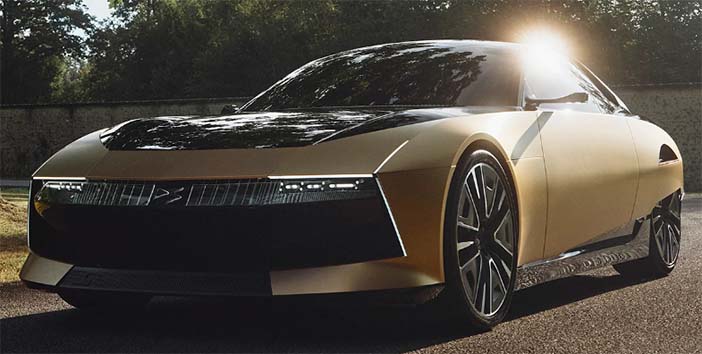
+++ Citroën ’s most iconic machines run a thoroughly broad gamut from the humble 2CV to perhaps the most striking car it ever produced, the Maserati-powered personal luxury coupe called SM. It’s this latter car being revisited by DS , the luxury brand spun off of Citroen with the name of the equally important mid-century Citroen DS. More specifically, it’s being re-revisited, as the company revealed back in 2020 a bunch of renderings its designers put together imagining a modern version. According to the design director of DS, Thierry Metroz, the company received many comments on those designs and learned that people were “very attached to the iconic models from our heritage” and “they didn’t want the original design to be spoilt”. So it took those comments into consideration, and kept playing with the idea until they reached the SM Tribute concept you see above. It’s relatively close in size to the original in most respects. It’s 3 centimeter longer, 2 centimeter taller and has 1 centimeter less ground clearance. But it’s far wider, gaining an extra 14 centimeter. It’s crystal clear that most of its lines are pulled straight from the original, from the full-width headlight and daytime running light wedge at the front to the tapered kamm-style tail. The window openings are all shaped basically the same, including the wrap-around rear hatch glass. But there are updates found everywhere. Most notable are the reworked rear wheel spats that now have semi-circle cutouts to help highlight the 22 inch wheels. The ultra-thin taillights continue around the sides of the car over the top lines of those spats to emphasize the line. The car also features two-tone paint, with the black parts helping highlight the most classic lines of the car along the sides. It also helps hide the aerodynamic extensions and general heft of the SM Tribute’s flanks compared to the original.
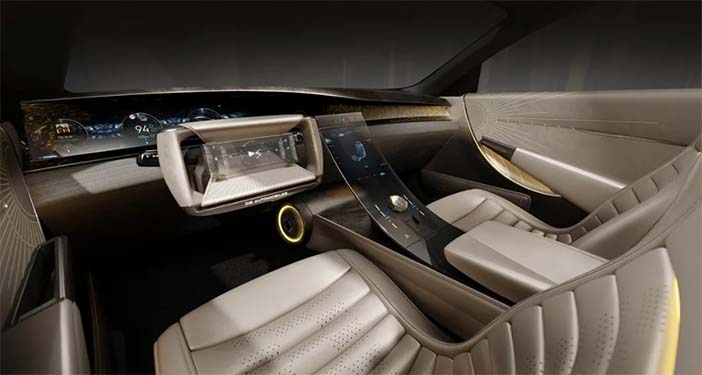
The interior is arguably a bigger departure from the original than the exterior. There are still echoes of the original, such as with the shape of the dash top and concave instrument display, as well as the seats with horizontally stitched cushioning. The concept departs with its concave monolithic center screen, which also adopts a small puck for shifting instead of a chromed lever, and the instruments also are shown on a screen. The distinctive single spoke wheel of the original gives way to a rectangular yoke, and the door panels feature intricately detailed “laser-engraved” leather. I dig this modern SM, even if I’m not sure it’s quite as elegant as the precursor. I’m not getting my hope up for a production car, though. While it could happen, perhaps with enough good reception from the public, any kind of coupe seems to be a hard sell in our SUV-obsessed world. It’s an even harder sell when all of Stellantis is already focused on modern gas and EV versions of its mainstream products. So for now, we’ll just be satisfied getting to see anything physical instead of just some pretty pictures. +++
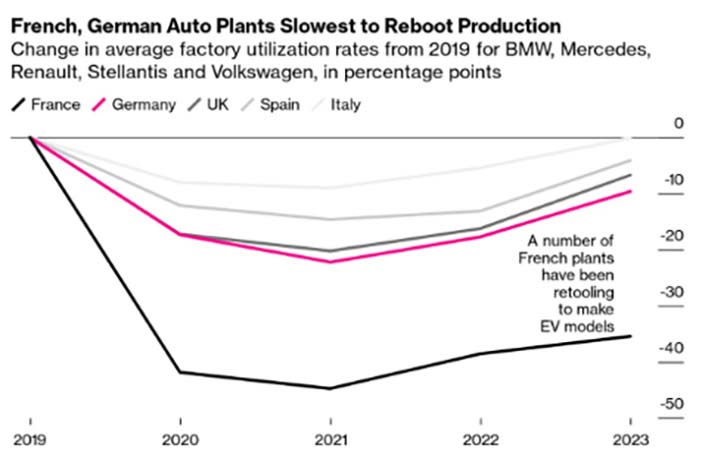
+++ Volkswagen threatening job cuts in GERMANY and warning it may shutter factories there for the first time is a reality check for Europe’s anemic auto market. Nearly a third of major passenger-car plants from Europe’s 5 largest automakers (BMW, Mercedes, Stellantis, Renault and Volkswagen) were underused last year, producing fewer than half the vehicles they have the capacity to make. Sites shutting down would add to concerns that the region is facing a protracted downturn after falling behind competitors. +++
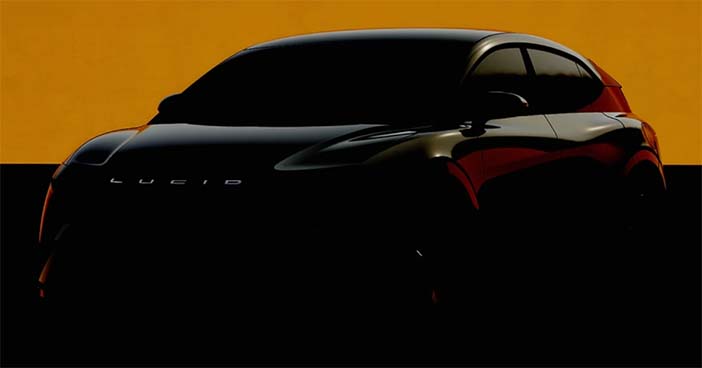
+++ With the Gravity 3-row SUV coming close to production, LUCID has given the world its first look at yet another SUV in the works. The silhouetted machine doesn’t officially have a name yet, but Lucid did share some interesting details, and the image shows more than I expected. There’s no mistaking this new SUV for anything but a Lucid, what with its rounded corners and distinct, almost vent-like dimples on each side of the hood. But this looks to be far curvier than the pebble-like Air and the arguably MPV-like Gravity. The roof dips low toward the rear, and the rear haunches look much more exaggerated than on any current Lucid. It will presumably be a 2-row SUV, not just because of the smaller size, but because of that low rear roofline. Naturally, details are scant, but during the company’s Technology and Manufacturing Day presentation, there were hints at what to expect from the new SUV. It will use a completely new motor and drive unit called Atlas. Lucid claims it’s significantly more compact, improving packaging needs, and it claims efficiency improvements over its current offerings. It was also noting that it will be somewhere around 335 horsepower in output. It will be used in Lucid’s midsize offerings, but may also end up in more entry-level versions of both Air and Gravity. In the presentation, it was mentioned that it will be arriving later in 2026, possibly with a reveal sometime next year. I expect the L.A. Auto Show to be a prime candidate for the reveal. Furthermore, the SUV will start at less than €70.000 in The Netherlands. As for the name, that’s still a mystery. A trademark filing was made by Lucid not long ago for the name “Earth”. It would be a fitting name with such elemental nomenclature as Air and Gravity. So keep an eye out for the new Lucid sometime next year. +++
+++ On September 4th, MERCEDES announced their intention to invest more than 14 billion yuan ($2 billion) with local partners to expand its product line-up in China. Starting from 2025, Mercedes-Benz will begin production of the China-exclusive all-electric long-wheelbase CLA model, a long-wheelbase GLE and a new luxury electric MPV based on the VAN.EA platform. This announcement comes with the backdrop of possible Volkswagen plant closure in Germany and recent EU tariffs on Chinese EVs. It also comes on the heels of 2 massive investments announced by fellow German automakers Volkswagen Group and BMW in April. It has been reported that over 10 billion yuan ($1.4 billion) will be allocated to passenger vehicle operations, while more than 4 billion yuan ($550 million) will be invested in light commercial vehicles. These new domestically produced models will be manufactured by existing Mercedes joint ventures, Beijing Benz (joint venture with BAIC) and Fujian Benz. Beijing Benz will begin producing new models on the MMA (Mercedes-Benz Modular Architecture) platform next year. The first local model produced will likely be the new all-electric long-wheelbase CLA. It features an efficient 800 volt platform with an energy conversion rate of 93% from battery to wheels. The model can achieve 400 km of range after 15 minutes of charge. Its energy efficiency reaches 12 kWh per 100 km. Another key focus of this investment is the local research and production of the China-exclusive GLE. Previously, the best-selling imported model in the Middle Kingdom, the new China-made GLE, will be the first model developed by the Mercedes’s Chinese R&D team. The new model will focus on rear-seat comfort and intelligent technologies tailored for the Chinese market. The localized CLA and GLE will further enrich Mercedes’ lineup of locally produced models. Mercedes launched its first China-exclusive model, the long-wheelbase E-Class, in 2010. And its first locally produced SUV, the GLK-Class, in 2011. The company has gradually expanded its local production since 2019, with a total of 11 locally produced models, including 6 SUVs. The commercial part of the investment will support Fujian Benz in producing a new luxury electric MPV based on the VAN.EA platform. All future medium and large light commercial vehicles will be built on the modular and scalable VAN.EA electric platform. Currently, the main light commercial vehicle models for Mercedes in China are the V-Class MPVs. Fujian Benz was established in June 2007 as Mercedes’ light commercial vehicle production base building V-Class vehicles. The JV is one of the largest industrial companies in Fuzhou, the capital of Fujian. It counts Mercedes and BAIC as its 2 largest shareholders. In June of this year, Fujian Benz began laying the foundation for the production of VAN.EA platforms in Fuzhou. Mercedes also disclosed information on its new MB.OS operating system, which will debut with the new local models. The system will feature a new virtual assistant as well as an “end-to-end” smart driving system. “End-to-end” smart driving is common terminology used by local manufacturers to describe their automated driving solutions that Mercedes has begun to adopt. Ola Källenius, chairman of then Board of Management of the Mercedes, on his 4th China visit this year stated “The Chinese market is one of the key pillars of Mercedes-Benz Group’s global strategy and is a major driving force behind our transition to electrification and technological innovation. Mercedes-Benz remains committed to long-term investment in China, deeply engaging in and contributing to the upgrading of the Chinese automotive industry”. According to statistics from Mercedes, the company has invested over 100 billion yuan ($14 billion) in China from 2014 to 2023, with 10 billion yuan ($1.4 billion) going to R&D over the last 5 years. Not only is Mercedes deepening its investments and local production in China. Other German auto giants are also increasing their investments in China. Volkswagen invested $2.7 billion to expand their Volkswagen Anhui operations. They are also in the midst of building two new EV models in collaboration with Xpeng. BMW, similarly, is investing an additional $2.8 billion in its Shenyang production base. Its the total investment in the plant rose up to 105 billion yuan ($14.7 billion). Mercedes’ investment serves as a notable example of German automakers taking a different stance from the European Union on trade with China. In the new era of competition from domestic companies in electrification and smart driving tech, maintaining their edge in China has become an important challenge for the historic German auto industry. In a unified move, Germany automakers have chosen to localize and further embed their operations to compete with the rise of domestic players. +++
+++ We’ve been hearing about TESLA ROBOT TAXI program for months, but we now have a reported date for the vehicle’s unveiling. Sources said the automaker would reveal the car at Warner Bros Discovery’s facility near Los Angeles on October 10. Tesla doesn’t have a public relations department, and CEO Elon Musk hasn’t responded to comment requests, so that date is unconfirmed as of yet. He previously mentioned the October 10 date, but the location was not revealed at that time. The automaker delayed its originally planned August 8 event, making the October date more believable. Musk requested design changes that required more development time before a reveal. The company moved its headquarters to Texas, where it has been holding launch events in recent times, but the location of this event on a California movie lot could help with this reveal. The movie set, located in Burbank, houses a simulated neighborhood with carefully mapped streets and an almost real-life look. Tesla could use the location to demonstrate the new taxis without worry about general traffic, and the compact location makes it easier to map routes in the vehicles’ software. It’s worth pointing out that other companies, such as GM’s Cruise and Alphabet’s Waymo, conduct pre-mapped testing, but their routes are on public roads with other vehicles and pedestrians. I don’t know much else about Tesla’s robot taxi ambitions. The company has not detailed whether existing owners’ vehicles could be used with the service, nor do we know how or when real-world testing might start. We’ll likely learn more at the October event, as Tesla has a lot riding on the program, and investors will want to hear some reassurance that Musk’s ambitions are aimed in the right direction. Earlier this year, reports surfaced that the automaker had scrapped its affordable EV program to focus on robot taxis, though Musk refuted the claims, calling them “fake news”. The report ruffled feathers, as Tesla had long pursued more affordable vehicles, and Chinese automakers gained considerable ground on the company, outpacing its sales in some regions. +++
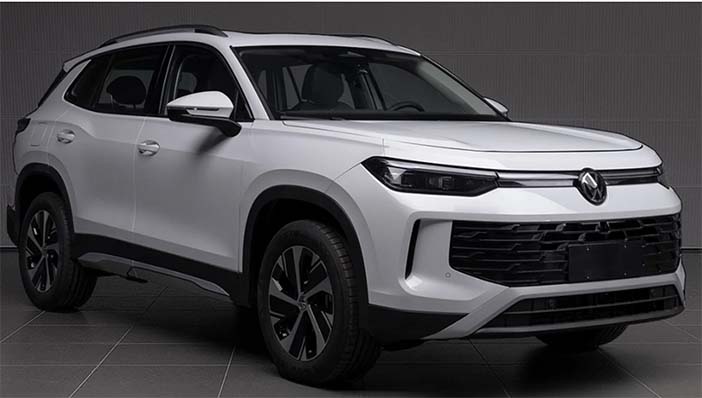
+++ VOLKSWAGEN has announced its new seven-seat SUV, the Tayron, will be unveiled on 10 October. It’ll serve as the replacement for the Tiguan Allspace, and rival other large SUVs like the Kia Sorento and award-winning Skoda Kodiaq. The Tayron name will be unfamiliar to European motorists, but Volkswagen has been using it in the Chinese market for several years now. As well as confirming the nameplate’s introduction to local showrooms, the company also provided a glimpse of the rear end’s full-width light bar and illuminated VW badge. We don’t have to wait until next month to know what the new Tayron looks like, however, as images of the car completely undisguised were recently shared by China’s Ministry of Industry and Information Technology (MIIT). The design makes the Tayron instantly recognisable as the third-generation Tiguan’s big brother. Both cars use the same modern and understated styling, right down to the very wide front grille and rear light bar treatment. Based on the patent images, the Tayron is also going to be offered in sportier-looking R-Line specification that adds a more aggressive front bumper and larger side air intakes with a gloss black finish. Of course, in order to accommodate a seven-seat layout, the Tayron will be longer than the Tiguan and have a longer wheelbase too. We expect the Tayron to measure more than 4.7 metres from nose to tail, with a wheelbase of nearly 2.8 metres, compared to the Tiguan that’s 4.539 mm long and has a wheelbase of 2.676 mm. We’ve not had a look inside the Tayron yet, but we expect the interior will be identical to the Tiguan’s, which gets a 10.25-inch digital driver’s display and 12.9-inch central touchscreen as standard, but an even larger 15-inch screen should be available as an optional extra. There should be some physical buttons dotted around the cabin, as well as the brand’s usual touch-sensitive climate controls that are now backlit, unlike earlier cars. The Tayron will be based on the same MQB Evo platform as the Tiguan, and the Skoda Kodiaq. That means future buyers should get a choice of diesel, mild-hybrid petrol and pure-petrol engines, plus a plug-in hybrid powertrain that, in the Skoda, offers a pure-electric range of up to 120 km. I expect prices for the Volkswagen Tayron will start from between €51.990 and €54.990 in the Netherlands, as the base price for the Tiguan is currently €46.990 euro while the Kodiaq starts from €44.990 euro. +++