
+++ The BYD DENZA Z9 GT is scheduled for a global launch on September 20. The luxury wagon, available in both plug-in hybrid (PHEV) and fully electric (BEV) variants, is currently on pre-sales in China, pricing from 339,800 to 419,800 yuan (approximately €65.000 to €80.000). The Denza Z9 GT, under the BYD brand, features advanced powertrain options and a unique design aimed at performance-focused buyers. The PHEV model has a 2.0-liter turbocharged engine and 3 electric motors, delivering a combined output of 858 hp. This setup provides a range of 1.100 kilometers, with fuel consumption rated at 5.6 liters per 100 kilometers when the battery is depleted. The BEV variant, powered by 3 motors, produces 952 hp and offers a range of 630 kilometers. The electric version accelerates from 0 to 100 km/h in 3.4 seconds, slightly quicker than the PHEV’s 3.6-second time. Designed by Wolfgang Egger, the Z9 GT features a distinctive front grille and a full-width rear light bar. Its body dimensions measure 5.180 mm in length, 1.990 mm in width and 3.125 mm in wheelbase, giving it a more substantial road presence than similar models like the Porsche Panamera. The PHEV model is slightly longer at 5.195 mm, owing to its more pronounced bumpers. Inside, the Z9 GT offers a range of tech-driven features, including multiple digital displays across the dashboard and door panels. A key feature are the dual refrigerators: 1 for front passengers and 1 for rear passengers, which can hold 4 wine bottles. However, the rear refrigerator impacts trunk space and restricts the ability to fold the second-row seats. The car also includes air suspension and a rear-axle steering system, which reduces the turning radius to just 4.62 meters, enhancing maneuverability. Pre-orders for the Z9 GT, available in 5 trims, are underway in China. Deliveries are expected to begin in late September. The vehicle will also enter European markets, where it is expected to challenge high-end models like the Porsche Panamera by offering a competitive mix of performance and luxury features. +++
+++ GENERAL MOTORS and HYUNDAI recently formed an alliance through a non-binding Memorandum Of Understanding (MOU). While the MOU outlines broad areas of collaboration, it also indicates that both automotive giants are aiming to strengthen their resilience amid the global slowdown in electric vehicle (EV) demand, often referred to as the “chasm”. In the MOU, the 2 sides have chosen joint development and manufacturing of commercial and passenger vehicles, joint management of supply chains and joint research for clean energy technologies as their main areas of partnership. Under the MOU, the 2 companies will jointly develop internal combustion engines (ICE) and electric and hybrid vehicles and jointly source raw materials for batteries, steel and other materials. This boosted GM’s share price, while Hyundai Motor also soared, indicating that the market is expecting the alliance to benefit both companies. Among the agreements outlined in the MOU, joint sourcing of raw materials is expected to yield the most immediate benefits, as securing materials at reasonable costs directly impacts the profitability of both companies. In terms of EV batteries, battery makers have been holding an upper hand in their supply negotiations with carmakers, due to battery’s importance in the EV industry. When GM and Hyundai Motor jointly source battery raw materials, their purchase volume will increase, bringing greater leverage regarding price negotiations with battery makers. “If realized, bulk purchasing could lead to cost savings, and by leveraging GM’s North American supply chain for battery materials, they are expected to more easily comply with the Inflation Reduction Act as well”, SK Securities analyst Yoon Hyuk-jin said. Another strategic oart in the MOU is that their joint development will include ICE and hybrid vehicles. In recent years, automakers have been forming various alliances and partnerships to develop and manufacture EVs, but such collaborations are rare in the realm of conventional engine vehicles as the industry continues to transition to the era of electric vehicles. In this context, GM and Hyundai decided to collaborate on the development of internal combustion engines and hybrid vehicles, anticipating that the current EV chasm (slowdown) may last longer than initially expected. Ford recently announced that it killed a planned 3-row electric SUV and pushed back a new electric version of its best-selling pickup, the F-150. GM also said in July that it slowed its plans for EVs, citing profitability. Though carmakers are confident they are moving in the right direction with EVs, consumers have been way slower than had been anticipated. To cope with this slowdown, GM and Hyundai seem to be extending their focus on ICE and hybrid vehicles while cutting costs through joint development. “While sharing the various costs required for the development and production of new cars, GM and Hyundai Motor can also improve capital efficiency and enhance cost competitiveness through joint procurement of key raw materials”, Hana Financial Investment analyst Song Sun-jae said. While GM has built its reputation with vehicle stability and engine capabilities, Hyundai has established its global status in the hybrid vehicle market. “Hyundai’s weakness in the North American market is the absence of a full-size pickup truck, while GM lacks hybrid technology”, SK Securities’ Yoon said. “If the MOU is successfully executed, it could lead to the release of Hyundai pickup trucks and GM hybrid vehicles. Through rebadging (releasing one model under multiple brand emblems), both companies could significantly reduce costs related to new car development and distribution networks”. Joint production is also a benefit of the alliance. Hyundai could benefit from GM’s extensive infrastructure in key regions including Mexico, Brazil and Argentina, enabling broader market access. GM, on the other hand, could use Hyundai’s facilities in regions where it had previously withdrawn, such as Europe and India. “The two sides’ collaboration is at its infant stage, vaguely suggesting which part they can join forces”, Hana’s Song said. “However, with the global EV market slowing, intensified price competition from Chinese EV makers, and value chain penetration by autonomous vehicle companies like Tesla, Huawei and Alphabet, the partnership between GM and Hyundai is expected to unfold in a mutually beneficial and strategic manner”. +++
+++ HONDA has temporarily halted production at all 3 factories operated in a joint venture with Dongfeng Motor in the central Chinese city of Wuhan to reduce output amid declining new car sales, sources familiar with the matter said. Dongfeng Honda Automobile Co has decided to stop the operation of the 3 production bases in the Hubei Province city for a week due to high inventories. The joint venture has an annual capacity to manufacture 720.000 units. In late August, Dongfeng Honda began consulting workers who may be willing to apply for voluntary layoffs. Chinese media have reported the company plans to slash some 2.000 employees. Honda has seen sales in China sharply drop amid an intensifying price war in the world’s largest auto market, where electric vehicle sales have been rising due in part to government subsidies. Japanese carmakers have been slow to embrace EVs and are struggling to maintain market share globally amid stiff competition from EV makers such as Tesla and BYD. In August, Honda saw its new vehicle sales in China dive 44.3 percent from a year earlier, down for the 7th straight month. The Japanese automaker has decided to halt production later this year at one Dongfeng Honda factory as well as one plant of GAC Honda; a joint venture with Chinese state-owned automaker Guangzhou Automobile Group. +++
+++ JAGUAR LAND ROVER ’s global headquarters has urged its South Korean branch to adopt business strategies from its Japanese counterpart, citing concerns about lagging sales in Korea. The U.K.-based automaker regularly conducts visits to its international offices to evaluate performance. During a recent review of its Korean operations, executives noted that Korean sales are trailing behind Japan’s. According to industry sources, high-ranking executives of the corporate headquarters emphasized that while sales in Korea have shown signs of recovery, more aggressive growth is needed to match Japan’s faster pace. Jaguar Land Rover Korea sold 5.073 vehicles in 2023, a 54.9% increase from the previous year, according to the Korea Automobile Importers & Distributors Association (KAIDA). However, this figure remains significantly lower than the 15.473 units sold in 2018, marking a sharp decline in annual sales. Jaguar, in particular, has struggled with low sales, leading to a temporary suspension of operations in the second half of 2022. The brand plans to relaunch in Korea next year, focusing on selling electric vehicles directly from the headquarters without local dealerships. Jaguar Land Rover Korea’s sales have steadily declined since 2019, when it sold 10.197 vehicles (7.713 Land Rovers and 2.484 Jaguars). Sales dropped to 5.676 vehicles in 2020 and by 2022, the company sold just 3.276 units (3.113 Land Rovers and 163 Jaguars). In contrast, Land Rover’s performance in Japan has steadily improved, driven by growing demand for mid- to large-sized SUVs such as the Defender and Discovery. These models have found favour among Japanese consumers who prioritize practicality and stability, as well as a lifestyle focused on outdoor activities. According to the Japan Automobile Importers Association (JAIA), Jaguar Land Rover sold 9.799 vehicles in Japan in 2022; a 77.8% increase from the previous year. This included 9.102 Land Rovers and 697 Jaguars. Marketing efforts in Japan, such as showcasing the Defender’s versatility in scenic locations like Karuizawa (a popular tourist destination for hot springs and skiing) have contributed to the brand’s success. Although sales in Japan have been gradually increasing, the number of Land Rovers sold surpassed 3.000 units in 2013 and continued to grow, with the exception of a dip in 2019 (from 4.560 to 3.959 units). The Defender 110 became the best-selling import SUV model in Japan, with 4.462 units sold in the 2023 fiscal year, making it the 14th best-selling import vehicle overall. Despite this, Jaguar Land Rover’s sales have slowed in both Korea and Japan in 2023, with the decline being more pronounced in Korea. From January to August, Jaguar Land Rover sold 2.791 vehicles in Korea; down 26.8% from the same period in 2022. In Japan, sales fell by 6.1%, from 6.187 to 5.808 vehicles. In the past, Jaguar Land Rover Korea was often presented as a model for other Asian branches, including Japan. However, with the recent downturn in performance, the Korean division is being encouraged to learn from Japan’s success to regain its competitive edge in the region. Jaguar Land Rover operates offices across Asia, including in Korea, Japan, Singapore, and Australia. +++
+++ Thanks to a Chinese government ministry, we now know a whole lot more about the Europe-bound LYNK AND CO Z02 . The new car is expected to be unveiled in Europe sometime in October before being first seen publicly in China at the Guangzhou Auto Show in November. Known as the Z20 in China, the car is expected to be called the Z02 in Europe and may well go on sale in the EU before China. It uses Geely’s SEA2 platform, which is a version of the company’s sustainable experience architecture platform customized to smaller vehicles. It is the same platform used by the Zeekr X, and the Lynk & Co Z20 can, in many ways, be seen as a direct sibling. The Lynk & Co Z20 has dimensions of 4.460, 1.845 and 1.573 mm (l/w/h) and a wheelbase of 2.755 mm. As suspected, the Lynk & Co Z20 is slightly bigger than the Zeekr X (see specs), which, for reference, is 4.450, 1.836, and 1.572 mm with a wheelbase of 2.750 mm. So far, there is only one power option for the Lynk & Co Z20, a 340 hp electric motor. For single motor versions of the Zeekr X the motor is rear mounted and so presumably this is also the case in the Lynk & Co Z20, although for the Zeekr X the single-motor version uses a less powerful 272 hp motor. The MIIT listing gives the battery as being a lithium iron phosphate unit but gives no details about the capacity. We previously believed the car would share the same battery as the Zeekr X. However, the 66 kWh battery fitted to the Zeekr X is an NCM battery and not lithium iron phosphate, meaning that the Z20 has a different battery. Buyers can specify 18 or 19-inch wheels in five different styles. Curb weight for the Lynk & Co Z20 is 1.899 kg. The pictures published by MIIT give us the best look to date of the Lynk & Co Z20. At the front, the car has the latest family face style and continues the double vertical light strip. Buyers can choose between a one-tone body color or a car with blackened pillars. The car uses semi-concealed door handles and, at the rear, has a very distinctive through tail light that doubles as a rear spoiler. The Lynk & Co car was first announced last year as part of the brand’s expansion plans in Europe. +++
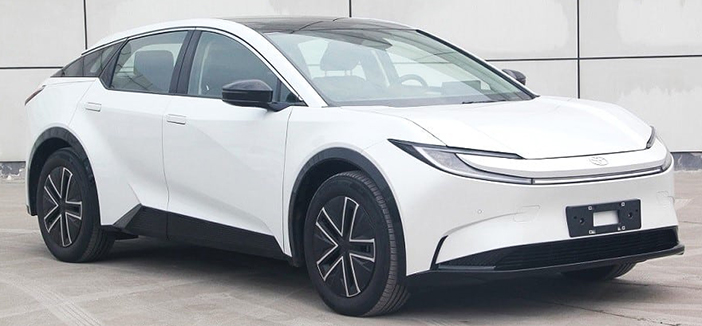
+++ The production version of the all-electric TOYOTA BZ3C was revealed as it applies for the sales license in China. The electric powertrain and battery are sourced from BYD, fillings revealed. The BZ3C is Toyota’s third all-electric car (yes, so behind the Japanese automaker is). The production is planned to start in the 4th quarter of 2024 in FAW-Toyota joint venture’s plant in Tianjin. In China, every car must be approved by the local regulator before hitting the market, and the Ministry of Industry and Information Technology (MIIT) publishes the list of vehicles that go through the homologation process every month. Automakers are not happy about it as it reveals production version images and specs of the cars they haven’t officially launched. But we don’t mind. As Toyota submitted homologation fillings to the Ministry of Industry and Information Technology (MIIT), we can finally see the pictures of the production version and key specifications. Toyota BZ3C is a 4-door 5 seater coupe-SUV with Prius-like look. Dimensions are 4.780 / 1.866 / 1.510 mm (length/width/height), with a wheelbase of 2.880 mm. The curb weight is 1.920 kg and the EV will offer 18 and 21 inch wheel options. It will feature optional laser radar on the top of the front windshield. BYD provides the electric powertrain. It will have a TZ200XS003 single electric motor with 272 hp output, supplied by BYD’s wholly-owned subsidiary Fudi Power, manufactured in Changsha. Maximum speed is limited to 160 km/h. The electricity will be stored in a lithium iron phosphate (LFP) battery sourced from BYD’s FinDreams. The capacity wasn’t revealed in the fillings, but Autointernationaal.nl expects the BZ3C to have a WLTP range between 375 and 450 km. The Toyota BZ3C was unveiled earlier this year at the Beijing Auto Show in April. Its platform was jointly developed by First Automotive Works (FAW), the state-owned and second-largest automaker in China, and Toyota. Battery, electric motor, and powertrain components were sourced from BYD. Toyota already sells 2 all-electric cars in China: the BZ4X (a cross-over) and the BZ3 (a sedan). The new BZ3C will launch by the end of the year. +++
+++ “You’ll love zipping around in your Taos thanks to the dynamic capability of the available 7-speed DSG dual-clutch automatic transmission that readies each gear for fast, smooth, and efficient shifting”. So claimed VOLKSWAGEN in its marketing blurb for the 2024 Taos 4Motion. But buyers didn’t love it, and they didn’t think it was smooth, either. They thought it was broken. Which is why, as part of the 2025 facelift, the all-wheel drive Taos swaps its DSG ’box for a conventional 8-speed epicyclic automatic, much like the hardware front-drive Taos models were already using. The move means that more than 2 decades after VW revolutionized 2-pedal cars with its original DSG dual-clutch transmission, the only VWs now sold in the US still using the tech are the Golf GTI and R. “There is a bit of hesitation in response to driver inputs on a DSG, and American customers, unless they’re performance customers, don’t like that”, a VW spokesperson told the media during the presentation of the refreshed Taos earlier this week. “They think their car is breaking, it’s not being responsive”, the rep added, contrasting the driving experience with the more familiar one drivers know from driving old-school autos in which a torque converter fluid coupling smoothly converts engine power to forward motion. “When we want to start stealing sales from rivals, we’re going to give owners the same feeling they’re used to in mainstream SUVs and that’s the 8-speed automatic transmission”. The now DSG-less Taos made its debut around the same time a BMW X1-owning couple in Virginia are bringing a class action lawsuit against the German automaker because they’re so unhappy with the way the X1’s dual-clutch transmission performs. The lawsuit alleges that the current X1, which in the reverse of the Taos situation switched from an auto to a twin-clutch with its 2023 refresh, is jerky and that the hesitation in engaging gear and taking up drive makes the SUV dangerous. Dual-clutch transmissions became increasingly popular through the 2000s and 2010s, liked by drivers for their fast, smooth gear changes, and by automakers for their efficiency. They were light years more technologically sophisticated and refined in use than the automated single-clutch gearboxes that predated them, but as anyone who has tried one will know, they’re nowhere near as slick in stop-go traffic as conventional automatics, which have also become far more efficient over the last 20 years. +++