+++ CAR DESIGN feels like a particularly fickle place in 2024. It’s always been an exercise in compromise, but never have opposing factors been so stark. Do brands pander to trends and risk losing their distinction, or forge their own path hoping consumers come along for the ride? And that’s before you consider letting electrified powertrains dictate design. These are questions that all motoring design studios are facing, and none more starkly than the legacy brands that have the weight of their reputation on the line. BMW, Audi, Mercedes and Jaguar have all been under the microscope in recent years, with designs that have been just as notable for their misses as their hits. But big moves in the design world over recent months might be a clue that some of these big manufacturers are on a mission to right some of their recent wrongs. It started with the shock resignation of Massimo Frascella from JLR; one of the fathers of a modern Range Rover, and a champion of reductionist design just as you might see in fashion or architecture. He’s now begun a new role at Audi, typically a brand on the precipice of cutting-edge car design, but of late under particular heat for being too fussy and a little generic. Frascella joined with a piercing public statement confirming he’ll be taking the maker in a more simplistic and sophisticated direction. The rather unceremonious departure of former design head Marc Lichte also spoke loudly by them saying nothing at all. BMW has also been given a shake up, albeit with a softer tone. Maximilian Missoni of Polestar has joined Adrian van Hooydonk’s A-Team in Munich, taking on the role of head of design for the maker’s medium and large model lines, plus Alpina. Former head Domagoj Dukec, instigator of BMW’s shock-and-awe design language of the last 5 or so years, will move over to Rolls-Royce, with former brand designer Anders Warming moving to BMW’s advanced design. In both cases, Frascella and Missoni are known for their instinctual sense of volume, proportion and minimalist detailing. These are in stark contrast to the rather more chaotic design studios they’re joining – signalling that quality of design, rather than shock factor, is back on the agenda. Mercedes has yet to call any change to its design management, but its all-electric EQ range has hardly been free of critical review, something mirrored in its showroom sales and resale values. These exciting new moves might be cause for celebration, but it’s worth remembering the stakes at play. Legacy brands face huge challenges outside of design, including a slowing of EV take-up and fast-moving, tech-forward Chinese and Korean rivals. And without a clear lead in electrified powertrain engineering and technology, it will rest on design and build quality to justify what actually makes ‘premium’ cars premium. However, while we’ve still got a long wait to see how Audi and BMW reinterpret their design languages under new leadership, the first up for major reinvention is much closer to home. Jaguar is on the verge of glory or ruin with its imminent rebirth due later this year. Gone is the steady hand of former design chief Ian Callum, and with Frascella out of the picture, Jaguar’s fate essentially rests on one person: Gerry McGovern. It was always going to be a tough job to execute the reinvention plan, even if the EV market stayed as buoyant as it was four years ago. But for the sake of one of Britain’s most iconic brands, anticipation is high. We’ll be getting our first real indication of Jaguar’s direction in the coming months. Make no mistake. The fate of these premium brands is under threat with advances from the East, but they all still have something newer rivals from more modern brands just don’t have – that of history and heritage. How they leverage their legacy in the design studio might just be their key to success. +++
+++ Omoda and Jaecoo, the new European brands of the Chinese giant CHERY , have finally landed in the Old Continent and now the Group is preparing a strategy to stay there, with new models on the way and investments. We talked about this and more during a trip to China organised by Omoda and Jaecoo, during which we took part in a round table discussion with Shawn Xu, CEO of the 2 brands. Of course, there was talk of duties, a hot topic for months now where the European Commission and China have been clashing. Xu, in addition to confirming the intention to produce in Spain, anticipated the need, in view of the desire to grow sales in the Old Continent, to open a second plant. Where? For now, nothing is certain and Italy could be a candidate. For now, the Bel Paese is preparing to host a research and development centre, whose task will be to adapt the various models to the needs of European customers. A plan that at present is not expected to undergo any setbacks. If in fact it seems that an indication has come from Beijing for Dongfeng to stop investing in Europe, in response to duties on Chinese electric cars, Chery confirms its expansion plans, not just in terms of new models on the way. Beyond factories and R&D centres, Omoda and Jaecoo are preparing a new batch of models to be launched in Europe. Not only electric. Jaecoo will focus on the launch of the Jaecoo 7, to be followed by the Jaecoo 5, a 4.38 metre compact SUV powered by petrol, full hybrid and 100% electric engines. The list of Omodas arriving in 2025 will be even longer. On the one hand, there will be the expansion of the Omoda 5 range with the LPG version, whilst on the other hand, there will be absolute models such as the Omoda 7 and Omoda 9, both mid-size SUVs with plug-in powertrains. In 2026 it will be the turn of the Omoda 3, a small SUV that will enter one of the most popular segments in Europe and beyond. It is a mix between electric and electrified, to meet the demands of European motorists who are still sceptical about BEVs, as witnessed by registrations in the Old Continent, and the need to avoid incurring the fines that Europe will give to manufacturers who exceed the new CO2 limits in force from 2025. +++
+++ Assisted driving is optional today, but it is becoming increasingly becoming more popular and in the future it will be as popular as any other technological device. So the EURO NCAP experts put it to the test by assessing 5 models on motorway routes (BMW i5, Mercedes-Benz C-Class, Volkswagen ID.7, Volvo EC40 and BYD Atto 3). “While these modern systems allow safe driving, they have their limits in certain situations and could create additional risks if not used correctly”, said Adriano Palao Bernal, ADAS & AD technical manager at Euro NCAP, explaining that the evaluations carried out “provide critical insights into the driver assistance technologies available in vehicles today”. The highest result (‘Very Good’) was achieved by the BMW i5 and the Mercedes C-Class. Their systems, according to Euro NCAP, offer good lateral and speed control, which, at the same time, keeps the driver alert to regain control of the vehicle (if necessary). Mercedes’ Safety Backup, then, scored particularly high because the car moves to the edge of the road and performs a controlled stop (in case the driver is not responsive). The Volkswagen ID.7 and Volvo EC40 scored ‘Good’, while the BYD Atto 3 was rated ‘Not recommended’: the speed control system does not read the signals correctly, while the Safety Backup scores very poorly. +++
+++ Electric car sales are struggling to take off in EUROPE and despite the growth recorded in September, with 213.443 units for a +13.9% year-on-year increase compared to the same month in 2023, the shift to plug-in mobility remains very gradual with more and more drivers being directed towards the purchase of hybrid models. Which last month set a historic record. For the first time in fact, hybrid cars were the best-selling cars in Europe, surpassing petrol cars, which have historically dominated the market. The numbers speak for themselves: in September, 337.168 hybrid cars were registered in Europe (including EFTA countries (Iceland, Norway and Switzerland) and the United Kingdom); an increase of 12.3% compared to 335.842 in September 2023. In contrast, petrol models dropped by 18.8%, from 450.491 to 329.207 units. More than 121,000 units were ‘lost’ to the general decline of the car market in Europe (-4.2% last month), but only for non-electrified fuels, or almost. While electric and hybrid (which includes mild hybrids and full hybrids) are on the rise, plug-in is losing share (-11.7%), as is diesel, which is in constant decline with September closing at 93,304 units and -23.8% compared to the same month in 2023. Looking at the numbers for the first 9 months of the year, petrol cars continue to lead the ranking of preferred fuels, with 3.337.265 units, closely followed by hybrids: 3.008,233. The numbers are now very similar, but the former have lost 5.6 per cent of market share, while the latter have grown by 19.2 per cent. However, at this rate, I would be surprised to see a historic overall overtaking by the end of the year: we will have to wait until 2025 until this happens. On the other hand, one only has to look at the ranking of the best-selling cars in Europe in September to get an idea of the tastes of European motorists, once again conquered by the Tesla Model Y (the best-selling car ever) with the Renault Clio stealing second place from the Dacia Sandero; a model also available with a hybrid powertrain as opposed to its cousin, which is still relying heavily on LPG while awaiting the arrival of the new generation, expected in 2027. In the top 25, the only non-hybrid models are, in addition to the Sandero, the Volkswagen Polo (combustion only), the Volkswagen T-Roc (combustion only) and the Mini Cooper. +++
+++ If Chinese manufacturers want to conquer foreign markets, foreign manufacturers want the same, carving out a place in the Sun in the world’s largest car market. This time it is HYUNDAI that tells how it wants to increase sales in the country of the Dragon, where it is very difficult to make inroads due to fierce domestic competition, where everything (or almost everything) hinges on the ability to offer low-cost electric vehicles. Let’s take a step back. According to the latest figures released by the China Association of Automobile Manufacturers (CAAM), 1.29 million so-called NEV (New Energy Vehicles) were sold in China in September this year alone, i.e. vehicles equipped with an electric or plug-in hybrid powertrain. This result is a good snapshot of the situation, with +17% compared to August and +42% compared to September 2023. In short, NEVs are flying in China, and it is doing so at the expense of other vehicles, which for the second month in a row have been overtaken in sales by electrified cars, which now have a 51.8% share. Chinese manufacturers in particular have taken advantage of this situation, while other manufacturers, from Toyota to Honda, via Volkswagen, General Motors and Hyundai itself, have seen their sales drop. Hyundai stopped at a market share of a very small 1.2% in September; the result of a volume contraction that began way back in 2017. How to get out of the crisis? Now it’s back to the present. Hyundai has made it known that it wants to launch electric cars designed and produced specifically for the Chinese market. To do so, it has also set up an independent R&D centre called Hyundai Motor China Advanced Tech and R&D, based in Shanghai. It will be from there that the Korean manufacturer will lead its grand return to the Asian country. Hyundai’s idea is to create a range that meets the needs and tastes of Chinese motorists. The first model in this project will see the light of day next year. It will be sold exclusively in China, will be built on a possibly new platform and will feature an innovative design and a range of state-of-the-art technologies. But, thanks to the creation of a network of local suppliers and on-site production, it will also be reasonably priced. +++
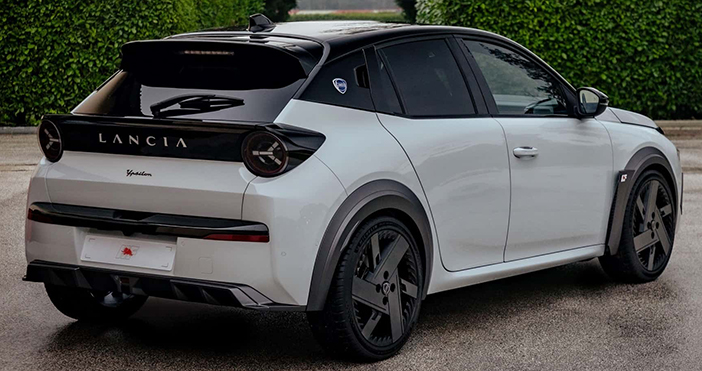
+++ We already knew that the LANCIA YPSILON HF would be big news in 2025 as well as how much horsepower it would have: 280. However, we were missing a significant detail: the style. We tried to guess it in a rendering published a few weeks ago, but now we have all the necessary details. The company has published the first official photos of the sportier Ypsilon in addition to taking the opportunity to make a long-awaited announcement: Lancia will return to rallying with the Ypsilon Rally 4 HF.
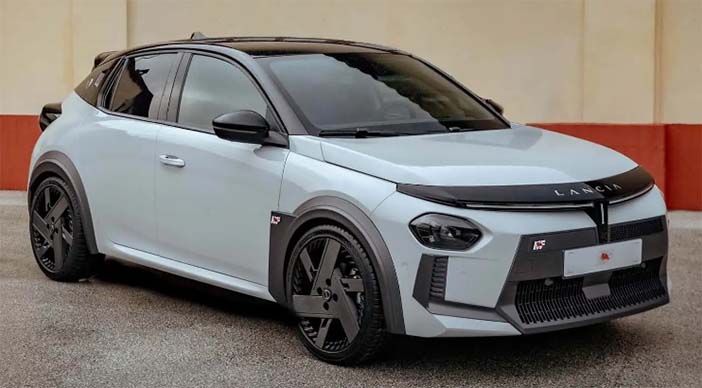
Here are all the details. As we already knew, although nothing was official yet, the Lancia Ypsilon HF will be powered by the same electric powertrain as the Abarth 600e and Alfa Romeo Junior Veloce, with a 280 PS engine coupled to the front axle and a 54 kWh battery, for a 0-100 kph in 5.8 seconds. Range figures have not been released. There will be mechanical changes such as a lowered set-up, widened track and probably steering and suspension. As can be seen from the photos, the new Lancia Ypsilon HF will also have a dedicated, sportier and more aggressive look, consisting of a redesigned front end, HF logo, sports seats with integrated headrest and more. The news that many fans were waiting for was the return of Lancia to the world of rallying, where the Italian manufacturer wrote unforgettable pages in the 1970s and 1980s. A new beginning that will see the Lancia Ypsilon Rally 4 HF at the starting line, perhaps as early as the 2025 season, ready to take part in Rally 4, a category reserved for 2-wheel drive cars driven by young drivers at their first experience. Unlike the road version, the Ypsilon rally car will not be electric but will use the 1.2-litre turbo petrol 3-cylinder engine increased to 212 PS, combined with front-wheel drive, 5-speed manual gearbox and mechanical self-locking differential. +++
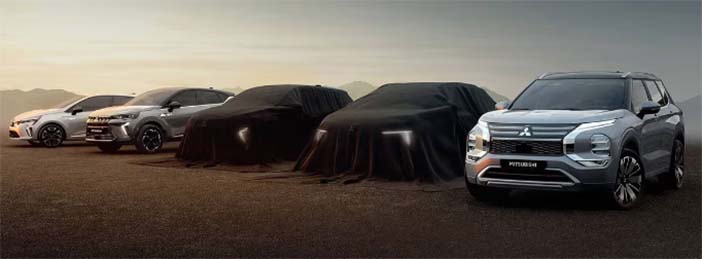
+++ Not so long ago, it was feared that MITSUBISHI would no longer produce any new models in Europe. But then came the turnaround with the ASX and Colt models. Next year will see more new models. Mitsubishi has announced the continuation of its product offensive in Europe with another new SUV in the C-segment, which will be launched in 2025. The new SUV, based on the Renault Symbioz, will be equipped with a petrol and full hybrid powertrain, advanced safety technologies and state-of-the-art connectivity including integrated Google services. This new model comes in addition to the previously announced all-electric SUV. In this case, Mitsubishi will launch its own model based on the electric Renault Scenic. Details are not yet known, but a teaser recently released by the brand gives an impression of what is to come. As with the ASX and Colt, Mitsubishi will probably only slightly modify the front and rear sections. This will be inspired by the recently presented XForce. With the introduction of these 2 new models next year, the Japanese manufacturer will have a total of five new models in its portfolio on the European market from 2023 as part of its product offensive with the ASX, the Colt and the new Outlander. “With this two-pronged approach in Europe’s largest segment, we will offer a diverse range of electrified models, covering a broad offering in different price segments for different customer requirements”, says Frank Krol, president and CEO of Mitsubishi Europe. “Together with the complete package of assistance and safety technologies and the integrated Google connectivity, Mitsubishi will take another important step towards the mobility of the future. We are very pleased to be able to further expand the brand’s position on the German market with the new Mitsubishi models. It is also a clear commitment by Mitsubishi to the European market and underlines our ambition to successfully continue the product offensive of the last two years in the new year with new modern and attractive models. +++
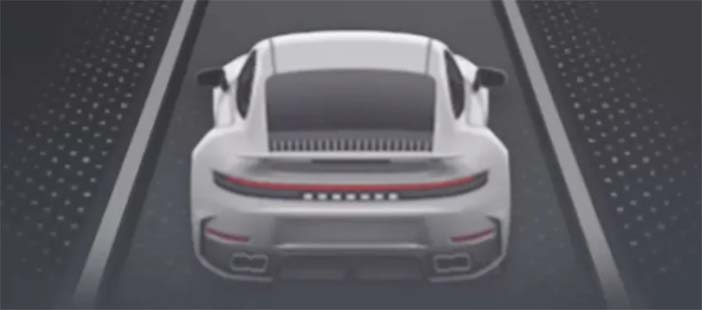
+++ Facelifted iterations of the new PORSCHE 911 are coming thick and fast: we’ve had the Carrera, GTS, T and even the hot GT3, but coming soon is the Turbo and we’ve spotted it lurking on Porsche’s configurator. The 992.2-generation 911s all receive a fresh set of LED headlights and updated rear lights and we can see this is the case with the Turbo, at least from the rear. The image of the car is from a video showcasing the facelifted 911’s cruise control system. What is clear, that a new exhaust tip layout will feature on the Turbo, along with a revised rear bumper, which we’ve caught a glimpse of on test cars already. Other changes on the new Turbo will mirror those featured on the 911 variants updated so far. Namely a fully digital instrument display, new front bumper designs that incorporate active aerodynamics and an upgraded version of Porsche’s PDCC active chassis control system for select models. Perhaps the most significant change for the 992.2 Turbo will be its powertrain, which will feature hybrid assistance for the first time. The hybrid news comes from Porsche’s deputy chairman Lutz Meschke, who said during a call to investors that the new 911 Turbo is entering production in the second half of 2025 and will include a battery cell from manufacturer Varta. The same company is responsible for producing the lithium-ion unit used by the all-new ‘T-Hybrid’ powertrain in the 992.2 generation 911 Carrera GTS that was launched back in May. Meschke didn’t go into detail about how hybrid technology would be integrated into the 911 Turbo, however it seems very likely that Porsche’s all-wheel drive, everyday supercar will adopt a similar set-up to the 911 Carrera GTS. The GTS used to have a twin-turbo 3.0-litre flat-six, but that’s been replaced by a brand-new 3.6-litre flat-six engine with a single turbocharger. In between the turbo’s compressor and turbine is an electric motor that can build boost pressure instantly when the driver hits the accelerator. Another e-motor is integrated into the 8-speed PDK’s transmission housing, with both drawing power from a 1.9 kWh lithium-ion battery in the front of the car. Combined power output for the GTS T-Hybrid is 540 hp and 610 Nm of torque; an increase of 60 hp and 40 Nm over its non-hybrid predecessor. Better still, the hybrid system only added 50 kg to the car’s overall weight. The outgoing 911 Turbo packs a twin-turbo, 3.8-litre flat-six engine that produces 580 hp, while the 911 Turbo S bumps that up to 650 hp. The addition of hybrid power is sure to see those numbers climb and performance turned up another notch or two. The new 992.2 Porsche 911 Carrera S is due to arrive earlier in 2025, according to Meschke, and won’t be electrified. But we expect its 3.0-litre twin-turbocharged flat-six engine to benefit from the larger turbos and intercoolers the base Carrera received when it was updated a few months ago. This should result in a minor power boost from 450 hp and 530 Nm of torque in the current model. +++
+++ The VOLKSWAGEN GROUP crisis continues to dominate the headlines across Europe. In Germany, criticism is raining down on the national carmaker for investment delays, car quality problems and erroneous market forecasts. Complicating matters is the trade war between Europe and China, which has been made official with the introduction of customs duties on electric cars produced in China. The German trade unions have been on the warpath for weeks, but now their actions are being called into question. On the one hand, there is the problem of the absolute number of Volkswagen employees, which is higher than that of any other car manufacturer in the world, and on the other, there are the labour costs, protected over the years by the powerful IG Metall union through particularly generous collective agreements. These costs inevitably affect the industrial competitiveness of the company, which is unable to produce electric cars as cheaply as other manufacturers. We’re talking here about the future ID.2, which is expected to cost no less than €30,000. What’s more, it was this same union that blocked production of a low-cost city car, which was to be developed by exploiting savings within the Renault group as part of the Twingo project. The German manufacturer is said to have pulled out of the collaboration because of union pressure acknowledged by Daniela Cavallo, chairwoman of VW’s works council, who said in an official statement: “For the focal point of our electric strategy, i.e. the brand’s future hatchback, we wanted to go head-to-head with the competition and have it built by Dacia”. The union’s aim was to keep production in Germany, since the Twingo will be made in Slovenia, but the result did not live up to expectations. The German compact, along with other VW group cars such as the Cupra Raval and the Skoda Epiq, will in fact find their cradle in Spain, in Pamplona to be precise, in the factory dedicated until now to the Polo (which is in the meantime moving to South Africa). In the meantime, Renault is pressing ahead with its plans to launch the car in 2026 at a price of €20,000, to take on rivals such as Dacia Spring and Leapmotor T03. Other ‘low-cost’ electric cars such as the Fiat Grande Panda and Citroën e-C3 are also part of this panorama. Above all, the case highlights the structural nature of the problem for the European car industry, particularly the German one, whose competitiveness is undermined by a superimposition of constraints, costs and vested interests that make any process of transformation slow and complicated at a time of transition when the key word should be “speed”. The Volkswagen Group is getting serious about cutting costs, seeking thousands of job reductions, paring back billions of dollars in expenses and attempting to close three plants. “Management is absolutely serious about all this. This is not saber-rattling in the collective bargaining round”, Cavallo told employees. “This is the plan of Germany’s largest industrial group to start the sell-off in its home country of Germany”. It’s too early to tell if Volkswagen’s cost-cutting binge could impact plans in North America, such as the much anticipated Scout launch or the $5 billion electric vehicle software partnership with Rivian Automotive. Perhaps the most troubling part of VW’s problems is that the automaker is hardly alone among its European counterparts. Profit warnings have been common. Mercedes-Benz faces sagging China sales, BMW is recovering from an expensive recall and Stellantis must combat cratering U.S. sales. +++
++ Then there’s VOLVO , which posted a 12 percent drop in U.S. deliveries during the third quarter. North American marketing chief Leigh Moynihan has resigned; the latest in a series of management changes at the Swedish automaker. “She understood the DNA of Volvo and got who the Volvo customer was”, a person briefed on the matter told. “The hope is that whoever replaces her does as well and can reflect it in all they say and do”. +++
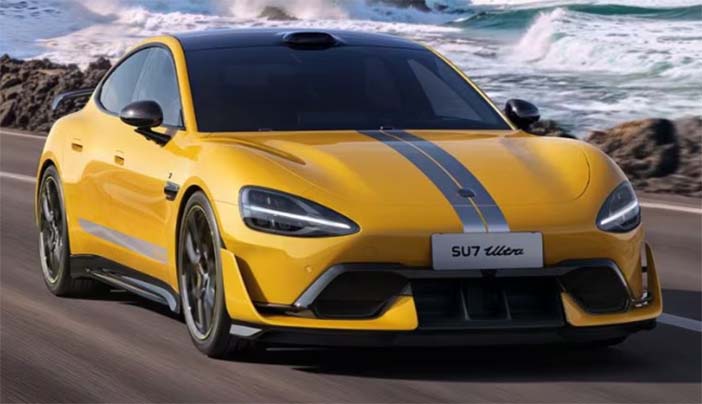
+++ With the SU7 Ultra, XIAOMI enters the Olympus of Nurburgring beasts. The over 1.500 HP electric saloon recorded (in concept form) a time of 6:46.874 in the Green Hell, making it one of the fastest cars on the planet. Even though we are talking about a prototype specially prepared for the fast lap, the time is highly respectable and puts the Xiaomi on a par with established supercars such as the Porsche 911 GT2 RS and Mercedes-AMG GT Black Series. And Chinese customers will soon have the opportunity to garage the production model. Compared to the concept, the production version of the SU7 Ultra has a less extreme, but still rather aggressive, aesthetic kit. At 5.12 meter long, 1.97 meter wide and 1.47 meter high, the Ultra can be recognised by a specific bumper with splitter and larger air intakes, as well as a 1.56 meter wide spoiler that provides downforce of 285 kg. There is also an active diffuser and 21 inch wheels on Pirelli P Zero tyres. The braking system houses the largest carbon-ceramic discs ever fitted to a sports car with a size of 430 mm at the front and 410 mm at the rear, mated to 6 piston Akebono callipers up front and 4 at the rear. According to the manufacturer, full stop at 100 kph is achieved in just 30.8 metres. The interior has been made even more personal than the base Xiaomi, with sports seats, yellow seatbelts and carbon fibre mouldings. The steering wheel is covered in alcantara and other elements such as the dashboard and door panels have an even more aggressive look. The technological equipment is basically confirmed, with the small instrument panel in front of the driver and the large central display to manage every aspect of the car, including the various driving modes. The Xiaomi is powered by a powertrain consisting of three electric motors: two units called V8 and one V6 unit (although the names are obviously not a reference to the number of cylinders). The total power available is 1.548 hp and 1.770 Nm, for a 0-100 kph sprint of 1.98 seconds. Top speed is 348 kph. Bringing the SU7 Ultra to life is a Qilin 2.0 battery made by CATL with a capacity of 93.7 kWh, which can guarantee at least 800 kW of power even when only 20 percent charged. And it recharges quickly, going from 10 to 80 per cent in 11 minutes in high-speed charging stations. The range is 462 km in the WLTP cycle. The SU7 Ultra will be sold exclusively in China at a price of 814,900 yuan, or about 212.000 euro (considerably more than the approximately €60.000 needed for the basic SU7 model). A relatively low figure in relation to the promised performance, with first deliveries scheduled for March 2025. And the impression is that it will be a sales success, with the Chinese brand already counting almost 4,000 orders just 10 minutes after the end of the presentation. +++