
++ ASTON MARTIN is developing a “revolutionary” new generation of cars (from sports cars to SUVs) powered by mild-hybrid petrol power and blasting onto the road before the end of the decade. “We’re developing the new generation of cars and their platform, with a new level of incredible technology: powertrain, electronic architecture, air-conditioning, seats, everything”, Aston Martin CEO Adrian Hallmark told in an exclusive interview. Aston’s engineering team is developing a clean-sheet modular architecture, which will be able to share componentry far more broadly across the brand’s varied product portfolio. It will mean sports cars and SUVs can go down the same line, as well as driving out costly complexity. The platform is being future-proofed for pure electric power. Battery Electric Vehicles (BEVs) have been pushed back in the plan, with the luxury electric car market yet to take off, though they will be introduced in the 2030s. More clarity is emerging on the combustion powertrain line-up, which Aston would like to simplify. But the V12 engine could in theory live on until Europe bans sales of new combustion engines. “We’ve done some work to make the V12 compliant to European and US regulations”, explains Hallmark. “If we keep our V12 sales under 1.000 per year, then we’re exempt from legislation until 2035 at least”. That means a series-production V12 flagship GT such as today’s Vanquish, along with ultra-exclusive, multi-million pound V12 specials such as the Valiant or One 77, can continue to crown the range. “We also looked at how much electrification is needed to remain compliant, and we don’t need plug-in hybrids (PHEVs)”. With Brussels downgrading emissions credits due to driving data revealing PHEVs are driven more frequently on polluting petrol, the cost, complexity and weight penalty just doesn’t add up for Aston Martin. “We’re not delusional, we’re pragmatic”, he says. Instead, the intention is to add mild hybrid support for the combustion engines, with the 48 volt electrical system powering the airconditioning and turbos. This should provide a slight power bump and boost economy, enabling Aston Martins to occasionally coast engine-off on motorways and potentially crawl silently in traffic. The British brand has been sailing solo since Ford cut it loose in 2007, whereas Bentley rests in the safe harbour of the Volkswagen Group, tapping into jointly-funded powertrains, vehicle platforms and electronics. “We’ve done an engine and that will continue”, says the boss, referring to the 5.2-litre twin-turbo V12. “We’ve bought in engines, and that will probably continue. We’ve bought an electronic architecture and we’ll buy another one”. That led to some initial niggles: Hallmark’s diagnosis is that Aston erred by overlaying its own infotainment system on top of the Mercedes one. “For the next-generation we have a mantra not to touch these core systems. Instead we’ll put all the money into the hardware and the interface: the functionality is fine, but our look-and-feel and switchgear must be totally different”. Hallmark calculates one-third of today’s Aston components are sourced from Mercedes, a figure that will rise with the new generation. “But more than 50 percent will be down to us. There’s no penalty for being independent, so long as there are players out there willing to provide credible technologies at a competitive cost”. The boss is incredibly fired up by the new architecture’s potential. “We’ve got a mathematical description of how every Aston will be in the future: in terms of vehicle performance, this will be a revolution”. Teams have gone through 52 systems (”from airco to steering to braking”) benchmarking today’s Astons and their rivals to drive the new cars to the next level. As with the current sports cars, the body-in-white will consist of bonded and extruded aluminium sections. New engineering methods should deliver a stepchange in torsional rigidity with only a minor weight penalty, providing stiffer suspension mounting points to enhance dynamics and refinement. Rear-wheel steering will also sharpen the GTs’ turn-in. The future portfolio will maintain today’s breadth: from the sports cars to the DBX to a mid-engined supercar such as Valhalla, plus the specials. But there will be far more commonality between core models. Could Aston put them down the same line? “Today, no. In the future, yes”. Better economies of scale will ”save a game-changing percentage cost of the vehicle”, and streamline the supply chain. In theory, some sports cars could even be assembled at the DBX’s factory at St Athan in Wales: today, sports car bodies are shipped there from Gaydon for painting, then returned for final assembly. This merry-go-round perfectly encapsulates another one of Hallmark’s mantras: “We are blessed with inefficiency … and opportunity”. +++
+++ BENTLEY ’s first electric car, the Torcal, will be revealed in the coming weeks as a luxury SUV that majors on “everyday usability”. It will also introduce a radical new design language that sets the tone for the Crewe firm’s future models.
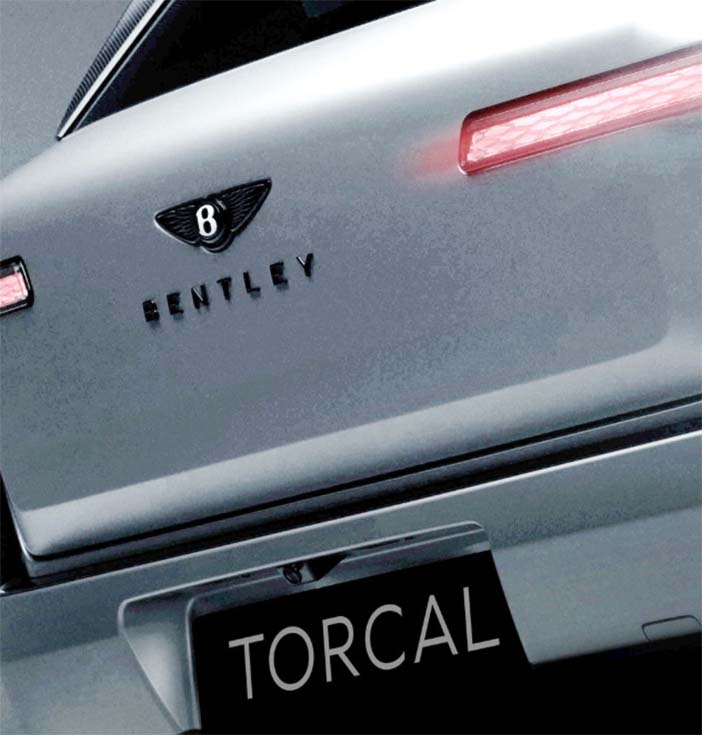
The new model, which is in the final stages of testing ahead of its unveiling on 23 September in London, will effectively be a production-ready interpretation of the EXP 15 concept that Bentley revealed last year as a showcase of its new-era design language. Like the Bentayga, Bacalar and Batur, the Torcal is named after a natural landmark, in this case El Torcal de Antequera, a limestone rock landscape in Andalusia, Spain. The moniker is also a nod to the Latin verb ’torquere’, which means to twist and is the origin of the word ’torque’. The 5 meter-long SUV will sit below the Bentayga in Bentley’s line-up. Defining features that were previewed on the earlier show car include a striking illuminated grille panel, new-look vertical LED quad headlights and the so-called “prestigious shield” at the rear, which is modelled on the luggage carriers fitted to vintage Bentley tourers. While it’s similar in silhouette to Bentley’s existing SUV and not significantly smaller, the Torcal is wholly distinct in its design. It is not intended as a replacement for the V8-powered Bentayga, which will remain on sale and gain a new combustion-powered generation in 2028, in line with Bentley’s strategy of offering a multi-powertrain offering globally. The Torcal was originally scheduled to make its market debut last year but was pushed back in light of weak demand for electric luxury cars. The other EVs that were due to follow it have been similarly delayed, with Bentley scrapping its earlier plan to go all-electric by 2030. The firm will now instead launch a new plug-in hybrid or pure-electric model each year until 2035. Rival brands including Aston Martin, Porsche, Lotus and Lamborghini have also slowed their EV transition plans and now Bentley will be first to market with an EV in this price bracket. The Torcal is expected to go on sale from just under €200.000 in The Netherlands; roughly halfway between the likes of premium propositions including the BMW iX and Volvo EX90, and full-blown ultra-luxury models like the Rolls-Royce Spectre and Ferrari Luce. Its closest rival will be the new electric Range Rover. Bentley believes now is the right time to launch its first electric car, despite the market uncertainty. It claims the new SUV will be “the right car in the right environment more of the time”, touting day-to-day practicality as one of its defining attributes. Bentley has confirmed it will offer a range of “about 500 km”. Bentley director of design Robin Page previously told the Torcal will not chase any outright range records. “We’re finding that there’s a sweet spot in terms of range. Our customers are basically telling us that 480-550 km is that sweet spot. Beyond that, they’ll use the private jet”, he said. The Torcal will be closely related to the Porsche Cayenne Electric, mirroring the relationship between the Bentayga and petrol-powered Cayenne. Based on the same PPE electric architecture as its German cousin, the Bentley is set to take its power from a 113 kWh battery capable of charging at up to 390 kW, which in the Porsche allows for a 10-80% top-up in fewer than 16 minutes. Like the Porsche, the Bentley is expected to be dual-motor as standard, but Bentley has not yet indicated whether it plans to match the heady output of the flagship Cayenne Turbo, which has 1140 hp and 1.500 Nm. The 670 hp of the mid-rung Cayenne S would seem more in keeping with the Torcal’s refined remit. Bentley has still to preview the cabin of its new model, but recent spy shots reveal it will feature the same curved central touchscreen as the Cayenne, portrait-oriented and split into two sections: infotainment at the top and climate control settings below. However, while this will be the largest screen yet fitted in a Bentley at 14.25 inch, it is unlikely to herald an all-out focus on digital controls. The future-looking EXP 15 concept’s cabin placed a renewed emphasis on physical controls to cater to the modern luxury buyer’s analogue preferences. “What we’re finding, especially at our end of the market, is that people are a bit bored with full-digital screens”, said Page earlier, suggesting that Bentley may not offer a secondary passenger touchscreen, as Porsche does. “What makes us premium is to keep a good level of mechanical detailing that the others can’t do”. Bentley will reveal further details in the run-up to the Torcal’s debut in September, which will be around the time the electric Range Rover is officially revealed and just a few weeks before Jaguar takes the wraps off the long-awaited Type 01 GT, making it a landmark moment for the UK’s automotive industry and taking the country’s series-production EV count from 2 to 5. Bentley has long been synonymous with guttural V8 and barking W12 engines, and it remains to be seen how or whether it will fill the silence of an EV powertrain. However, CEO Frank-Steffan Walliser hinted at plans to synthesise some sort of powertrain noise in his acknowledgement that one of the defining traits of a Bentley is “a soundtrack with soul” and his pledge that the new EV will set “extraordinary benchmarks in every area that matters”. Other performance firms (including Hyundai’s N brand, Mercedes-AMG and Porsche) have created artificial engine notes for their EVs to boost driver engagement, but that approach is unlikely to tally with Bentley’s emphasis on authenticity. Another option could be the Ferrari approach: the Luce uses amplifiers and speakers to magnify the frequencies from its EV motors to give a powertrain soundtrack that’s completely unsynthesised. +++
+++ GENERAL MOTORS reported Q2 sales totaling 714.896 vehicles. That number leads all automakers in the United States, but it’s still a 4.2 percent decrease from 2025, when the Detroit automaker delivered 746.588 units. Through the first half of 2026, GM has delivered 1.341.325 vehicles. That’s down 6.8 percent from the 1.439.951 units the company moved in 2025 during the same period. Though it isn’t the sole cause for the drop in volume, GM says the lower sales numbers reflect a smaller electric vehicle market. Following the expiration of the $7.500 federal tax credit, the EV market saw a major contraction, particularly for lower-priced models. Out of GM’s entire EV lineup, which currently includes 11 models (counting the discontinued BrightDrop), all but 4 experienced sales drops compared to the second quarter of 2025 and the first half of 2025. These 4 include the Cadillac Optiq, Cadillac Vistiq, Chevrolet Bolt and GMC Sierra EV. Even in pointing out these four vehicles, there are a few outliers. The Chevrolet Bolt only sold 123 units in the first half of 2025, so it was effectively off the market, heavily skewing the numbers and resulting in a 3.334 percent sales increase over 2025. While not as noticeable, the Cadillac Vistiq also launched in the second quarter of 2025, so its 123.7 percent gain may also be partially explained similarly. Every other EV in the GM portfolio saw a sales decrease, with the Chevy Blazer EV posting the biggest loss of 75.10 percent. Chevrolet sold 12.736 electric Blazers in the first half of 2025 compared to only 3.166 so far this year. The GMC Hummer EV (Pickup and SUV) also saw a sizable 54.9 percent drop from 7.987 units in 2025 down to 3.601 in 2026. Just as there are outliers for GM’s EV sales increases, the BrightDrop EV delivery van also stands out in the data for decreases. The 400 and 600 models saw a 39.9 percent drop, which is to be expected considering GM ended production of this model back in October 2025. Even still, the automaker delivered 956 of its electric delivery vans so far this year, compared to 1.592 in 2025. GM says it remains the number-2 EV seller in the US for 2026 with 56.679 units so far. That number is down by 27.477 units (32.6 percent) from last year, and likely trails Tesla by a wide margin. +++
+++ The HENNESSEY VENOM F5 is already one of the most bonkers hypercars on the planet, packing 1.817 horsepower and a claimed top speed of 498 kph. But at this year’s Goodwood Festival of Speed, Hennessey is unveiling an even more outrageous version: the Venom F5-M. The ‘M’ stands for ‘Manual’, as it should.
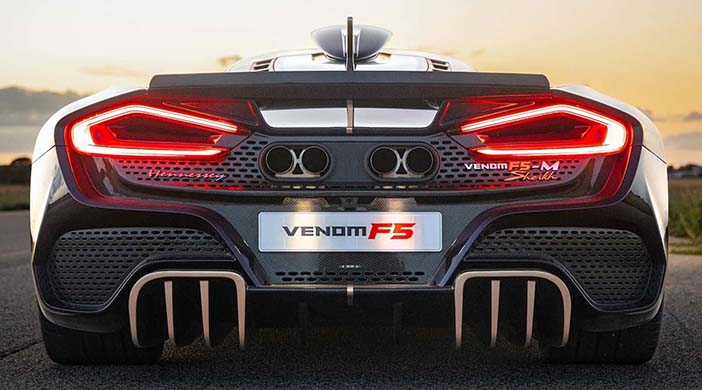
Hennessey first announced the F5-M back in 2024, promising a 6-speed gated manual transmission paired with 1.817 horsepower. But the production version takes things up a notch. The Venom F5-M now produces a staggering 2.031 hp from its twin-turbocharged 6.6-liter V8. That makes it one of the most powerful production cars on the planet, trailing only the Rimac Nevera R (2.107 hp) and Koenigsegg Gemera (2.300 hp). All of that power is sent exclusively to the rear wheels through a 6-speed gated manual transmission. The monster powertrain sits inside a new carbon-fiber monocoque chassis wrapped in revised bodywork, including an integrated roof scoop and a massive 55.0-inch dorsal fin designed to generate additional downforce, especially at over 320 kph. The F5-M will be offered exclusively as a roadster and introduces adaptive suspension to the Venom line-up for the first time. The first production F5-M, shown here, was commissioned by a UK customer working with Hennessey’s bespoke Maverick division. It wears exposed purple carbon fiber, real 24-karat gold accents, and hand-painted flags on either side of the dorsal fin. It even bears the family name of its very lucky owner: ‘Sheikh’. Qwning one of these manual American hypercars won’t come cheap. Hennessey plans to build just 12 examples of the Venom F5-M, each priced at $2.65 million. Not that the standard coupe is that much cheaper, with a starting price of around $2.1 million for the coupe. +++
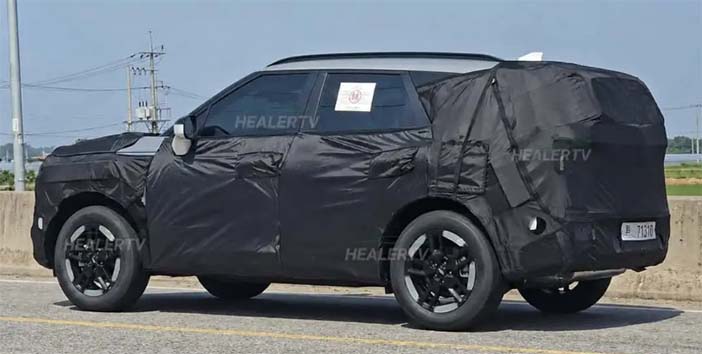
+++ They say never change a winning team, but KIA can’t let its best-selling model stand still while the competition moves forward. With nearly 570.000 units delivered last year, the Sportage was the company’s most popular product, accounting for just over 18 percent of total deliveries. That’s even though the fifth-generation model debuted back in 2021, though it did receive a mid-cycle facelift 3 years later. Kia has now been spotted testing the next-generation model on its home turf. A heavily camouflaged prototype of the redesigned Sportage appears to conceal a more upright shape. At the same time, we get the impression the test vehicle is slightly larger than the current model. Eagle-eyed viewers will also notice the turn signals are mounted unusually low in the corners of the rear bumper. It’s a common, albeit annoying, trait among Korean cars to separate the turn signals from the main taillights and position them low, making them harder to see from behind.
Even more significant changes are expected inside with the addition of the new Android-powered Pleos Connect system. The next-generation infotainment setup has already appeared in a handful of Hyundai models, and it looks as though the next Kia Sportage will get it as well. A large screen dominates the center console, but we’re hopeful some physical controls will survive. The two Korean brands have made a point of keeping conventional switchgear for frequently used functions such as climate and audio controls. New entries like the Hyundai Ioniq 3 feature a physical row of buttons below the supersized central screen. If the next Sportage follows suit, it should adopt a similar layout, including a rectangular digital instrument cluster mounted deep into the dashboard while remaining within the driver’s line of sight. +++
+++ If you think the POLESTAR 2 is stylish, just wait until you see what’s coming in 2027. The all-new Polestar 2 will kick off the brand’s second chapter, being the first Polestar model to replace an existing car. It won’t hold back when it comes to design, either, as it’s set to morph into more of a sporty saloon. The new 2 will be the first model shaped by CEO Michael Lohscheller and new design chief Philipp Römers. Polestar poached Römers from the Volkswagen Group, where he designed the Audi e-Tron GT and Volkswagen Golf VII; cars with handsome proportions. Römers said the 2’s stance is set to change dramatically. The current car is a jacked-up notchback peppered with SUV-style cladding; elements I expect to be diluted on the replacement car. I asked Römers directly if the ride height would be lower and he answered intriguingly: “The new design language, the strong evolution we are doing, it would change a few things. But today’s design is a good car, as you know”. However, with the current Polestar 2 being so successful, the new car will tread the fine line between evolution and revolution. “The Polestar 2 is a very successful car”, added Lohscheller, previously the boss of Opel. “We have more than 180.000 cars on the road, so I don’t think we will have a revolution. The basic role of this new car is to keep those customers, but of course we’re thinking about improvements in battery tech and range”. The teaser image supplied by Polestar looks closer to the ground, so we can expect a sportier saloon that’s significantly longer too, as confirmed by Lohscheller. Today’s car is just over 4.6 meter long: a 100 mm stretch would make it the same length as today’s BMW 3 Series. Lohscheller said: “It will keep all the great things and add a few things that the current car didn’t address in the optimal way: the car is a little longer. Customers told us that they would like a bit more room in the back, and that’s exactly what this car does; it’s beautiful and keeps the good things of the current one and adds things that were not optimal”. Römers says he’s keen to accentuate horizontal design cues, which will visually lower the car.

The front end will be dominated by Polestar’s ‘dual-blade’ headlamps, as well as “characterful details: no traditional grille and the Polestar 3’s bridge”. This is a raised section across the nose which pushes air onto the bonnet to improve aerodynamics. Both Römers and Lohscheller are determined to emphasise the car’s performance. “It’s something we want to address even more and that gives me an opportunity”, said Römers. And he namechecked ‘the Beast’, Polestar’s high-performance, special edition from 2022. It had 476 hp, an aggressive bodykit and lowered suspension. “This is inspiration for the future, because it looks sporty”. Precise technical details are still under wraps, with the 2’s premiere set for 2027. Unusually, the 2 launched as a front-wheel-drive car but switched to rear-wheel drive in its midlife facelift to boost efficiency. Today’s standard-range car packs 272 hp and 550 km of range, with the flagship dual-motor variant kicking out 422 hp and sprinting from 0-100 kph in 4.3 seconds. The long-range, single-motor car posts the best range, at 654 km. Polestar will also offer superior charging to the current model’s 200 kW public DC charging peak. The 2’s sister car, the Volvo EX60, showcases the technological progress we can expect: peak power spans 375 hp to 580 hp, and the longest-range model covers 805 km on the WLTP cycle. With the new 2 having more space to stow batteries, expect a far superior range to the outgoing car’s. The interior design will also reflect Polestar’s sporty ethos. The cockpit will be more driver-oriented, with the screen angled towards the driver. Römers will also use more vibrant colours than today’s grey-dominated shades and a warmer, more human user interface with more switches. The new design is enabled by a box-fresh vehicle architecture. Boss Lohscheller has railed against the number of car platforms the Swedish EV-maker currently uses: “Over time, I want to harmonise architectures, because we have too many different ones”. The outgoing 2, Polestar’s SUVs and the all-aluminium 5 performance GT are all based on different vehicle platforms. That’s a luxury for any car maker, let alone one that sold only 60.000 cars in 2025. Spurred on by its crippling losses and the strategic direction of owner Geely Holdings, Polestar is regrouping on a new platform that will feed a number of the group’s brands. Sister marques include Geely, Lotus, Lynk&Co, Volvo and Zeekr, and in autumn 2024 owner Li Shufu’s ‘Taizhou Declaration’ called for more component and powertrain sharing across the group to squeeze out unnecessary expenditure. Lohscheller referred to the new underpinnings as “a group architecture”, noting that Volvo executives have also publicly spoken of their integration into family R&D. “We have access to probably the best EV technology in the world. How about we integrate this in a group architecture where Volvo and Geely play a key role? It’s our intention to use it widely over time”. And it’s not just about hardware, as car makers embrace the shift to Software Defined Vehicles (SDVs) knowing that connected features and the onboard digital experience are the new automotive battleground. Lohscheller said: “You need to have cutting-edge software stacks and central core computing”, which is the ultrafast-processing power that enables hi-tech safety, autonomous and dynamic features. He added: “All this can be done, but it needs to be well planned. The companies who have done it, it took them years”. The CEO confirmed that the new platform has the flexibility to support a variety of vehicles, with different lengths, tracks and wheelbases, and suitability for both high-riding and low-riding cars. That will enable the 2 and the 7, the mid-size-SUV that will follow it to market in 2028, to use the same underpinnings. And Römers is incredibly nonchalant about the Geely group’s technological convergence. “I’m happy that I arrived at a time where we want to share platforms and set our brands in clear directions to avoid a horse-race mentality”, said the head of design. “It’s the same in Volkswagen Group: the brands share platforms but a Volkswagen is completely different to an Audi”. +++
+++ RANGE ROVER is poised to unwrap one of its most crucial models in years as it looks to take on the BMW iX3, Mercedes-Benz GLC and Volvo EX60 with a sleek new electric SUV that will replace the Velar and the brand has confirmed a combustion version will follow. The upcoming crossover is at an advanced stage of testing and is tipped for a debut within the next 6 months. It will arrive as part of a wave of models that will end a long period of new-product drought for JLR, which has not launched an all-new model since the Range Rover Sport in 2022. The company’s focus for now is on the long-awaited Range Rover Electric and Jaguar Type 01 flagships, both of which will be revealed by the end of the year. JLR will then move to introduce more volume-oriented electric models, including the rakish new iX3-rivalling crossover and a chunky entry-level 4×4 known as Defender Sport. They will be the first models based on JLR’s new EMA platform, which had been planned as an electric-only architecture. However, it has since been confirmed that it will also be compatible with hybrid powertrains as part of an effort to offer more choice across the JLR portfolio. The company said last week that while future Jaguars will be all-electric and the full-size Range Rover models will offer the choice of ICE and electric power, the first EMA car (confirmed as the smaller Range Rover crossover) “is planned to provide flexibility in the future through a full hybrid electric vehicle propulsion offering”. The hybrid powertrain is said to be a “unique new addition to JLR’s propulsion portfolio”, suggesting it will be unrelated to the ICE powerplants it currently offers across its range. The Range Rover crossover will be followed by a “new model from the Defender family”. This will be the long-awaited Defender Sport, which will also offer hybrid and electric power. JLR said the move recognises that global demand still exists for combustion engine-based drivetrains, and it marks a return to an earlier plan to offer the EMA as a multi-fuel platform. It remains to be seen if the firm will offer the smaller cars with a range-extender system, as had originally been mooted. The crossover is among the last of the models to be shaped under the stewardship of former JLR design boss Gerry McGovern. It will represent a dramatic break from Land Rover and Range Rover by eschewing a traditional high-riding, two-box SUV silhouette. Instead, it adopts a sleeker and more rakish look that appears to ride closer to the ground and has the air of a saloon car; similar to the Polestar 4 and DS N°8 in profile. Its roofline is sharply angled down to the rear, where a small, saloon-style deck extends out of the back and around the sides to give a muscular look to the rear haunches. Prototypes seen testing have had their rear decks camouflaged, suggesting the new SUV will forgo a traditional rear screen in favour of a digital rear-view camera, like the Jaguar Type 01. The arrangement boosts rear-seat head room because it does away with the bulky header rail that’s needed with a glass pane. JLR has yet to comment on the design of its new model, but the bold shape will help to distinguish it from its range-mates. This is in line with the company’s push to segregate more categorically its various model families, in this case by emphasising a greater focus on long-distance refinement than outright utility or off-road capability. The move to a ‘segment-straddling’ bodystyle could also help the model compete more effectively in a segment in which many rivals field a technically identical saloon and SUV, such as the BMW i3 and iX3, the Mercedes GLC and C-Class EVs and the Audi A6 and Q6 e-Tron. Despite having a silhouette and footprint that are similar to the current Velar’s, however, it is not yet confirmed whether the new model will use that name, as has been widely speculated. JLR is working to build its best-performing and longest-standing nameplates (Discovery, Range Rover, Defender and Jaguar) into brands in their own right, and it will begin to introduce distinct, stand-alone model lines under each of those 4 banners. It is not yet clear, however, how ‘Velar’, which has only been used for a production car since 2018, fits into that strategy. The new mid-sized Range Rover crossover is set to become one of JLR’s best-sellers and certainly one of its most popular EVs in the medium term, along with the smaller and possibly cheaper Defender Sport. But it will need to be suitably technically equipped if it is to compete with its German and Swedish rivals. The BMW, Volvo and Mercedes each offer a maximum range of around 800 km in their longest-legged forms, and they are capable of charging at well over 300 kW, which significantly enhances their appeal as long-distance executive models. JLR has not yet released the specifications of any of its EMA-based models, but it is likely to equip the EV architecture with the same 800V hardware that is said to allow the larger electric Range Rover to top up as quickly as the fastest-charging EVs on sale. It is not yet known if the smaller Range Rover EV, which is thought to be roughly as long as the current combustion Velar, at 4.8 meter, could take the same substantial 118 kWh battery pack as its bigger sibling. However, the EMA is understood to have been engineered as an ‘electric-first’ architecture. So while the full-fat Range Rover’s MLA platform was designed to be multi-fuel from the beginning, with provision for an ICE drivetrain in the chassis, it’s possible that more cells could fit into a smaller wheelbase on an EMA-based model. For reference, the iX3 and EX60 both pack more than 110 kWh of capacity in their longest-range forms. It is unclear if JLR, which is synonymous with 4×4 drivetrains, will equip this road-focused model with a cheaper and more efficient single-motor arrangement. The firm has sold two-wheel-drive options since 2010, but only on the entry-level Freelander and Evoque models. The EV’s batteries will come from the €4.6 billion Somerset battery factory currently being built by Tata-owned Agratas and which will produce units for JLR and other customers. The facility is due to open next year, following a series of delays, and has a targeted outright capacity equivalent to 500.000 EV batteries per year. It will supply JLR’s production lines in Solihull, where the firm will build the Range Rover and Jaguar EVs, and Halewood, where the new mid-sized SUV is due to be built. The Merseyside site currently produces the Discovery Sport and Evoque, but it is undergoing a €575 million makeover so it can manufacture EVs. The Velar-sized SUV and Defender Sport are due to be the first, and they could in time replace the petrol-engined crossovers, which are seven and eight years old respectively. However, JLR has already said Halewood will remain capable of building pure-combustion and hybrid models alongside their electric counterparts. So the latest announcement that the EMA can accommodate hybrids suggests that EV and HEV versions of the new ‘Velar and Defender Sport will be built in sequence there. JLR’s incoming rakish SUV will be the first all-new model released under the stewardship of PB Balaji, whose appointment as JLR CEO last year was seen as an attempt by parent company Tata-where he had previously been finance boss – to take a tighter grip on the reins of its highly profitable British subsidiary. Automotive industry newcomer Balaji faces a tough task in steering JLR through the innumerable global headwinds currently battering the automotive Industry. The company is recovering from the crippling cyber attack that knocked out all of its production lines for several weeks last year, and JLR is still grappling with the challenges of import tariffs in the crucial US market, intense competition in China and the forthcoming imposition of new ‘Made in Europe’ rules that could threaten the viability of UK-built cars in the EU. Introducing a new car with higher volume potential than the upmarket Range Rover and Defender models will be pivotal in helping the firm to preserve its market share while navigating these choppy waters. But it will be just as important in boosting JLR’s electric vehicle mix in a market that so far has been lukewarm to full-blown electric luxury cars. The electric version of the Velar-sized SUV will arrive around the same time as the electric Range Rover and Range Rover Sport, as well as Jaguar’s long-awaited Type 01 GT. But while those three will be priced above €120.000 and pitched into the luxury sector, this smaller new entrant has a crucial role to play in stealing sales from the likes of the BMW iX3, Volvo EX60 and Mercedes GLC Electric. Unlike those rivals, JLR’s new mid-sized SUV does not have to take the role of playing the electric alternative to a combustion-powered best-seller: the current Velar outsold only the ageing Discovery and Discovery Sport last year in Land Rover showrooms, but the model will be vital in maintaining the brand’s footprint in a key segment as it transitions to electric power. Faltering demand for electric luxury models worldwide has prompted many marques (including Aston Martin, Bentley, Lotus and Porsche) to delay or scale back their plans to electrify their line-ups fully in recent years. JLR itself is bringing its flagship Jaguar and Range Rover EVs to market later than planned partly, it is understood, in anticipation of the market picking up. Electric powertrains are, however, proving far more popular lower down the pricing scale in the premium sector, where large-capacity engines and thrilling exhaust notes have traditionally been less central to a car’s appeal. Indeed, BMW has already added a second shift at the iX3 factory in Hungary to cater to soaring demand: the EV notched up just over 10.000 sales in its first 2 months. Volvo, meanwhile, also boosted output following strong demand for the EX60, and Mercedes took more GLC orders in the first 3 months of production than for any of its previous EVs. +++
+++ In the UNITED KINGDOM , mainstream car brands from Europe, Japan and Korea are struggling to sell enough EVs to hit the British government’s tough targets but newcomer brands from China currently have it far easier. This has helped China gain a firm foothold in the electric and hybrid car market but proposed changes to EV sales rules could see major players like Jaecoo and Chery in hot water. Analysis from transport research firm, New AutoMotive, suggests that major automotive names such as Volkswagen Group and Stellantis are struggling to keep up with the targets set under the British Government’s ZEV Mandate. The current rules necessitate a third of all the cars a manufacturer sells being fully-electric. Reducing engine emissions and borrowing ‘credits’ from future years or rival manufacturers that are compliant are other ways to avoid fines of €14.000 for every non-compliant car sold over the threshold. Chinese manufacturers have enjoyed huge success in the first half of 2026, accounting for 15 percent of total UK car sales; according to the Society of Motor Manufacturers and Traders (SMMT). The Chinese-made Jaecoo 7 is the third-best-selling car so far this year, while the BYD Seal electric saloon made its way into the top 10 EVs. New AutoMotive also says the likes of BYD, SAIC (the owner of MG), Chery (the owner of Jaecoo and Omoda), Geely (the owner of Lotus and Polestar) and XPeng are all complying with the ZEV Mandate rules. However, the research firm’s CEO, Ben Nelmes, says that this compliance could actually be down to an unfair advantage in the ZEV rules enjoyed by newer brands. While legacy manufacturers can earn credits by selling vehicles with lower emissions than their own average prior to 2021, manufacturers that have arrived since that point must instead meet a target based on industry-wide emissions in the year before they entered the market. “It’s a design of the scheme that has meant that some of the new entrants have very low estimated real ZEV targets. In my view, that was a bit of a mistake in the design of the regulations, and I really hope the British government fixes it in the course of the forthcoming consultation”. In fact, Nelmes estimates that a change in the regulations could see major Chinese brands such as Chery needing to buy or borrow credits to comply. “EVs don’t feature particularly heavily in their sales”, he pointed out. “The current requirements are too lax and it needs to be fixed. My guess would be that the likes of Chery would see their credit balance turn red pretty quickly”. In the meantime, 2 brands currently in the ‘red’ are Volkswagen Group and Stellantis, who are navigating large credit deficits of 5.367.3 and 9.416.3 respectively. Taking into account aforementioned credits issued due to emissions reductions, the 2 automotive giants need to ensure around 26 percent and 30 percent of their sales respectively are full-EV. However, despite the introduction of the Government’s £3,750 Electric Car Grant as well as heavy dealer discounts, VW and Stellantis have only managed to achieve EVs as a 23 percent proportion of overall sales. Nelmes told that “The 2 companies have quite a different story going on. VW finished with a significant surplus of credits last year, which are bankable. So what we’re seeing is that they don’t necessarily need to make their numbers go green for this year. Stellantis is a bit of a different story”, Nelmes continued. “They’re behind target and they were behind last year as well. They’re doing a decent job of selling EVs and hybrids, but both of those things are just not enough to bring them to the target”. While VW and Stellantis are certainly the standout problem cases, almost every other European, Japanese and Korean automotive conglomerate is also struggling to shift enough EVs to satisfy the UK Government. In fact, the only European brand to do so is Renault which, thanks in part to the success of the 5 E-Tech, is estimated to be over 2.000 credits clear of the threshold by year end. With this in mind, the SMMT’s chief executive, Mike Hawes, is also calling for change to the rules. He highlighted how; “record sales levels are still not enough to meet mandated targets. Manufacturers are investing billions developing and bringing the vehicles to market – and spending billions more to sell them, yet the market is still not moving fast enough. Reforming the mandate now is essential not just to keep the transition on track but to protect the UK’s competitiveness, attract investment and safeguard jobs”. At the other end of the spectrum, CEO of Electric Vehicles UK, Tanya Sinclair, said that “The government just needs to align itself with the British motorist’s direction of travel, not certain carmakers’ lack of ambition, towards an electric future”. In June the Government confirmed it will hold a consultation on reforming the ZEV Mandate to more realistically match demand. EVs accounted for 30 percent of all new cars sold last month and roughly a quarter of registrations in 2026 so far; last year, EV market share stood at 21.6 per cent at the end of H1. In total, over 1.1 million new cars were registered in the first 6 months of 2026, with market share of petrol and diesel cars reducing in volume and the slack taken up by hybrids and EVs. +++