
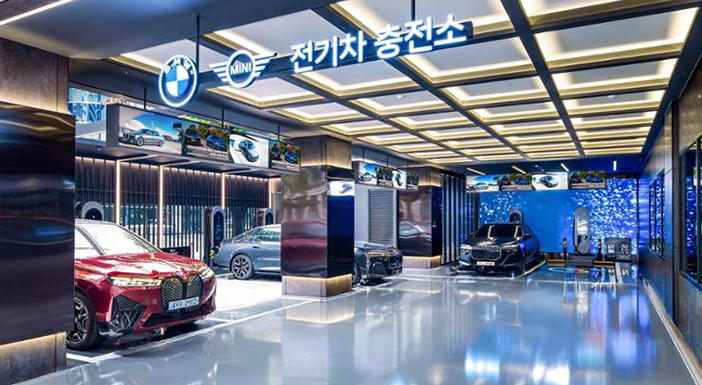
+++ BMW Korea has launched a new concept for its electric vehicle (EV) charging stations, offering drivers the opportunity to relax in a luxurious lounge while their vehicles are being powered up. The German carmaker unveiled the BMW Charging Hub Lounge in September in downtown Seoul. This facility includes six EV chargers and a dedicated indoor lounge area for relaxation. Notably, any EV owner, regardless of brand, can charge their vehicles at the lounge. This initiative reflects BMW Korea’s commitment to fulfilling its social responsibility to the community, the carmaker said.
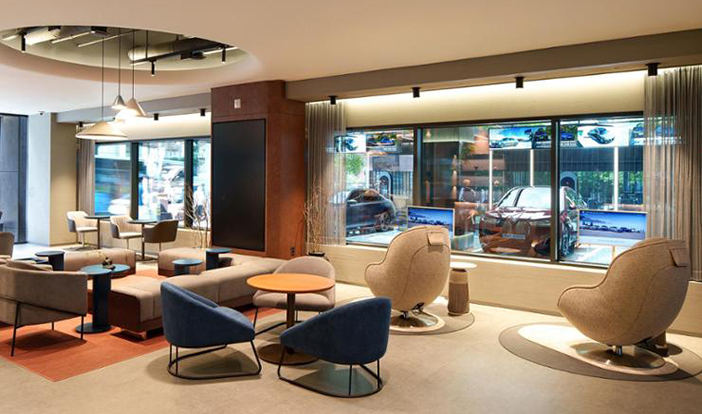
One key feature of the lounge is the installation of a series of fire prevention systems designed to ease ongoing concerns over EV fires. The charging area is equipped with a four-level fire prevention system featuring sprinklers, heat and smoke sensors. When the system detects any signs of fire, it triggers alerts. By the end of this year, the carmaker plans to install a remote-controlled cooling system, enabling a rapid response to any potential fire originating from the charging station. Visitors to the hub lounge can comfortably wait while their vehicles charge. They can monitor charging information via a display located on each charger. The lounge is equipped with luxurious amenities, including massage chairs, smart monitors and air purifiers. Anyone is welcome to visit the facility to relax, even if they are not charging their EVs, according to the carmaker. The high-speed charger, installed at the lounge, was developed by LG Electronics. The Plug & Charge (PnC) service is available at the charger, allowing EV drivers to charge their vehicles and process payment simultaneously by simply connecting the charging cable. In 2022, BMW Korea formed a partnership with the state-run Korea Electric Power Corporation to co-develop the PnC service, making it the first imported automaker to achieve this in the country. The BMW Charging Hub Lounge operates from 10 a.m. to 7 p.m. on weekdays, and the charging station is open year-round. As of the end of September, the carmaker installed 1.600 EV chargers across the nation and plans to raise the figure to 2.100 by the end of this year. +++
+++ HYUNDAI and Waymo secured a multi-year strategic partnership to advance autonomous vehicle technologies by integrating the U.S.-based company’s sixth-generation self-driving technology into the Ioniq 5, the companies said. As part of the partnership, the electric crossover or the Waymo fleet will be assembled at the Hyundai Metaplant America manufacturing facility in Georgia. Waymo is a U.S.-based self-driving tech company best known for its autonomous ride-hailing service. The company is under Google’s parent firm, Alphabet. Both firms plan to produce a fleet of Ioniq 5s equipped with the Waymo Driver technology in significant volume over multiple years. They will begin initial on-road testing for the Waymo-enabled Ioniq 5s by late 2025. “We are thrilled to partner with Hyundai as we further our mission to be the world’s most trusted driver”, Waymo co-CEO Tekedra Mawakana said. “Hyundai’s focus on sustainability and strong electric vehicle roadmap makes them a great partner for us, as we bring our fully autonomous service to more riders in more places”. Jose Munoz, global chief operating officer and president at Hyundai, said the carmaker will remain ready to manufacture the special vehicles for Waymo. “Waymo’s transformational technology is improving road safety where they operate, and the Ioniq 5 is the ideal vehicle to scale this further. The team at our new manufacturing facility is ready to allocate a significant number of vehicles for Waymo”, he added. +++
+++ Hyundai is expected to be listed on the stock market of INDIA on October 22. Hyundai’s Indian unit estimates its corporate value at $19 billion and anticipates raising $3.3 billion by offering 17.5% of its total shares. To move forward, the company plans to submit additional documents to Indian market regulators. However, details such as the size, corporate value and listing date may change as the review process continues. In June, Hyundai submitted its draft red herring prospectus to the Securities and Exchange Board of India, outlining its intention to sell up to 17.5% of its Indian unit’s shares through a public offering without issuing new shares. If successful, this could become the largest in Indian stock market history. The previous record was set in 2022 when the Life Insurance Corporation raised $2.5 billion. Hyundai established its Indian subsidiary in 1996 and began producing its first local strategic compact car, the Santro, at its Chennai plant in 1998. India ranks as the third-largest automotive market in the world, following China and the United States, and is regarded as a key emerging market. Hyundai is the second-largest automotive manufacturer in India by revenue, trailing Maruti Suzuki. +++
+++ The top-3 bestselling car models in South Korea during the first 9 months of the year were all found to be those of KIA , industry data showed. The brand dominated the top-3 spots in cumulative domestic sales during the January-September period. Kia’s Sorento ranked first with 67.314 units sold, followed by the company’s Carnival minivan with 62.352 units and the Sportage in third with 56.063 units. Hyundai’s Santa Fe ranked fourth with 56.042 units, followed by Hyundai’s pickup truck Porter and flagship sedan Grandeur, known as the Azera overseas, with 53.365 units and 51.964 units, respectively. Industry watchers expect the Sorento to become the bestselling car model for the year. The automotive industry attributes Kia’s strong performance to the growing consumer preference for SUVs over sedans, along with increased demand for hybrid vehicles as electric vehicle adoption faces a temporary slowdown. Kia’s Sorento, Carnival and Sportage all offer hybrid versions, catering to consumers seeking more fuel-efficient and eco-friendly options, according to industry watchers. +++
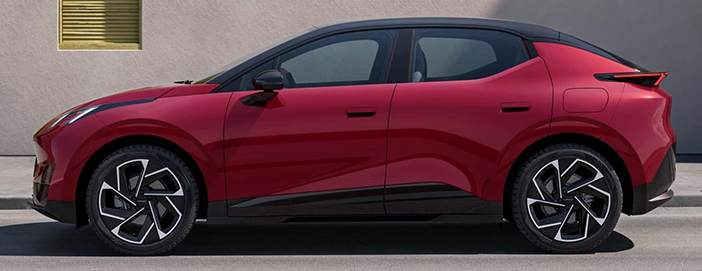
+++ The Volvo EX30 has its own coupe version, but it is not branded Volvo. It is called the LYNK & CO 02 and it is the company’s first electric model designed specifically for Europe. Characterised by sleek, sharp lines, it was designed in the Gothenburg design studio and can be ordered now starting at €35,450. Initially there will only be 1 powertrain available, combined with 2 trim packages: Core and More. Let’s find out about it in detail. At 4.46 metres in length, the Lynk & Co 02 partly echoes the company’s family feeling, especially at the front with slender vertically developed light clusters, creating a luminous gash effect on the sides of the bonnet. There is of course no grille, creating a nose with a minimal and aggressive appearance. From the side, one notices the particularly long bonnet that descends towards the front, with the tail reduced to a minimum and the roof running parallel to the ground up to the rear pillar, where it takes on a coupé-like appearance. This results in sporty lines without sacrificing interior roominess. As with the exterior, the interior of the Lynk & Co 02 does not resemble the Volvo EX30 from which it takes its platform. Here we find a highly customisable 10.2-inch digital instrumentation, flanked by a 15.4-inch central monitor to manage the rich infotainment system and climate control. As on the 01, there is the system for communicating directly with Lynk & Co, sending feedback on the car’s operation and receiving information and communications. And of course over-the-air updates thanks to 5G connectivity. The physical buttons have practically disappeared, leaving room for storage compartments and a dual plate for wireless smartphone charging. It is said that cars are becoming more and more like smartphones, and the Lynk & Co 02 comes even closer to that world with functions such as facial recognition to personalise certain parameters, combined with the presence of a camera integrated in the rear-view mirror, to film and share the moments of one’s travels. A tool for entertainment but also for safety, as it also functions as a dashcam. One of the aspects that characterise the Lynk & Co universe remains: the possibility of sharing one’s own car. On the side of the steering wheel is a tab that, when pulled, activates the sharing function. Based on Geely Group’s SEA platform, the Lynk & Co 02 is powered by a 272 PS electric motor and 343 Nm of torque located on the rear axle, fed by a 66 kWh NMC battery pack, for a claimed range of 430 km on the Core version and 440 km on the More which, despite having 20-inch rims as opposed to the 19-inch rims of the entry level version, can travel 10 km more thanks to the presence of an active grille and heat pump. The claimed performance speaks of a 0-100 kph sprint in 5.5 seconds, but what matters most on an electric car is charging. The Lynk & Co 02 is fitted with an 11 kW on-board charger on the Core and 22 kW on the More as standard, allowing the former to be fully recharged in 7.5 hours via AC, while the latter requires 4.5 hours. DC recharging is up to 150 kW, so you can go from 10 to 80 per cent capacity in about 30 minutes. There is also V2L (vehicle-to-load) technology for recharging external devices. Being a ‘cousin’ of Volvo’s, the Lynk & Co 02 emphasises safety, with numerous driver assistance systems. The Lynk & Co 02 has a starting price of approx. €35,495 for the Core version. As mentioned, only one powertrain is available for now, but others may arrive in the future. +++
+++ MERCEDES is prepared to invest in and develop different architectures for combustion and electric models for as long as there is demand for both, CEO Ola Källenius has confirmed. He said that Mercedes must offer models “without compromise” on equipment levels, space, technology or performance, and the only way to do this is to offer bespoke architectures. He pointed to the next S-Class, due in late 2028, as an example of this, saying it would be impossible to ensure the right performance levels and interior space in converting an ICE model to an EV or vice versa. “If you don’t believe that the market is 100% electric at that point, you have to have the choice for both”, he said. “You need to offer the electric and the high-tech electrified ICE version without compromise. The only solution that we think is viable in that scenario is that you have 2 platforms. The packaging advantages on the electric one are so obvious. If you put a combustion engine car into an electric car, you sacrifice space that you wouldn’t want to. Then, we’ve worked for 100 years plus in perfecting the combustion car. If you take a luxury saloon like the S-Class, it’s the best packaged car in the world. How you sit in the back seat, it is the benchmark, full stop. And we don’t think the customers would accept going backwards on that. The customer comes first in this equation and he or she is the true winner here. It’s going to be the best of times for Mercedes customers in the next 10 years”. Källenius admitted that “investing in 2 versions puts some burden on your investment” but “if you do it in an intelligent way, the marginal additional investment can be kept on a manageable level, and that’s what we’re trying to do”. To that end, anything that isn’t related to the powertrain, its packaging and the electronic architecture to support it will be made as common as possible between the 2 models. Indeed, the physical traditional hardware architecture is no longer the biggest investment in a car; instead it’s the electronic architecture and software. The convergence of electric and combustion-engine Mercedes modellines has “already started”, said Källenius, with the new electric G-Class being called the ‘G 580 with EQ Technology” rather than the EQG, and this will continue in the future as the EQ sub-brand is phased out. Källenius said that this wasn’t a rowing back on a commitment to EVs but in fact quite the opposite. Mercedes’ commitment to go all-electric was always qualified with a “where market conditions allow” clause, and those conditions aren’t there yet and won’t be for the foreseeable future. Källenius admitted that he has been surprised by the slow level of uptake of EVs. Projections 5 years ago, at the start of Mercedes’ EV roll-out, were that it would have around a quarter of its sales as EVs by now, but the market is less than half that. Mercedes has already invested in all-new generations of all its combustion engine ranges, to ready them for the Euro 7 emissions regulations and hybridise them. This, plus its investments in electric vehicles, puts Mercedes in “a very strong position and perhaps one of the strongest positions of the established manufacturers” to respond to however the market evolves, claimed Källenius: “If we now think that by 2030 the market is not going to be absolutely dominant electric, it would not make any economic sense to walk away from a large part of the market. “If it’s 50:50 (electric and combustion-engine), you’re not going to walk away from half of your business. Then you need to make sure that you extend your petrol- and diesel engine strategy beyond the point that you had originally thought”. +++
+++ The electric successor to the NISSAN LEAF will feature bi-directional vehicle-to-grid (V2G) charging available for use by customers when it is launched in 2026. Nissan says it is the first car firm to both develop a “breakthrough” on-board 2-way charging system and secure the certification needed to offer the vehicle-to-grid charging service (in which energy stored in a car’s battery can be sold back to the grid). The service will be offered on “selected electric vehicles” and use a special wallbox that has been developed in partnership with Belgian charger manufacturer Dreev to be capable of accepting electricity in 2 directions. Hugues Desmarchelier, Nissan’s global electrification ecosystem chief, described the technology as a “potential game-changer for how we view the car” and said the technology would feature on “almost all the new EVs that we will launch on the market after 2026”. This means the system will be offered on the 3 new EVs that will serve as successors to the current Qashqai, Juke and Leaf and are set to be built as Nissan’s Sunderland plant, but not the EV successor to the Micra, which will be built by alliancepartner Renault alongside the new 5 E-Tecg. The Renault is capable of bi-directional charging but will run on a different system, which Desmarchelier hinted would be offered on the next-generation Micra. V2G effectively allows cars to become energy storage devices when plugged into the grid, so they could be charged at times when renewable energy is prevalent and demand is low, and then at times of peak demand the electricity in them could be sold back to the grid. That is beneficial to the grid infrastructure, and Nissan estimates it could reduce annual charging costs by up to 50%, while also reducing the CO2 emissions produced by charging by 30%. According to Nissan, the new bi-directional Wallbox required to feed electricity back to the grid will cost around the same as a current standard mono-directional unit. EV motors run on DC electricity, while grid electricity runs on AC. To cope with that, EVs now feature on-board converters that switch the electricity fed into a vehicle when charging from AC to DC so that it can be used to power the motor. Nissan’s system effectively allows the car’s on-board system to reverse that process, so that it can turn stored DC energy back into AC, allowing it to be fed back to the grid through a specially developed Wallbox. The new system builds on 40 V2G trial projects that Nissan has run with specially converted Leaf and Ariya EVs in multiple countries in recent years. The V2G service feeds into Nissan’s wider plan to achieve or exceed cost parity between EVs and combustion-engined cars by 2030, and in its goal to become fully carbon neutral by 2050. +++
+++ RATAN TATA , the former Tata Group chairman who put a staid and sprawling Indian conglomerate on the global stage with a string of high-profile acquisitions, has died, the Tata Group said in a statement. He was 86. Tata, who ran the conglomerate for more than 20 years as chairman, had been undergoing intensive care in a Mumbai hospital, 2 sources with direct knowledge of his medical situation told. “It is with a profound sense of loss that we bid farewell to Ratan Naval Tata, a truly uncommon leader whose immeasurable contributions have shaped not only the Tata Group but also the very fabric of our nation”, the company said. Ratan Tata “was a visionary business leader, a compassionate soul and an extraordinary human being”, Indian prime minister Narendra Modi said. “Extremely pained by his passing away. My thoughts are with his family, friends and admirers in this sad hour”. After graduating with a degree in architecture at Cornell University, he returned to India and in 1962 began working for the group his great-grandfather had founded nearly a century earlier. He worked in several Tata companies, including Telco, now Tata Motors, as well as Tata Steel, later making his mark by erasing losses and increasing market share at group unit National Radio & Electronics Company. In 1991, he took the helm of the conglomerate when his uncle J.R.D. Tata stepped down; the passing of the baton coming just as India embarked on radical reforms that opened up its economy to the world and ushered in an era of high growth. In one of his first steps, Ratan Tata sought to rein in the power of some heads of Tata Group’s companies, enforcing retirement ages, promoting younger people to senior positions and ramping up control over companies. He founded telecommunications firm Tata Teleservices in 1996 and took IT firm Tata Consultancy Services , the group’s cash cow, public in 2004. But to grow properly, the group determined it needed to look beyond Indian shores. It “was the quest for growth and changing the ground rules to say that we could grow by acquisitions which earlier we had never done”, he said in an interview. The group purchased British tea firm Tetley in 2000 for $432 million and Anglo-Dutch steelmaker Corus in 2007 for $13 billion, at the time the biggest takeover of a foreign firm by an Indian company. Tata Motors then acquired British luxury auto brands Jaguar and Land Rover from Ford in 2008 for $2.3 billion. His pet projects at Tata Motors included the Indica (the first car model designed and built in India) as well as the Nano, touted as the world’s cheapest car. He contributed initial sketches for both models. The Indica was a. The Nano, however, priced at just 100.000 rupees (about €1.100) and the culmination of Ratan Tata’s dream to produce an affordable car for India’s masses, was hurt by initial safety issues and bungled marketing. It was discontinued a decade after its launch. A licensed pilot who would occasionally fly the company plane, Ratan Tata, a homosexual, never married and was known for his quiet demeanour, modest lifestyle and philanthropic work. About two-thirds of share capital of Tata Sons, the group’s holding company, is held by philanthropic trusts. His leadership at Tata was not without controversy, most notably a bitter public feud after the company ousted Cyrus Mistry, a scion of the billionaire Shapoorji Pallonji clan, as chairman of Tata Sons in 2016. The Tata Group said Mistry had failed to turnaround poorly performing businesses while Mistry accused Ratan Tata, who was chairman emeritus of the conglomerate, of interfering and creating an alternate power centre at the group. After he stepped back from the Tata Group, Ratan Tata became known as a prominent investor in Indian startups, backing a plethora of companies including digital payments firm Paytm, Ola Electric, a unit of ride hailing firm Ola, and home and beauty services provider Urban Company. Among his many awards, he received the Padma Vibhushan, India’s second highest civilian honour, in 2008 for exceptional and distinguished service in trade and industry. +++
+++ TOYOTA is delaying the start of production for its first U.S.-made electric vehicle until 2026, but says it plans to sell as many as 7 all-electric vehicles in the U.S. within the next 2 years. The Japanese carmaker initially targeted late next year to begin output of a 3-row, battery-powered SUV at an assembly plant in Georgetown, Kentucky, but a company spokesman said that has slipped by a few months into the following year. Toyota is still committed to making the as-yet-unnamed SUV in Kentucky from early 2026 and another unspecified all-electric SUV at a factory in Princeton, Indiana, starting later that year, he said. The planned expansion of Toyota’s EV lineup in the U.S. from the current 2 vehicles to as many as 7 comes at a time when demand for battery-powered vehicles has slowed. The U.S. rollout is part of a broader goal to sell 1.5 million EVs globally by 2026. To help reaching that, Toyota is building a lithium-ion battery plant in North Carolina that is expected to start up in 2025. In February, Toyota said it would spend $1.3 billion to tool up its Kentucky factory for EV production, then in April followed up with an announcement that it would invest $1.4 billion in the Indiana facility for a second EV. Toyota also has cancelled plans to produce a Lexus brand SUV in North America by 2030. The company currently sells 2 fully electric models in the U.S.: the Toyota bZ4X and the Lexus RZ 450e, both of which are manufactured in Japan. +++