
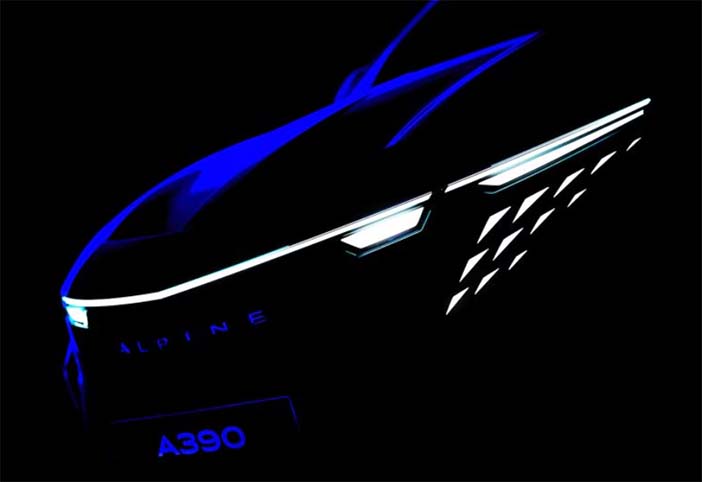
+++ The ALPINE A390 will be unveiled on 27 May as the French performance brand’s first electric crossover. Previewed by the A390 Beta concept that was displayed at last year’s Paris motor show, it has been conceived as “a bigger A110 for five” that pairs a futuristic fastback design with what Alpine believes to be best-in-class driving dynamics. It will use the Renault Group’s Ampr Medium EV platform (making it a relation of the Renault Scénic E-Tech) and be positioned as a rival to the likes of the BMW iX2 and Tesla Model Y. Alpine benchmarked the Porsche Macan-sized crossover against its own 4-cylinder sports coupé and claims its tri-motor powertrain (one at the front and two at the rear) combines with active torque vectoring to give the “driving dynamic of a lightweight car”. This set-up, Alpine CEO Philippe Krief confirmed, will also be adopted by the upcoming A110 EV. Chief designer Antony Villain said: “Most EVs are about just driving straight. Here the driving sensation is developed similar to the A110. This is mainly down to the torque vectoring”. The A390 Beta (inspired by the 2022 Alpenglow concept that serves as “the mother of all future Alpine cars”) is described as 80% production-ready. Villain confirms the front end will remain relatively unchanged, including the Le Mans-inspired central fin. Elsewhere, the concept’s alloys, designed in the shape of a snowflake (“both strong and light”), will light up blue when active torque vectoring is occurring. It has been confirmed that this will make production. Radical elements that won’t make production include the rear-hinged doors, the rear light strip-cum-spoiler (which can extend by up to 80mm to reduce drag) and the radical Formula 1-inspired interior, although these all point to “the future of the brand”, said Villain. That interior is centred on the hydraulically assisted driver’s seat, which can switch from the standard driving set-up to one that mirrors an F1 bucket. The pedals also raise, while the steering wheel transforms from wide to narrow and displays extra information such as the weather. The cabin has also been designed for the front passenger to “share the driving experience”. As well as getting the same type of seat (although without the ability to change position), a panel is fitted to the dash displaying upcoming road information. According to Villain, this means that they are “no longer a passenger but a co-pilot”. Elsewhere, the interior’s Alps theme can be seen in the white (snowy) seats and in the floor, which has been designed to mimic stones found on an Alpine pass. These light up when the car is moving, with beams travelling from front to rear to give the feeling that you’re floating over the road. Alpine wouldn’t be drawn on the battery, range or power the production car might possess, but Robert Bonetto, vice-president of Alpine Engineering, told it would “not aim to be the fastest” or the rangiest car of its type, because increasing the battery size would add weight. Instead it will offer “the right levels” and “be something that is still competitive”, he said. When it does arrive, it will come with a hefty price tag, said Krief: €100.000 so expensive enough to keep volumes lower than rivals. +++
+++ New electric powertrain technology will allow BMW GROUP to launch electric cars at a cheaper price but while offering more range and better efficiency than today’s cars, the firm has claimed. The Munich firm has been working on an entirely new electric vehicle architecture, which will start to be rolled out with its forthcoming line of ‘Neue Klasse’ models. Now labelled ‘Gen6’, the platform will first be used for the next BMW iX3, which will be unveiled in September and was previewed with the Vision Neue Klasse SUV concept. The 800 volt platform is claimed by BMW to be a “quantum leap forward” in terms of technology compared to today’s offerings. “Neue Klasse is not just a new car, it is a new technology”, said BMW Group purchasing and supply board member Joachim Post. The scalable platform will eventually also be used by all Mini and Rolls-Royce EVs before the end of the decade. It is centered around a new nickel manganese cobalt (NMC) battery that utilises cylindrical cells which are 20% denser and easier to package than modules (made up of square cells) found in today’s Lithium-Iron (LI) packs. The headline figures are that these new batteries increase range by 30%, efficiency by 20%, charging speeds by 30% (with bi-direction capabilities), and reduce production costs by up to 50% when compared to today’s packs. BMW has yet to give a capacity for the batteries that will be fitted. These costs (achieved through most of the development and building now being done in-house) will be passed onto buyers, said Post, instead of being swallowed as extra profit. “It is important to be competitive in the market from the price range in terms of reachability for the customers”, he said, adding that this will allow the firm to push for a price parity between ICE and EVs. To give an idea of the technology’s advancement, that range boost applied to the recently refreshed BMW iX (which in xDrive 60 form offers the most kilometres per charge in the brand’s stable) would increase its maximum range by 200 km to 900 km, with the ability to also add 300 km in as little as 10 minutes. Key to the technological advancements is the new cylindrical cells. They are built in-house in 2 sizes, either 95 mm or 120 mm tall and 46 mm wide. In both instances, they are easy to package because they do not require modules to fit them together like today, said BMW. As such, they can be attached directly to the pack (called cell-to-pack) which not only saves money as fewer parts are used, but reduces the weight and size of the batteries, allowing for slimmer batteries. As part of a “clean sheet way of thinking”, these packs are then bolted directly onto the bottom of the chassis and used as the base of the car. Today’s packs, for example, are fitted under the floor of the car, rather than forming the floor. This new technique, according to BMW, increases the chassis’ structural integrity, optimises car integration, saves money on parts, reduces weight, and maximises interior space. What’s more, it means no additional battery housings are required. Coupled with the new sleek pack, this allows for sleeker, flatter, and more aerodynamic car designs, potentially eliminating one of the major design hallmarks of today’s high-sided EVs. To maximise interior space within this setup and keep the cars’ heights as low as possible, BMW will unusually bolt the front seats directly to the pack, with the batteries energy master (which manages energy output and thermal levels) positioned below the rear seats. New and updated motors are similarly important to the Gen6’s advancements. The core drivetrain is the Electric Excited Synchronous Motor (EESM), introduced with the first-generation iX3 in 2018. It has, until now, been the only motor option offered on a BMW Group EV. This has now been heavily enhanced with an adapted inverter design, new water / oil cooling system, fettled weight and the single-speed gearbox integrated into its outer casing. It is offered in 4 variants that range from 275 hp to 408 hp and is exclusively attached to the rear axle, where up to two can be fitted, both, BMW suggests, with independent gearboxes. It weighs 120kg. New with the Gen6 platform is a small asynchronous motor (ASM) motor. Weighing just 70 kg it is offered with either 161bhp or 241bhp. It is fitted exclusively to the front axle, where (like the EESM) two can be had. This means BMW can now offer tri-, or dual-motor configurations alongside the single-, dual-motor setups that were solely available in today’s cars. The motors have been configured to be used for all models from entry level to top-rung M cars. M Division has been involved in the motor development process so this can be achieved, BMW said. A key brief of the new motors was efficiency. When combined in a dual-motor setup, the pair leak 40% fewer miles compared to two last-generation EESMs. What’s more they are 20% cheaper to make and weigh 10% less. “The motors are an important contributor to the Gen-6 powertrain”, said BMW. One limiting factor of the new platform is that because the ASM does not house a gearbox, it cannot be fitted on its own, meaning future BMW Group cars, such as the iX1 and Mini models, are not likely to be offered with single-motor, front-wheel-drive setup. One of the reasons for this decision is because a rear-wheel-drive setup is “better for dynamics”, BMW engineers told. These motors, like the batteries, are developed and built in-house at five factories across four continents. With as many materials as possible collected within the markets they are built in, this “ensures efficiency and enhances robustness against natural or political headwinds in the future,” said Post. +++
+++ FIAT will launch all-new versions of the 500 and Panda as the foundations for a dramatically expanded range that will enable the Italian brand to break out from its recent history as a small car specialist and into larger vehicles over the next 5 years. After spending much of the past decade in the doldrums as safety legislation gradually eroded its ageing model range in Europe, Fiat now has a whole host of new models in the works. The company now has the architectures on which to build new models thanks to the scale offered by being part of the Stellantis group. In addition, two larger C-segment models, previewed by 2024 concept cars, will join the all-new electric and hybrid versions of the 500 and Panda as well as the recent range additions of the 600 and the Grande Panda. All of these new models have been confirmed for production. The Panda and 500 have done the bulk of the heavy lifting for Fiat over most of this century in Europe. But both cars have been allowed to grow old on ageing architectures. Last year, time was finally called on the 500 Hybrid, as it became known, to differentiate it from the all-electric, mechanically unrelated 500e that was launched in 2020. The current Panda, now nicknamed ‘Pandina’ by Fiat internally, lives on in some markets and will continue to do so until 2030 courtesy of ongoing updates that will keep it as fresh as possible. However, replacements for both cars are confirmed and they will each be launched in mild-hybrid and all-electric forms on what is now known as Stellantis’s STLA City architecture. This was originally launched on the 500e as an EV-only architecture but it is now being reworked to accommodate mild-hybrid drivetrains as well. The 500 Hybrid will return at the end of this year underpinned by this architecture and built alongside the electric model at Fiat’s Mirafiori plant in Italy. Both electric and hybrid versions of the 500 will be replaced in 2029 and again built in Mirafiori. In 2030, a replacement for the Panda will follow, also with both powertrain options but built at the Pomigliano plant in Italy. STLA City will therefore underpin two Fiat models, each with two different powertrain options, across two factories. The design of the new 500 will be evolutionary but there will be a bigger change for the Panda, CEO Olivier François confirmed. “I expect the design of the replacement of the Panda to be a bit closer to the original Panda of the ’80s”, he said. This would also link it more closely with the new Grande Panda. “When you see them next to each other, you will see mama bear and baby bear. It will be really cute. It won’t just be a smaller version of the Grande Panda but it will have visual links, the same roots and the iconic silhouette”, he added. They will be the last models launched at the end of a product offensive that follows the demise of much of Fiat’s existing range. François said it was “painful” to “have to stop big names” with the likes of the 500X, Tipo and 500 Hybrid retiring due to GSR2 safety regulations that came into force last summer. “Things were tough but we have come through”, said François. +++
+++ There’s no denying that Chinese automakers, particularly those in the EV space, have successfully broken into markets around the globe. FORD wants to get ahead of the game by utilizing advances in Chinese technology, particularly in the battery space. Ford’s CEO Jim Farley is already moving forward with plans to use Chinese battery tech in order to make headway with their own vehicles. It seems roles have reversed. 20 years ago, the Chinese needed Western tech to move forward. Now, Western automakers need Chinese battery technology to remain competitive. No matter what way you cut it, Chinese batteries, particularly those from CATL, charge faster and have a longer range than those from American manufacturers. That gives them a significant advantage in both the EV and PHEV spaces. Farley made his position on the American automotive industry and Chinese battery technology clear. In short, utilizing their technology is crucial to the survival of the American automotive industry on a global scale. “So, the way we compete with them is to get access to their I.P. just the way they needed ours 20 years ago, and then use our innovative ecosystem and American ingenuity and our great scale and our intimacy with the customer to beat them globally. It will be one of the most important races to save our industrial economy”, the CEO told. That’s going to be a hard pill to swallow, especially with plenty of people still in denial that electrification is the future of the automotive industry. However, statistics don’t lie, and electric and plug-in hybrid vehicles are becoming more popular globally with each passing year. For example, nearly half of all new vehicle sales in China are battery-electric or plug-in hybrid cars, and in Norway, more than 90% are battery-electric models. In the United States, more than 1.3 million EVs were sold, which is a new record. The growth rate has slowed, sure, but volume continues to increase. Thanks in part to government EV incentives, Ford opted to move its new battery factory from Mexico to Marshall, Michigan. That factory is scheduled to open in 2026 and is expected to create around 1,700 jobs. While the BlueOval Battery Park is owned entirely by Ford, it will produce batteries based on lithium-ion phosphate (LFP) technology from Chinese battery giant CATL. Ford has also invested $5.6 billion in its BlueOval City production facility in Stanton. That factory will build new EVs and batteries and offer educational programs to help prepare for the next generation of American electrification. The 2025 model year is in full swing, and Ford’s domestic EV offerings are limited to just 2 vehicles, the Mustang Mach-E and F-150 Lightning. The former offers a range of 370 to 510 km, while the latter has a 385 to 510 km range. CATL batteries offer much longer ranges by comparison, up to 1.000 km on a single charge. That’s more than the Lucid Air Grand Touring’s 820 km range, the longest available in the United States. The Chevrolet Silverado EV comes in second at 735 km. +++
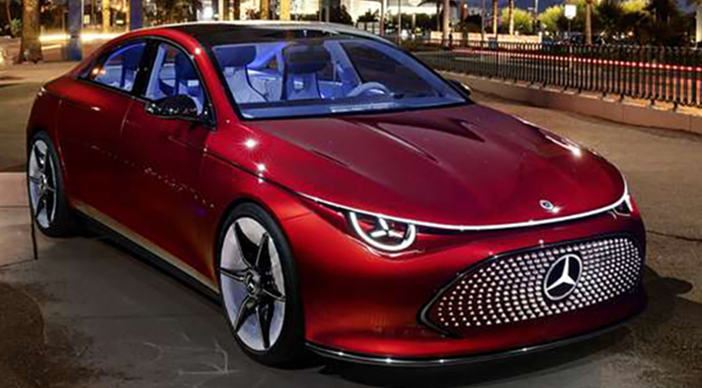
+++ Electric and hybrid models based on MERCEDES ’ new MMA compact car platform will be priced at similar levels, CEO Ola Källenius has said. Mercedes will reveal the production electric version of the new CLA saloon on the MMA platform next month, ahead of deliveries in the summer, then the hybrid version will follow later in the year. Savings of up 30% in battery pack producton have helped Mercedes reduce the cost of the electric version by around 15%. This means the EV will have roughly similar pricing to the hybrid combustion engine version, Källenius said. Currently Mercedes doesn’t offer an electric version of the CLA, but the EQA costs over 10.000 more than the GLA equivalents. Mercedes will offer 4 body shapes atop the MMA platform with both hybrid and electric drivetrain options: limousine and shooting brake versions of the CLA and replacements for the GLA/EQA and bigger GLB/EQB crossovers. The company estimated that MMA-based models will account for a quarter of its sales globally, totalling 500.000, once all the models have been launched. Mercedes said the uncompromising MMA platform allows for a front-wheel-drive layout for hybrids without compromising the packaging for EVs. The cheapest EVs will be offered with a lower-cost 58 kWh LFP battery, while a 85 kWh NMC pack will give a maximum range of around 700 km. Mercedes’ new electric drive unit comes with a 2-speed transmission to help cruising efficiency. A second electric motor creates a four-wheel-drive option. The new CLA will be the first car to feature the latest version of Mercedes Benz Operating System (MB.OS), which includes the AI-powered MBUX Virtual Assistant. Mercedes also said it had worked to cut the costs on the mild-hybrid CLA, which pairs a 48 Volt starter-generation with the new ‘M252’ 1.5-litre 4-cylinder petrol engine, driving through an eight-speed dual-clutch automatic gearbox. The company has promised “diesel levels of efficiency” from the mild hybrid. +++
+++ Next-generation electric MINI cars could switch from the firm’s customary front-wheel-drove set-up to rear-drive, due to the adoption of a new BMW Group platform. The new “Gen6” 800-volt architecture developed by that Mini’s parent firm is claimed to be a “huge leap forward” in terms of technology compared to what is offered in current generation EVs. This includes an increase in range and charging speeds, while the cost of making cars is reduced. Starting in September with the next-generation BMW iX3 (which morphs from the Vision Neue Klasse SUV concept) it will be rolled out across all BMW, Rolls-Royce and Mini EVs from their respective next generation models. But that adoption could mark a significant change for Mini, which in the spirit of the 1960s original has always focused on a front-wheel-drive set-up. The configurability of the new platform means single-motor cars can only be had with a powertrain on the rear axle. This is because the main Electric Excited Synchronous Motor (EESM) is the only one offered by the Group with an integrated gearbox, and this exclusively sits between the rear wheels. BMW Group engineers told at the launch of the platform that there are currently no plans to develop an EESM to be used on the front axle, and only the new small asynchronous motor (ASM), which doesn’t house a gearbox, will be fitted there. BMW models have long been developed with a rear-drive focus. One of the reasons for this decision is because a rear-wheel-drive setup is “better for dynamics”. As such, the platform can only support rear- or all-wheel-drive setups in either single-, dual-, tri-, or quad-motor configurations. When asked if this meant the end of front-wheel drive electric Minis in the future, purchasing and supply board member Joachim Post would not directly confirm. Instead, he said: “We will see what the future is”. Post added that the brand’s future models will “always have Mininess” but questioned “what is the best, the optimum for the package?”, adding: “We want to make one thing feasible: sheer driving pleasure”. Any changes are still a long way from arriving given Mini’s entire line-up (which includes the new Cooper, Aceman and Countryman) was completely refreshed over the last 18 months. +++