
+++ A new higher-performance DB12 has been spied undergoing testing at the Nurburgring, reflecting ASTON MARTIN ’s plans to diversify the current model range with more variants. It’s immediately clear that this prototype is more than just a standard DB12, because it seems to be packing a range of visual and mechanical upgrades that should lift the already potent DB12 to an even higher level of performance. Key changes can be seen around the car’s front bumper, which has a new splitter and grille insert. The wheels are the wider 21-inch options as already found on the latest Vanquish, and there will be more defined sill extension along the side of the body. It’s the rear that looks to have the biggest change, thanks to a new bumper and vertically arranged exhaust pipes. The standard DB12, despite its significant upgrades over the DB11, still shared a rear bumper and aero arrangement, something this high performance model looks to finally change. These changes are joined by a small gurney flap on the rear bootlid to boost downforce, although I can’t yet tell whether this will be a production item or replaced by something more stylised on the production car. In terms of performance and chassis upgrades, we expect more power from the DB12’s twin-turbocharged 4.0-litre V8 engine, potentially growing from the existing 680 hp to the 707 hp produced by the DBX. This will probably be accompanied by a range of software tweaks to the transmission and electronically controlled differential, as well as tuning changes to the Bilstein DTX adaptive dampers and coil springs. Aston Martin did offer an AMR-badged variant of the previous DB11, but that car’s changes were largely made up of some subtle colour, trim and software tweaks, suggesting that this new edition of the DB12 might take on a different name. Look back through Aston’s recent history and the ‘S’ signature is found on various models like the Vantage, which means we could be looking at a new DB12 S here. +++
+++ The CUPRA TERRAMAR will be turned into an upmarket electric car for its second generation, borrowing its underpinnings from the Porsche Macan Electric. Cupra’s large SUV will become its new flagship EV within the next decade. It will join electric versions of the Cupra Formentor and Leon estate. Both were confirmed last year and they will bolster Cupra’s electric line-up, which currently comprises the Born hatchback and Tavascan fastback. A spokesman told: “For the next generation, the next platform, we’re looking at battery-electric vehicles succeeding both Formentor and later Terramar”. Given the Terramar was launched late last year and model life cycles normally last at least 6 years, the EV would be likely to arrive in around 2031, but the spokesman said the brand is “flexible” on dates for all its models. However, he said that as “both cars were brand new or updated and launched last year”, they will “run until after the end of this decade”. He added: “We can then make a decision based on how fast the market’s EV adoption is, and that’s a big thing. The current sub-€49.000 SUV is based on the MQB platform of its Volkswagen Group parent and gives Cupra a footing in the hotly contested C-SUV segment. However, the EV will move onto the bigger Premium Platform Electric (PPE) architecture, pushing it into the larger D-SUV sector. Aligned with the Audi Q6 e-Tron and Porsche Macan Electric, it is expected to share their batteries, motors and key chassis elements. Power-wise, the Macan opens at 360 hp and tops out with 639 hp in Turbo form. While Cupra’s sporty positioning means the Terramar EV will pack a punch, it is unlikely to push beyond the 516 hp offered by the Macan 4S. The current car, launched last year as a BMW X1 rival, offers up to 272 hp and is tuned with a focus on handling. When the SUV was launched, Cupra said it was likely to be its final combustion model. Asked why the Terramar was not launched originally as an EV, the spokesman said: “We need to offer both combustion and EV models at the moment” because “nearly 90% of the market in Europe is combustion-engine sales”. Last year, Cupra recorded 248.100 sales. “If we only had the Tavascan and Born and didn’t have a Formentor or Terramar, we would be up the river without a paddle”, the spokesman said. “At the moment, you have to bet on both combustion and electric. I’d prefer to say let’s go all in on EV. But you can’t do that right now”. +++
+++ LOTUS will cut up to 270 job cuts in the United Kingdom as it reacts to “volatile and evolving market conditions including the tariffs in the United States”. The firm sent a statement which said it was “committed to the United Kingdom” but “the proposed restructuring is vital to enhance our competitiveness in today’s market”. Lotus’s UK-built cars, the Emira and Evija, are now subject to a 25% import fee in the US, under president Donald Trump’s new tariff structure. Earlier this week, Lotus halted shipments of the Emira to the US in response, and now cites the tariffs as a factor in its restructuring. +++
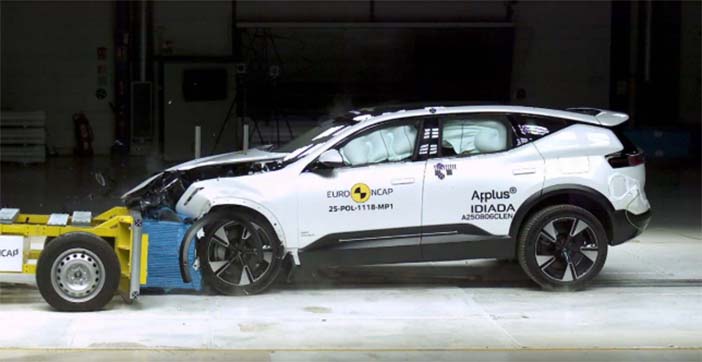
+++ The POLESTAR 3 electric SUV has, in the words of car safety experts Euro NCAP, “set a new standard for child safety” after scoring top marks in its official crash tests, beating the likes of Tesla in the process. In Euro NCAP’s latest batch of testing, the Polestar 3 was given the full 5-star safety rating, but of particular note was its impressive 93 percent score for child occupant safety; the highest achieved in the past 9 years, and higher than the 87 per cent reached by the Tesla Model Y. Such a lofty rating is thanks to what Euro NCAP describes as “good side and rear protection”, as well as a feature that shows the active status of the front airbag whenever it detects that there is a child seat fitted. The icing on the cake is a system that will prevent the driver from locking the car if they leave a child alone inside. The program director at Euro NCAP, Aled Williams, said the performance was “tantalisingly close to a perfect score and shows how a commitment to the safety of all occupants can pay off in providing outstanding protection in the event of an accident. Car makers continue to rise to the challenge of making our vehicles and roads safer, and Polestar deserves recognition for setting a new standard, no matter how small the improvement may seem”. Polestar’s latest SUV wasn’t the only model under the microscope; the Cupra Terramar and BYD Sealion 7 (both SUVs) also netted 5-star scores, as did the new Audi A6. Euro NCAP’s secretary general, Michiel van Ratingen, warned buyers and makers alike that “Chinese brands are developing and releasing new car models at a breakneck pace, with many scoring the maximum 5 stars in Euro NCAP’s safety assessment. However, issues discovered during the tests suggest potential production problems that should not be neglected if Chinese producers want to keep the safety standards that are prevalent in Europe”. +++
+++ After decades of riding the sales gravy train, legacy PREMIUM BRANDS face a harsh new reality in China. BMW, Mercedes-Benz and Porsche had a rough 2024, and the start of this year has been even more brutal. The posh trio saw double-digit declines in the first quarter, with Zuffenhausen taking the hardest hit by far. Porsche plummeted by 28 percent to 56.887 cars in 2024 versus the year before. In the first quarter of 2025, deliveries decreased by a worrying 42 percent versus the January-March 2024 interval. During the first 3 months of the year, the company sold only 9.471 cars in China. Why? Porsche blames “the continuing tense economic situation in the Chinese market and its focus on value-oriented sales, which aims to balance demand and supply”. But Porsche isn’t an exception. Mercedes fell 7 percent in 2024 to 683.600 cars. In first quarter of 2025, shipments to Chinese customers decreased 10 percent to 152.800 vehicles. Despite the fall, the three-pointed star sees the glass half full. It was the best-selling brand for cars priced at over RMB 1 million ($136,000). Additionally, it hopes the launch of the new CLA in the second half of the year will move the needle. Lest we forget that Mercedes has a handful of regional models with a longer wheelbase. Chinese buyers continue to have a soft spot for an abundance of rear legroom, which is why the A-Class, C-Class and E-Class have been stretched specifically for the local market. Mercedes still isn’t in great shape despite these efforts to better cater to local customer preferences. It’s a similar story for BMW Group. Deliveries of BMWs and Minis decreased 13.4 percent to 715.200 cars and the January-March 2025 interval is even worse. The 2 brands suffered a 17.2 percent drop to 155.195 cars. In the first quarter of the year, the core BMW brand grew in all regions except for China, which continues to be its largest market. Like Mercedes, BMW offers several stretched sedans and even long-wheelbase derivatives of the X1, X3, and X5. China is also the only country where the company sells the i3. No, not the oddball small hatchback, but a fully electric sedan based on the elongated 3 Series manufactured at one of its Chinese factories. Audi has yet to publish sales figures for the first quarter of 2025, but I won’t be surprised if they don’t look good. In 2024, the Four Rings were down by 10.9 percent to 649.900 units in China and Hong Kong because of an “intensely competitive market.” Indeed, domestic rivals are finally catching up in design and technology. They might lack the aura of long-running prestige brands, but the latest high-end cars are significantly cheaper. The EV boom has caught Western car brands off guard, and now they’re the ones playing catch-up. However, it’s easier said than done, as Chinese brands have an edge in a few critical areas. For one, they have access to raw battery materials for EVs, giving them a significant advantage in production costs. Additionally, the far lower labour costs in China allow these brands to offer competitive pricing, making it even more challenging for Western automakers to keep up. Unusual efforts to fend off increasingly stronger competition from domestic automakers include the launch of sub-brands such as Volkswagen’s Jetta and Audi’s confusingly named AUDI. Elsewhere, job cuts announced by Mercedes, Porsche, and Audi are a clear indication of the difficult road ahead for traditional luxury automakers. These legacy brands are trying to position themselves for the future. +++
+++ I feel sad for SEAT . While the other Volkswagen Group bands have exciting new small cars to look forward to (such as the Volkswagen ID.Every1, ID.2 and ID.2X, Cupra’s Raval, the Skoda Epiq and Audi’s Q2 e-Tron, the Spanish stalwart is sat on the outside looking in. And now it’s leaderless, too, with CEO Wayne Griffiths’ abrupt departure being announced late last month, only a couple of weeks after saying that he was there for the long haul, and that Seat and Cupra were in his heart. No word yet on what prompted the decision, but Volvo and Nissan also changed leaders within days of the Griffiths news, so there’s clearly something in the air. Whoever comes in to take over from a man who had been at the helm for almost 5 years will have plenty on their plate with Seat, a brand that many people love, and is still selling in decent numbers in the Netherlands and Germany at least, but is starved of product investment. While Cupra is growing nicely thanks to a range of attractive and impressive new models, Seat has been left to tick along with its ageing line-up. Ageing but decent, with the Ibiza, Arona, Ateca and Leon all highly recommended used buys. At one point, the talk was of Seat transforming into a mobility brand, but being positioned as VW’s e-scooter specialist and coming up with a Citroen Ami rival is a direction that has been quietly dropped. Similarly, the plan to include Seat in a group project that would give it a small electric hatch around the €20.000 mark has also gone, as VW goes it alone with the ID.Every1. There’s not even a Skoda version of that car planned, just the VW to take on the Citroen ë-C3, new Renault Twingo, Nissan Micra and others. It does seem odd that the numbers add up when VW goes solo, but including Seat and Skoda (as was the plan talked about as recently as last year) doesn’t make it more economically viable. And that has left a void for Seat in particular. So if a small car isn’t viable, and its core models are being revised rather than replaced, where does that leave the brand? You have to fear for the future of a car company that appears to have no new models on the way, nor any plan to pivot to a new purpose. Whoever ends up running Seat (and Cupra) has a pretty big decision to make. +++
+++ STELLANTIS is already wounded. The conglomerate watched as sales and revenue nosedived through 2024, eventually leading to the abrupt resignation of its former CEO, Carlos Tavares. This was supposed to be a year of rebuilding for the company, but with Trump’s steep tariffs now in effect and no indication of stopping, things at Stellantis may soon get much worse. Particular attention falls on Alfa Romeo and Maserati, 2 brands struggling more than most. Stellantis hired management consulting firm McKinsey and Company to examine the situation, notably with an eye toward tariffs. A company spokesperson told that McKinsey was “asked to provide its considerations” for the 2 automakers but didn’t offer further insight. Stellantis declined my request for additional information. A company spokesperson provided the following statement: “McKinsey has been asked to provide its considerations regarding the recently announced U.S. tariffs for Alfa Romeo and Maserati”. Bringing in a consulting firm suggests things are dire in the Stellantis camp. In the US, Alfa Romeo sold just 8.865 cars for the entire year. That’s a 19 percent drop from 2023, but things are far worse at Maserati. This brand sold 11.300 cars globally, with just 4.819 sold in the United States. Now that tariffs of at least 25 percent are in effect for anything imported to the States (which includes every single Maserati and Alfa Romeo model) it’s no surprise that Stellantis is left wondering what to do. Discussions are currently in the very early phase, but it seems like all options are on the table. That includes the possibility of partnering with other companies or even selling the brands. Collaborations with Asian-based automakers could be possible, which sure sounds like Chinese buyers are lining up for a possible fire sale on Italian brands. Ultimately, the fate of both automakers will likely depend on Trump’s tariffs. Any extended run at 25 percent could wreak havoc on the entire auto industry, never mind niche Italian houses. Alfa Romeo is working hard on new products. Next-generation versions of the Stelvio and Giulia are in development, though we may not see them on the streets until 2027. Maserati had plans to go electric, but changing tides have led to the company cancelling the MC20 EV. +++