
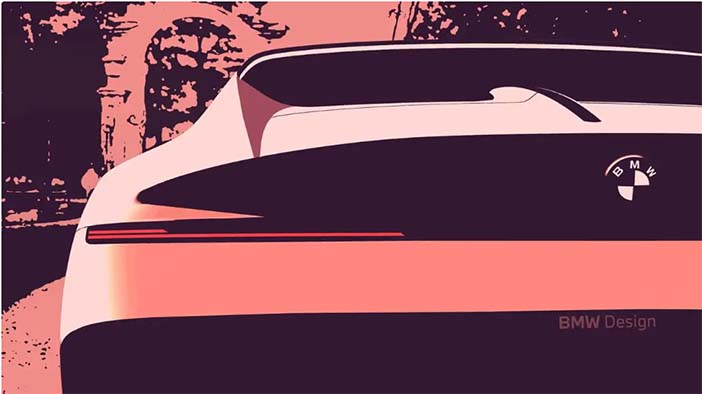
+++ The Concorso d’Eleganza Villa d’Este has become a venue for BMW to release some stunning cars. It’s where the automaker unveiled the 8 Series Concept in 2017, the Concept Touring Coupe in 2023 and the Skytop in 2024. BMW will follow that up with another concept at this year’s event; however, the German automaker isn’t telling us much ahead of its reveal. BMW says the concept will be an “elegantly sporting one-off designed to provide motoring pleasure for 2”. BMW based its previous concepts on production models and I expect the automaker to do the same for this one. While BMW didn’t provide many details, a car for just 2 persons leaves only a few potential models that could underpin it. Last year’s Skytop had a ton of cues from the 8-Series, so it’ll be interesting to see what BMW creates based on its current line-up. The mysterious concept won’t be BMW’s only debut at the event. According to the press release, BMW M will host a world premiere for a new high-performance model. It could be the long-awaited M2 CS. The Concorso d’Eleganza Villa d’Este starts on Friday, May 23, and runs through Sunday, May 25. +++
+++ In late 2021, the pillars of the hypercar world were shaken. Rimac and BUGATTI merged under a new joint venture called, fittingly, Bugatti Rimac. Could the 2 brands (one being a young EV hypercar builder and the other a seasoned combustion-engined hypercar powerhouse) actually coexist without sacrificing each brand’s identity? Bugatti Rimac CEO Mate Rimac pledged as much, and in the years since the merger, that’s remained true. But behind the scenes, Porsche was also a significant player in the company. It holds a 45 percent stake in the joint venture, with Rimac being the majority at 55 percent. That could change per a Bloomberg report, which claims Rimac is looking to buy out Porsche’s slice of the pie. Citing anonymous sources familiar with the matter, the report states Rimac has already made a preliminary offer. A dollar figure isn’t mentioned, but the joint venture is allegedly valued at approximately $1.1 billion. The report goes on to say Rimac could seek out other investors to help make the purchase happen. Apparently, things are at a very early stage and negotiations are ongoing. This is all unconfirmed chatter at this time. Porsche and Rimac have nothing official to say, but given the current state of the global auto industry, Porsche could probably use the cash from the deal. The German brand isn’t hurting, but global sales were down in 2024. With tariffs now a reality for companies wanting to import and sell cars in America, 2025 could be a difficult year for Porsche. And then there’s Bugatti. The storied French brand has marched forward without losing any of its 16 cylinders, though some electrification has entered the mix. The Tourbillon’s new V16 trades multiple turbochargers for 3 electric motors, but it’s still hypercar crazy with a total output of 1.800 horsepower. Meanwhile, at Rimac, the Nevera uses 4 electric motors to generate 1.914 hp. So if Rimac does wholly take over Bugatti, excessive power won’t be going away anytime soon. I’ll jump in with an update should more information become available. +++
+++ The FORD MUSTANG isn’t doing too hot right now in the United States. Sales of the last-remaining muscle car have nosedived so far in 2025, falling 31.6 percent in the first quarter of 2025 compared to the same time last year, according to sales numbers released by Ford. The Mustang is no longer a big seller for Ford. In the first 3 months of 2024, the company moved just 13.707 units. But this year, that number is down to just 9.377 units. Sales of the petrol-powered Mustang are so bad, in fact, that the all-electric Mustang Mach-E is currently outselling it. Ford has moved 11.607 of those crossovers so far in 2025. There are a litany of possible reasons for the Mustang’s sales decline. The most obvious is the price. The base Ecoboost coupe starts at $33.515 with destination. While that sounds reasonable, most people can no longer justify owning a second vehicle, as wages haven’t kept up with inflation. And to have a 2-door, rear-drive coupe as your only car isn’t feasible for the average American. Things get even tougher if Americans want a V8. The cheapest 8-cylinder trim, the GT coupe, starts at $47.055. At that price, the Mustang has to fight with competition like the Nissan Z, the Toyota Supra and the BMW Z4. Then there’s the weather. The US has had an especially cold first 2 months of the year. Low temps don’t exactly tempt people to visit dealerships, nor do they entice customers to buy sports cars. A return of the Shelby GT500 could be what the Mustang needs to bounce back. Rumours of the top-level trim coming for 2026 swirled after what looked to be a leaked document from the UAW revealed plans to produce a supercharged V8 called the “Legend” for an upcoming GT500. The rest of Ford’s portfolio isn’t doing much better. Sales of the Explorer and Expedition are down 19.1 and 37.5 percent, respectively. Sales for the Maverick, E-Series Van and Transit are down year-over-year, too. The F-Series line-up is up 24.5 percent, though sales of the F-150 Lightning are down by 7.2 percent. Overall, the Ford brand is down 1.2 percent in the first quarter of 2025. +++
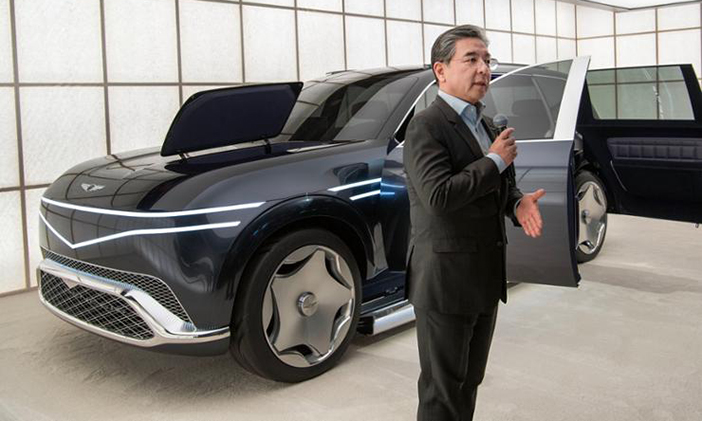
+++ GENESIS isn’t being tempted into launching smaller or more affordable models as it readies its next wave of new products. Instead, it’s going full-speed ahead with larger, more expensive and more profitable cars that will cement it as a true global player, not just in the premium car market, but the luxury car market too. This will start with a new full-sized SUV that’ll be revealed at the New York Auto Show in May. I asked Genesis’ director of design, Luc Donckerwolke, what was in store for the future of the brand to which he told me: “You have seen it already with the new Neolun concept (photo), which is a new flagship of the brand. Which will be the new flagship of the brand”. This replaces the traditional notion that the top model in most premium car brand ranges is usually a saloon, with Donckerwolke explaining that: “Flagship was the traditional 3-box sedan, but now we have SUVs that are becoming flagships, too”. Yet Genesis is only too aware of the fierce competition in the global premium car market. At the top of its range it wants to offer customers choice between vehicle types to help differentiate its offering from rivals. “Genesis will have a variety of typologies at the flagship level, and [we]are ready to put them into production”, he said. This strategy can be seen in action thanks to the brand’s latest concept cars revealed at the Seoul Mobility Show, including the striking 2-door coupe and convertible version of the flagship Genesis G90. Genesis head of product planning, Marc Choi, said: “Genesis doesn’t do pure concept cars without an intention of putting it into production; it’s our job now to put the business case together. We’re not interested in smaller models, as we’re not chasing volume, but rather profitability and prestige. This is not about the risk of cannibalising sales from Hyundai and Kia, but maximising profitability and raising the brand’s profile”. This strategy also answers questions about which models in the current Genesis range will be replaced and which won’t, with the BMW 3 Series-sized G70 saloon and shooting brake not actively under consideration for replacement. Choi continued: “The G70 is difficult because again it’s in that smaller end of the market and there’s not much profitability there. This is why we’re focusing on 80 and 90 models”. The Genesis’ high performance Magma brand is a key part of this, too, as every Genesis model will feature its own Magma variant. Yet Genesis isn’t set on creating a distinct sub brand, such as Hyundai N. Instead, it’s planning Magma cars that will either be totally redeveloped with a bespoke powertrain and chassis setup (as per the forthcoming GV60 Magma) or something less dramatic with only tweaks to an existing powertrain and chassis setup. “What we’re doing with Magma is defining a Genesis driving character that we call ‘solid and agile’ ”, said Choi. “Whether that’s paired with a high powered powertrain, or something with enough power, we’re not yet sure. It’s how we manage that power and integrate driving excitement which is more important”. +++
+++ JLR is gearing up to launch a long-mooted and highly anticipated ‘Defender Sport’ 4×4 as a crucial new entrant into its electric SUV portfolio, and it’s now been spotted testing for the first time. The rugged, compact 4×4 is rumoured to have been on the cards for several years but has never officially appeared on JLR’s product roadmap presentations. Now it’s finally inbound as a sibling model to the next-generation Range Rover Evoque, Range Rover Velar and Discovery Sport. It will share with them the company’s new EMA platform for electric vehicles. These first images reveal that it will be closely related to its full-sized namesake in its chunky, straight-edged proportions but will be a smaller, lower-riding proposition, less geared towards off-road performance. Similarly, Mercedes-Benz is readying a new entry-level compact SUV based on the Defender’s G-Class rival, dubbed the ‘Little G’. The move to expand the Defender family into the compact 4×4 segment with a new EMA-based model was confirmed previously by JLR boss Adrian Mardell, who said the “Range Rover, Defender and Discovery brands will come off that platform”. The revelation shed further light on the mysterious 4th model line due to be built alongside the 3 electric SUVs, which are new-generation variants of current models, at the Halewood factory. The second-generation Velar will be another and is expected to be launched first, having first been spotted testing almost a year ago. Mardell’s confirmation that the smaller Defender will use the electric-only EMA architecture reveals much about the new model. It could adopt the Defender Sport moniker, in keeping with the more road-focused versions of the Discovery and Range Rover, and arrive in dealerships as soon as 2027. Most importantly, it will be much more compact in all dimensions compared with today’s combustion-engined ‘L663’ Defender. That car uses a variation of the D7 platform that also underpins the Discovery, but the promised electric variant, which is due in around 2026, will use the MLA platform that underpins both the ICE and EV variants of the Range Rover. The EMA-based Baby Defender in turn will be a similar size to its platform-mates. It’s likely to measure around 4.6 meter long and 2 meter wide and stand at less than 1.8 meter tall, therefore making it similar in size to (albeit no doubt a good deal more expensive than) the upcoming Dacia Bigster and Skoda Kodiaq. The move to introduce new Defender models is reflective of JLR’s ambition to separate each of its core brands (Jaguar, Discovery, Range Rover and Defender) into 4 distinct product lines. As part of this separation, which comes under the ‘House of Brands’ retail strategy, the Defender strapline is ‘Embrace the impossible’, in a nod to the original car’s storied off-road heritage. Previously, JLR’s marketing director, Anthony Bradbury, said: “It’s an explorer’s vehicle, it’s always pushed boundaries, it’s always physically allowed you to do things no other vehicle can. It’s about that spirit of embracing the impossible, and it has been like that for 75 years”. Defender-badged cars, he said, must have “that feeling of activation, of doing”. Even the smallest entrant into the family will embody the rugged, go-anywhere ethos that made the Defender a household name. Squared-off lower quarters, purposeful body cladding and bluff, simple panels are likely to be employed both to draw a link with the full-size car and enhance the crossover’s off-roading credentials. Even despite its inherently more road-focused billing, an expansive suite of outdoors-themed add-ons is likely to be available. Recent updates on the EMA platform suggest it is a ‘simple’ structure engineered to accommodate the advanced battery and propulsion technology needed to make it competitive against an increasingly crowded field of mid-sized SUVs. EMA-based cars will be equipped with 800 Volt charging architecture and capable of topping up as quickly as any EV currently on the market, most likely with a peak rate of 350k W, while the batteries themselves (supplied by JLR owner Tata’s new United Kingdom-based factory) will have a significantly higher energy density than those used by the Jaguar I-Pace. That will allow them to be slimmer and therefore make a smaller incursion into the cabin, which will be a boon for any Defender model given the nameplate’s long-standing affinity with family buyers and commercial operators. Slimmer batteries will also facilitate a raised ride height, which will again aid Land Rover’s aim for even its smallest cars to offer newly accentuated ethos of the Defender brand. Being priced from significantly less than its full-size sibling but with a comparable set of attributes and a tangible familial link, the Baby Defender has the potential to quickly become a key volume player for JLR globally. That outcome is especially significant from a British perspective, given that the model is tipped to be built on Merseyside, using batteries manufactured in Somerset. JLR has not said what proportion of global sales it hopes for its EMA-based models to achieve, much less each specific car using the platform, but the Evoque and Discovery Sport have been consistent strong sellers since their launches in 2011 and 2015 respectively. That lends credence to the notion that volume-friendly, downsized interpretations of iconic full-size SUVs hold appeal for a substantial portion of the premium car market and no doubt strengthens the case for a new take on the formula. +++
+++ The MERCEDES-AMG C 63 is set to receive a new 6-cylinder plug-in hybrid drivetrain as part of its mid-life facelift in 2026. The move marks a retreat from the 4-cylinder plug-in hybrid system introduced in 2022, with an electrically turbocharged 2.0-litre petrol engine and rear-mounted electric motor developing a combined 680 hp and 1.000 Nm of torque. Despite the C 63 being the most powerful C-Class model to date, its sales have lagged well behind expectations in all of AMG’s key global markets, forcing a rethink of its Formula 1-inspired drivetrain. In the facelifted C-Class line-up, the 4-cylinder drivetrain will be replaced by a new plug-in hybrid drivetrain featuring a 3.0-litre 6-cylinder engine. The new set-up is a development of that used in various AMG models, including the E 53, GLE 53, CLE 53 Coupé and CLE 53 Cabriolet, albeit with greater power and torque. As well as being earmarked for the facelifted C 63, it’s planned to be brought to the facelifted GLC 63, due out in 2027. Buyer resistance to AMG’s 4-cylinder PHEV has already led to a decision to bring back V8 power in other parts of its line-up. The upcoming CLE 63 Coupé and CLE 63 Cabriolet (the indirect successors to the E 63 Coupé and E 63 Cabriolet, due to be revealed by the end of 2025) will receive a flat-plane-crank version of AMG’s ‘M177′ 4.0-litre twin-turbo V8. Having a 4-cylinder CLE 63 positioned above a 6-cylinder CLE 53 would have made little sense to customers, according to Stuttgart sources. Engineers involved in the C-Class programme say packaging constraints within the model’s MRA platform make the adoption of the new AMG V8 unfeasible. “It requires more space, not just in terms of physical dimensions but also for associated cooling systems and crash protection measures”. The current C-Class’s engine bay, optimised for 4- and 6-cylinder engines, would require significant structural changes to accommodate the V8; changes that would likely necessitate a fresh round of crash testing and regulatory approval, which my sources suggest isn’t viable at this stage of the model cycle. Instead, the facelifted C63 will use a re-engineered version of AMG’s ‘M256′ 3.0-litre turbo straight-6. It’s expected to deliver up to 488 hp, or more than 660 hp in combination with an electric motor. Torque is expected to top 900 Nm. In the current E 53, launched in 2024, a less powerful version of this drivetrain delivers a combined 585 hp and 750 Nm of torque, with 450 hp and 550 Nm of that from the petrol engine alone. The C63’s new PHEV drivetrain is set to ditch the current rear-axle electric motor mounting of the current ‘P3’ layout in favour of a ‘P2’ arrangement, with the electric motor placed between the engine and gearbox. The ‘M256’ engine’s relatively compact packaging (a result of it using a 90 mm bore spacing) makes it well-suited to the C-Class platform. With this set-up, AMG hopes to balance performance targets with a return to the smoother, more characterful delivery associated with the earlier, V8-powered C 63. The decision to adopt 6-cylinder power places the C 63 on the same mechanical path as the BMW M3, which has used a 6-cylinder engine since 2000. Other changes set for the facelifted C 63 include the adoption of a new dashboard featuring Mercedes’ Superscreen display in combination with the MB:OS operating system. +++
+++ As we roll into the first full week of TARIFFS in the United States, there’s a whole mess of uncertainty floating through the automotive realm. That holds especially true for automakers based outside the US with little or no manufacturing footprint in the States. A 25 percent ding on cars crossing the border is significant, and now it seems some brands are temporarily pausing shipments. Audi is among them. In a memo sent to dealers, all Audis headed to the US are on hold. Cars that arrive at ports after April 2 will be held there. Vehicles that entered the country on or prior to April 2 will be processed and sent to dealerships and marked with a sticker showing no tariff charges. At this time, there’s no mention of when shipments might resume. When they do, some models could see tariffs totalling 50 percent. Specifically, the Q5 is built in Mexico, but Audi isn’t part of the US-Canada-Mexico trade agreement. That could lead to a double whammy for the Q5. In a statement last week, an Audi spokesperson said the company “is closely monitoring developments and will comprehensively assess internally the potential impact on supply chains and our production network”. We asked specifically about the pause in shipments, but haven’t yet received a reply. It’s possible this could be the case for all of Volkswagen Group. Volkswagen has also reportedly paused shipments, and I’ve heard that Porsche has followed suit. I contacted Volkswagen along with Porsche and several other brands regarding vehicle shipments. In these cases, there’s no specific timeframe mentioned for when shipments may resume. Outside of Germany, Jaguar Land Rover has also paused shipments. Reuters first reported the news over the weekend, and a JLR spokesperson confirmed a one-month pause in the following statement: “The USA is an important market for JLR’s luxury brands. As we work to address the new trading terms with our business partners, we are enacting our planned short-term actions including a shipment pause in April, as we develop our mid- to longer-term plans”. Lotus has paused all shipments indefinitely. Automakers pausing shipments doesn’t come as a surprise. US President Trump’s tariff talk has been inconsistent since he took office. Initial tariffs of 25 percent were announced then walked back almost immediately. The current round that went into effect on April 3 feels a bit more permanent, but the language in the Executive Order Trump signed leaves all kinds of room for interpretation. It also leaves the door open to cancel said tariffs at any time. By punting the ball downfield, automakers get time to wait out possible changes in the tariff structure. Based on the previous tariff rulings, not to mention the general financial turmoil hitting global markets caused by the tariffs—something is likely to change sooner rather than later. +++
+++ In the UNITED STATES , first-quarter sales results are rolling in, and things are looking up for most automakers. Toyota sales are off to a strong start, Mazda and Subaru had record months, and Kia had its best quarter ever. But when digging into the data, results for electric vehicles were much more mixed. Tesla’s quarterly sales plunged 13 percent, delivering 336.681 vehicles through the first 3 months of 2025. Rivian reported delivering 8,.640 vehicles, down 36 percent. But General Motors reported a 94 percent increase in EV sales for the same period, selling 31.887 EVs. Only the Cadillac Lyriq saw its sales fall at GM, down 25.9 percent. However, Cadillac launched the Optiq and Escalade IQ EV, which more than made up for the Lyriq’s losses last quarter, and increased Cadillac EV sales overall. Every other GM EV, including the GMC Hummer, saw its sales increase compared to last year. Sales for the burly EV were up 108.6 percent, moving 3.479 units in Q1. The Chevrolet Equinox EV remains GM’s best-selling EV, with 10.329 sold. It’s been on sale for less than a year. Thanks to the Mustang Mach-E and E-Transit, EV sales were up 11.5 percent at Ford to 22.550. The automaker sold 11.607 electric Mustangs, up 21.0 percent, and 3.756 Vans; a 29.9 percent jump. Those 2 cars made up for the 7.2 percent dip in F-150 Lightning sales last quarter, with the company selling 7.187 electric pickups. BMW’s battery-electric vehicles also had a strong start to the year, increasing 26.4 percent overall: 13.585 for the quarter. BMW i4 and iX sales jumped 57 and 23.1 percent, respectively, making up for the 15.2 and 10.4 percent dip in i5 and i7 sales. Kia saw sales dip for the EV6 and EV9, down 7.9 and 6.3 respectively. At Hyundai, the Ioniq 5 saw its sales increase by 26.0 percent, while Ioniq 6 sales fell by 9.0 percent. Subaru Soltera sales jumped 172.9 percent, from 1.147 in Q1 2024 to 3.131 in Q1 2025. Toyota BZ4X sales increased 105.7 percent, to 5.610. However, sales for the Lexus RZ fell 9.3 percent. Volkswagen ID.4 sales were also up, increasing 24.3 percent to 7.663. The automaker just added the ID.Buzz to its line-up, which has moved 1.901 units so far. Nissan Ariya sales increased 0.1 percent to 4.148, while the Leaf jumped 103.4 percent: 1.142 to 2.154 units. Other EVs on sale haven’t been on the market long enough to see if sales are up or down. Honda has sold 9.561 Prologue and 4.813 Acura ZDX crossovers this year. Stellantis just began offering the Jeep Wagoneer S and the Dodge Charger Daytona EV, moving 2.595 electric crossovers, and 1.947 coupes. Just a few years ago, automakers made considerable promises to electrify their line-ups. Petrol was out, and batteries were in. But buyers didn’t show up as expected, leading companies to temper their electrification plans. Policy changes and proposed tariffs could soon wreak havoc on the growing EV market, and next quarter’s results will better indicate the market’s future. +++