+++ China’s Ministry of Industry and Information Technology has announced new mandatory national safety standards for electric vehicle BATTERIES that will take effect on July 1, 2026. The updated regulation GB38031-2025 “Safety Requirements for Power Batteries of Electric Vehicles” represents the world’s first standard requiring batteries to prevent fire and explosion even after internal thermal runaway occurs. The most significant change in the new standard is the thermal diffusion test requirement. While the previous standard only required a warning signal five minutes before fire or explosion, the updated regulation mandates that batteries must not catch fire or explode, even during thermal runaway events. Additionally, any smoke generated must not harm vehicle occupants. The standard also introduces new tests, including: 1) Bottom impact testing to evaluate battery protection capabilities when the underside experiences a collision. 2) Fast-charging cycle safety testing requires batteries to withstand 300 fast-charging cycles without fire or explosion during subsequent short-circuit tests. Industry experts believe these stringent requirements will significantly enhance consumer safety while accelerating industry consolidation. Leading manufacturers like CATL claim they have already developed technologies that meet the new standards. CATL states that their first-generation No Thermal Propagation (NP) technology has been produced since 2020. “The new standard will effectively reduce the risk of power battery fires after collisions in new energy vehicles, better protecting consumers’ lives”, said a CATL representative, emphasising that meeting these requirements demands collaboration between automakers and battery manufacturers. The timing of this announcement follows closely behind a high-profile accident involving a Xiaomi SU7 electric vehicle that caught fire after a collision in March. However, the cause of that incident remains under investigation. Industry experts believe the new national standard safeguards battery safety through rigorous testing protocols, significantly alleviating public concerns about spontaneous combustion risks in electric vehicles. While these regulations may increase R&D costs for small and medium-sized enterprises and potentially trigger short-term market consolidation, the industry’s long-term benefits are substantial. Enhanced safety performance will ultimately reduce hidden costs related to insurance and maintenance, creating greater value opportunities across the sector. +++
+++ CADILLAC ’s longtime struggle to attract younger buyers may finally be bearing fruit. For real this time. Cadillac brand chief John Roth said that the average age of the luxury brand’s customer was 58 in 2015. Today, it’s closer to 54 or 56. For the Escalade IQ, the electric counterpart to Cadillac’s full-size SUV franchise that recently went on sale, it’s even younger: that average buyer is just 48. “That’s an excellent customer to have in your portfolio”, Roth, vice president of global Cadillac, said of the longevity that customer will have in terms of repeat business. “It’s really amazing to watch luxury goods that are able to reposition themselves younger”, he said. “We’ve shaved off roughly four years of age demographic, which is really another data point that tells you we have a really healthy brand inside General Motors”. Cadillac’s attempts to win younger buyers have been epic over the last 20-plus years. In 2002, it used Led Zeppelin’s “Rock and Roll” for its much ballyhooed “Break Through” ad campaign, which ended about four years later, not long before the Great Recession pushed GM into Chapter 11 bankruptcy. At the time, “Rock and Roll” was already a 30-year-old song; not exactly the kind of tune the younger generation would gravitate to. +++
+++ Electric vehicles are evolving rapidly, and if you’re still skeptical, CATL has just unveiled a series of significant advancements in battery technology that will soon make their way into production models. The highlights include next-generation Shenxing batteries with ultra-fast charging capabilities, a new dual-power battery system for EVs, and sodium-ion batteries designed to perform better in colder climates. The fast-charging news are probably the most important for the future of EVs, as they will eventually make charging stops as quick and easy as refuelling stops for ICE-powered vehicles. In this context, CATL promises that its second-gen Shenxing batteries will add 520 km of range in 5 minutes of charging, which is the equivalent of gaining 2.5 km of range per second or about as fast as it takes to fill your average car with petrol. The impressive figure surpasses earlier developments by rival BYD, whose batteries will be able to add 400 km of range in just 5 minutes. For comparison, the first generation of CATL’s Shenxing batteries, which debuted in 2023, could replenish 400 km of range in 10 minutes. CATL’s second-gen Shenxing batteries promise a total range of up to 800 km. Even better, they’ll be able to charge from 5% to 80% in just 15 minutes, even at chilly temperatures as low as -10°C. While we don’t yet know how many of the 67 new EVs launching in 2025 will be equipped with these second-gen batteries, it’s safe to say that the technology is coming sooner rather than later. Another interesting development from CATL is the “Freevoy Dual Power Battery” technology. By combining two battery packs into one, an electric vehicle could achieve a range of over 1.500 km, putting it on par with the most efficient range-extender hybrids. The new design splits the battery pack into two independent energy zones with different cell materials, somewhat akin to the dual-engine systems used in aircraft. The auxiliary battery, acting as a range extender, won’t use graphite, making it smaller and cheaper to produce. However, the trade-off is slower charging speeds and fewer charging cycles, as these auxiliary batteries will only come into play once the main battery is empty, so they won’t be charged nearly as often. CATL expects this dual-power battery technology to reach production EVs in the next 2-3 years, though they’re staying tight-lipped about which automaker will be the first to adopt it. Last but not least, CATL is advancing sodium-ion batteries, which are set to enter production in December 2025. These could potentially replace the lead-acid batteries in many ICE vehicles, as well as the lithium iron phosphate batteries used in hybrids and EVs. The key advantage of these batteries is their superior performance in cold weather, making them an attractive option for those in frigid climates. The company claims its tests have shown that sodium-ion batteries can withstand extreme conditions whether it’s being punctured by needles, drilled, or even sliced in half with a power saw, without catching fire or exploding. Safety isn’t the only benefit, though. These batteries also offer high energy density, providing over 200 km of range in plug-in hybrids (PHEVs) and a robust lifecycle of 10.000 charges. Even at -30°C, these batteries can charge from 30% to 80% in just 30 minutes and will continue to perform normally at -40°C. Additionally, sodium-ion chemistry is expected to be more cost-effective than traditional lithium-ion batteries as the technology matures, which could bring a significant price advantage in the long run. +++
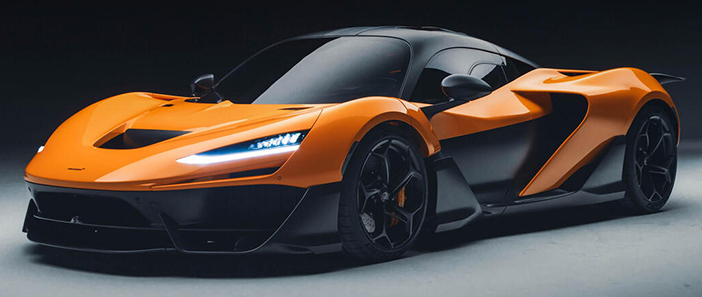
+++ Just like its Formula One cars, MCLAREN ’s ‘1’ series models have always been at the cutting edge of hypercar design. With the launch of the W1, the brand has presented its new era of ultra-high- performance engineering, using everything learned from the earlier P1 and F1 models. models. Here we take a close look at three classic Brits. While 1992’s F1 was modern for the time in terms of chassis and aero tech, the engine was old school. McLaren turned to BMW and engine whisperer Paul Roche to develop a naturally aspirated 625 bhp V12. This motor, with a 9.000 rpm red line and individual throttle bodies, powered the rear wheels through a 6-speed manual transmission and little else. There was no traction control and no stability programme. The P1 moved this on, because the intervening 20 years saw not only a refinement of tech such as turbocharging, but also the application of hybrid drive. McLaren’s 3.8-litre twin-turbo V8 lacked the V12’s theatrics, but produced a combined figure of 910 hp including its e-motor. Its flat-plane crank still let it rev to a super-high red line, spurred on by 2 turbos. To fill out the low end, McLaren’s KERS- style hybrid system integrated learnings from F1. Although the W1 also uses a twin-turbo V8 and hybrid system, McLaren designed this new 4.0-litre engine from scratch, targeting both numbers (such as a 9.000 rpm red line and a 925 hp power figure) and more emotional targets surrounding its power delivery and soundtrack. The hybrid system has also seen a major upgrade, and while the V8 alone outperforms the P1’s combined output, the 347 hp e-motor brings the W1’s total to 1.245 hp. All 3 models sit on a carbon-fibre tub-style chassis, with aluminium subframes that carry the suspension up front, and the engine, transmission and suspension at the rear. But the advances in carbon-fibre tech mean they vary substantially. The F1 used exotic materials and racing-derived tech, such as 18-carat gold leaf around the engine bay and a bag-style fuel tank. The P1’s Monocage took a step forward by housing the model’s battery pack behind the front seats. But the W1 moves things on by incorporating the seats into the bucket itself and using 3D printing for suspension parts to shed weight, increase stiffness and create stunning-looking mechanical elements. All 3 cars buck the trend of many rivals by retaining rear-wheel drive. This benefits weight and steering feel, but also compromises acceleration due to the issue of channelling all that power to the back axle. But this is where McLaren’s advances in electronic traction-management systems come in. The F1 had no traction control, leaving it to the driver to mete out the V12’s power and torque. The P1 had a launch-control system that helped augment the engine and e-motor to maximum effect. There’s scarcely a faster rear-wheel-drive car that’s been on sale since, but the W1 pips it. McLaren also says the power delivery to the rear is more measured, predictable and tractable. The F1 was a result of collaboration between its chief engineer and creator, Gordon Murray, and designer Peter Stevens. In 1992, the main hypercar competition came from heavily styled cars that were arguably more striking than the F1. The aero was balanced but understated, helping to achieve that head-spinning 241mph top speed. The P1 kept this mentality of pure functionality, but designer Frank Stephenson added more flair and the aero package was far more sophisticated, thanks to the huge rear wing and under-floor design. The adjustable suspension dropped the car right to the floor in Track mode, and made it illegal to drive on the road in that setting due to its lower stance. The W1, designed in-house by Rob Melville and his team, takes the notion of aero trickery to the extreme. The rear wing, or Active Long Tail, can extend backwards by 300mm to improve airflow and give the W1 an even more aerodynamic shape. No McLaren hypercar was designed to be a comfortable cruiser, and the interior design on all 3 is minimalist, but the quality and functionality of every component were uncompromised. The F1’s central driving position limited its interior design, but the more traditional P1 introduced DRS and Pass buttons on the steering wheel and glass in the roof to increase the amount of light. The W1 follows this path and offers supreme forward vision. +++
+++ NISSAN is rushing a small crossover powered by an affordable electric drivetrain into production, to rival the Volkswagen ID.1. And the Japanese car maker, in the midst of a battle to turn around its flagging global business, is calling on family members Renault and Dacia to help deliver its new baby in late 2026. The small crossover will tap into the components set of Renault’s reborn Twingo and its all-new lithium-iron phosphate (LFP) battery, to speed up the model’s introduction and help peg its cost at €20.000. That’s an impressive price for an electric car that will be assembled in eastern Europe, not China. China is where the original version of its other sister car, the Dacia Spring, is assembled. But with new EU import tariffs eating into the Dacia’s profitability, its successor will surely be produced alongside the Twingo and Nissan at the Renault Group’s factory in Novo Mesto, Slovenia. The brands have long formed an alliance (also including Mitsubishi), initiated when Renault saved Nissan from bankruptcy in 1999. The smart money is on the new baby Nissan’s design being twinned with the Spring’s rather than the Twingo’s. That’s because the Renault city car has an unusual ‘monospace’ silhouette, with a slanting nose that fluidly blends into the windscreen. Dacia’s Spring, in contrast, has a clear 2-box shape with a distinct, horizontal front end, a slightly raised ride height and SUV design cues. Given Nissan’s 4×4 heritage kicking off with the 1951 Patrol and the popularity of SUVs, it makes sense for Nissan to tap into this bodystyle. But given the tough economics of making ‘A-segment’ city cars pay, especially those with costly battery power, the vehicles will share at least 80 per cent of their componentry. Renault has adopted the Stellantis way of making windscreen, glasshouse and door structure common to multiple vehicles, so it’ll be down to the front and rear ends to deliver the Nissan family look. Nissan Design Europe, based in London, is sure to have influenced the styling. The engineering is being led by Renault’s EV and software division Ampere. Back in 2024, then CEO of Nissan Makoto Uchida said: “Nissan has asked Ampere to explore the development of the A-segment car for Europe. With Ampere we are targeting a very short development time. This car will deliver the convenience and advanced functionality that customers expect, but in a small-sized EV at an affordable price”. Renault Group CEO Luca de Meo established Ampere to speed up its electric cars’ development time to better compete with fast-moving Chinese rivals. Taking just 2 years, the new Twingo is the fastest-engineered car in Renault history; the new Renault 5 took 3 years and the Megane E-Tech 4 years. The secret sauce was setting up an R&D skunkworks in China to learn from the experts themselves. The Advanced China Development Centre (ACDC) is a small operation of 150 people empowered to make decisions in days, not weeks, Ampere’s powertrain and EV engineering boss Philippe Brunet told. “We selected some key, competitive partners in China who we work with. This is the best way to get competitive very fast”. The reason the Twingo could be engineered in 24 months was because it has the Renault 5’s vehicle architecture at its heart. “We are reusing the Ampere Small platform where we have changed the wheelbase: the car is less than 4 metres long. This is the same architecture and we redevelop the battery, add a new e-powertrain and the top hat new body; this we did in 2 years”. And that development work can be scaled across sister models, including the A-segment Nissan and more. “The Dacia is a sister car of the Twingo and it’s also developed in China”, explained Brunet. That means embedding a small design team there to digitally model their ideas, creating the 3D development data for the engineering team to use. “Usually in our process, I would say the convergence takes about three months. In China, they’re able to make it in 5 weeks”. The new trio are expected to be around 3.75-metres long, shorter than the new Mini Cooper. The wheelbase is about 2.5 meter long and will accommodate the battery pack. The headline news is that the triplets will use LFP batteries. Pioneered in EVs by Chinese car maker BYD, lithium-iron phosphate cathodes don’t include expensive cobalt but the downside is they’re less energy-dense than NMC batteries. This can be offset by using clever designs to cram more cells into the battery module, and using a heat pump to improve their inferior cold-weather performance. “Using LFP is only part of the cost competitiveness”, explained Brunet. “The cost gap between LFP and NMC is 8 to 15 percent. “The other way to get the cost down is to have an efficient car. That allows you to reduce the battery which is the main lever to reduce the cost of the car; it’s between 30 and 45 percent of its total”, he said. Given this is the group’s first European LFP pack, most likely supplied by CATL in Hungary, it’s difficult to predict the three A-segment cars’ battery sizes. Today’s Dacia Spring, which is a little shorter and has a slightly smaller wheelbase than the new models harbours a 26.8 kWh battery. That’s capable of just 230 km on the WLTP cycle. But Dacia’s product development boss, Patrice Lévy-Bencheton, told that range was sufficient for the city car’s typical customer usage. Dacia’s data calculates the average daily trip at 27 km. “We define our cars according to customer needs and this helps us position the Spring as the most affordable EV by far. We will bring in our new A-segment EV at below €18.000”, said Lévy-Bencheton. It’s likely that the Nissan will, along with the Twingo, pack additional battery modules to boost range. And the Nissan’s aerodynamic design and inherent efficiency (the platform will supposedly be good for more than 10 km per kWh) should boost the range close to 320 km. Performance will also beat that of today’s Spring, whose higher-output motor sends just 65 hp to the front wheels. Nissan and Renault both use the same electrically excited synchronous motor design, known for their efficiency and lack of rare earths in the rotor’s magnets. Expect the Nissan to offer the 95 hp and 122 hp e-motors from the Renault 5, driving the front wheels. Despite Japan’s love of tiny kei cars, Nissan doesn’t have a lot of form in the European city car segment. It did sell the Pixo between 2009 and 2013. Its 2026 successor is also a collaboration with other brands. But the hi-tech, electric, Euro-centric baby Nissan will be in another league entirely. +++
+++ TESLA has long promised an affordable vehicle to bolster sales. That car, a stripped-down, bare-bones Model Y, was supposed to show up in the first half of this year. But now, it’s been delayed by “at least several months”, according to a report by Reuters. The cheaper vehicle, codenamed E41, could now start production anywhere from the third quarter of 2025 to next year, sources told. No reason was cited for the delay, though tariffs hindering parts importation could be to blame. It’s also possible that Elon Musk has delegated too much of his time to running the Department of Government Efficiency (DOGE) to get the ball rolling. Tesla has been promising an affordable, entry-level vehicle for years. The company was finally set to introduce a standalone $25.000 car in 2025 before Musk reportedly killed those plans, instead pivoting towards a two-door Robotaxi called the Cybercab, set to hit the streets in 2026. Now, the company is planning a cheaper Model Y and later, a cheaper Model 3. A delay in such models would come at a bad time for Tesla. The electric carmaker saw a decline in annual deliveries for the first time ever last year, and sales are down 13 percent in the first quarter of 2025, plagued by an aging line-up and Musk’s polarizing political actions, which have caused extensive damage to Tesla’s brand reputation. Production of the cheaper model would start in the United States in late 2025 before also kicking off in China in 2026. The car will be smaller and cost 20 percent less to produce than the equivalent Model Y, according to the report. A cheaper car could be the only way for Tesla to attract new buyers. But that all depends if the company can actually get it into production. +++
+++ XPENG is aiming for 50% of its vehicle sales to come from international markets within the next decade, a sharp increase from just 10% last year, according to CEO He Xiaopeng. As part of this long-term strategy, the Chinese EV maker plans to enter 60 countries by the end of 2025; twice as many as the previous year. Xpeng didn’t specify the overall 2035 sales target, but the company previously announced that it is confident in delivering approximately 380.000 vehicles in 2025, doubling its sales from last year. In July 2023, Volkswagen invested approximately $700 million in Xpeng, acquiring a 4.99% stake. For VW, this strategic partnership included plans to co-develop 2 mid-sized, Volkswagen-branded electric vehicles for the Chinese market featuring Xpeng’s tech, with production expected to begin in 2026. For Xpeng, it brought an appetite for overseas expansions. The Guangzhou-based EV maker is concentrating its efforts on Europe, Southeast Asia, the Middle East, and Latin America, with plans to invest more heavily in around a dozen key markets. Co-president Gu Hongdi stated that Xpeng is working to tailor its offerings to local needs, including product adjustments and enhancements to service infrastructure. In its latest move in March, the automaker officially expanded to Poland, the Czech Republic, Slovakia, and Switzerland, where it appointed its local distributors. Rather than relying solely on imports and exports, Xpeng wants to establish a more localised presence in international markets through R&D, manufacturing, and service networks. The current focus is on establishing robust local support systems, encompassing charging infrastructure, maintenance services, and OTA (over-the-air) updates. While recent U.S. tariff increases won’t affect the company (since it doesn’t sell in that market) Xpeng considers Europe its top priority outside China. The Guangzhou-based automaker is exploring production opportunities in the region and anticipates launching several new models there over the next 3 years. Xpeng also plans to build its first overseas assembly plant in Indonesia, marking a significant step toward localising production. Looking ahead, He predicts that only 5 to 7 NEV brands will remain competitive globally over the next decade. Xpeng plans to invest 4.5 billion yuan (approximately $616 million) in AI this year and launch L3 autonomous driving capabilities in China by the end of 2025. The company is also pushing into new tech frontiers, including flying vehicles and humanoid robots. Xpeng’s flying car unit, AeroHT, expects to receive type certification for its “Land Aircraft Carrier” model by year-end, with production and deliveries beginning in 2026. Meanwhile, its Iron humanoid robot is currently undergoing testing, with mass production targeted for next year. Last year, Xpeng expanded to Germany, where it sold about 800 cars so far, with 176 deliveries in March. In October 2024, the additional tariff of 20.7% went into effect for Xpeng’s imports as a result of the EC’s anti-subsidy investigation. The company now faces a total tariff of 30.7% on its import of EVs into the EU. +++
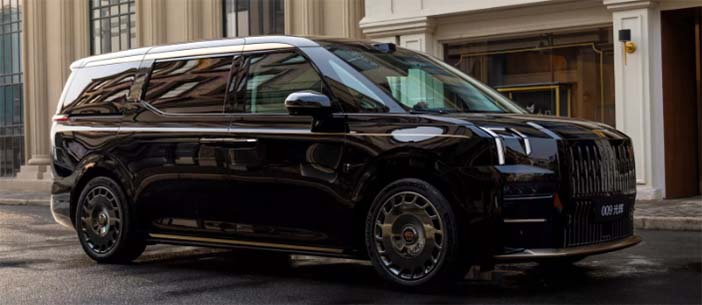
+++ Minivans have a surprising level of importance in China, sparking fierce competition among automakers to offer the most luxurious and opulent options. Geely is a key player in this race with its new ZEEKR 009 Grand Collector Edition, a premium EV featuring 24K gold accents and plush Alpaca wool carpets inside the cabin. The 5.217 mm long Zeekr 009 Grand Collector Edition builds upon the standard Zeekr 009 Grand, which debuted last year. What sets this ultra-luxury trim apart are the gold details that are found on the bumpers, window surrounds, and side skirts, and which contrast sharply against the black exterior. The gold accents extend to the badging and the 20-inch alloy wheels, which take design cues from Rolls-Royce, just in case you missed the luxury memo. Step inside, and the real showstopper is the carpeting. Made from soft alpaca wool, these carpets are sourced from the necks and shoulders of young alpacas living at 13.000 feet in the Andes of Peru. So, yes, your feet will be treading on luxury. Let’s just hope passengers are mindful enough to remove their shoes, so they can truly experience what $123.000 worth of floor covering feels like. The interior layout is focused entirely on comfort. With a 4-seat configuration, rear passengers enjoy reclining captain’s chairs that feature a 24-way adjustable position, leg rests, retractable tables, and no fewer than 8 massage programs. If you still need distractions, there’s also a 43-inch 4K display, electrochromic glass, a Yamaha sound system with 31 speakers, and an 18-liter compartment with heating, cooling, and sterilization functions. This is not your typical minivan. The underpinnings are the same as the Zeekr 009 Grand, but the powertrain is no slouch. 2 electric motors generate a combined 778 hp, delivering 810 Nm. This translates to a 0-100 km/h time of just 3.9 seconds, which is almost laughable for a minivan, except it isn’t. The 108 kWh CATL-sourced Qilin battery provides a range of up to 527 km, so you can travel in comfort (and speed) without worrying about recharging too soon. The Zeekr 009 Grand Collector Edition is already available to order in China for a cool ¥899,000 ($123,000), making it ¥110,000 ($770) more expensive than the Zeekr 009 Grand. Deliveries are expected to begin in June. If you’re in the market for luxury on wheels, you might want to take a look at the Zeekr 009 Grand, just be ready to break the bank. Beyond the Grand Collector Edition, Zeekr has also introduced a right-hand-drive version of the 009. Additionally, the upcoming Zeekr 9X SUV will soon join the lineup, expanding Geely’s offerings under the Zeekr brand. +++