
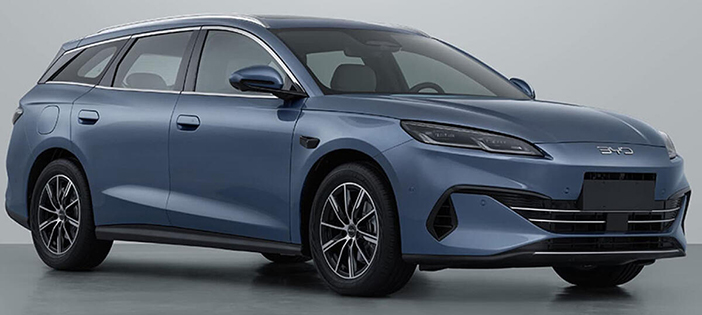
+++ BYD ’s European line-up is set to swell in the coming months with the addition of a new plug-in hybrid saloon and estate to rival the BMW 330e, Mercedes-Benz C 300e and Skoda Superb iV. Called the Seal 06 DM-i, the new model will become the 8th BYD model on sale, joining the Atto 2, Atto 3, Dolphin, Seal, Seal-U, Sea Lion 7 and the forthcoming Dolphin Surf supermini. It is a separate model line to the BYD 06 GT (which is a battery-electric hatchback in the mould of the Mazda 6e) also due soon. The company has not confirmed a launch date, nor any specifications, but the Seal 06 DM-i was launched in China last year and the European variant is expected to be little changed. Its PHEV powertrain combines a 100 hp 1.5-litre petrol engine with either a 10 kWh or 16 kWh battery for an electric range of either 60 or 90 km, according to official WLTP figures. Power output is pegged at either 160 hp or 213 hp, and both versions get from 0-100 kph in less than 8.0 seconds. Each powertrain variant sends all its power to the front wheels through a CVT gearbox. Both the saloon and estate versions of the Seal 06 measure around 4.8 metres long and 1.5 metres tall. The cockpit is almost identical to that of the Seal, with an 8.8 inch digital gauge cluster, a 15.6 inch rotating touchscreen and a selection of physical buttons on the centre console and steering wheel. There is no indication of price yet, but the mechanically related Seal-U DM-i starts at around €39.610 euro in the Netherlands. BYD is expanding its plug-in hybrid line-up in Europe as part of a drive to boost its market share in the face of wavering EV uptake in the region. European boss Stella Li told last year that PHEVs have a “very important role” in the company’s growth plans, because they provide a bridge for buyers to move from combustion to electric powertrains. “A lot of people want to try electric cars, but currently they have range anxiety and hesitate, but this car gives them the solution”, said Li. +++
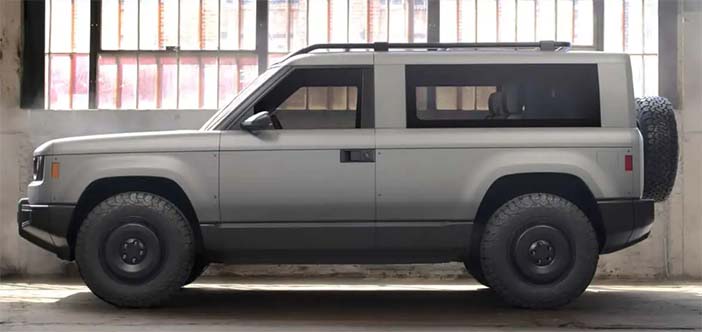
+++ The European Union might have relaxed its rules regarding the sale of new gasoline/diesel cars, but it’ll still be hard for automakers to keep combustion alive. That frustrates INEOS AUTOMOTIVE boss Lynn Calder, who says the industry should listen to customer demand and not top-down policies pushing full electrification. Ineos wants to give customers a choice; not just electric vehicles. She told that hybrids are popular and yet “policy is defining what people should buy, and people don’t want it”, even though she believes electrification “will always have its place”. These policies are significantly harder on smaller auto operations like Ineos. But the company is embracing the new technology. Over a year ago, Ineos revealed the Fusilier, an electric vehicle with a range-extender option. The project is currently paused, according to Calder. If it hits the market in 2027 or 2028, Ineos might be unable to sell it long enough to make a business case for producing it. Calder also believes the EU will extend the ability to continue selling non-zero-emissions vehicles beyond the deadline. The EU relaxed the wording regarding its ban on combustion-powered vehicles, saying instead that it wants zero-emissions vehicles, which leaves the door open for carbon-neutral fuels like hydrogen or synthetic fuels. She said that pushing for lowering emissions should be the goal, not a push for zero-emissions vehicles. Ineos Automotive was formed in 2017 to design and build a utilitarian off-road vehicle that would become the Grenadier. It also sells the Quartermaster pickup truck. The company sources its 3.0-liter inline-6 petrol and diesel engines from BMW. +++
+++ The covers have just come off the new all-electric MERCEDES CLA and coming soon will be a hot AMG variant which is expected to be launched later this year. The AMG will gain a bespoke front bumper with a more aggressive look, thanks to larger air intakes. The main Mercedes ‘Panamericana’ grille (which remains blanked off) looks unchanged from other AMG products, although we can expect a unique insert design. Atthe rear, we should see another unique bumper and some AMG badging. The AMG model will gain some slightly more flared wheelarches (with an AMG badge on the front wing) to give the car a more imposing look, and house wider wheels and chunkier tyres. That’s not just for visual punch, either, because as you’d expect, it’ll get more power than the regular car. The CLA 250+ kicks off with a single rear-mounted electric motor producing 272 hp that’ll get it from 0-100 kph in just 6.7 seconds and hit a top speed of 200 kph. The dual-motor CLA 350, meanwhile (with its more potent 354 hp output) reduces the CLA’s 0-100 kph time to 4.9 seconds. The AMG will get dual-motor power, although we expect it to be upped to around 450 hp, potentially with British firm Yasa providing the motors, just like it’s doing with the new Mercedes-AMG EV super-saloon. Prioritising performance over efficiency, the AMG model might not be able to match the standard CLA EV’s 770 km range maximum, although I expect an impressive figure from an 85 kWh battery, possibly over the 650 km mark. In terms of rivals, the electric Mercedes-AMG CLA will most likely have the German performance compact EV space to itself initially, with both BMW M and Audi Sport focusing their attention on larger models like the forthcoming iM3 and RS 6 e-Tron. Instead, the flagship CLA will have to deal with new-age competitors, with companies like Hyundai and Tesla leading the charge in the segment. +++
+++ The first order of business for NISSAN ’s new boss is to put the struggling company into recovery mode. Drastic decisions were made from day one: slashing 20.000 jobs, closing 7 factories, eliminating 6 platforms, reducing parts complexity by 70 percent, and halting the development of certain models. These are the main bullet points of a long list of cost-cutting measures. But how did the Japanese automaker end up here? Ivan Espinosa said the first issues emerged about a decade ago when Nissan set an optimistic goal of selling 8 million vehicles annually. That’s a far cry from the latest figures published earlier this week. Deliveries stood at just 3.3 million in Japan’s fiscal year 2024, which started on April 1, 2024 and ended on March 31, 2025. Espinosa said that Nissan spent heavily on ramping up production capacity and expanding its workforce to pursue what turned out to be an overly ambitious sales target. Those plans were made under Carlos Ghosn, the same man who recently described Nissan as being in a “desperate situation”, blaming the management team for being slow to act. Nissan’s new boss claims the “fundamental problem” deepened over the years because “nobody did anything to fix that until now”. The new measures announced this week are part of the “Re:Nissan plan” to cut expenses after the company posted a staggering $4.5 billion loss in the last fiscal year. “Let me start by explaining why we are here. This is not something that happened in the last couple of years. It’s more of a fundamental problem that probably started back in 2015, when management thought this company could reach annual global vehicle sales of around 8 million. There were heavy investments both in terms of planned capacity as well as in human resources, but the reality today is we are running at around half that volume. And nobody did anything to fix that until now”. When asked if Nissan has what it takes to bounce back, he responded: “We are very confident with the plan and we’re going to push it forward”. The cost-cutting strategy also includes strengthening ties with Renault and Mitsubishi. Nissan is also working more closely with its Chinese ally Dongfeng, and is not ruling out allowing Dongfeng to build cars at Nissan’s Sunderland factory. The underutilized UK plant is not among the 7 sites facing closure. Still, cutting costs and forming alliances won’t be enough to save Nissan. It needs fresh products, and thankfully, they’re on the way. More than 10 new models are slated for North America in the coming years, starting with the Leaf crossover and a plug-in hybrid X-Trail based on the Mitsubishi Outlander. The next X-Trail will offer petrol, PHEV and E-Power range-extender options. In Europe, the next-generation Micra will be a badge-engineered Renault 5, joined by an electric Juke and Qashqai equipped with the next-gen E-Power system. In Japan, Nissan will introduce an updated kei car, a next-generation large Van with E-Power and an all-new Skyline. Multiple new products are also planned for India, Oceania, Africa and Latin America. Ok, but what about fun cars? Described by his predecessor, Makoto Uchida, as a “real car guy,” Espinosa drives his Z to work every day. The 46-year-old Mexican has already stated that the “GT-R name will exist into the future” and has expressed interest in reviving the Silvia. However, the harsh reality is that sports cars are niche products that don’t move the needle. Nissan has bigger priorities in recovering after years of financial losses. Focusing on SUVs and the occasional sedan and minivan makes more sense to improve the balance sheet. +++
+++ POLESTAR boss Michael Lohscheller is bullish that the EV start-up will survive the next 5 years, due to its ongoing new-car offensive, Tesla-targeting marketing and green shoots in its quarterly results. The CEO was asked why loss-making Polestar (whose share price remains marooned just above $1, or about 300 times lower than Tesla’s) would still be here in 2030? “Because we have fantastic cars, we focus on inspiring design, great performance and sustainability”, he shot back. “We have access to the best technology in the world and we focus on the right execution”. Lohscheller, who joined the company in autumn 2024 tasked with turning Polestar around, has delivered some green shoots in his second quarter as boss. Sales rose 76 percent with the ‘4’ coupe-SUV and ‘3’ large SUV gaining a foothold in the EV market, but it remains modest: just 12.306 cars were delivered. The Polestar 7, a compact SUV, is being fast-tracked to market, pushing the open-top 6 down the pecking order. For the first time, this Polestar won’t be produced in China or the United States. “We have decided to localise ‘7’ production in Europe because Europe is our strongest market”, said the Polestar boss. “Not only because of tariffs, but it makes sense to have it here. We will actually announce a specific location in a few weeks time”. The company outsources its manufacturing to Volvo and Geely, and the choice will be between Volvo plants in Sweden or Ghent, Belgium. Every current Polestar sits on a different platform, which goes completely against the industry logic of maximising scale. The forthcoming ‘7’ will be based on a new global architecture, co-developed with Geely and Volvo, an iteration of which will almost certainly underpin the replacement for the Volvo EX40. “We have access to probably the best EV technology in the world. So how about we integrate this in a group architecture, and it’s our intention to use it and harmonize our platforms over time”, confirmed the boss. The new platform will be able to underpin low-riding saloons and high-riding crossovers, and will have the flexibility to stretch length, track and wheelbase to cover all Polestar’s core models. “You also need to have the software stacks and central core compute the network of ultra-fast processors. All this can be done but it needs to be well planned and executed,” Polestar’s boss told us. “It took years for the companies who have done it”. Lohscheller confirms that the compact SUV will be the smallest Polestar: he has no intention of launching a supermini-sized car below it. Even though it will be launched ahead of the 6, scuppering Polestar’s consecutive numbering convention (like Apple iPhones), don’t expect any immediate changes to the system. “It does make sense to call the Polestar 7 the ‘7’ even though the Polestar 6 will come at a later stage”, said Lohscheller. Unpicking the disparate numerical order (not arranged by size as per the BMW 1 to 7-series) will be tricky given that cars are replaced at different frequencies and two cars could never share the same showroom badge. One thing is for sure: the new boss disapproves of the naming strategy. “We discussed it when I came in”, he admitted. “Once these 2 cars are launched, we have a super-strong portfolio, and then you talk about successors. But don’t expect the Polestar 15 to happen!” So could Polestar switch to names instead to enable a reordering? “No, the brand is more important. We just have a few cars so it’s not that confusing”. The second-generation Polestar 2 will be the first Polestar to be replaced, and it’s likely to retain its high-riding saloon bodystyle while growing in size, Lohscheller confirmed, addressing criticism of its shortage of rear-seat space. But the next new Polestar, coming this year, is the flagship GT, the 5. It’s a very different to Polestar’s other saloon (the ‘2’) packing high-performance motors and big, flagship positioning. “It’s super high end with a bonded aluminium chassis, 800 volt, super high performance. Fantastic, I like the car a lot. But we need more volume”. Lohscheller believes the biggest change in execution he’s made, is investing in the dealer network. Polestar sales were initially online only and without discounts: the new CEO is determined to attract new dealer partners and grow the retail base to the correct size, to give customer prospects a focal point for a test drive, to find out information on the technology and finance offers and to cut a deal. +++
+++ PORSCHE isn’t having the best time right now. Recently considered among the world’s most profitable automakers on a percentage basis, the German sports and luxury marque faces dropping sales, steep tariffs, and stiff EV competition in China. It’s even reportedly delaying the arrival of a new wave of electric products, including electric 718 Boxster and Cayman replacements and a long-awaited 3-row SUV. So, what went wrong? The company’s overly aggressive and inflexible electrification strategy is to blame. The report cites Fabio Hölscher, analyst at Warburg Research, saying Porsche’s goal of going 80 percent electric worldwide by 2030 is at the heart of its issues. “Because the battery electric adoption is behind schedule, Porsche now has to develop additional combustion models on top of dealing with the costly delays in BEV ramp-up, as well as managing the weak situation in China and uncertainty around U.S. exports”, Hölscher told. Porsche cut 1.900 research and manufacturing jobs across its German facilities in February, citing a “delayed ramp-up of electromobility”. Now, its 2025 sales revenue goals are cut by around €2 billion and an additional 8.000 jobs are at stake. Hölscher told that it didn’t have to be this way. If Porsche had adopted “a more flexible production approach” with more plug-in hybrids and shared platforms, such as BMW did, it would’ve been able to adjust more quickly to shifting trends in demand. As if flagging EV demand isn’t enough, there’s also stiff competition from China. Porsche’s first-quarter sales there fell 42 percent compared to the same period last year, and it could abandon the market entirely, according to the brand’s CEO. At the same time, China’s performance EV market has surged ahead, with cars like the Xiaomi SU7 Ultra and Yangwang U9 offering 4-figure horsepower and active suspension tech at relatively affordable prices. “Porsche’s biggest problem is China”, Gartner vice president of Research Pedro Pacheco told. Can Porsche right the ship, and quickly? It’s shaking up its executive team, with Michael Steiner, former VW Group development boss moving to deputy chairman of Porsche’s executive board. At the end of February, Porsche replaced its finance and sales bosses, too. Known for its high-end sports cars and extensive motorsports pedigree, Porsche has brand equity in spades. If it can get through the next few years and bring its next-generation EVs to market, it should be in good shape. But its electrification plans, combined with a competitive Chinese market and tough economic climate, may give its leadership headaches for the foreseeable future. +++
+++ SLATE , the startup electric carmaker with backing from Amazon founder Jeff Bezos, revealed on Monday it has secured over 100.000 reservations for its affordable pickup truck. The refundable reservations cost $50 each, meaning Slate has raised over $5 million in reservation fees alone. “We are truly humbled by America’s response to Slate’s brand launch and the launch of our truck”, Slate’s chief commercial officer, Jeremy Snyder, told. “We are excited for what the future holds”. The milestone comes just 2 weeks after Slate unveiled the budget pickup, which is expected to start at under $25.000 after federal incentives. It’s a sign there’s significant demand for a truly cheap, bare-bones utility vehicle; a segment that, currently, sits totally vacant in the US market. Reservations don’t always translate to sales, of course. Cadillac, for instance, said it had enough Celestiq reservations to fill the first 18 months of production. But once the big EV finally started rolling off the line, Cadillac revealed it had sold fewer than 25 examples. Fisker sold just a few thousand Ocean SUVs before going bankrupt, despite claiming more than 60.000 reservations. Tesla was rumoured to have more than 2 million reservations for the Cybertruck, but after about 50.000 sales, inventory of futuristic electric pickup is languishing in storage lots. The Slate Truck seems like a more viable product, at least from what we’ve seen so far. Its low price and utilitarian nature mean there’s a far larger buyer pool. Reservation holders won’t have to wait terribly long, either. Slate says its factory in Indiana will have the capacity to produce up to 150.000 vehicles per year starting in 2027. Production of Slate’s pickup is expected to begin sometime next year. In the meantime, we suggest hitting up the truck’s comprehensive configurator, which allows you to equip dozens of accessories and choose from three different body styles. +++
+++ On December 23, Nissan and Honda signed a memorandum of understanding to explore a potential merger. The negotiations didn’t last long before the 2 Japanese automakers parted ways, however. On February 13, the companies officially ended talks, partly because Nissan was against becoming a Honda subsidiary. While the 2 are still collaborating on electrification and software, a full-blown merger is off the table. Before the deal collapsed, TOYOTA chairman Akio Toyoda said in January at CES that Nissan never approached Toyota about a super-merger. He believes it wouldn’t have happened anyway, as creating a single mega-company would likely have violated anti-monopoly laws. However, it has now emerged that Toyota allegedly reached out to Nissan about a possible alliance following the failed merger with Honda. Mainichi Shimbun national newspaper claims that a Toyota executive spoke with Nissan about a partnership. Nissan declined to comment on the matter, while Toyota is still reviewing the report before issuing an official statement. Toyota, the world’s largest automaker for the fifth consecutive year, already holds shares in several Japanese car manufacturers. It owns 20 percent of Subaru, a 5.1 percent stake in Mazda, 4.9 percent of Suzuki and 5.9 percent of Isuzu. I can only imagine how complicated it would have been had Toyota and Nissan exchanged shares. I recall what Toyoda said after the press conference Nissan and Honda held when the memorandum was signed. The chairman expressed disappointment over the lack of product-focused details. Instead, the shared document used words like “business integration” and “synergies”, aiming to transform Japan into a “leading global mobility company”. Nissan has addressed the lack of product direction by announcing a wave of new vehicle launches across all global regions. It’s also leaning on alliance partners Renault and Mitsubishi for badge-engineered models to significantly reduce the time to market. Closer ties with China’s Dongfeng are evident in the new N7 electric sedan and the Frontier Pro plug-in hybrid pickup truck. Nissan CEO Ivan Espinosa recently stated that the company is open to new collaborations, but the top priority is to stabilize internally. The Re:Nissan plan includes major cost-cutting measures such as eliminating 20.000 jobs, closing 7 factories and drastically reducing R&D spending. It also aims to cut parts complexity by 70 percent and discontinue six vehicle architectures, all while continuing to invest in the Infiniti luxury brand. As for how Nissan ended up in this situation, Espinosa recently explained it began in 2015 when Carlos Ghosn was still in charge. The goal was to boost annual vehicle sales to 8 million units by heavily investing in production and workforce. However, sales for fiscal year 2024 totalled only 3.3 million vehicles. Speaking of Ghosn, he claims Nissan is in a “desperate situation” and that Honda had planned a “disguised takeover”. Although the 2 companies no longer discuss a merger, a tie-up in “vehicle intelligence and electrification” is still in the works. +++
+++ VOLKSWAGEN is preparing to expand the GTI performance brand across multiple model lines in the electric era and CEO Thomas Schäfer says the hot new models will be “mind-blowing” to drive. The company is preparing to take GTI electric in 2026 with the production version of the ID.GTI concept, which will be the hot range-topping variant of the ID.2 supermini. A potent version of the electric 9th generation Golf will follow by the end of the decade and these 2 cars will “start a whole group of GTI” models due to be rolled out in the coming years across Volkswagen’s electric line-up. Schäfer revealed that work is well under way on development of the first GTI EVs and he pledged that they will remain true to the characteristics of every GTI model that has gone before. “First of all: can you make an electric Golf exciting? Absolutely”, he said. “We have driven a few prototypes that we have built on the new set-up and it is mind-blowing”. Schäfer said the overarching priority of the electric GTI engineering programme is to make these next-gen hot hatchbacks feel obviously different from the standard car. “What about the sound? What about the total feel? The handling and so on can be done”, he said. But it will be a few years before Volkswagen shows a production-ready electric Golf GTI, with today’s petrol-powered car due to remain on sale well into the second half of the 2020s. Schäfer said: “We have time now, as the Golf is running very well into the end of this decade, and at the end of the decade, we’ll bring an electric Golf”. He added that his experience of the prototypes suggests the next GTI will be “a monster car”. “I’m very happy with the progress”, he said. “It’s cool and you can make it exciting. It has to be exciting and it has to be authentic”. Schäfer did not give any indication of when Volkswagen will reveal the final version of the ID.2 GTI, but the standard car is due to be launched in early 2026, which is also the 50th anniversary of the launch of the original Mk1 Golf GTI, opening the possibility of a debut at the firm’s annual GTI festival in Wolfsburg next summer. Meanwhile, Volkswagen plans to mark the occasion with a new special 50th anniversary version of today’s Golf GTI at the Nürburgring 24 Hours in June. +++