
+++ BMW latest M cars are hot commodities. Demand for the M5 is surpassing the automaker’s expectations, and now we have word that buyers are placing orders for the new M2 CS in greater numbers than initially predicted. This is forcing BMW to increase the number of build slots. Sylvia Neubauer, BMW M’s Vice President of Customer, Brand, and Sales, told there’s “huge demand” for the new M2 variant. I don’t know how many CSs BMW plans to produce or how many each market will receive, but Neubauer said that it has had to increase allotment by “quite some units.” Demand is especially up in Germany, the United States and China. The M2 CS is one of BMW’s hottest M cars ever. Under the hood is the brand’s twin-turbocharged 3.0-liter straight-six engine producing 530 hp and 650 Nm of torque. That’s 50 more hp and an extra 50 Nm of torque over the standard M2 with the 8-speed automatic, which is the only gearbox available in the CS. However, it is rear-wheel drive, unlike BMW’s other CS models. The M2 CS is also lighter than the regular M2, primarily due to its carbon-fiber body, with BMW claiming it weighs 45 kilos . However, it still weighs in at nearly 1.700 kilos. It can reach 100 km/h in 3.9 seconds and hit a top speed of up to 300 kph, but all that performance commands a steep price. +++
+++ DACIA is readying its hugely popular Duster for the EV age and the upcoming electric variant is set to stay true to its affordable, rugged ethos as well as retain the option of a go-anywhere 4×4. The Romanian brand will showcase the next chapter of its reinvention in November, following the launch of its new Bigster flagship SUV earlier this year. CEO Denis Le Vot has already promised that there will be “a lot about electrification” as part of this showcase, suggesting that the firm will give the first details of how it will transition from ICE to EV power across its line-up. Because of its focus on affordable models, Dacia currently only has one European EV, the Spring supermini, and it is sticking with ICE power for its core models: the Sandero, Jogger, Duster and Bigster. But as the 2035 phase-out date for ICE cars in the UK and the European Union approaches, Dacia is turning its attention to putting an electric line-up in place. As a result, EV versions of each of its cars are in the pipeline, and Le Vot has already told that an electric Duster “will come in time”. Dacia has not disclosed a timeframe or specific details for an EV version of its big-selling SUV; a car that has sold 65.000 examples across Europe so far this year. In keeping with Dacia’s policy of using architectures and technology from its Renault sibling brand, the electric Duster will be based on the EV-specific CMF-BEV platform that underpins the 5 E-Tech, 4 E-Tech and upcoming Twingo E-Tech. Effectively an EV-adapted version of the current, petrol-powered Duster’s CMF-B platform, this structure can be used for city cars right through to mid-sized SUVs and will be the basis for all of Dacia’s upcoming electric cars. Crucially, it has now been confirmed that CMF-BEV can house a second motor on the rear axle, which means the Duster EV can remain faithful to its rugged, outdoorsy billing with the addition of a 4×4 variant. All existing production cars that use CMF-BEV are front-driven and there had been questions over whether the platform’s packaging could facilitate a second motor. However, Renault recently revealed a 4×4 concept version of the 4 (understood to preview an imminent production version) which adds a driven rear axle to enhance the crossover’s off-roading abilities. That has significant implications for the Duster, which is very close in size to the 4 E-Tech. The Duster is one of the most affordable 4x4s currently on sale and will no doubt be pitched similarly in the electric era, when it will compete against the likes of Fiat’s upcoming Grande Panda 4×4 and Toyota’s ‘baby’ Land Cruiser. In the shorter term, Dacia will add a new range-topping hybrid 4×4 version of the third-generation Duster (which was launched towards the end of 2024) later this year. An electrified back axle will give it all-wheel drive to challenge the Jeep Avenger 4xe. The Duster is set to be the second of Dacia’s current model line-up to gain an EV, after the Sandero hatchback, which is due a battery-electric option as it moves into its next generation in 2027. But before that, Dacia will launch a pair of new C-segment models to sit alongside the Bigster at the top of the line-up as part of the firm’s push to claim a share of Europe’s busiest and fastest-growing market segment. Dacia has not confirmed any details of these two new cars, but they are expected to be ICE-powered initially, given that they’re due in dealerships by 2027. A €17.500 electric city car to replace the Spring is also due to be launched next year and, unlike its predecessor, it will be built in Europe for the local market, most likely alongside the upcoming Renault Twingo on which it will be based. As with the Sandero, the Duster is expected to continue in its current ICE-powered guise past the end of the decade, with the EV being added as a powertrain option, rather than a replacement. Parent company Renault does the same with the ICE-powered Clio and similarly sized electric 5, which use CMF-B and CMF-BEV respectively. Dacia has not said whether it plans to build electric and ICE-powered cars at the same factory. However, it touts the commonality between its current core models as instrumental in keeping prices down, because it is able to build all of them on the same line and thus save significantly in production costs. It is likely to pursue the same approach in the electric era. +++
+++ FORD temporarily idled factories in the US over the last three weeks due to a shortage of magnets containing rare earth minerals, key components embroiled in US trade tensions with China. Chief Executive Officer Jim Farley said the situation demonstrates the need to develop a domestic supply chain for critical auto components. China has instituted a new approval process for exports of rare earths that has slowed supply lines. “We cannot get any high-powered magnets without China”, Farley said Friday at the Aspen Ideas Festival. “We shut down plants for the last three weeks because we cannot get high-powered magnets”. Trump pledged the flow of magnets would loosen up, but that hasn’t been the case. +++
+++ LOTUS has denied that it is planning to end production at its Hethel base and move car production to the US. On Friday, a source told that the order to stop has come from Lotus’s Geely management in China, with a move across the pond a result of growing tariff uncertainty. Asked about this, Lotus didn’t provide a comment but did confirm that production of the Emira sports car at Hethel has been paused since mid-May as the firm manages the fallout from the increase in tariffs in its key market of the US. Lotus has subsequently posted a statement on social media, headed “the UK is the heart of the Lotus brand”. It reads: “Lotus Cars is continuing normal operations. There are no plans to close any factory”. It affirms that the UK is “home to our sports car manufacturing, global design centre, motorsport operations and Lotus Engineering” but adds that Lotus is “actively exploring strategic options to enhance efficiency and ensure global competitiveness in an evolving market”. According to The Financial Times, that statement came after the UK government indicated to Lotus that it was prepared to offer support to protect British jobs. The newspaper claimed that business secretary Jonathan Reynolds was due to meet with Lotus officials on Sunday. Lotus’s plan to build cars in the US is in part to eradicate tariff barriers. “We believe that localisation is a feasible plan”, Lotus CEO Feng Qingfeng said on his company’s first quarter earnings call. “We are trying to leverage our US strategy to catch up the losses due to the tariff hike”, Feng said that Lotus had an “in-depth discussion with our strategic partners” to build in the US, without mentioning names. The strongest possibility is that Lotus moves some production, including possibly the Emira, to fellow Geely brand Volvo’s under-utilised plant in South Carolina. Lotus has scrambled to reduce costs amid persistent losses. The company in April laid off 270 workers at Hethel and its Clerkenwell (London) headquarters is set to close, having only been opened a few months ago at huge expense. The brand’s flagship store on Park Lane has been transferred to dealer group HR Owen, understood to also be part of a cost-cutting move. Lotus sales fell 42% in the first quarter of the year, marking the first significant decline since Geely started rolling out a new range of electric ‘lifestyle’ vehicles with the Eletre and Emeya. Geely bought Lotus in 2017 from Malaysian firm DRB-Hicom, which also owns Proton, but has yet to see a return on the its £2 billion investment. Lotus posted a net loss of $183 million the first quarter while debts increased to $3.3 billion. The company has been hit by muted demand for cars at the top end of the electric segment. “In recent years, premium brand BEV penetration does not meet our expectation”, Feng said on the earnings call. The US was to be a big market for the new electric Lotuses, but the country’s imposition of 100% tariffs on Chinese-built EVs forced Lotus to stop selling the Eletre there. Demand has also fallen in Europe and China, with deliveries of the Eletre and Emeya down 31% to 719 in the first 3 months. The company will pivot instead to Hyper Hybrid PHEVs, with Lotus sports cars also in-line for an electrified drivetrain. The first Lotus PHEV will be the Eletre and will go on sale in the first quarter of next year, starting in China. Hethel was to build a planned electric sports car when Emira production ended, but lack of enthusiasm in the market led Lotus to postpone that indefinitely. “Is the market ready for an electric sports car? I don’t really know the answer to that yet”, Lotus Europe CEO Windle told in May. Windle had been pushing Geely to build more models in the Hethel plant, which assembled around 5000 Emiras last year but has a theoretical capacity for 10.000. One potential model was the specialist Polestar 6 electric roadster. “I think we could build it”, Windle said. “There’s an element of transition because at the moment it’s just ICE, but we’re going to have to go on that journey”. Geely might have judged that Hethel wasn’t worth investing in further, given that legislation would force the end of ICE cars, with the less climate-friendly US emerging as the last major ICE car market on the planet. Lotus CEO Feng has previously said that the company is assessing a V8 engine option for the Emira. Lotus’s reset has come after the company dramatically over-estimated its growth. Ahead of its listing in New York in 2024, the company predicted it would be building 150.000 cars year by 2028, most from a new factory in Wuhan, China. A mid-size SUV aimed at the Porsche Macan Electric and codenamed Type 134 would deliver the bulk of sales when it launched in 2027. However, the Type 134 was put on hold amid the EV slowdown and Lotus has struggled to build the momentum it needs to pay for the investment. Deliveries last year reached 12.134. Closing Hethel would be a massive blow for the government, which earlier this week laid out its industrial strategy to help grow vehicle production to 1.3 million by 2035, up from 905.233 last year. Lotus production is small compared with bigger players like JLR, but the brand has survived in its Norfolk home since 1966, when founder Colin Chapman bought the former airfield from the government. Geely has invested €120 million in the site, including a new sports car manufacturing facility that opened in 2022 to build the Emira. One former senior Lotus executive called plans for closure “a disgrace”. +++
+++ Autointernationaal.nl has been up close and personal with MERCEDES-AMG ’s all-new, power-hungry super-saloon after prototypes of the Porsche Taycan and Lotus Emeya assassin were spotted lurking around the performance brand’s headquarters in Affalterbach, Germany. I was there for the reveal of the AMG GT XX concept: a 4-door supercar featuring all the innovative new technology that will power the as-yet-unnamed road car you see here. It’s known internally as the C590 and is due to be revealed in full next year.
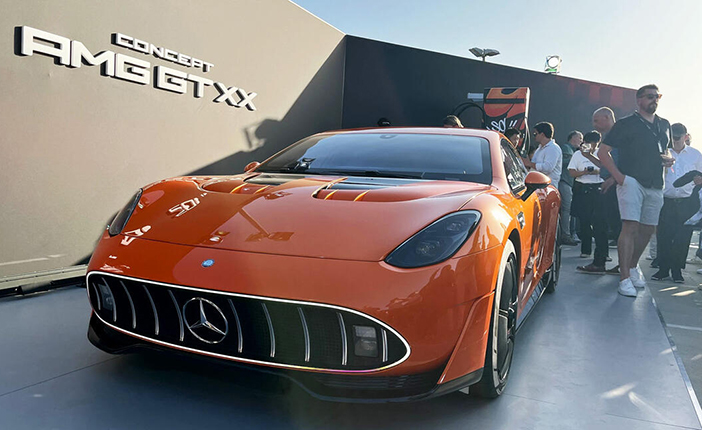
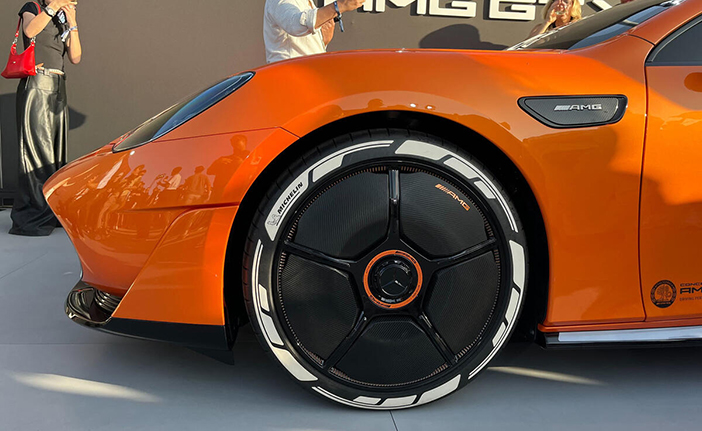
Mercedes chief technology officer Markus Schäfer described the new super-saloon to us as “a Swiss watch in the electric age”. He explained, “if you look at the components, the attention to detail and how we crafted this car. We didn’t just take every component off a shelf somewhere. It has a very unique technology”. In particular, the axial-flux motors developed by British firm Yasa stand out. These are 3 times more power dense than the radial e-motors used in most EVs, yet smaller and lighter at the same time. The GT XX concept used 3 of these motors to deliver 1.360 hp, a similarly huge amount of torque and torque vectoring capabilities, which help boost agility through corners and stability at high speeds. While the road-going model will also feature a tri-motor setup, it’s expected to be slightly less potent, with the combined output probably reduced to around 1.000 hp. That’s still plenty to catapult you into the next county in the blink of an eye, though. As advanced and technologically sophisticated as this new car may be, AMG has already shown us it can get sideways on demand when yet more prototypes were testing up near the Arctic Circle. It’s a signal of the brand’s desire to ensure this is a truly engaging car for drivers. Schäfer sees the axial-flux motor as the equivalent of the AMG’s iconic V8 or V12 engines for its future electric cars. Driving the new model, he promises, is “an emotional experience. It has to be authentic when it comes to power, drivability and track performance. But the AMG is also an emotional experience from an acoustic standpoint, from noise, vibration and hardness. And that’s exactly what you can expect in this car as well”. Much of the AMG GT XX’s aggressive yet streamlined design appears to have been carried over to the production car. For instance, despite the heavy camouflage, we can make out the outline of AMG’s signature (and absolutely gigantic) Panamericana grille that will stretch across the face of the car, and, of course, feature Mercedes’ iconic 3-pointed star sitting proudly at its centre. The air curtains on either side of the grille, the sleek silhouette, sweeping roofline, big shoulders, long bonnet and circular tail-lights all feature on the concept too, but some details have clearly been changed. Most noticeably, the headlights are bigger on the prototypes, and feature a 3-pointed star motif, similar to those on the new Mercedes CLA. The GT XX also does without a rear windscreen, much like a Polestar 4, but it looks like the road car will let you see out of the back.
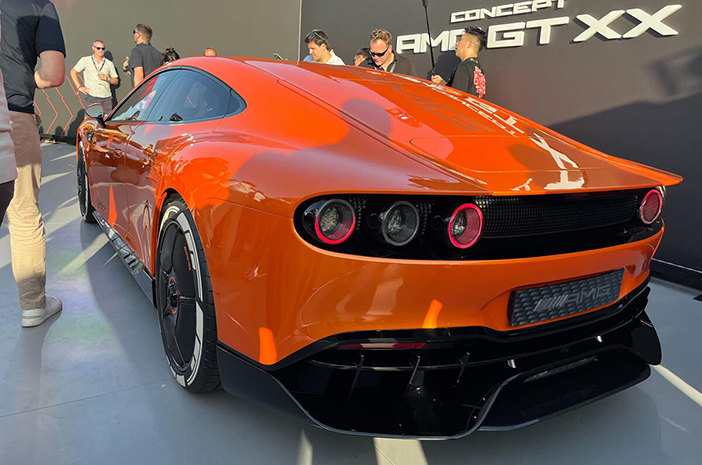
Unfortunately the interior was completely covered up so I don’t know how much of the concept’s interior design is set to reach production. Despite the lack of an internal-combustion engine under the bonnet, and being based on a bespoke EV platform, as we mentioned AMG has still given its new flagship an incredibly long bonnet and generous overhangs. It’s a more traditional front-end design than the Mercedes EQS and EQE electric saloons, which have much shorter and less distinctive bonnets. Unlike on the current petrol-powered AMG GT 4-Door 63 S, there’s no fixed rear spoiler. We might see an active aero spoiler eventually pop up, but overall AMG has managed to create an elegant and sophisticated silhouette; one of many design elements that were previewed by the AMG Vision Concept back in 2022, as well the newer GT XX. This new high-end 4-door model will be based on an entirely bespoke architecture called AMG.EA, rather than using tech from Merc’s existing AMG EQ models. AMG.EA utilises several potentially game-changing new technologies, like those innovative new axial-flux motors (which we learned about by visiting the creators at Yasa) and brand-new battery design. It uses tall, slim cylindrical cells, inspired by those used in Formula One, and features liquid cooling for maintaining the optimal temperature to deliver maximum performance, again and again, while ensuring longevity. This will provide AMG’s future EVs with “a level of stamina that is simply unique,” according to the performance division’s top boss Michael Schiebe, and means drivers will experience “relentless, continuous performance”. The AMG GT XX, and the road-going version too, use a ‘more than’ 800 Volt electrical system that allows the cars to achieve an average charging speed of more than 850 kW, and a peak figure that’s even higher. For context, the Porsche Taycan maxes out at 320 kW. Once Mercedes starts building the chargers capable of delivering its cars’ enormous speeds, drivers should be able to add around 400 km of range in around 5 minutes. Naturally, none of this will come cheap. Mercedes’ flagship EV will most likely rival only the highest spec versions of the Taycan and the Emeya. This should see pricing start well over 6 figures. Such is the price of progress, especially when there’s an AMG badge affixed to the bootlid. +++
+++ Under the new boss Ivan Espinosa and after a failed merger attempt with Honda, NISSAN is trying to turn things around. That means mass layoffs, pausing work on some new models, and now, asking suppliers if they’ll take an IOU. Reuters reports that Nissan is asking some of its suppliers in Europe and the UK if they’ll accept delayed payments to free up some needed cash. This isn’t an unusual move for an automaker, and Nissan told Reuters it’s offering suppliers the option of taking payments right away, or at a later date with interest. If the supplier decides it wants immediate payment, HSBC will pay the supplier, then Nissan will pay back the bank with interest at a later date. Espinosa’s stated goal is to achieve $3.4 billion in cost cuts over the next 2 years. Over the last fiscal year, Nissan lost $4.5 billion. Its aim to delay supplier payments in the UK and Europe could help it free up $69 million in cash. In total, Nissan has around $15 billion in cash, but nearly $5 billion in debt coming due. The automaker is also reportedly considering selling its $700 million Yokohama headquarters, possibly leasing the space back from the buyer. Meanwhile, Nissan is moving ahead with lots of new products. It recently revealed the new Leaf, and in Europe, it now has the Renault 5-based Micra. +++
+++ TOYOTA lost an important link in its corporate culture this month, with the passing of legendary production guru Nampachi Hayashi. He died June 21 at age 82. Hayashi was tapped by the company’s founding family to bring Japan’s flagship carmaker back to its roots in 2009 after it slumped to its first operating loss in seven decades. After being promoted to the board of directors that year, Hayashi redoubled his focus on a “kaizen mindset” of continuous improvement, and helped put the Japanese juggernaut back on the road to profitability. The idea is the North Star of Akio Toyoda’s mantra of “ever-better cars”. “The biggest problem is thinking you are OK”, Hayashi was fond of saying. Hayashi was one of the last direct disciples of Taiichi Ohno, the founder of the Japanese carmaker’s world-renowned production system. Ohno died in 1990, but Hayashi carried the torch into the modern era. Among Hayashi’s pupils in the Toyota Way was Toyoda, the third-generation family leader who was appointed president in 2009, in the same board shuffle that promoted Hayashi. Toyoda revived his namesake automaker and became chairman in 2023 after driving the company to record profits and sales. Hayashi retired from Toyota in 2018. +++
+++ The VOLKSWAGEN Multivan and its camper van counterpart the California have gained the four-wheel drive with the introduction of a new plug-in-hybrid powertrain. The new system comprises a turbocharged 1.5-litre 4-cylinder petrol engine, a 6-speed automatic gearbox and 2 electric motors (one per axle). They combine to put out 245 hp, allowing the van to complete the 0-100 kph sprint in 9.0 seconds. A 19.7 kWh lithium ion battery gives an electric-only range of up to 100 km, depending on the chosen model; the California is less energy-efficient, due to its extra weight. The battery can be charged at a rate of up to 50kW on a DC connection or at up to 11kW on AC. VW said it has devised the PHEV system to run on electric power as often as possible. The front motor takes priority over its rear-mounted counterpart or the petrol engine. The engine is primarily used to generate electricity, driving the wheels only when the battery is flat or when the gearbox kickdown is activated. The rear motor is also decoupled from the powertrain above 130 km/h to improve energy efficiency. The new four-wheel-drive powertrain replaces the Multivan’s previous 1.4-litre PHEV option. +++