
+++ There once was a time when AUDI could get away with selling the A8 with a mighty W12 and still pass emissions regulations. At the peak of the Piëch era, when everything seemed possible, engineers shoehorned a V12 diesel into the Q7. Heck, they even adapted the engine for a bonkers R8 TDI supercar concept with a 6-speed gated manual gearbox. But both 12-cylinder powerhouses are now nothing but distant memories, and the naturally aspirated V10 mounted behind the seats of the R8 is also in the rearview mirror. Seeing the glass half full, the V6 and V8 engines still have a future in Ingolstadt. This pledge comes from a company that once said it would go completely electric by 2032. Like nearly every other automaker, it has backtracked on its lofty EV agenda. Audi will continue selling ICE-powered vehicles for an indefinite period, and its head honcho just made an interesting observation about customer preferences. Speaking with Bloomberg, CEO Gernot Döllner said people shopping in the higher segments tend to prefer combustion engines. That’s why it made perfect sense to launch the exotic Nuvolari with a big V8 by taking the Lamborghini Temerario shortcut. At the other end of the hierarchy, EVs have broader acceptance, according to Döllner. Audi is about to cater to that audience by bringing back the delightfully quirky A2 as a fully electric compact car, serving as an indirect replacement for the subcompact A1 hatchback and Q2 crossover, both of which have recently gone out of production. “We find that the higher the segment is, the more the enthusiast still loves the combustion engine. The lower the segment is, the more battery electric is accepted”. But despite Audi’s newfound appreciation for engines, the Concept C will remain purely electric when it morphs into a production vehicle next year. The 2-seater sports car with the company’s first-ever Targa roof won’t gain a petrol engine, according to a statement from Daniel Schuster, spokesperson for Technical Development. That’s disappointing to hear, as we can all agree the Porsche 718’s alter ego with an Audi badge is exactly the type of performance vehicle that practically begs for the RS3’s inline-5. Seeing the glass half full, at least Audi has managed to retain the V6 engine in the RS4-replacing RS5 and will give the upcoming RS6 sedan/wagon duo at least a V6. These are heavyweight plug-in hybrids designed to meet emissions regulations, as the alternatives would have meant downsized engines or killing the cars altogether. +++
+++ Which electric cars fare the best and worst when it comes to BATTERY DEGRADATION ? That’s what the world’s largest independent electric car battery study has revealed as tests of over half a million cars across the world shine a light on how frequent charging can take its toll on crucial (and expensive) components. Austrian EV battery diagnostics firm, Aviloo, compiled data from more than 500.000 battery State of Health (SoH) tests conducted across North and South America, Asia, Australia and Europe, between 2022 and 2026. The data was drawn from 20 of the most popular EV models. All batteries degrade over time, but these tests determine how much of a battery’s original capacity remains. If a battery is at 80 percent SoH, it’s only capable of 80 percent of its original maximum range. Results showed that electric car batteries are lasting a lot longer than some sceptics may have envisioned. None of the 20 EV models tested showed a median drop in SoH of more than 10 percent in the first 50.000 km.
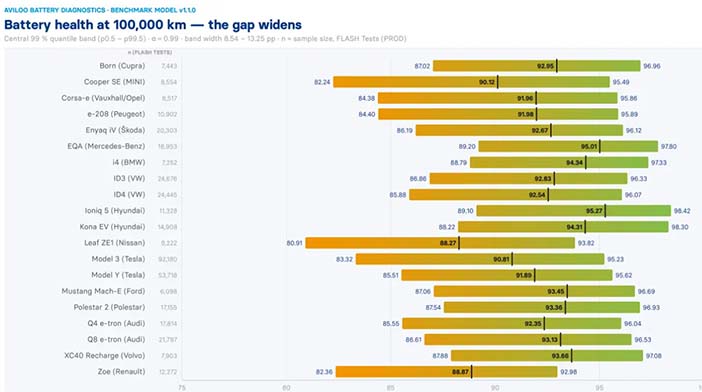
The study did show significant variations in performance between the batteries in individual car models, but also similarly big variations in different examples of the same model. “Yes, EV batteries are ageing better than the ‘they wear out fast’ myth suggests, but that’s not the most useful thing this report tells you”, said Aviloos CEO, Marcus Berger. “What matters is that battery health varies significantly between models, and even more between individual cars of the same model”. As a general rule, Aviloo found that cars with smaller battery packs tended to show the greatest levels of degradation; the Nissan Leaf (ZE1) and Renault Zoe, for example, both have comparatively small battery packs and showed the greatest level of degradation over 50.000km. The Leaf recorded an average SoH of 91.23 per cent and the Zoe managed 91.64 per cent. The reason for this is that smaller batteries will need charging more frequently, with the charging cycle causing wear that gradually reduces overall capacity. At the other end of the scale, the Hyundai Ioniq 5, which can be specified with large batteries in excess of 80 kWh, achieved the highest median SoH at 50,000 km with 97.13 per cent. There are some outliers to the big-battery rule; the Tesla Model Y, which is the world’s best-selling electric car, actually performed poorly in comparison to other large-battery EVs, alongside the smaller Model 3; the pair returned a median of 94.42 and 93.77 per cent respectively. Such a finding somewhat contradicts Tesla’s own studies in which it claims it would take 20 years and 360.000 km for their cars’ batteries to lose 15 percent capacity. The firm did admit, however, that drivers will see an “initial drop” in SoH over the first few thousand kilometres before the curve flattens off. On top of all this, it’s worth considering the sheer variation in battery condition within individual models themselves; the aforementioned Leaf, for example, saw the widest variation, with SoH readings ranging from 85.41 per cent to 95.31 at 50.000 km and even more as the mileage increased. The Volkswagen ID.4, another popular EV, saw between 11-14 percent variation in SoH at higher mileages, something a spokesperson for VW said “is influenced by a wide range of factors including charging behaviour, usage patterns, climate and software status, so individual vehicle results will naturally vary”, Nevertheless, Berger highlighted how “A gap of 10 or 15 percent in state of health is a real difference in range, in what a car is worth, and in what you can rely on it for. You simply can’t know where your car sits in that range without testing it”. +++
+++ It’s safe to say the i4 has served its purpose as an electric 3 Series, but time is running out for the 5-door liftback. Earlier this year, BMW product boss Bernd Körber told that the new i3 is essentially the i4’s successor, leaving no room in the lineup for the aging model running on previous-generation hardware. The i3 has the company’s most efficient electric motors to date, plus cylindrical battery cells with 20 percent higher energy density for significantly more range. BMW will retire the i4 either by the end of this year or in early 2027, depending on the market. Interestingly, the nameplate might not remain dormant for long. Although Munich won’t be doing another electric Gran Coupe in the 3 Series/4 Series segment, the moniker is allegedly being repurposed for a pair of 2-door models. An all-new coupe and convertible without combustion engines are apparently on the way, with the rumor emerging shortly after BMW pulled the plug on several 2-door cars. Production of the Z4 roadster and 8 Series has ended, leaving the German luxury brand with only the 2 Series Coupe and 4 Series Coupe/Convertible in its lineup of less practical cars. Although coupes typically take precedence, BMW could break with the norm and launch the convertible first. I’m making that assumption based on the fact that a prototype of an electric 4-seat convertible with a folding fabric roof was already spotted . Both models are rumored to arrive in 2028, likely a few months apart. In the meantime, BMW is cooking up a couple of other similarly sized EVs. There’s an i3 Touring on the way for the wagon-loving crowd, with production expected to kick off in mid-2027. But before all these new EVs break cover, a first-ever iX4 is coming sooner than you might think. The wraps are supposedly coming off in the next few months, if not weeks. This time around, BMW won’t develop another X4 generation with combustion engines, as the fully electric model will serve as its de facto successor. Judging by a massive leak on the company’s U.S. website earlier this year, the iX4 will be available for the 2027 model year. Many, if not all, of these future i-badged models are widely expected to spawn high-performance variants, following in the footsteps of next year’s M3 and X3 M pair of sporty EVs to carry the “M” letter. +++
+++ Regulators in CHINA just told BYD and Geely their cars did not match the paperwork. Wheelbases came in outside tolerance, fuel figures ran higher than declared and some units shipped without owner’s manuals. Those findings landed days after 4 ministries, including the Ministry of Industry and Information Technology, opened a year-long nationwide inspection campaign targeting production quality and vehicle safety. Surprise factory checks are now part of the deal. China builds cars fast. The average new model takes about 2 years to reach showrooms there, against 3-5 years for most legacy foreign brands still running traditional development cycles. Automakers want to go faster still. The China Association of Automobile Manufacturers and IAT Automobile Technology have suggested using artificial intelligence to shorten that timeline to just 18 months, a number that would make Western product cycles look almost leisurely by comparison. Regulators are not cheering. Bloomberg reported that Chinese officials are now scrutinizing whether breakneck speed is compatible with rigorous testing, and the industry’s ambitions to shave off even more time are facing a genuine reality check. The timing is not an accident. Massive overcapacity and brutal price wars have squeezed margins across the industry. Officials now see the risks caused by these cost pressures that push manufacturers to skip or shorten validation work, rather than these defects being isolated mistakes. The campaign, launched on August 27, requires roughly 100 domestic manufacturers to submit reports on product quality, reliability and durability to local authorities by the end of 2026. Automakers must also file and carry out voluntary recalls the moment they find defects. Inspectors are collecting sample vehicles and components straight from factories and dealerships, sealing their hardware and software configurations, then shipping them off for crash, structural and battery-pack testing. Cybersecurity and data security checks are also part of the same sweep. MIIT’s own case files show why. A Geely EX2 model sold domestically as the Xingyuan had a wheelbase deviation beyond the permitted one percent margin, and a BYD Qin L DM-i unit posted fuel consumption above its declared figure in charge-sustaining mode. Other flagged units lacked user manuals entirely, and some emergency window and side-impact protection devices fell short. Regulators are also weighing whether to double the mandatory road test distance for new electric vehicles to 30.000 kilometers; a change that would stretch validation timelines. None of this stays inside China’s borders. Brands like BYD and Geely are counting on export growth to offset domestic price wars, and any brand caught with conformity violations carries that reputation into markets abroad, where skepticism about fast, cheap-built cars is already baked in. +++
+++ Big, heavy and luxurious ELECTRIC SUVS : while they’re a solid testbed for tech that’ll no doubt filter down, they feel like the answer to a question nobody is (yet) asking. Just this week, there’s been 2 cars in the news. First up is the Range Rover EV550: a 2.8-tonne behemoth that has been drip-fed to us for what feels like years now. It’ll launch properly over the next few months, giving well heeled customers a “real-world” range of 530 km and the ability to top up the battery to 80 percent in just over 20 minutes. Then there’s the Bentley Torcal, which we’ve had the pleasure of riding in for the first time. While specifications are still under wraps, this “urban EV” is expected to be more than 5 metres long and go from 0-100 kph in less than 4 seconds. Of course, these aren’t the first cars of their kind. The bulbous Mercedes EQE and EQS, despite their strong on-paper numbers and tech-filled cabins, haven’t been the sales successes their maker hoped. The Lotus Eletre sets a high benchmark for driving dynamics, but when was the last time you saw one on the road? Even the Volvo EX90 has struggled in a market seemingly controlled by the internal-combustion engine. BMW has never really bothered (apart from the heavy and over-engineered iX, and forthcoming, multi-fuel X5), nor the closely related Rolls-Royce. It’s odd, because in theory, nothing is more luxurious than the sound of silence – an EV staple that, without the worry of weight or efficiency, goes hand-in-hand with opulent SUVs. The problem is, if you’re spending upwards of €120.000 on a new car, compromise isn’t in your lexicon, especially with a family SUV. You want pace and practicality, plus long-legged luxury; all mated to cutting-edge tech and refinement in spades. It makes you wonder: instead of forcing these luxury SUVs into the EV mould, would makers do better to focus on the back-up blanket of a petrol powertrain, with PHEV or range-extender tech that lowers emissions without trading usability? A mixed powertrain approach isn’t a step backward; it remains a necessary bridge to mass-scale decarbonisation. I’m not sure the one-size-fits-all, EV-everything approach works in every segment just yet. However, as a diehard supporter of the automotive industry, as well as a champion of consumers like you, I’ll be very happy to be proved wrong. +++
+++ Another month, another disappointment for FORD as combined sales on its homemarket plummeted 10.3% in August to 170.681 units. That’s a decline of nearly 20.000 vehicles and this can largely be chalked up to the elimination of the Escape (Kuga in Europe). Electric vehicle sales plunged 79.4% and this was partly due to the axing of the F-150 Lightning. Dealers only sold 148 of them last month, which was down 95.4% from a year ago. The aging Mustang Mach-E didn’t do much better as sales tumbled 72.5% to a disappointing 1.989 units. However, it’s important to note last year’s sales were elevated as there was a mad dash to buy vehicles before the clean vehicle tax credit expired on September 30. Putting EVs aside, overall Ford sales fell 10.3% to 163,175. The top seller was unsurprisingly the F-Series, which found 67.504 takers. That was a slight 1.2% decline from a year ago and this only equates to 814 units. In a distant second place was the Explorer, which was down 4% to 19.801. It was followed by the affordable Maverick as 13.680 Americans scooped one up last month. While the sales chart wasn’t terribly interesting in August, the Mustang was up 12.7% to 3.647 units. Furthermore, the Bronco Sport climbed 8.3% while the Bronco fell 8.8%. It’s also worth noting the recently redesigned Expedition is having a tough go as August sales were down 11% and it’s off 11.6% year-to-date. Part of this can likely be blamed on high petrol prices, which makes it a shame we never got the hybrid variant that was originally promised in 2023. +++
++ The Volkswagen Group is considering phasing out the SEAT brand by 2029, as part of a sweeping programme to simplify its operations and cut costs. The proposal, which has reportedly already been approved by Volkswagen’s management board, is due to go before the supervisory board on Friday 4 September, according to German media reports. Under the plan, Seat would disappear from Volkswagen Group’s brand portfolio by the end of the decade, with financial resources instead concentrated on Cupra, the performance-oriented offshoot launched as its own brand 8 years ago but now comfortably outselling the brand from which it emerged. The Volkswagen Group has officially declined to comment on the reported decision. A spokesman said internal documents are discussed and approved by the appropriate bodies and that the company wouldn’t pre-empt that process. In a statement, a Seat spokesman didn’t deny the reports but said: “The entire industry, including the Volkswagen Group and Seat, is undergoing a transformation, driven by our commitment to electrification. The global context has changed significantly, with a strong impact on the automotive sector, particularly over the past year. Therefore the Volkswagen Group is working on a transformation plan for the entire Group business to strengthen its competitiveness and efficiency. The goal is to make the entire Volkswagen Group and respective entities more efficient and leaner and to capture technological synergy potential consistently. This strategy has been discussed in several supervisory board meetings. No decisions have been taken at this stage. We will inform about any strategic decisions affecting Seat in due time”. Seat was founded in 1950 and for decades has served as Spain’s national car maker. Cupra, meanwhile, existed as the badge applied to Seat’s fastest models before being established as a separate marque in February 2018, following the Volkswagen Group’s failed attempts to purchase Alfa Romeo. 8 years later, Cupra is set to effectively succeed its parent brand. The reasoning behind Volkswagen’s proposal is reflected in the Spanish brands’ sales figures: Cupra delivered a record 170.100 cars during the first half of 2026, compared with 129.600 for Seat. Cupra accounted for almost 57% of the pair’s combined 299.700 deliveries from January to the end of June. The direction was already clear last year. Cupra sales rose 32.5% to a record 328.800 cars in 2025, while Seat deliveries fell 17% to 257.400. It meant Cupra outsold Seat by more than 71.000 cars in just its 7th year of independence. Cupra has now sold more than 1 million cars globally since its creation and has expanded well beyond rebadged performance versions of Seat models. Cupra was initially dependent on Seat-derived cars and shared showrooms, but the Volkswagen Group has progressively given it its own products, design identity and positioning. The result is that what began as an attempt to extract greater margins from Seat’s sporting heritage has evolved into a substantially more valuable proposition in its own right, with Cupra providing higher profitability. For Volkswagen, maintaining 2 Spanish brands increasingly means spending money developing, marketing and distributing cars that often compete for the same customers. This duplication is particularly difficult to justify as the Volkswagen Group embarks on its biggest restructuring programme in decades under CEO Oliver Blume. According to internal documents cited by Germany’s Bild newspaper, the Volkswagen Group’s reasoning is explicit: continuing Seat in its present form would require additional resources while strategic development within the brand group is to be focused on Cupra. +++
+++ Months after I first reported that dealers were measuring TOYOTA RAV4 supplies in hours rather than days, the situation still hasn’t returned to normal. Some customers are waiting months for Toyota’s redesigned hybrid SUV, while dealers are staring at spaces where shiny new RAV4s should be sitting. CNBC visited Colonial Toyota in Milford, Connecticut, where owner Bobby Crabtree said his lot has room for another 250 vehicles and is currently only around one-third full. Not every empty spot would normally contain a RAV4, but there ought to be more of them, and Crabtree would certainly like more. Customers Nancy and Ira Berman know the problem from the other side of the salesman’s desk. They ordered their RAV4 in March and are only now preparing to take delivery, 6 months later. “The wait was a slight annoyance”, Nancy Berman told CNBC, adding that the couple already had other Toyotas they could drive in the meantime. Toyota openly admitted that supplies would initially be tight when it launched the latest RAV4. The redesigned SUV went hybrid-only in America, with the initial supply coming from Japan and Canada due to factory retooling at the Kentucky plant, and those Japanese exports were also hurt by the conflict in the Middle East. Kentucky is now churning out RAVs too, but the gradual production ramp-up meant dealers weren’t going to receive their usual volumes straight away, and Toyota is still playing catch-up with runaway demand. I’ve been watching the squeeze for months. Earlier this summer, some dealers were measuring RAV4 inventory in hours, while one California Toyota store reportedly had more than 800 customers waiting. The tight inventory has cost Toyota tens of thousands of potential RAV4 sales this year. But customers still want them, even if they have to wait, because America loves its RAV4s. Almost 480.000 were sold in the US last year, making Toyota’s crossover the country’s third best-selling vehicle behind only the Ford F-150 and Chevrolet Silverado. And a move to hybrid-only power at a time when gas prices have skyrocketed looks well timed. Hybrids account for more than 18 percent of US new-vehicle sales this year, according to JD Power. +++
+++ In the UNITED STATES , the latest monthly sales results for several automakers reveal little has changed this summer. Automakers with a lineup of hybrid-powered models continue to see record-breaking results as consumers seek new ways to save a few bucks at the pump. Battery-electric vehicle sales continue to take a beating, with numbers across the industry taking a tumble. Sales of affordable petrol models, meanwhile, skyrocket; the Kia Seltos, Hyundai Elantra, and even the aging Mazda3 are hugely popular right now. I expect these trends to continue so long as petrol prices remain high, given that hybrids offer a great solution for most buyers and their lifestyles. So expect brands with electrified powertrains to keep posting big sales numbers. That said, only a handful of automakers release a monthly sales report, I don’t have exact data from every single automaker. Regardless, here are the winners and losers from last month. The Kia Seltos got a major glow-up, and buyers are already taking notice. Sales for the updated crossover exploded last month, jumping 65.3 percent compared to August 2025, with 9.214 sold. For the year, Seltos sales are up 42.6 percent, and the hybrid version isn’t even available yet. The Seltos is Kia’s cheapest crossover and second-cheapest model in the lineup. For 2027, the automaker gave it a Telluride-inspired redesign inside and out that looks really good. Kia makes the 147 hp naturally aspirated 2.0-liter standard, with a 190 hp turbocharged 1.6-liter engine available on specific trims. Battery-electric vehicles continue to take a beating as buyers opt for cheaper hybrid offerings. Everywhere you look, it’s a bloodbath. Ford Mustang Mach-E sales are down 72.5 percent. Subaru Solterra sales are down 86.6 percent. The Honda Prologue, which the automaker will cease producing after the 2026 model year, is down 80.9 percent. At Hyundai, things are just as dire. Ioniq 5 sales are down 51 percent, while Ioniq 9 sales fell 42 percent last month. The Ioniq 6 is all but dead: Hyundai sold just 28 units last month. Kia EV6 and EV9 sales were down 60.4 percent and 33.2 percent, respectively. The Hyundai Sonata might not be the brand’s cheapest model, but buyers are flocking to the sedan. Sales for the model jumped 44.0 percent in August, with Hyundai selling 6.899, but that’s nothing compared to the Elantra. Last month, the automaker sold 17.747 Elantras, up a much more modest 16 percent. It’s Hyundai’s second-best-selling model behind the Tucson, which also had a great month. Hyundai offers all three models with Hybrid powertrains. It’s a strange time at Mazda as its newest models are struggling. Sales for the CX-70 and CX-90 continue to suffer. Sales for the two-row CX-70 were down 25.0 percent last month and are down 27.7 percent for the year. The three-row CX-90 experienced a larger fall in sales, 37.3 percent, but is outselling the CX-70 by a wide margin. Mazda sold 4.265 CX-90s compared to 1.229 CX-70s. Sales for the CX-90 are down 27percentt for the year. While sales for Mazda’s crossovers are not doing well, it’s a different story for its cars. Sales for the Mazda3 are popping off as consumers search for fuel-efficient vehicles, up 91.7 percent compared to August 2025. The 3 isn’t the most economical in its class, but it is quite fun and available with a manual transmission, so what’s not to love? Buyers are gobbling up the sedan by roughly four to one, with sales up a whopping 113.9 percent. Even MX-5 sales were up last month. The Japanese automaker sold 925 roadsters, up 14.4 percent. Sales for the model are up 2.0 percent for the year. +++