
+++ BENTLEY has revealed a dramatic, high-riding limousine concept that previews the design of its upcoming cars, and it could evolve into a successor to the Mulsanne flagship. Called the EXP 15, this 5.4 meter long show car will inspire the shape and styling of the next generation of Bentley cars, beginning with its first EV, an ‘urban SUV’, which will be launched next year to sit underneath the Bentayga. Straddling the boundaries between saloon, SUV and grand tourer, the EXP 15 takes design inspiration from some of Bentley’s best-known historic models but ushers in a futuristic new treatment that departs radically from the current Continental GT, Flying Spur and Bentayga.
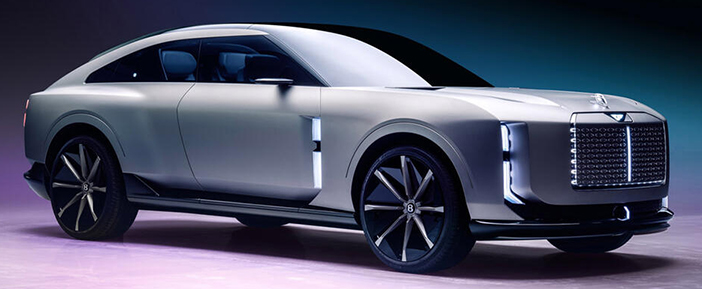
It’s a statement of intent from recently appointed director of design Robin Page, who rejoined Bentley from Volvo in 2023, having previously served in Crewe’s interior design team for 17 years. He told that his aim with the EXP 15 is to drastically evolve the company’s design hallmarks while remaining true to its most recognisable elements. “It’s still in that linear line of Bentleys, but it’s a fresh start: a new design language”, said Page. “The point is to make a bit of a bang: next chapter”. “It’s also given us a chance to try a new, modern design language: more monolithic, stronger and cleaner in its surfaces and not too over-complicated”, he continued, giving clues to the styling of Bentley’s initial wave of electric cars. The primary aim of the new concept is to showcase five overarching design themes that will define the next-generation Bentley line-up; all 5 of which are inspired by one of the earliest Bentley GT cars: the 1928 Speed Six with bodywork by coachbuilder Gurney Nutting. Better known today as the Bentley ‘Blue Train’ for its association with original ‘Bentley Boy’ Woolf Barnato, who won a race against the legendary ‘Train Bleu’ express from Cannes to London in 1930 with a Speed Six, that car showcases various definitive styling cues that Page has reinterpreted for the modern era. First is the “upright elegance” of its front end, which is referenced in the new concept’s bluff, imposing face; a departure from the more angled visages of Bentley’s current cars. Page said: “We started to lean things back, but what we see from the heritage cars is this strong vertical element and that gives it that kind of proud confidence that we want to capture on the front of our cars. What we’ve been relating it to is a horse. If you think of a thoroughbred horse coming to a stop, it has that upright, vertical chest”. The more upright, monolithic face is at odds with the low-slung and heavily sculpted front ends that other firms are applying to their electric cars in pursuit of enhanced efficiency. But Page said Bentley is not out to claim any range records with its electric cars. “We’re finding that there’s a sweet spot in terms of range. Our customers are basically telling us that 480-560 km is that sweet spot. Beyond that, they’ll use the private jet,” he said. The “endless bonnet line” is a key feature, too, and Page points to the slim, distinctively shaped daylight opening as one of the more obvious parallels between the old and new cars. Meanwhile, the new-look rear end, with a prominent new light signature inspired by the firm’s ‘B’ emblem, is described as the “prestigious shield” and modelled on the rear luggage carriers affixed to Bentleys of old. The fifth design theme common to future Bentley models will be the “resting beast” proportions showcased by the EXP 15, with a long bonnet (here housing a sizeable frunk with a pair of 1930s-style, piano-hinged lids), a cab-rear silhouette and heavily accentuated rear arches.
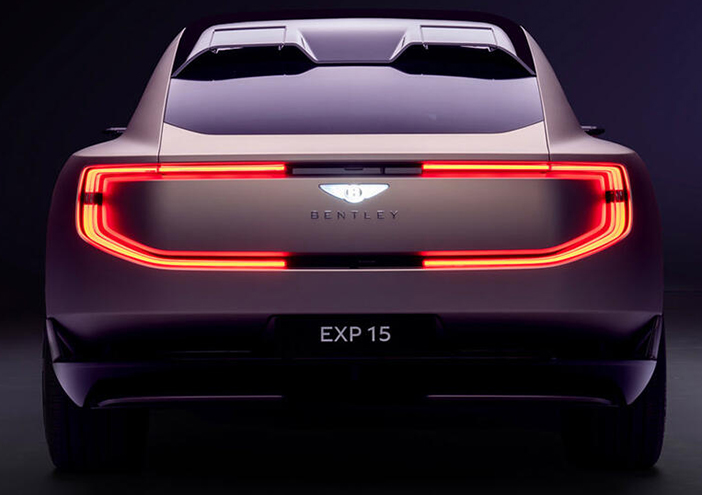
“We relate this to a tiger having a strong shoulder when it’s laid down”, said Page. “It’s got power in the back legs”. Although the EXP 15 is a dramatic departure from the current conventions of Bentley design and has certain similarities with the new Volvo ES90, its creators have preserved some of the firm’s most important and recognisable features. Page cites the grille-inspired front lighting design as a prime example: “We decided to keep the grille as being our main communication. In the past, the grille was all about getting air into the car. We don’t need that any more, so we created a piece of art. The concept’s front end is dominated by a large section of cutaway diamond motifs, with a ‘crystal’-themed led light display behind, giving a dynamic effect that changes according to the angle they are viewed from. The EXP 15 also swaps from a traditional circular headlight design to a slimline vertical arrangement that references the chrome strips on the wings of the old Speed Six. Page said round headlights are effectively a hangover from a time when lighting technology wouldn’t allow for other shapes. “What we find is every time we did round lights, you get the retro signal. We just want to test the water to see how passionate people are about round lights”, he said. Page has sought to avoid an overtly retro-inspired design, despite taking influence from Bentley’s past. “As soon as you start to duplicate”, he said, “you fall into the retro trap”. He added: “What we’re getting from our customers and dealers is that we need to be more modern and progressive. We love the old cars, but at the end of the day we want to be the coolest kid on the block”.
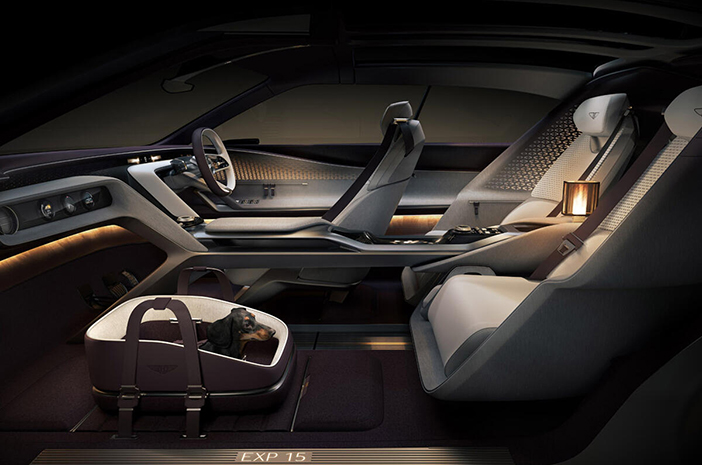
Uniquely for a full-sized luxury car, the EXP 15 features a three-seat layout, with the nearside passenger seat sliding fore and aft electrically on demand, and rotating 90 degrees when the doors open for a more elegant exit; an arrangement that harks back to the cockpit of Barnato’s famous continental cruiser. “Barnato was a playful character: he liked to drive himself, but sometimes he wanted to have a whisky in the back. And he also had his girlfriend with him, and sometimes she would sit in the back. It was a very self-indulgent car”, said Page. The concept also has picnic seats and a champagne cooler in the tailgate, a reverse-opening rear door on the passenger side and a central section of the roof that opens when parked so passengers can stand before getting out. Bentley has even designed a bespoke dog carrier that mounts in the passenger footwell. “What we’re finding is that people love this idea of real luxury”, said Page, “and the dog is now a very important accessory”. He said the aim with the EXP 15’s cabin is to ensure VIP passengers have the most dramatic entrance possible upon arrival at a prestigious destination. “The idea is that the most important person sits in the rear, and when they arrive at an occasion, the 2 doors open, the seat twists around, the roof goes back and you get ‘the art of arriving’. That is the Instagram photo shot; someone arriving in style and that’s what we wanted to capture”, said Page. Traditionally, outlandish features such as these remain the preserve of concept cars as designs progress through to production, but Page said “we’ve based it all around a viable package” in order to “gauge whether this is an interesting concept”.
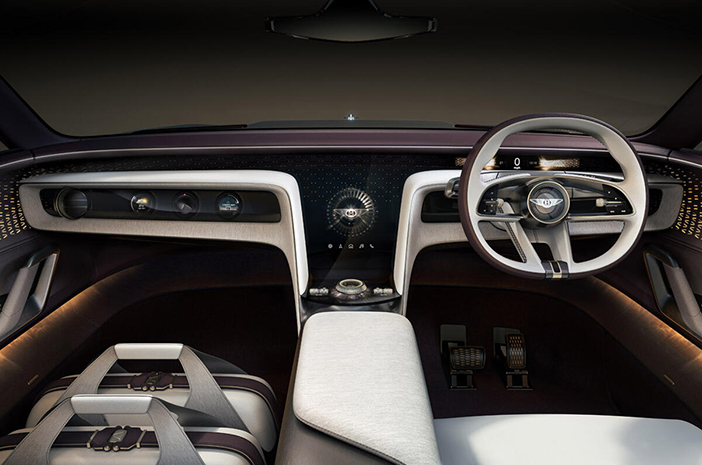
Meanwhile, in the centre of the dashboard, where a large touchscreen is usually mounted, there is a prominent physical dial to control various in-car functions, with a small digital display housed within it that can show the state of charge or directional arrows for the sat-nav, among other functions. “It’s like having a mechanical watch and a digital watch”, said Page, adding that Bentley is exploring new dashboard formats that aren’t centred around a traditional touchscreen, and emphasising its focus on analogue controls, which feature throughout the cockpit of the EXP 15. “What we’re finding, especially at our end of the market, is that people are a bit bored with full-digital screens. What makes us premium is to keep a good level of mechanical detailing that the others can’t do”, said Page. The EXP 15 was conceived first and foremost as a design showcase, but Page suggested that a positive reception to its genre-bending silhouette would strengthen the likelihood of a production version. Asked if the EXP 15 could be readied for showrooms, he said: “It’s doable”. The concept has been designed around “a viable package and platform, and these are mechanisms that exist. What we want to do is gauge whether this is an interesting concept”, said Page. He stopped short of saying whether the EXP 15 had been conceived around a specific architecture, but a variation of the SSP ‘Sport’ platform that sibling company Porsche is using for its new upcoming SUV flagship, the K1 (a large, 3-row SUV that will sit above the Cayenne) would be a logical fit for a production version. If it does make showrooms, the EXP 15 would not replace any current model, but rather it would pick up where the Mulsanne limousine left off when it was retired in 2020 after a 10-year run; once again giving the Crewe firm a direct rival to the Rolls-Royce Phantom. Before giving the green light, though, Bentley will closely monitor reaction to the EXP 15 concept in order to gauge the viability of offering a high-riding saloon in this vein. Page said: “We know really well the GT market. We pretty much invented that market. That’s solid. We know our customers. We know what we want to do. Even in the luxury SUV market, we’re now pretty experienced. The one we’re curious about is the sedan: we’ve got a very successful Flying Spur. The question is: do we continue with that kind of proportioned car, or do we elevate it a bit more?” There are no plans to dramatically reinvent the Continental GT (“people love it for that really amazing driving experience”) or the Bentayga (“its capability as an SUV is incredible”) in this vein. But Page said the market for luxury saloons is changing and the EXP 15’s unique shape could be the key to renewed success in that market. “What we’re exploring here is: there is the traditional sedan, but is there something else out there?” he said. “People are starting all the time to want a more elevated seating position, and if you look at the trends, the SUV is constantly, always growing, and the sedan one is steady. So we’re just exploring if that’s an area that we’ve not tapped into”. +++
+++ The electric vehicle boom in CHINA has reshaped the global automotive landscape, but not every player in the field is built to last. While China’s automotive industry has grown into a formidable force, a new report suggests that only a fraction of the country’s EV brands may survive the coming years. With hundreds of startups already gone and consolidation gaining momentum, China’s EV market is headed for a major transformation. In 2018, it was estimated that over 500 companies in China were developing and planning to build “new energy” vehicles. Many of these companies failed to get off the ground and quickly folded. As of 2024, it’s understood that there were 129 companies selling NEVs in China. According to consulting firm AlixPartners, just 15 of these are expected to remain financially viable through 2030. While the consultancy firm didn’t name which companies it expects to thrive, these 15 brands could account for roughly 75 percent of China’s total EV and plug-in hybrid market. Some of them have already reached full-year profitability. According to the head of AlixPartners’ automotive practice in Asia, Stephen Dyer, some local governments may support non-viable companies to protect jobs and economies. As such, consolidation may proceed more slowly across the industry in the coming 5 years. “China is one of the most competitive new energy vehicle markets in the world”, Dyer said. “It is experiencing a fierce price war. Its rapid innovation speed is constantly being refreshed by new forces. Such an environment drives significant breakthroughs in technology and cost efficiency, but it also makes it difficult for many businesses to become sustainably profitable”. As I reported in March, only 3 EV brands in China are believed to have achieved profitability. These are BYD, Li Auto and the Seres Group, which includes the Seres, Aito and Landian brands. Some other local companies are edging towards profitability, including Zeekr, Xpeng and Leapmotor. +++
+++ There’s been a noticeable shift in the automotive industry this year. Automakers are rethinking their roadmaps that had put them on a path toward full electrification. Electric vehicle adoption is slowing in the United States, and the federal tax incentives are set to disappear soon. That makes pouring billions of dollars into EV development even riskier for already strained auto companies, and that uncertainty is forcing some, like HONDA , to pull the plug on developing some future models. The automaker has reportedly cancelled plans for a large electric SUV. It was supposed to launch in 2027, but according to a new report from Nikkei Asia, Honda has halted development on the model and slashed how much it plans to spend on EVs through 2030. According to the publication, Honda will cut EV-related funding from ¥10 trillion ($68.6 billion at today’s exchange rate) to ¥7 trillion ($48.0 billion). However, it’s still planning to launch the flagship electric sedan and midsize SUV EVs that it showcased earlier this year with the 0 Series concepts. They’re scheduled to arrive next year. Honda had plans to launch 7 EVs by 2030, but it’s unclear how many of those are still in development. The automaker is reportedly shifting its focus to building more hybrids, which are already in development for America. In the last 6 to 9 months, automotive companies have had an epiphany and realized their EV plans don’t align with consumer demand. In November 2024, Lotus cancelled its proposal to go fully electric by 2028. Instead, it will focus on hybrids, like Honda, and that’s the direction many automakers are now heading. Porsche also announced it would shift to offering more hybrid options, admitting it would not achieve its initial goal of 80 percent of its sales to be fully electric by 2030. However, the German brand said it would continue to expand its EV line-up. Nissan scrapped plans for a small electric SUV in January, and in April, Mini said it wouldn’t abandon gasoline engines anytime soon. Even Volvo has admitted defeat in achieving its EV plans. And then there are the companies trying to keep the combustion engines alive. BMW said the combustion engine is its “foundation”. Lamborghini is hopeful that synthetic fuels will happen, as its new V8 can run on them without sacrificing performance. Mercedes-Benz is making a “course correction” to extend the life of its engines, and Audi has announced it will now build gas engines for another 10 years. If 2025 has proven anything, it’s that the auto industry is facing a massive upheaval, and automakers are scrambling to navigate an ever-changing landscape unlike anything they have ever seen. Competition from China on electric vehicles is putting Western automakers in a difficult position as EV adoption begins to falter elsewhere. Plans are changing, and that means some automakers are closing the purse strings on EV investments as things change. +++
+++ In just a few years, HYUNDAI has built an impressive line-up of electric vehicles that rivals, and in some cases surpasses, what many long-established automakers have brought to market. With options ranging from the retro-styled Ioniq 5 to the spacious new 7-seat Ioniq 9 and the compact Niro EV, Hyundai is covering a lot of ground. And the brand isn’t slowing down, as another electric model is on the way. This upcoming addition will slot in above Hyundai’s Inster, the battery-powered version of the compact Casper. While the Inster’s charm lies in its tiny footprint, it may be a bit too small for some buyers. That’s where this new model fits in. A new report points to a debut in concept form at the Munich Motor Show this September. The vehicle is expected to land between the Inster and the Kona in terms of size, aligning closely with the Bayon, which is currently offered in European markets. Few details are known about the new model at this stage. However, Autointernationaal.nl speculates that it could be dubbed the Ioniq 2 if it is to use the automaker’s well-established E-GMP platform. Styling remains a mystery, but regardless of what the concept looks like, recent Hyundai history suggests that the eventual production model should resemble it closely. One of the more significant updates is expected inside the cabin. This SUV is likely to be the first Hyundai equipped with the new Pleos Connect infotainment system. Unveiled earlier this year, Pleos Connect is based on Android Automotive and features a large, freestanding touchscreen mounted at the center of the dashboard. It’s a layout that recalls Tesla’s approach and echoes what’s becoming common in many Chinese EVs. This new setup could prove controversial. Most current Hyundai cars feature sleek digital instrument clusters and infotainment systems, sometimes housed within a single curved display. While tablet-like displays often have great functionality, they’re not particularly appealing to the eye. Underneath, the new model is expected to share much of its architecture with the forthcoming Kia EV2. That vehicle will ride on a shortened version of the E-GMP platform and be offered with a single electric motor. If Hyundai follows a similar path, it could help keep costs manageable while still delivering competitive performance in the growing sub-compact and compact EV segments. +++
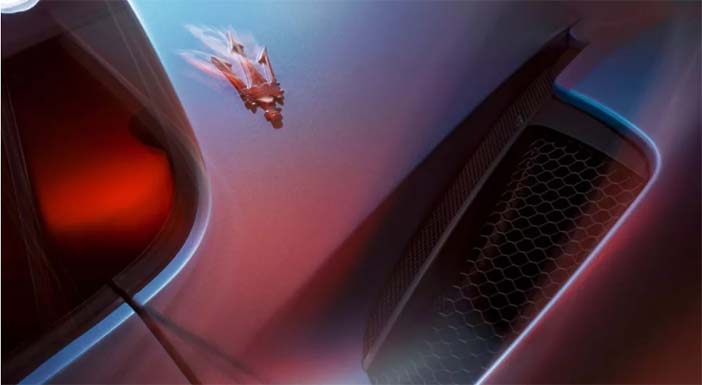
+++ Even in the face of financial challenges, MASERATI isn’t losing sight of its roots. The company is gearing up for a world premiere at the 2025 Goodwood Festival of Speed, teasing what looks like an evolution of its mid-engined MC20 supercar. While the teaser image doesn’t give much away, it zooms in on the pillar and side cooling intakes, features that look nearly identical to those on the MC20. The honeycomb mesh design and carbon fiber insert are carried over, suggesting this new model will share more than a few traits with its predecessor. According to the announcement, the world debut is about a “new and authentic expression of energy crafted in the true Maserati way“. On Instagram, the automaker added: “An all-new equation for energy is coming. Sharper form, same unfiltered soul. Prepare yourself: a new MC chapter is about to begin”. Alongside the teaser image, the company included the famous equation E=mc², a clear nod to Einstein’s mass-energy equivalence principle. That last detail might offer a subtle clue. While the model could be a mid-cycle refresh or a limited edition, the physics reference might hint at an optimized weight-to-power ratio. Still, nothing has been confirmed. Currently, the MC20 runs on a twin-turbocharged Nettuno V6 engine. It produces 630 hp in its standard form and 640 hp in the track-ready GT2 Stradale. Maserati originally had plans for a fully electric MC20 Folgore, but reports now suggest that version has been shelved due to low demand in the high-performance EV segment. The MC20 was first introduced in 2020 as a coupe, followed by the open-top Cielo in 2022. Since then, it’s spawned 2 specialized variants: the track-only MCXtrema in 2023 and the GT2 Stradale in 2024, a road-going version of its GT2 race car. All of our questions will be answered at the Goodwood Festival of Speed on July 10. Besides the new model, Maserati’s line-up at Goodwood will include an MC20 GT2 Stradale, an MCXtrema and a V6-powered GranCabrio. All 3 models that will be on display will tackle the hill climb. This appearance lines up with a pair of important anniversaries for the brand. Maserati is celebrating 100 years of its Trident emblem in 2025, with its racing centennial coming up in 2026. One of its earliest triumphs came in 1936 when the Tipo 26 won its class at the Targa Florio with Alfieri Maserati himself behind the wheel. +++
+++ Big news coming from PORSCHE today. With the first half of the year in the rearview mirror, Zuffenhausen is sharing some interesting sales data. The Macan saw a 15 percent increase compared to the January–June 2024 period, rising to 45,137 units to become the brand’s best-selling model. It’s no surprise the electric-only, second-generation version is outselling its gasoline predecessor, which remains available in certain markets. Roughly 57 percent of Macan buyers opted for the EV, with 25.884 units delivered without a combustion engine. The remaining 43 percent, or 19.253 vehicles, were powered by gasoline. It’s important to remember that the Macan has been unavailable in the European Union since the middle of last year. Not due to emissions regulations as some might assume, but because of a cybersecurity law that took effect in July 2024. Had the ICE-powered Macan still been on sale in the EU’s 27 member states, it might’ve tipped the balance in its favour. Since pulling the original model from most European markets, Porsche has realized there’s still demand for a traditional replacement. Although the first-gen Macan will be phased out globally by 2026, Porsche is considering a new gas-powered crossover to slot below the Cayenne. The company says it’s “evaluating an independent model line in the SUV segment with combustion and hybrid powertrains”. If approved, the new crossover would “benefit from synergies,” potentially sharing underpinnings with the latest Audi Q5 and its Premium Platform Combustion (PPC). Even so, there’s expected to be a gap in the lineup between the original Macan’s discontinuation next year and the potential new model’s arrival toward the end of the decade. Unsurprisingly, the second-best-selling Porsche through June was the Cayenne. However, demand dropped by 23 percent to 41.873 units; a decline partially attributed to “catch-up effects during the same period the previous year”. A next-generation electric Cayenne will debut later this year, though it won’t influence sales figures until 2026. The EV’s impending arrival won’t impact the gas model, since the ICE Cayenne will continue through the 2030s. The 911 rounded out the podium with 25.608 units, representing a 9% decrease compared to the same period in the previous year. Porsche attributes the drop to the gradual rollout of the updated 992.2 series and strong demand during the final days of its predecessor. The Panamera came in fourth place with 14.975 deliveries; a 13 percent jump over the same period of last year. Much like the Cayenne, the sports sedan (technically a hatchback) will continue to offer gasoline engines into the next decade. EU cybersecurity regulations also forced the discontinuation of the Boxster and Cayman in the region last year. That double blow is reflected in the January-June 2025 figures, with global sales down 12 percent to 10.496 units. Porsche will end production of the current 718 in October. Electric successors are on the way, with sadly no plans for future gasoline-powered Boxsters or Caymans. At the bottom of the chart is the Taycan, with 8.302 cars sold through June. It’s a 6 percent drop versus the same period in 2024 and follows a sharp 49 percent decline for the entire year compared to 2023. Even so, Porsche Germany’s new boss recently said it is “the best electric car in the world”. Overall, Porsche delivered 146,391 vehicles in the first 6 months of the year, marking a 6 percent year-over-year decline. North America remains its largest market with 43.577 deliveries, up 10 percent YoY. The discontinuation of the Boxster, Cayman and original Macan in Europe has impacted demand. In Germany, shipments fell sharply by 23 percent to 15.973 units. Excluding the domestic market, Porsche’s European sales declined by 8 percent to 35.381 vehicles. +++
+++ TESLA shares fell after Elon Musk announced he’s forming a new political party, digging deeper into a pursuit that’s been a drag on his most valuable business. Musk announced over the weekend that he’ll take on Republicans and Democrats with the “America Party”, focusing on House and Senate seats for the next 12 months. After that, backing a candidate for president isn’t out of the question, Musk wrote on X. Tesla’s stock slid 6.8% shortly after the start of regular trading Monday. The shares already have declined 28% this year as the CEO’s politicking has hurt Tesla’s standing with car buyers. +++