
+++ CADILLAC is aiming to lead the pack when it comes to luxury EV offerings in the United States, and it doesn’t plan to slow down, even as federal tax incentives disappear. By the end of September, president Trump’s One Bill Beautiful Bill Act will eliminate credits, effectively increasing the prices of all eligible new EVs by $7.500. It comes at a bad time for Cadillac, which has recently grown its EV family fast. The company has introduced several new electric models: the performance-focused Lyriq V, the full-size Escalade IQ and IQL, the compact Optiq and Optiq V, as well as the mid-size Vistiq and the ultra-luxury Celestiq. While the loss of the credit could push some automakers to lean more heavily on internal combustion engines, Cadillac appears committed to its EV trajectory. As John Roth, vice president of global Cadillac, put it, “you can never stick your head in the sand”. According to Roth, “the auto business is not a straight line. The EV business is certainly not”. He noted that while Cadillac will remain eligible for the $7.500 lease and non-lease vehicles through the third quarter, it is making plans for when the credit is removed. Roth didn’t reveal specific steps Cadillac will take once the credits are gone, but he made it clear that adjustments are underway. “Are we always game-theorying what’s going on in the marketplace? Absolutely”, he said. “As you look in our past, chip shortages, pandemics, you name it, we’ve been through a lot as an organization. And going through that makes you stronger about managing the challenges that are in front of you but also taking advantage of the tailwinds that are blowing behind you”. Fortunately for Cadillac, it has remained relatively shielded from the impacts of trade tariffs enforced by president Trump. With the exception of the Optiq, all of Cadillac’s current US models are manufactured in the United States, meaning there has been “very limited impact, if you will, on the Cadillac brand”. +++
+++ CHINA ’s electric vehicle industry has seen explosive growth in recent years, and much of that momentum has been fuelled by generous government incentives. While this support has helped establish China as a global EV powerhouse, a closer look reveals that not all of the subsidies have been fairly or properly claimed. Even some of the country’s biggest names in the EV space, including BYD and Chery Automobile, have reportedly received funds they weren’t entitled to. An audit of China’s EV subsidy program covering the years 2016 through 2020 uncovered that around 864 million yuan (roughly $121 million at current exchange rates) was distributed to automakers that didn’t meet the qualifying criteria. Chery, for instance, claimed 240 million yuan (about $33 million) for approximately 8.860 electric and hybrid vehicles that were not eligible for the subsidy. Additionally, China’s Ministry of Industry and Information Technology has revealed that 143 million yuan (about $20 million) worth of subsidies were provided to BYD for just 4.900 cars. There’s no word on whether these subsidies have had to be returned to the authorities or if the excess amounts were deducted from recent payments, as reported by Bloomberg. China launched its EV subsidy program in the early 2010s and provided as much as 60.000 yuan ($8.400) per car. This rebate was paid in bulk to manufacturers who could then use the discount to slash prices for customers. As it turns out, the program was rife for scams, and in 2016 alone, it’s reported that dozens of companies fraudulently claimed roughly 9.3 billion yuan (approximately $1.3 billion) in subsidies. Government officials are keeping a watchful eye on the local EV market. Car brands have been urged to stop the ongoing price war and to stop using shady sales targets to boost volumes. It was recently revealed that many companies are providing new dealers to traders and dealers in bulk, who then register them so brands can record them as sales. These vehicles then hit the market as “zero-mileage used cars”. +++
+++ Last month, GENERAL MOTORS announced Fairfax Assembly would begin building the redesigned Chevrolet Bolt by the end of the year. That was expected, but the company also teased future investments for their “next-generation of affordable EVs”. GM is now doubling down on affordable electric vehicles as their Ultium Cells plant in Spring Hill, Tennessee will be upgraded to produce “low-cost” lithium iron phosphate batteries. Work will begin later this year and production is scheduled to start in late 2027. The automaker isn’t saying much, but they’re “targeting significant battery pack cost savings” by embracing lithium iron phosphate technology. They noted the move also increases consumer choice as the company will continue to offer batteries with a nickel cobalt manganese aluminium chemistry. GM’s vice president of batteries, propulsion and sustainability said: “This upgrade at Spring Hill will enable us to scale production of lower-cost LFP cell technologies in the U.S., complementing our high-nickel and future lithium manganese rich solutions and further diversifying our growing EV portfolio”. There’s no word on which vehicles will be equipped with lithium iron phosphate batteries, but nearby Spring Hill Manufacturing makes the Cadillac Lyriq and Vistiq. However, the batteries are likely destined for affordable EVs and not luxury models. While GM is excited about LFP batteries, president Mark Reuss focused on their recently announced lithium manganese rich (LMR) chemistry. He noted construction at the Ancker-Johnson Battery Cell Development Center in Michigan hit a milestone last month when the final steel beam was hoisted into place. Once the facility opens, its first task is to “advance LMR batteries into production before anyone else”. Reuss added the center will “help reduce development times for new batteries by as much as a year”. +++
+++ Carmakers on both sides of the Atlantic are scrambling after a sudden announcement that threatens to upend INTERNATIONAL TRADE . A new 30 percent tariff on goods imported to the U.S. from Mexico and the European Union is set to take effect on August 1, according to President Trump. The announcement came Saturday via Trump’s Truth Social account, following weeks of stalled trade negotiations between the three parties. The 30 percent rate would “practically prohibit” trade between Europe and the US, making it “almost impossible to continue”, the EU’s trade commissioner, Maros Sefcovic, said in a comment. Sefcovic believed the EU and US had come close to striking an agreement, which the European countries hoped would be on a par with the 10 percent rate the United Kingdom pays (though only on the first 100.000 imported cars) after finalizing a deal with Trump. Even that 10 percent levy was going to be hard to swallow. European carmakers had been used to paying just 2.5 percent, and are currently paying 25 percent on top of that, but a 30 percent rate would be a real serious blow. In a letter to European Commission president Ursula von der Leyen, Trump demanded the EU “allow complete, open market access to the United States, with no tariff being charged to us, in an attempt to reduce the large trade deficit”. Meanwhile, Mexico is also trying to get its head around being hit with the same rate. Like the EU, Mexico is home to many car plants (some owned by US-based companies) that export vehicles to the US. Some of those cars were already reportedly under consideration for a production move to America before Trump dropped his latest tariff bombshell. Trump claims Mexico has not done enough to stem the flow of fentanyl heading north across the border. The knowledge that Canada has been hit by an even more harmful 35 percent tariff rate won’t come as much comfort to the Mexican businesses that rely on trade with the US and help make the country America’s single biggest single trading partner. Both the EU and Mexico still have 2 weeks to come to a deal with the US and avoid the new tariffs, but whether the sides can come to a deal that leaves everyone feeling satisfied remains to be seen. +++
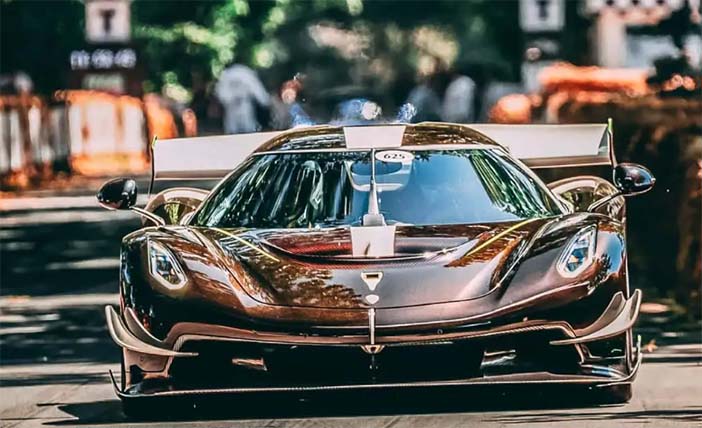
+++ KOENIGSEGG ’s most radical hypercar ever, which the company unveiled just a few weeks ago, has already set a record. During this weekend’s Goodwood Festival of Speed, the Sadair’s Spear became the fastest road-legal production car to conquer the famous hillclimb. It completed the course in just 47.14 seconds, beating the previous record holder, the Czinger 21C, by 1.68 seconds. The Czinger set its record last year, snatching it from the Rimac Nevera that ran the course in 49.32 seconds in 2023. The Sadair’s Spear is an even more hardcore version of the Jesko Attack. It uses the same twin-turbocharged 5.0-liter V8 engine, but it can make up to 1.625 horsepower. It’s also 35 kilos lighter, weighing 1.310 kilos dry. Despite Koenigsegg’s concern about the car’s weight, it still features wireless phone charging. Michelin Pilot Cup 2 tires are standard, measuring 275/35/20 at the front and 335/30/21 at the rear. Buyers can also upgrade to stickier Cup 2 R rubber. The car features revised aerodynamics that help improve downforce at lower speeds and the airflow to the engine and cooling systems, which the car appears to have taken full advantage of in its Goodwood run. Koenigsegg is producing only 30 examples of its new hypercar. It revealed the car to potential customers behind closed doors, selling out “instantly” so your chances of buying one are already gone. Maybe next time. +++
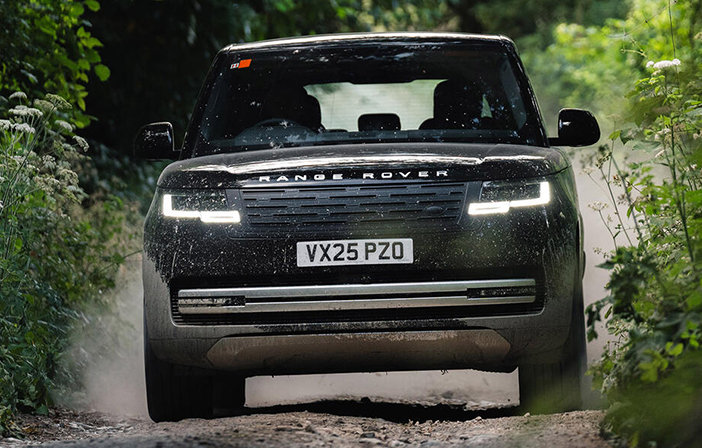
+++ It’s been more than 2 years since Land Rover announced plans to launch a fully electric RANGE ROVER . While we’re still waiting for the official debut, the teaser campaign has already revealed much of the luxury SUV’s design. Visually, it will look nearly identical to its combustion-engine counterpart, with which it shares the same platform. Unlike some EVs that offer a front trunk in place of an engine, the Range Rover Electric won’t feature one. In an interview, the vehicle’s chief engineer explained why the first Range Rover without a combustion engine won’t have a supplementary front cargo area. Land Rover surveyed customers on the matter, and the consensus was that the rear luggage space was sufficient. Lynfel Owen confirmed that the rear cargo volume will match that of the combustion-engine model, with no need to raise the floor to accommodate the 117-kWh battery pack. However, packaging the 344 prismatic cells in a double-stacked layout while maintaining cargo space means the electric Range Rover will be offered exclusively with 2 rows of seats. A 7-seat version isn’t planned due to packaging constraints. Land Rover will sell a spare wheel, but it’ll eat into the luggage capacity by sitting above the cargo floor. Customer preferences weren’t the only reason Land Rover skipped the front trunk. Owen rhetorically asked: “Why would I want to lean against the dirtiest part of the car to put stuff?” Jaguar Land Rover took a different approach with the I-Pace, which offered a small 27-liter front storage compartment. That model was discontinued at the end of last year, and going forward, all new Jaguars will be electric-only. Although Owen wasn’t involved in the I-Pace’s development, he acknowledges that missteps were made: “We’ve learned that we can’t do that to our customers, and we’re not going to do that again”. Designed by Ian Callum and built in Graz, Austria by Magna Steyr, the I-Pace struggled with reliability and frequently ranked near the bottom of customer satisfaction surveys. While the interview didn’t delve into curb weight, JLR is targeting 2.800 kilograms. That’s hardly lightweight, but it would make the Range Rover Electric 285 kg lighter than the Mercedes G 580 with EQ Technology. Like the Range Rover, the electric G-Class doesn’t have a front trunk either, but compensates with a tailgate-mounted cargo box styled like a spare wheel for storing charging cables. Owen insists the electric Range Rover won’t compete directly with the G580, claiming it offers superior go-anywhere capabilities and a nicer cabin: “This is still a Range Rover. It is not an EV. There really isn’t another EV out there doing what this car does. Not at this level of off-road ability with this type of luxury”. The world premiere is scheduled for later this year, with deliveries expected to kick off in 2026. +++
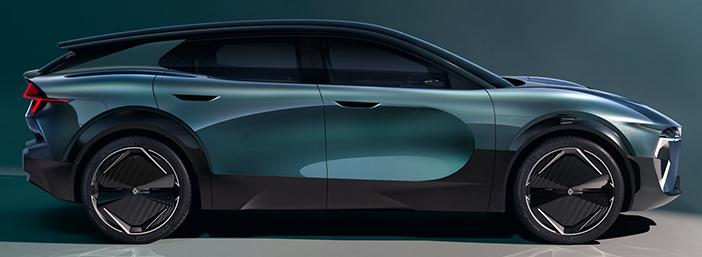
+++ RENAULT design boss Gilles Vidal predicts the people carrier could make a comeback to shake up the family car market as designers explore new ways of boosting efficiency and depart from the hallmarks of conventional SUV styling. People carriers, or multi-purpose vehicles (MPVs), used to be big business in Europe, with the likes of the Renault Scenic, Opel Zafira, Volkswagen Touran and Citroën Picasso claiming a huge share of the regional car market (the segment accounted for more than 10% at one point) on the basis of their ability to accommodate 7 occupants in a tall cabin, while occupying a footprint comparable with an estate car. The decline of the MPV began in 2006 when Nissan launched the Qashqai; effectively the genesis of the crossover segment, which would come to be the default choice for family motoring and dominate Europe’s car market. Currently, SUVs account for more than half of all European car sales, while MPVs have dropped to a market share in the low single digits. But Gilles Vidal says the transition to electrification could bring about a renaissance for the MPV segment, as car makers strive to make their vehicles as efficient as possible and exploit the packaging freedoms of EV ‘skateboard’ architecture. He said: “SUVs won the battle against the MPVs because MPVs are cars that you need but you don’t desire, and suddenly SUVs with the same engines, same weight, same everything: they are shapes that you will desire. “Now there’s an SUV bashing going on in Europe, especially. You would never do MPV bashing because it’s a very respectable family car, but it’s equally polluting, equally heavy, equally everything, so that’s a weird society twist”. Vidal added that the general concept of an SUV “is still attractive today for most people, and still a functional car in terms of size, roominess and practicality”. But he said that as cars become more aerodynamic in pursuit of efficiency, we could see a return to lower, sleeker and more MPV-like silhouettes. “What will probably happen with SUVs is they will try to be more and more efficient, so maybe slightly lower and better in aerodynamics. They will morph into a very efficient car, less energy consuming, with equivalent habitability and roominess and everything that’s probably the trend”. He said Renault’s segment-straddling Emblème concept, due in production in the coming years as the first of a new-generation electric car line-up, is a “morphing of all of that”, with a raised ride height but a sleeker, lower profile than any of Renault’s current SUVs. MPVs are already playing an important role in China, the world’s biggest car market, where manufacturers such as Zeekr, Lynk&Co, Li Auto, Denza and Xpeng have each launched luxurious 3-row people movers with technology and refinement to rival limousines like the Mercedes S-Class and BMW 7 Series. Vidal suggested that this quest for efficiency could ultimately prompt an all-out rethink for Europe’s most popular type of car: “What could kill SUVs? That’s the interesting question. Maybe MPVs could come back in a sexier, desirable shape or form”. However, he said, MPVs would be broadly comparable with SUVs in terms of energy consumption and material usage: “In the end, they wouldn’t be lighter or less energy-consuming, maybe slightly better in aerodynamics, so that would maybe be the win. “I see 2 trends: super-efficient SUV transformation, and maybe a big comeback of sexy, desirable MPVs”. It was previously reported that Renault is considering a retro revival for the Espace MPV, using the Scenic’s AMPR Medium platform as the basis for a sharp-nosed electric 7-seater to rival the Volkswagen ID Buzz. However, Vidal said the Renault 4-Tech, 5 E-Tech and Twingo E-Tech will be the company’s only retro-styled designs for the foreseeable future. “For everything else, we will go future. We will go innovative. We want to be super-innovative, but we don’t want to be sci-fi, futuristic, and lack personality or emotion. We don’t want robots. We want emotional cars, which could make them more classical”. +++
+++ VOLKSWAGEN will overhaul the ID.4 so comprehensively next year that it will be more like a new generation than a facelift, as part of a drive to sustain its strong sales figures and make it a more obvious electric equivalent to the Tiguan. The ID.4, Volkswagen’s second bespoke electric car after the closely related ID.3, is approaching its fifth birthday, having launched in 2020 as a crucial component of the firm’s drive to become a global leader in EV sales. It quickly became one of the world’s most popular EVs, and remains an important part of Volkswagen’s electric portfolio: currently it is Europe’s 4th best-selling electric car, between the ID.7 and ID.3, according to figures from Jato Dynamics. And now, at 5 years old, the Toyota BZ4X and Tesla Model Y rival is due an extensive round of design and technical updates to bring it into line with its newer stablemates.
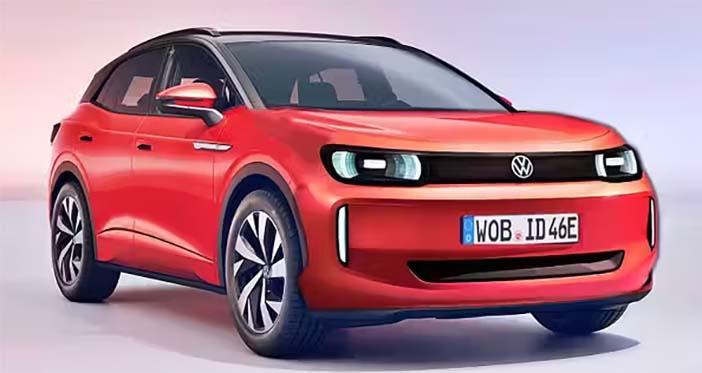
Volkswagen CEO Thomas Schäfer said the new 2026 ID.4 is “really beautiful” and hinted at just how extensively it has been overhauled: “We’ll re-do the ID.4 completely inside and out. It will be a completely different car – a huge step up”. A major priority for the design overhaul is to ensure the ID.4 is visually related to the upcoming ID.1 and ID.2. “We felt it needed to fit in with the new design language going forward, since it is still our most important electric vehicle in numbers”, said Schäfer. “It’s also to stay competitive for a while: let’s bring a completely new one”. The new ID.4 is known internally as the ‘electric Tiguan’, hinting at a push to present the 2 similarly sized SUV models more overtly as siblings. The company has not confirmed plans to go as far as changing the ID.4’s name, but Schäfer previously suggested that the Tiguan moniker would always have a place in Volkswagen’s portfolio – even as the line-up goes all-electric: “We’ve decided we’re not going to throw away the traditional, successful names that have carried us for so long, that we’ve invested in for so long, like Golf and Tiguan. Why would you let them go?” An electric Tiguan equivalent has long been understood to be part of Volkswagen’s product roadmap, the combustion-powered car being Volkswagen’s most popular car globally, and was earmarked for a launch in 2025 or 2026, which would coincide with the planned rollout for the upgraded ID.4. Volkswagen technical development boss Kai Grünitz recently confirmed that the ID.4 will follow the ID.3 in adopting the new design language first introduced on the ID.2all concept, giving them “a family resemblance to the ID.2” as well as a “lower and squatter stance”. Inside, Grünitz confirmed that the facelifted ID.3 and ID.4 will receive fully revised interiors featuring a new dashboard and user interface. Among the changes is a return of physical buttons and knobs in place of digital display-based functions and the controversial slider element, a move first hinted at by the ID.2All. “We’re going to bring back a round knob for the volume control”, an insider said, adding: “If you develop something that works, and it has worked for years, there’s no reason to replace it”. Technical details of the facelifted ID.3 and ID.4 have yet to be revealed, though Volkswagen’s best-selling electric models will benefit from the efficiency and performance gains brought to other more recently launched models, including the ID.7, through newer and more technically advanced electric motors and more contemporary battery and inverter technology. The facelifted ID.3 is scheduled to be revealed during the second quarter of next year, with the ID.4 arriving later in 2026. The ID 4’s rakish-roofed ID.5 sibling is understood to be earmarked for retirement, rather than undergoing the same round of updates. Volkswagen does not break out individual model performance in its annual reports, but the ID.5 is not currently in Europe’s top 25 EVs. The updates are part of a broader effort to reset Volkswagen’s image as a maker of EVs after early criticism of quality, software and user experience in its first-generation MEB-based models. Alongside the arrival of 3 new MEB Entry-based EVs next year (the Volkswagen ID.2, the Cupra Raval and the Skoda Epiq), the goal is to extend the lifespan of the current 400V models to keep VW at the top of Europe’s EV sales charts, insiders say, while the firm readies its next-generation 800V SSP platform, which is due to underpin VW EVs from 2028. Volkswagen also intends to differentiate its EV designs by region, with European and US models sharing a common design theme while Chinese-market cars receive their own styling direction. This strategy was hinted at by the unveiling of the ID Aura, Era and Evo at the Shanghai motor show in April. Before the arrival of the heavily updated ID.3 and ID.4, Volkswagen will use the Munich motor show in September to preview its next electric model: the ID.2X. A crossover sibling of the ID.2, it is due to arrive in 2027 as a rival to the Jeep Avenger and Peugeot e-2008. +++
+++ VOLVO ’s bad news continues as the company is taking a one-off, non-cash impairment charge of $1.2 billion (11.4 SEK / €1.0 billion) in the second quarter. The hit stems from several challenges, including the disastrous launch of the EX90 and tariffs targeting Chinese-made vehicles. Tariffs are impacting the brand-new ES90 and Volvo said the high fees prevent them from profitably selling the car in the United States. According to one recent report, Chinese EVs now face a 247.5% tariff when imported into the United States. That’s an astronomical number and one that appears to have doomed the S90 successor. Unfortunately for Volvo, tariff pressures aren’t limited to the United States. Europe has also been trying to protect its automakers from cheap Chinese EVs by establishing tariffs of their own. As Volvo noted, “ES90 margins are also under pressure in Europe for the same reason”. Besides tariff troubles, Volvo confirmed the EX90 will have “reduced lifecycle profitability”. The company blamed this on “significant launch delays and subsequent additional development costs”. The electric crossover debuted in November of 2022 and was billed as the “start of a new era for Volvo”. That era turned out to be a nightmare as the 2023 launch was pushed back to 2024 due to software issues. On top of that, sales have been modest as only 1.972 Americans have bought an EX90 in the first 6 months of the year. To put that number into perspective, Volvo sold 3.004 XC90s and 2.421 XC60s in June alone. In a statement, Volvo Cars CEO Fredrik Hansson said “Given market developments such as import tariffs in the US, development and launch delays for the EX90, and strategic investment prioritizations, we have reassessed volume assumptions for these 2 cars. This has resulted in a lower than planned lifecycle profitability”. Despite all the software issues with the EX90, Hansson suggested the headaches will eventually be worth it as the crossover “laid a critical technological foundation for our future”. He added: “the learnings and core systems we developed, including core computing and electric drivelines, will be used in next-generation platforms. These innovations are key to realizing our long-term electrification and software-defined vehicle strategy, putting Volvo Cars at the technological forefront of the auto industry”. +++